Seven Things to Do When Exploring Jerusalem

Jerusalem is an absolutely fascinating city on many levels. I loved it. Whether you are religious or not, you can’t help but be hypnotised under it’s spell. My advice is to give the city time. Don’t do a whistle stop tour ticking off the usual suspects and leaving within 24 hours. We stayed for three days and to be honest I would have loved a couple more to explore further and just watch the world go by. People watching in this city is something else.

  1. Hire a Guide

Whilst we did a lot of exploring on our own, we did book an excellent ‘Three Religions Holy City Walking Tour’ of the old city via Viator. We lucked out massively on a hugely knowledgable guide called Joshua Levinson. He was absolutely brilliant. Our tour was a group tour and he kept our attention for 7 hours, both my daughters (12 and 9 years old) were absolutely entranced by all his stories and did not once say they were bored.

If you want to book him directly you can contact him via his facebook. You’ll need a comfortable pair of shoes – be warned that the narrow streets in the old city can be slippery if the shopkeepers have washed their steps outside their shops, and a big bottle of water. I also found an umbrella a great way to keep out of the sun.

The old city is divided up into four uneven quarters – Armenian, Jewish, Christian and Muslim and within these quarters there are subdivisions; for example in the Christian quarter you will also find Ethiopian Orthodox Christians living in an area with their own Ethiopian Monastery Church and dwellings.


2. Tea at the Austrian Hospice

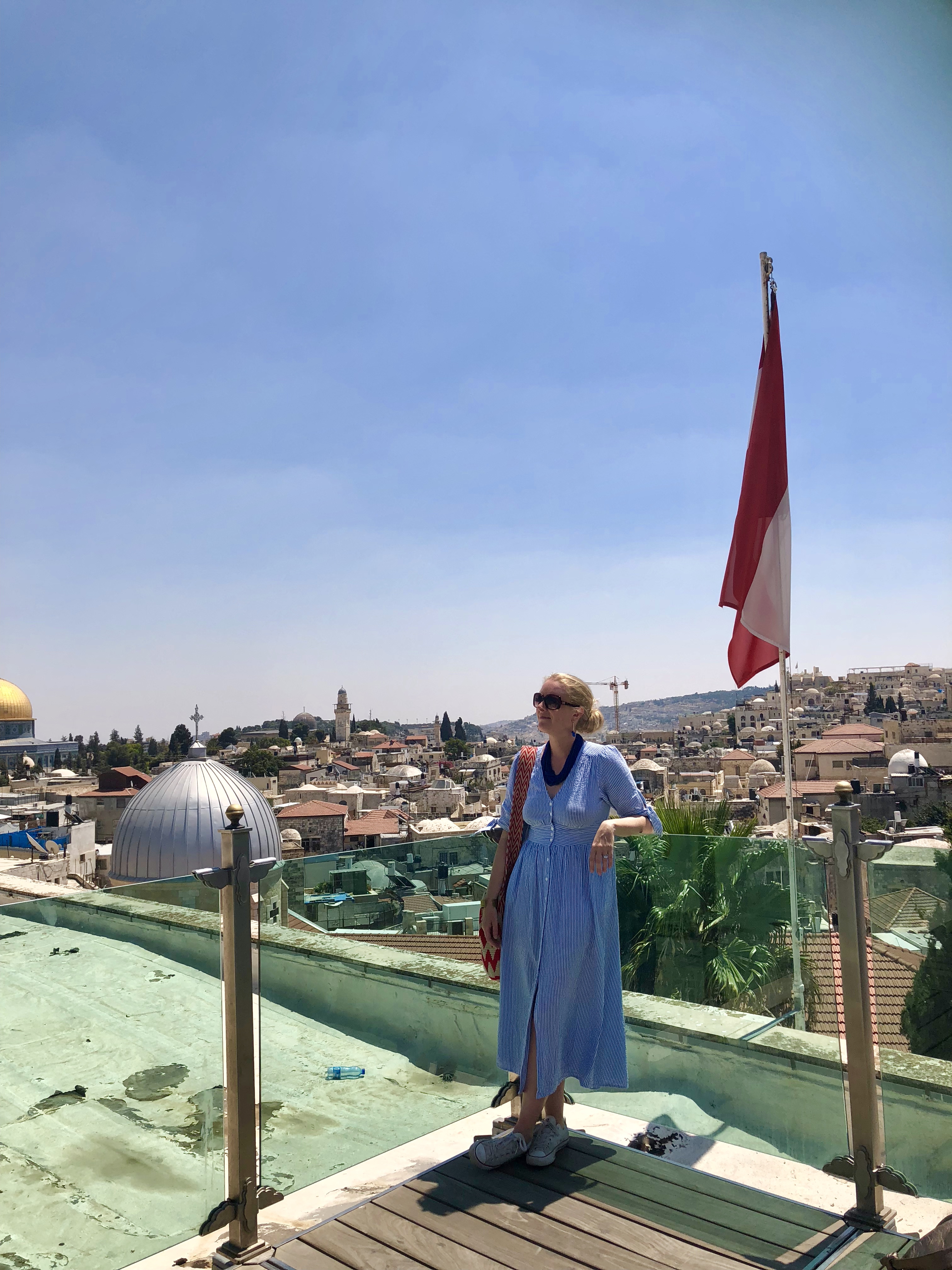
Take some time out from the hustle and bustle whilst exploring the old city and go to the Austrian Hospice for tea, sachertorte and apple strudel.  Seriously. Sure it’s surreal eating these Austrian fancies in Israel, but I think it’s these things that adds to its charm. It’s based directly on the Via Dolorosa (the road that Jesus walked on carrying the cross to his crucification).  Built in the style of Vienna’s Ringstrasse palaces, once you’ve found the buzzer to open its large looming doors you’ll be greeted by a peaceful oasis. You can also stay here as well – it’s perfectly located in the middle of all the action, but peaceful at the same time. As a visitor you can also go on to the roof, which affords beautiful views across the old city.
3. Try some Middle Eastern Jewish Food at Azura

Modern Jerusalem is culturally rich with a wide range of ethnic backgrounds living together. The food at family-run Azura, located in the middle of the Machine Yehuda Market, or shuk, is an unforgettable experience. It has Iraqi, Kurdish, Turkish and Tunisian influences and the result is sublime. On our first visit (yes we returned it was so good) we felt the best way to experience the menu was to try the tasting menu – obviously! The portions are still large, not your usual tasting menu size, so we ended up taking a doggie bag of goodies home to have for supper.

Highlights from the menu were Azura – Turkish eggplant filled with ground beef and pine nuts in a special sauce with cinnamon, okra with tomatoes, Mejadara – a rice and lentil combo, beet kubbeh, a glorious soup made with beet, celery and swiss chard, the meatballs in a tomato sauce, beef sofrito and of course the hummus to kick off the proceedings.
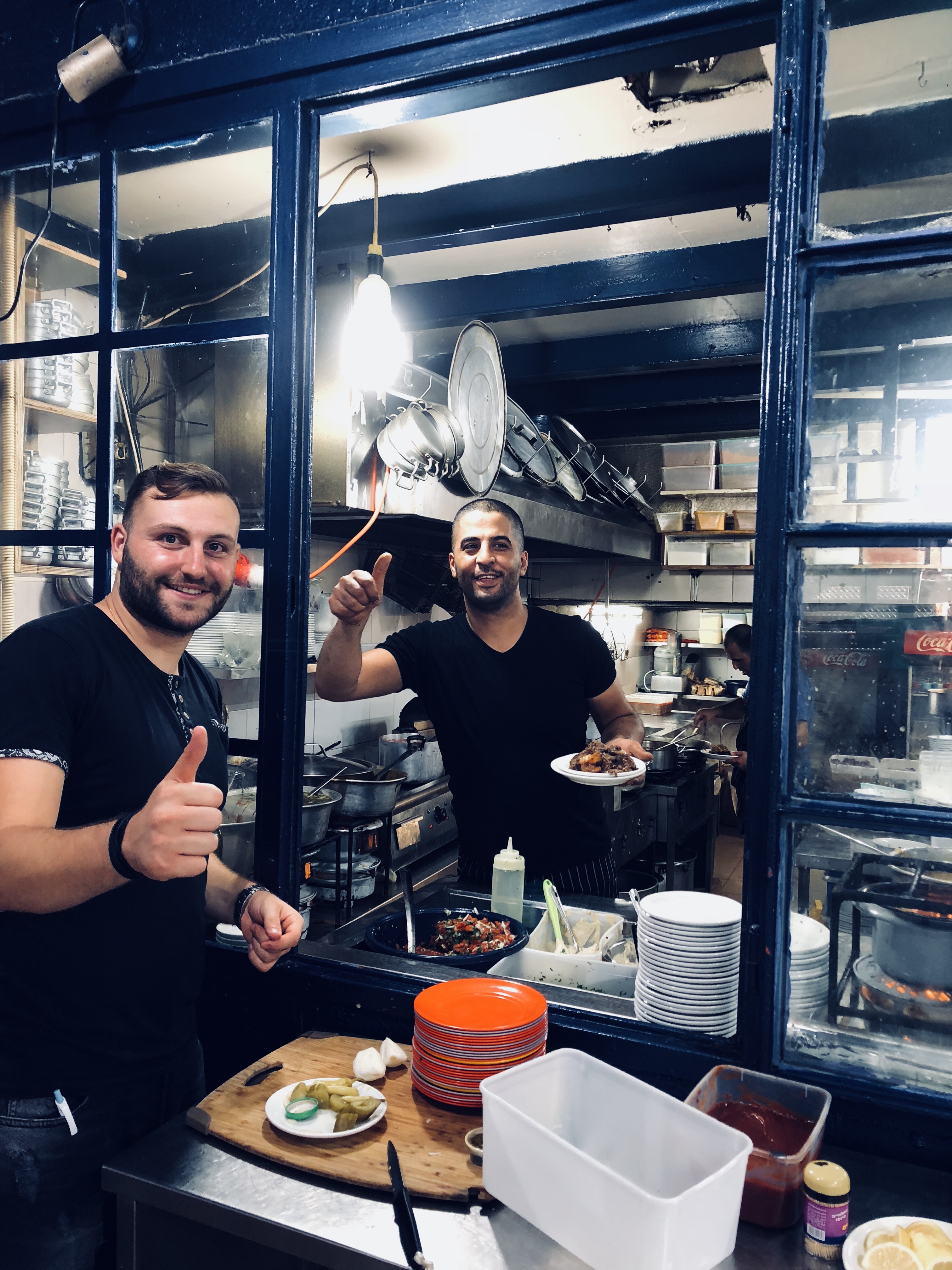
The staff were great, the owner – Moshe – incredibly affable and warm and the food delicious. If you aim for a late lunch getting a table won’t be tricky. It’s closed for supper, but lunch goes on until 4pm. Also don’t go on a Saturday as you’ll find it closed.

4. Linger in Machane Yehuda Market

Since you’ll be going there anyway to visit Azura, make sure you leave time to properly explore the Machane Yehuda Market. It’s the largest in Jerusalem with over 250 vendors selling a wide range of food and clothes. There are also a number of bars within the market, which even at 5pm were pretty buzzing. The sights, sounds and smells are hypnotic and its a great place to feel the vibe of a Middle Eastern style market. If you are staying in an Airbnb and want to cook at home then it’s also a great place to pick up some delicacies.


There are a number of food tours available, but it just so happened that the lovely lady, Aliza Press, who welcomed us at our Airbnb (who was a friend of the owners who were away), was a chef and she offered food tours as well as being a private chef. If you drop her an email to AlizaPress@gmail.com she can arrange a time to show her beloved city from a food perspective. Sadly due to timing I could not take her up on her offer, but when I return, I will be certainly be getting in touch. Mention my name and my blog if you get in touch with her.

5. Go eat Pizza and Panzanella at P2

Yes….. seriously….. you read correctly. P2 on Keren HaYesod Street is a small (max 20 covers), unassuming little restaurant where most of seating is up at the bar watching the chefs make the pasta and pizza from scratch – literally. The menu is short, as all good menus should be, but the quality of the food was spot on. We were in awe at the one waiter who served out the tiramisu, made the lettuce salads, served and cleared plates like a whirling dervish, took orders and settled bills for the whole restaurant; it certainly created a buzz. The panzanella salad was the best I’ve eaten – so make sure to order one to share before your pizza. Photo of said salad below.
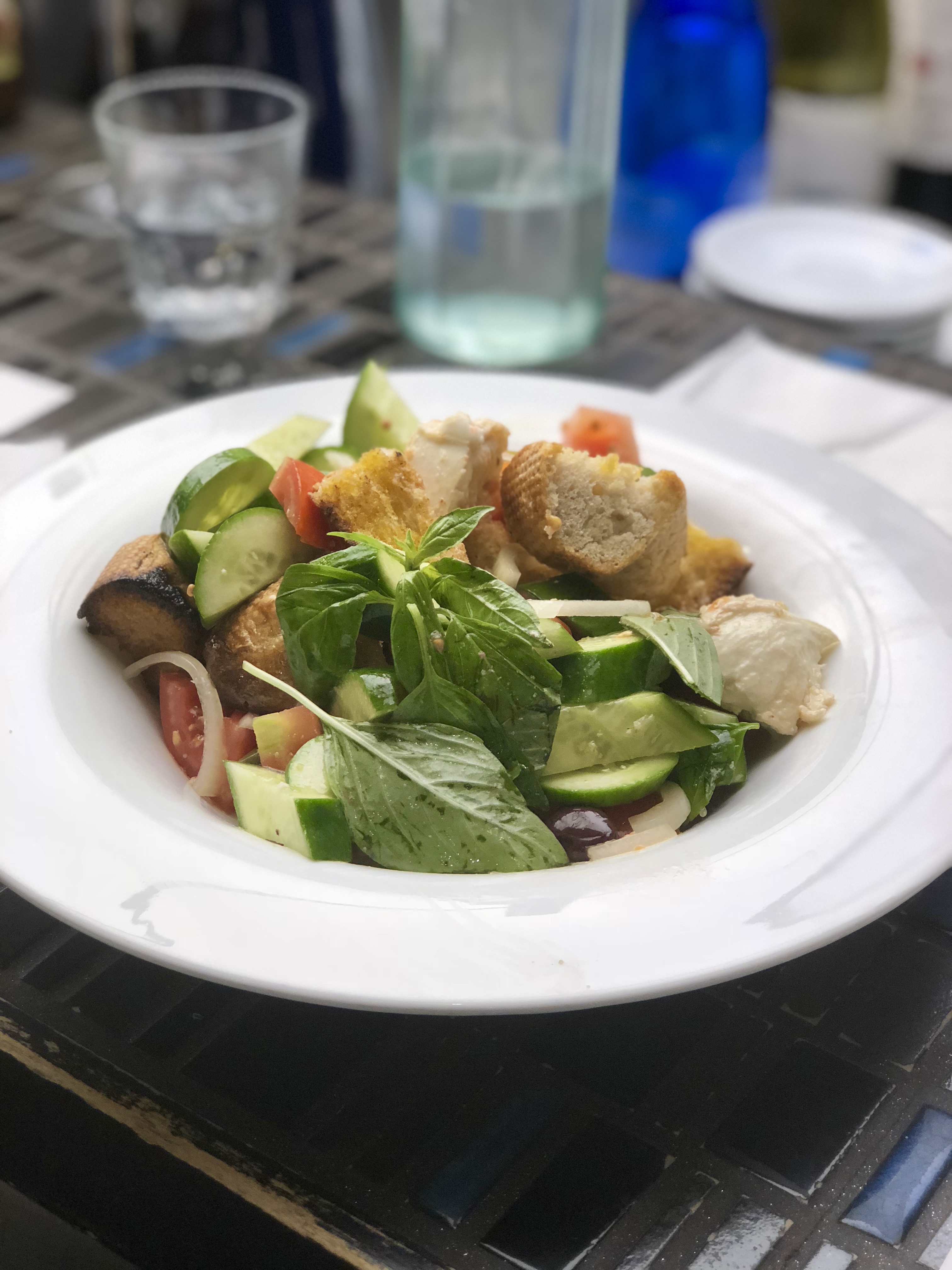
Below is my take on the wonderful salad that we ate at P2 and the recipe to follow. The combination of the crunchy old toasted baguette, onion rings, cucumber, the creamy mozzarella, salty black olives, fleshy tomatoes, work so well with the sherry vinegar dressing.


Panzanella Salad

serves 4

4 medium tomatoes, quartered

1 cucumber, cut at diagonal angles

1 small/medium white or red onion, finely sliced

3 tbsp black stoneless olives

2 mozzarella, broken up into bite size chunks

12 small pieces of day or two old baguette, cut into bite sized pieces (I used white petite ficelle hand cut bread that I found at Waitrose)

1 tbsp olive oil

handful or two of fresh basil leaves

*********

vinaigrette 

3 tbsp extra virgin olive oil

1 tbsp sherry vinegar

1/4 tsp dijon mustard (optional)

1 tbsp lemon juice

salt and pepper


  1. This recipe is mostly a case of compiling ingredients. Make sure you cut the cucumber into diagonal bite sized chunks. The different shapes of the ingredients really makes this dish. Place all the ingredients in a bowl.
  2. Using a pan, dip both ends of the bread in the olive oil and heat in the pan so that it begins to bronze and slightly char, turn over to bronze the other side and then remove. Place into the bowl with all the other ingredients.
  3. Prepare the vinaigrette in a separate small bowl.
  4. When ready to serve gently toss the vinaigrette over the salad and place in a large bowl for people to serve themselves.

Delicious hey!

6. Deciding Where to Stay

There are lots of options on where to stay in Jerusalem. For us it made sense to book an Airbnb and I found a beautiful apartment in Talbiyeh, a good 15 minutes walk to the Jaffa Gate. The area is safe, quiet, with tree lined roads with beautiful grand houses. Below is a photo of the outside of our apartment.

If a hotel is what you are after and perhaps one with a pool, then The American Colony might be a stylish option. The Austrian Hospice, that I spoke about earlier in this post, looked lovely and might be a good option if you are travelling as a couple or solo traveller. This article by Vogue also has a few other good options.
7. Sunset at the Mount of Olives
Walk up to the Mount of Olives just before dusk to watch the setting sun over the old city. Yes it’s a step – ish climb, but you will be rewarded with a truly beautiful sight. It’s a 15/20 minute walk from Lions Gate in the old city. The walk takes you pass the Garden of Gethsemane as well as the Russian Orthodox church and convent (photo above). It’s a great way to work up an appetite before supper.
There are taxi’s at the top, if you don’t want to walk down, but the evening was so balmy when we were there that we continued down on foot to walk through the old city once the crowds had made their way home.
Jerusalem really is an extraordinary city that I would urge you to visit if you get the opportunity, but don’t get too carried away. I will leave you with these words below written by Lonely Planet about  ‘Jerusalem Syndrome’.
Jerusalem syndrome
Each year tens of thousands of tourists descend on Jerusalem to walk in the footsteps of the prophets – and a handful come away thinking they are the prophets. Jerusalem Syndrome is a medically recognised ailment that occurs when visitors become overwhelmed by the metaphysical significance of the Holy City and reach the conclusion that they are biblical characters or the Apocalypse is drawing near. Doctors estimate the syndrome affects between 50 and 200 people per year, and although many have a recorded history of mental health issues, about a quarter of recorded cases have no previous psychiatric record.
Source: Lonely Planet

The Allure of Ancient Jaffa in Tel Aviv

I’d not been to Tel Aviv before, so deciding which area to stay in required a bit of research. Friends had recommend a range of areas but in the end we opted for Jaffa, which is the southern and oldest part of Tel Aviv. It is an ancient port city that is steeped in history with a natural harbour that has been in use since the bronze age. It also offers great vistas of the whole of Tel Aviv as you can see.

The area is predominantly Muslim and home to winding alleys with shops and art galleries, as well as the lively Flea Market, which was a stones throw away from our apartment. The area is filled with cool eateries and hip bars and whilst our Airbnb apartment was in the thick of it, the noise level was low and we slept like logs.  We were also lucky to only be 5 minutes walk from the sea.

The stone staircase leading to the door of our apartment were the most ancient we had ever climbed; it really did feel as if we were stepping back in time with every step. You can see what I mean if you look on my instagram under my instatories under ‘Israel’.

The food in Jaffa is seriously good and a place to head for lunch if you are staying in Jaffa – or indeed another part of Tel Aviv – is Abu Hassan. It’s one of the oldest and most loved hummus restaurants located on Dolphin Street. It attracts locals – Jews and Arabs, as well as tourists and labourers. The concept is simple – there are four dishes (no written menu – only the dishes presented in writing on the wall) – hummus, masabacha, brown beans and labna. To accompany the dishes you are served warm pitas, fresh onions, chilli in lemon water and falafel. It is masabacha that I have tried to replicate in a recipe for you today.

The main difference between masabacha and hummus is the texture. Whilst hummus is smooth, masabacha keeps some of the chickpeas whole. It is also eaten warm – although it is also equally delicious eaten at room temperature. To top the masabacha some chickpeas are added on top in a little water and lemon juice with a little cumin powder or smoked paprika and some freshly chopped parsley. This is my recipe. It is pretty straightforward once you have soaked the chickpeas for 24 hours in cold water.


 Masabacha 

Serves 4

8 garlic cloves, unpeeled

255g dried chickpeas

1 tbsp baking powder

*********

80ml chickpea cooking water

3 tbsp chickpeas

125ml reserved chickpea stock

1/4 tsp cumin powder

4 tbsp tahini

125ml olive oil

5 tbsp lemon juice

1 tsp salt

********

chickpea juice

2 tbsp chickpea juice

3 tbsp tahini

2 tbsp lemon juice

1 garlic clove

1 pinch of salt


  1. Place the dried chickpeas in a bowl and cover with cold water. Add the baking soda and stir. Refrigerate the chickpeas overnight.
  2. Drain the chickpeas the following morning and place in a pan along with the unpeeled garlic cloves. Cover with fresh cold water so that it covers the chickpeas completely. Simmer for 40 minutes, by which time the chickpeas will have softened. Remove the scum that will form whilst cooking and add more water if it looks to be getting dry.
  3. Strain the chickpeas, keeping all the water and place to one side. Rinse the chickpeas thoroughly. Remove 3 tbsp of chickpeas and place to one side.
  4. Place the chickpeas, all the garlic (except one which you will use later) – with the skins now peeled, 80ml of reserved chickpea cooking water and cumin powder in a blender and whizz. Gradually add the olive oil and tahini so that you end up with a very creamy, smooth hummus. Add salt to taste. Place in a medium sized, shallow serving bowl.
  5. In a separate small bowl mix the chickpea juice ingredients.
  6. To serve make a slight well in the centre of the hummus and scatter the remaining whole chickpeas on top.  Spoon in the tahini-lemon mixture – you may find you won’t need to add it all so spoon it in gradually. Sprinkle with cumin and/or paprika powder and garnish the parsley. Serve with pita bread.

*****************

After lunch it is worth spending time walking around the beautiful narrow streets of old Jaffa. Whilst it might be very hot, if you are visiting in summer, the narrow streets do offer some shade and being near to the sea a gentle breeze is a welcome respite.

A meander around the famous Jaffa Flea market is an absolute must – it sells a range of trinkets, bags from Afghanistan, evil eye pendents, jewellery and clothes, as well as a host of interesting antiques. Being so close to our apartment I spent a fair amount of time nosing around this market as you can imagine.

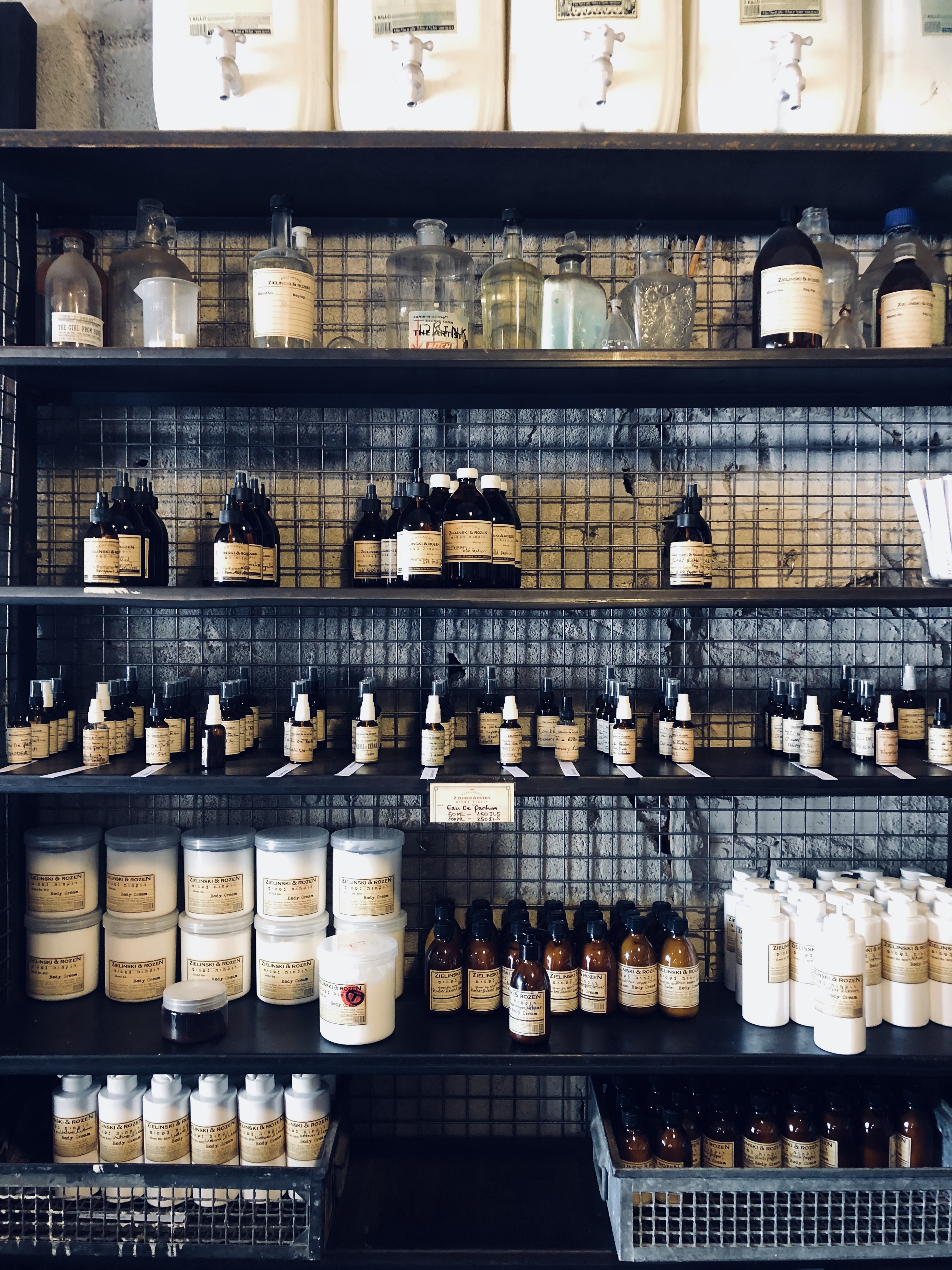
There are also a number of interesting shops surrounding the market and neighbouring streets. My favourite without a doubt was this little gem. Erez Zielinski Rozen Perfumery.

If you like brands like Aesop and Le Labo then this is really going to appeal. The good news is that the price tag does not equal the other two brands, thankfully. The smells were divine and the packaging and branding were elegant and understated. You can’t buy it in the UK so it feels deliciously unique and original. A few bottles of perfume and hand made soap may have found their way home in my luggage.

If a food market is what you are after then a short taxi ride (I think the taxi drivers were the nicest I’ve experienced – not trying to rip you off and pleasant to talk to) will deliver you to the Carmel Market (in Hebrew it is known as ‘Shuk HaCarmel’ so use that name if riding in a cab).

First opened in 1920, 11 years after the establishment of the city, the market or ‘shuk’ occupies one street, which runs south from the junction of King George Street, Allenby, and Sheinkin Street to the Carmelit Bus depot in the south. The lower part of the market (nearer the sea) is the place to head where food stalls and fresh produce are on offer.

If you are feeling peckish, then head to THIS guy below.

…..he is located on the right hand side – if the sea is behind you – in the food section of the market –  for an egg, potato or a mix of both, or lamb burika.  He is a real entertainer and is pretty mesmerising to watch as he prepares his tasty treats. Burika is basically a paper thin pastry dough that is smeared with herbed mashed potato that is folded and dunked in boiling oil, then an egg is wrapped in it. It comes out crisp and is then popped into a pita bread along with hot sauce (harissa I guess), fresh tomatoes, cabbage, onion and then presented in a little paper bag. Order one to share as they are filling.

Whilst munching on your burika you can stroll through the market taking in the smells, sounds and general buzz of the market.

As the sun sets head back to the harbour by Jaffa to watch the setting sun.

Then grab a pew and wait to be entertained by the whirling dervish waiters at ‘Old Man and the Sea’ 

Sit outside and soak up the ambiance of the locals and tourists promenading around the harbour, whilst you devour your feast. 


Oven Baked Aubergines with Tahini and Tomatoes in Acre, Israel

It’s been a while, but I am excited to be back. Israel was the most INCREDIBLE adventure where we were treated warmly by all those we met. I have been pondering on how best to break up the blog posts as I know that some of my blog readers (or social media followers) have trips planned and others that are thinking about going in the future. As not everyone is interested in the travel aspect I will incorporate every Israel blog post with a recipe that was inspired from my trip – therefore hopefully appealing to all readers.

The order of our trip (which maybe useful if you are thinking on going yourself) was as follows:

Tel Aviv (stayed in Jaffa – highly recommend)

Acre (also known as Akko/Akka) – which I will talk about today

Sea of Galilee – and explored all the northern region – Golan Heights

Jerusalem  – mind blowing – absolutely loved the city.

Dead Sea – stayed on the Kibbutz part of Ein Gedi (more on that in another post)

First up I wanted to tell you about the old Crusader city of Acre, which is also known as Akko/Akka. In Israel most places have two or three names – just to keep us on our toes. Acre was recognised in 2001 by UNESCO as a World Heritage Site and is an absolute must if you are visiting Israel. The old city is mainly Muslim, although Jewish and Christians can be found living and working together within its walls.  It is an ancient port city and was the gateway to the holy land. The present day city is 300 years old, but beneath it lies amazing ruins of a 900 year old Crusader city, which as a tourist you can see first hand for yourself, thanks to careful preservation.

The place itself is wonderfully peaceful, a living museum, that was not overrun with tourists when we visited. As an aside the city reminded me of Galle in Sri Lanka – probably because of its ancient stone wall surrounding the city and its walkable size.

As we wanted to experience all that Acre had to offer we bought a combined ticket which allowed us to visit: The Knights Hall, The Hospitaller Fortress,Turkish Bath, Templars’ Tunnel and the Okashi Art Museum. You are given an interactive headset, which really helps bring the city to life, especially when you are in the old city under the present day old city. The exhibitions and sites were really impressively curated and filled a large part of our day. You can find details of all the sites here. I highly recommend embracing all these museums. They are fun and perfect for all ages.

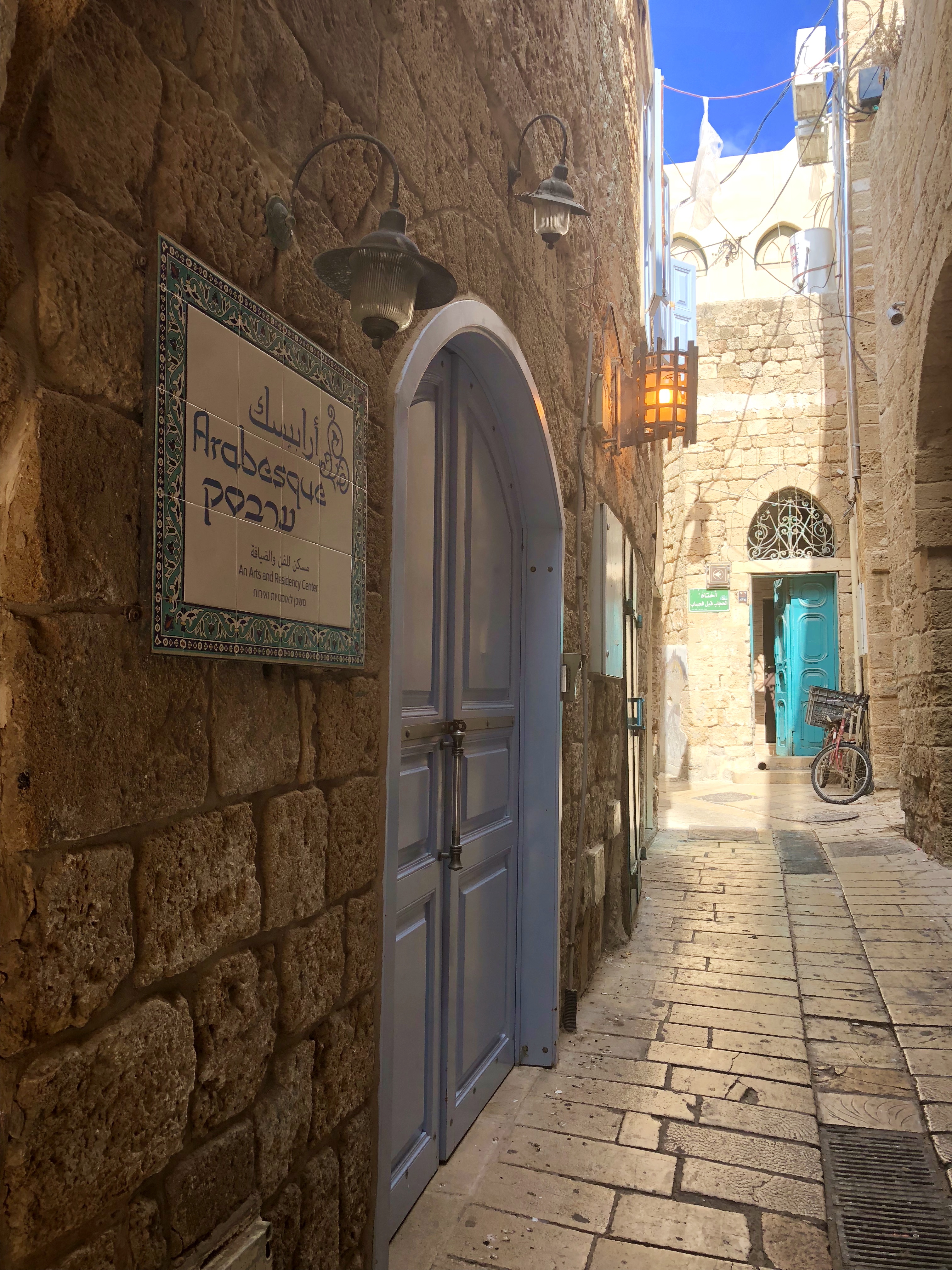
Taking a step back however, I will never forget our arrival through the labyrinth of streets, little changed for hundreds of years, at the boutique Arabesque Hotel, which is a beautiful Ottoman building that has been recently restored and renovated to a high standard. It has three bedrooms, however, in the next couple of months a further four rooms will be available at another equally beautiful building across from Arabesque. The hotel is an oasis of calm and tranquility and the perfect place to rest after a days touring of the city, which is very easy to do on foot.

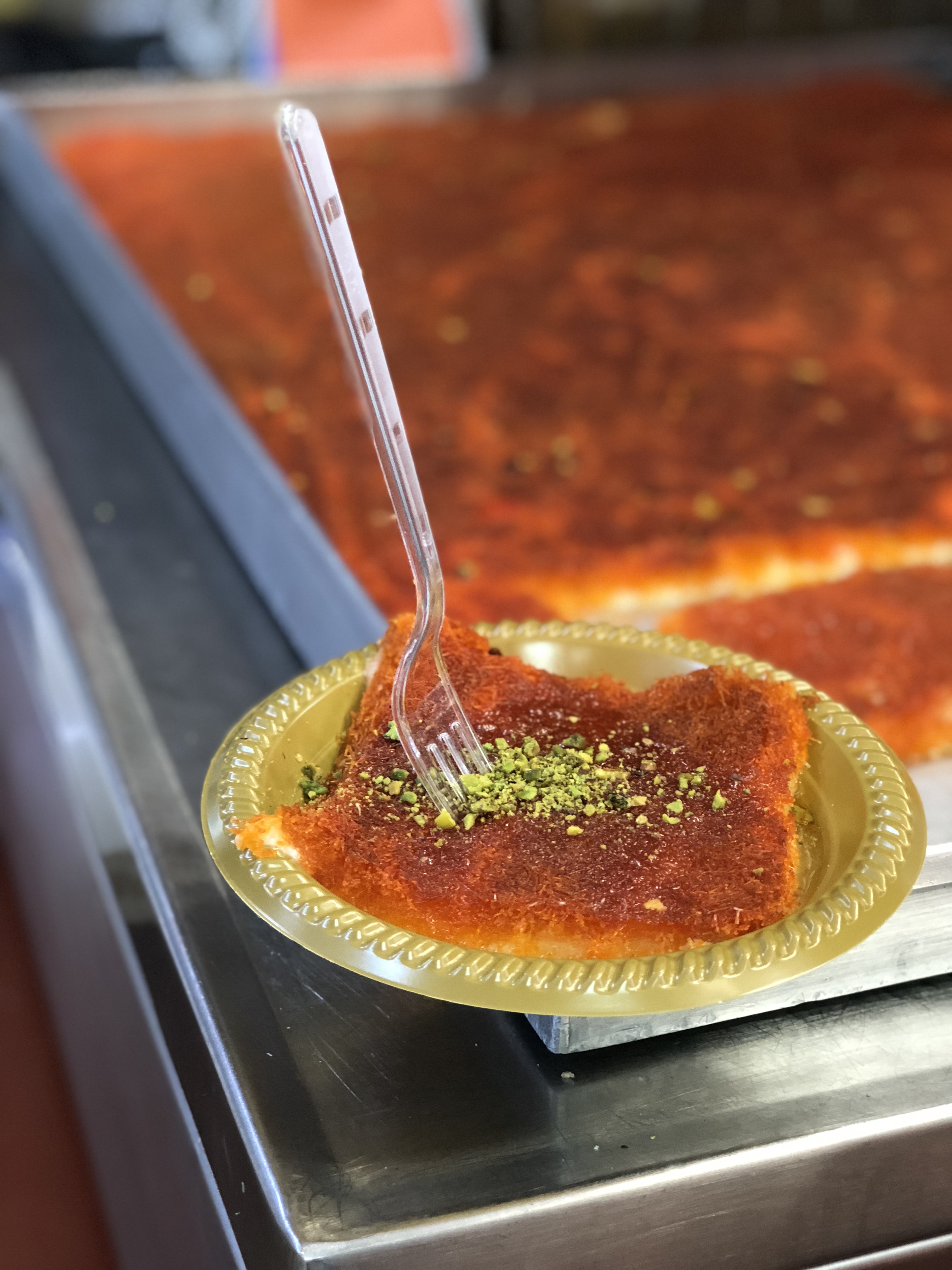
It is also a few minutes walk away from the old market (suk) where you will find a little shop selling all manner of baklava and the BEST kanafeh I had in the whole of Israel. It is a traditional Arab dessert made with thin noodle-like pastry, or alternatively fine semolina dough, soaked in sweet, sugar-based syrup, and typically layered with cheese, or with other ingredients such as clotted cream or nuts, depending on the region. It tastes amazing and I urge you to see out this cake shop.

It comes hot, which surprised us, but it utterly addictive; it became our daily tea-time treat whilst we were there. You will recognise the shop as you go down a couple of stairs and all the baklava and kanafeh are on the right, even in the entrance, and the seating is on the left. It’s so close to Arabesque, you can’t miss it.

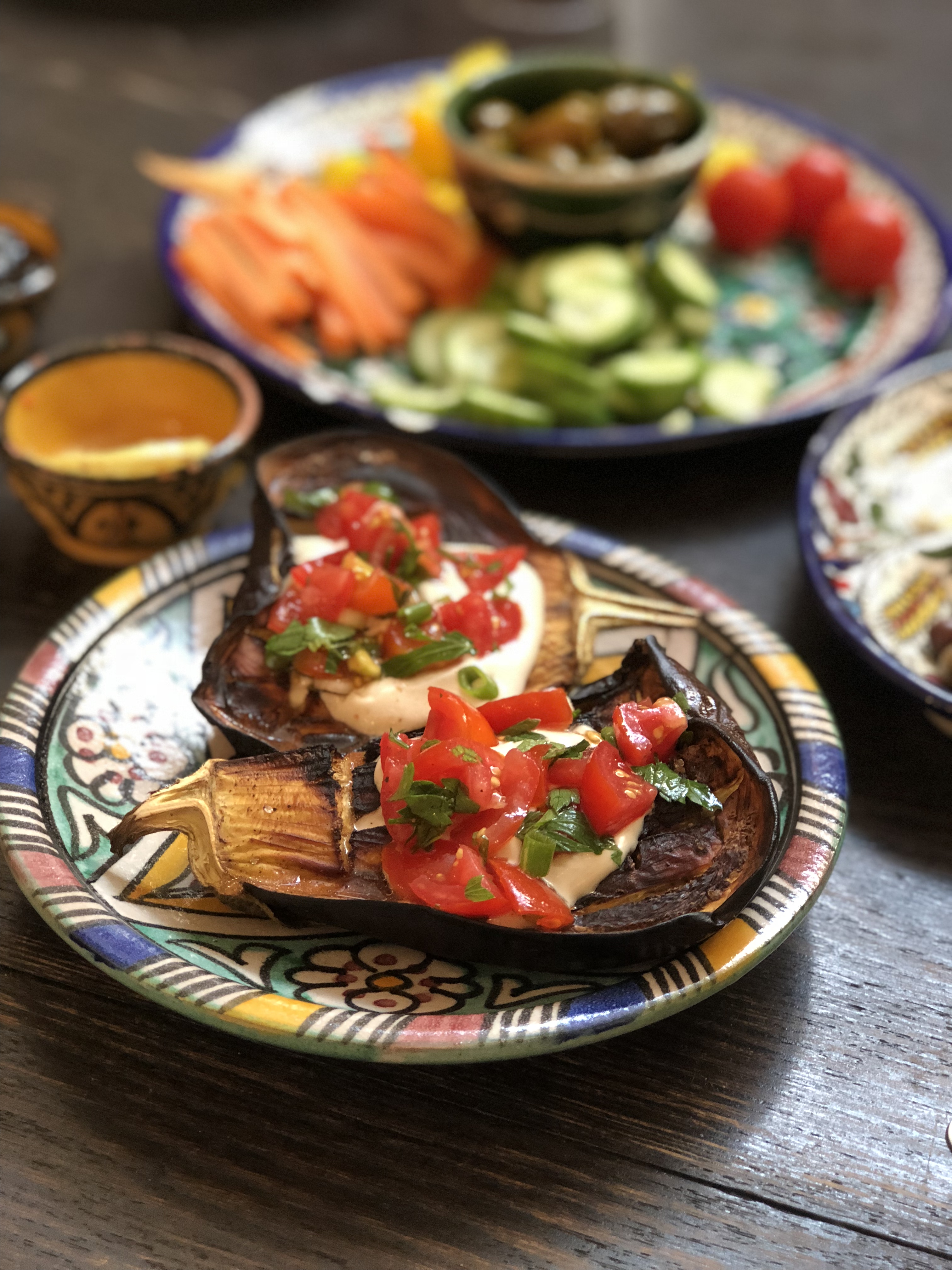
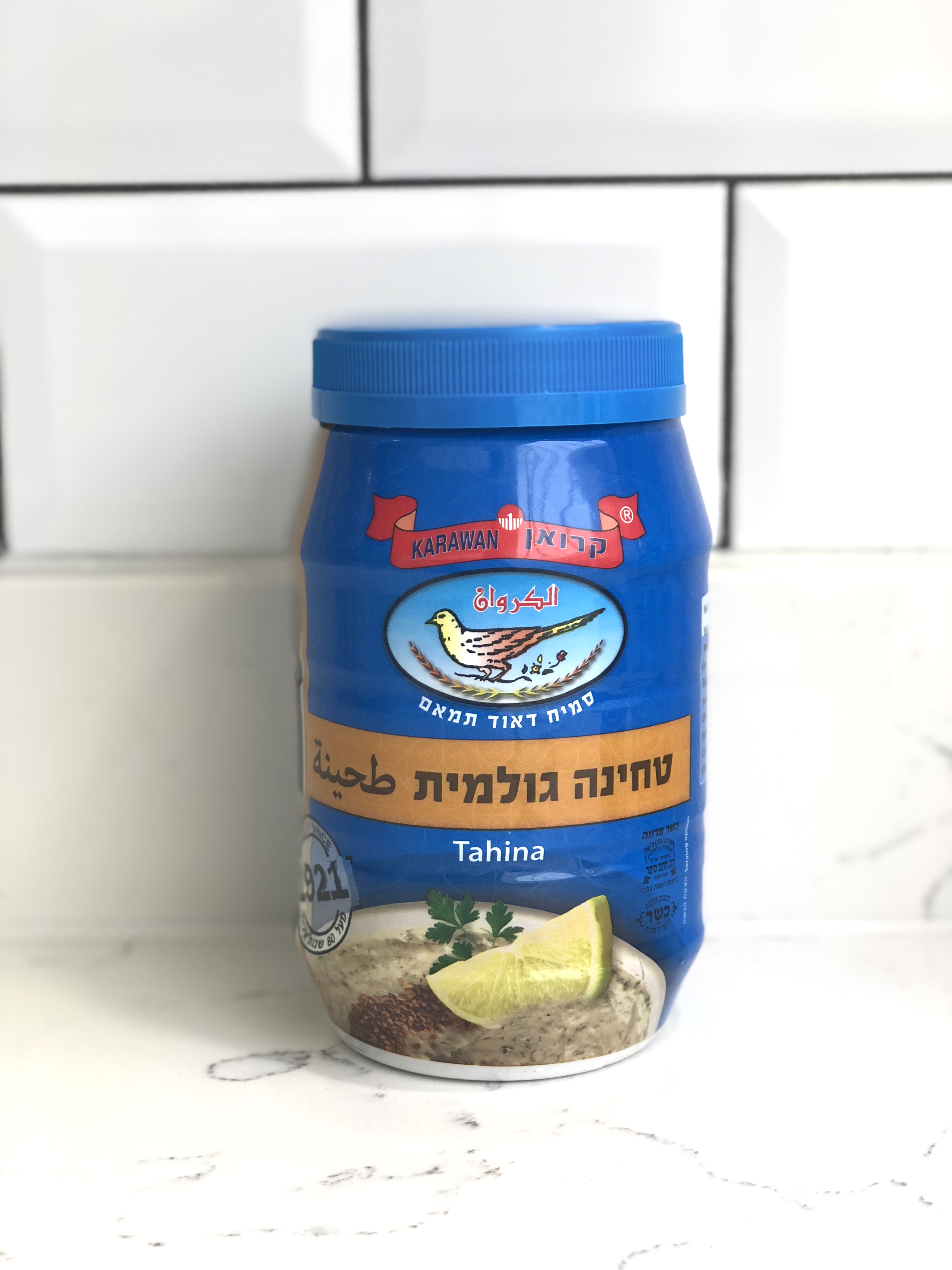
Whilst staying at the hotel, which offers B&B, we were fed this wonderful offering at breakfast (see above). So much so that I wanted to show you all how to make. Simple to prepare and yet it tastes SO good. I have cooked it quite a number of times since returning home, although I have mainly eaten it for lunch of supper, along with a couple of other dishes. All it requires is a couple of aubergines, tahini – which you can pick up at any supermarket these days, although I did managed to purchase the one below in Acre itself, as the guys at the hotel said it was the ‘best’, – tomatoes, flat leaf parsley, spring onions and a little olive oil and salt and pepper. Tahini, for those who are unfamiliar with it, is a sesame seed paste, which is added to hummus in fact. The flavour combinations and textures work really well and I think you will be equally impressed.


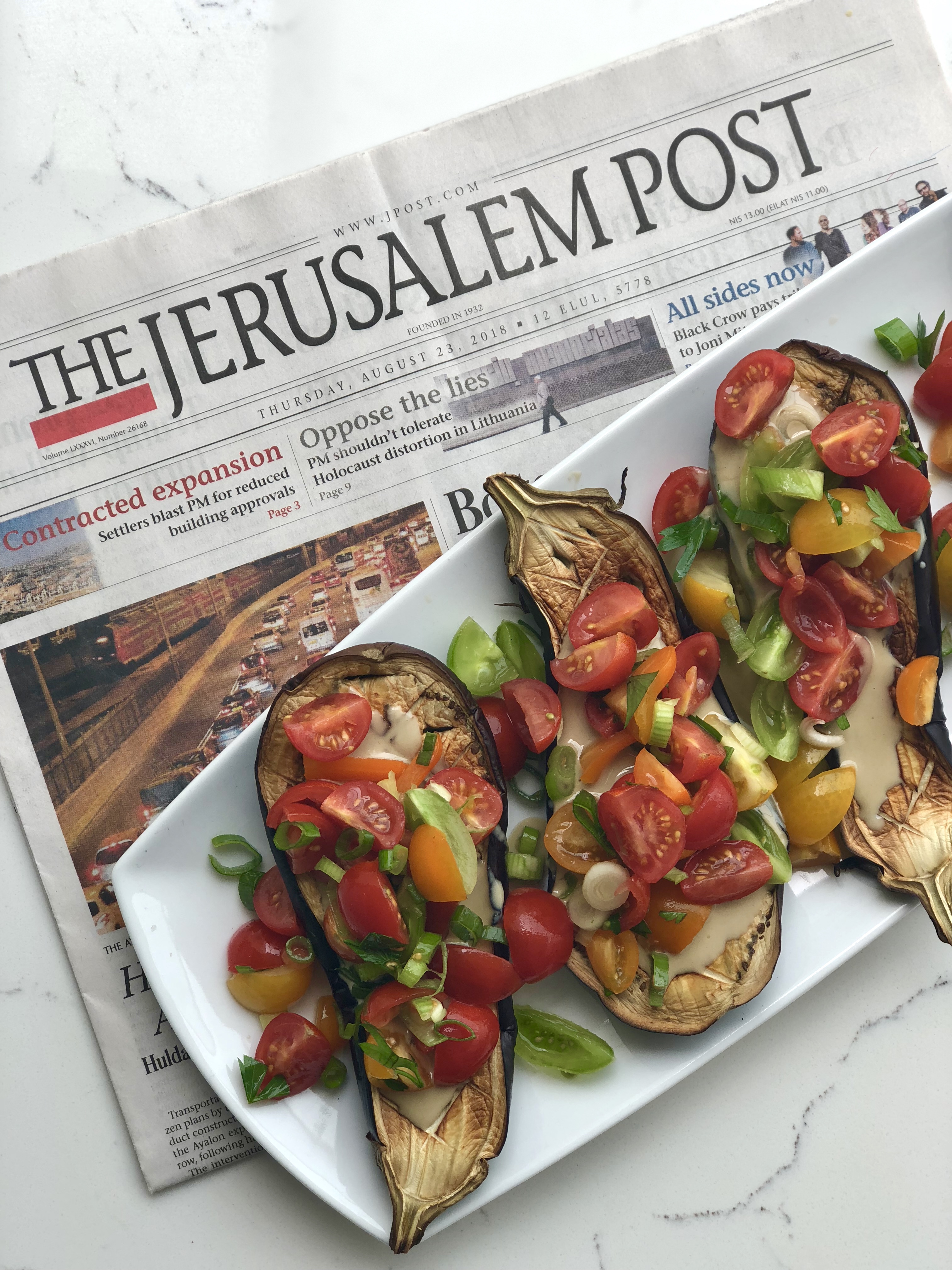
Here is my version of this dish.

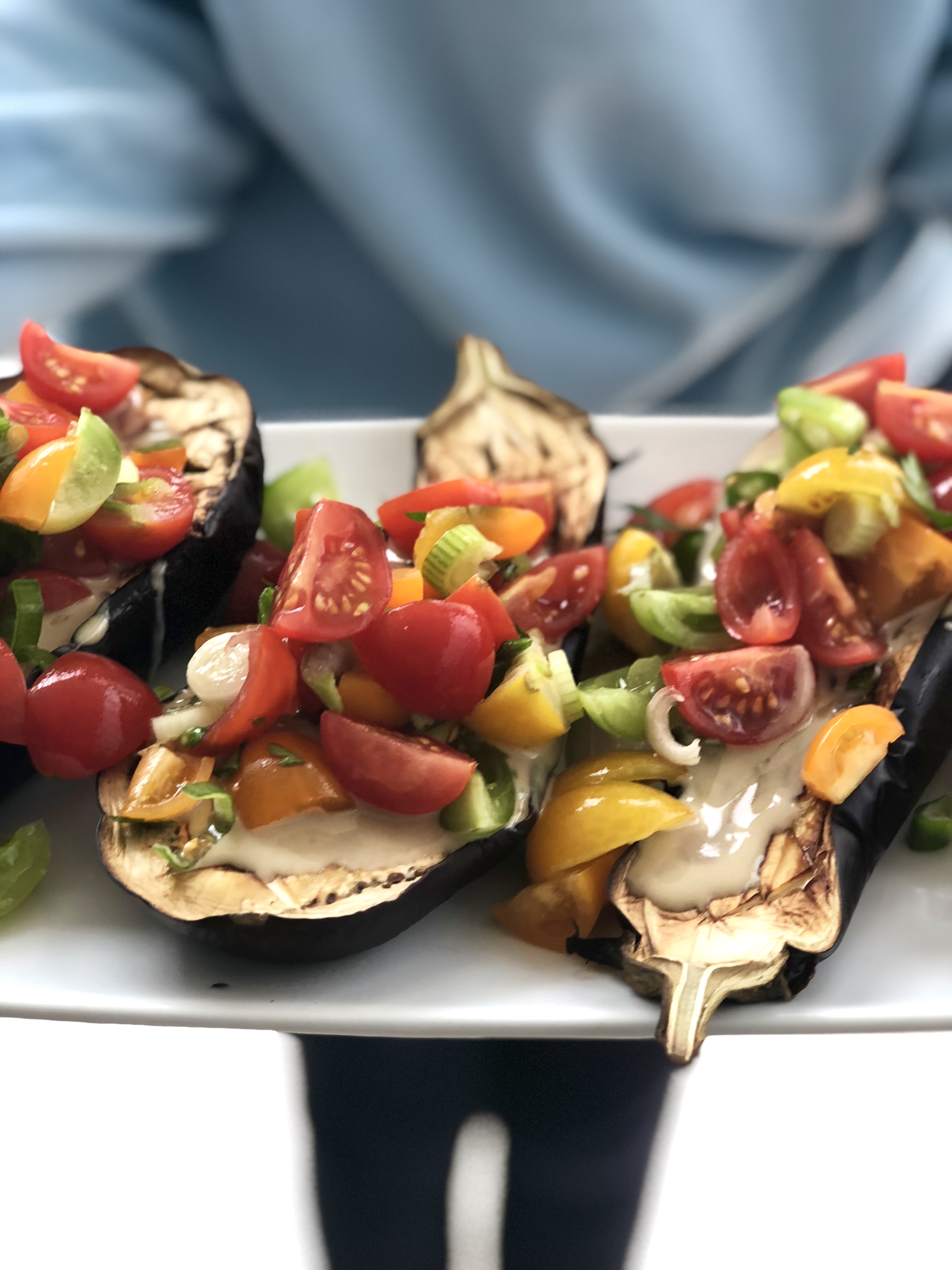
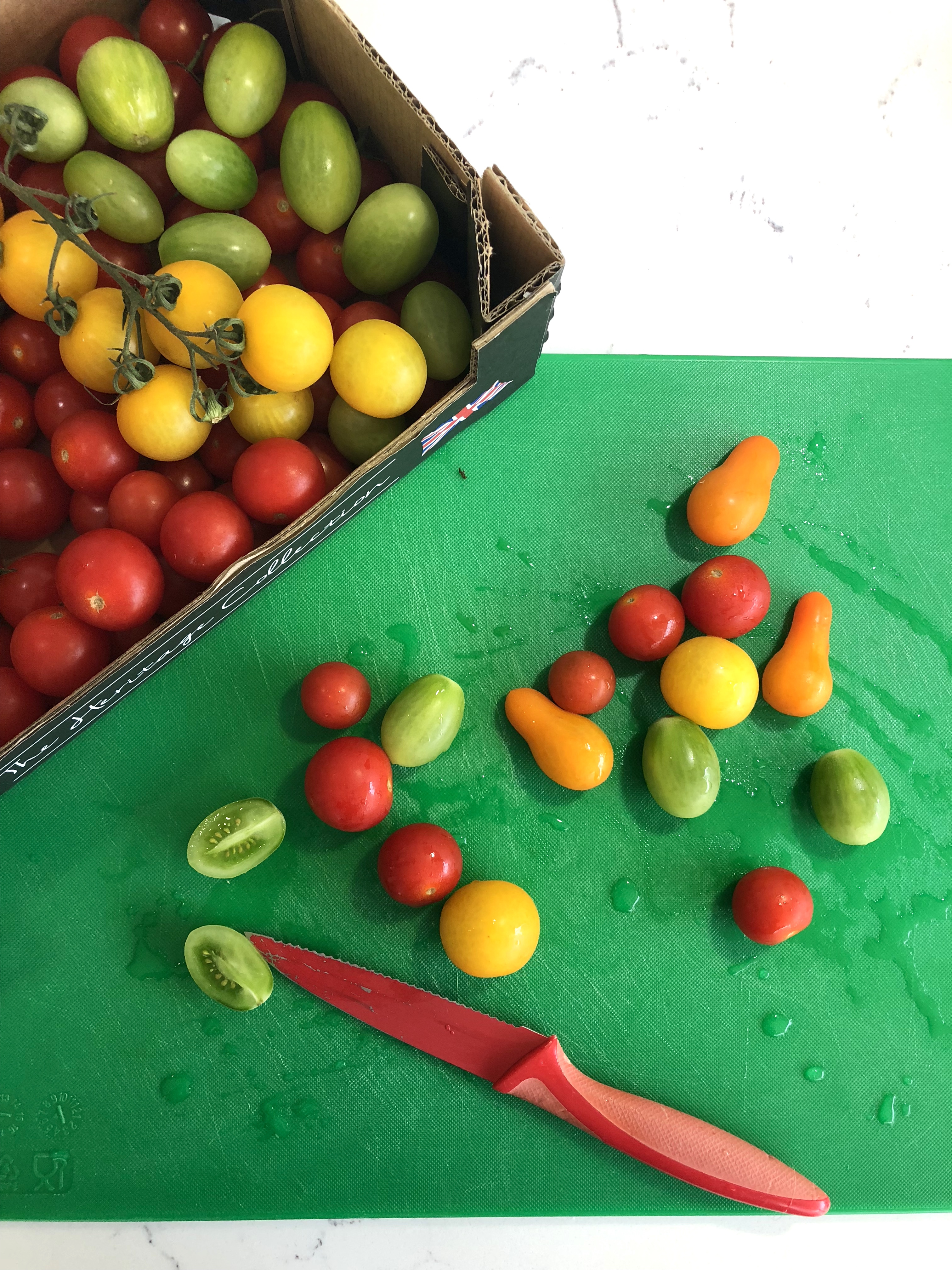
Not bad hey! I had some heritage tomatoes in my fridge hence the rainbow coloured tomatoes. Here is a close up.

Oven Baked Aubergine with Tahini and Tomatoes

Serves 4

2 aubergines, cut in half lengthways

2 tbsp olive oil

270g tomatoes, cut into bit sized pieces

1 spring onion, finely chopped

1 tbsp fresh flat leaf parsley, roughy chopped

salt and pepper to taste

  1. Preheat an oven to 260C (I use a fan oven) –  basically you want the oven really hot.
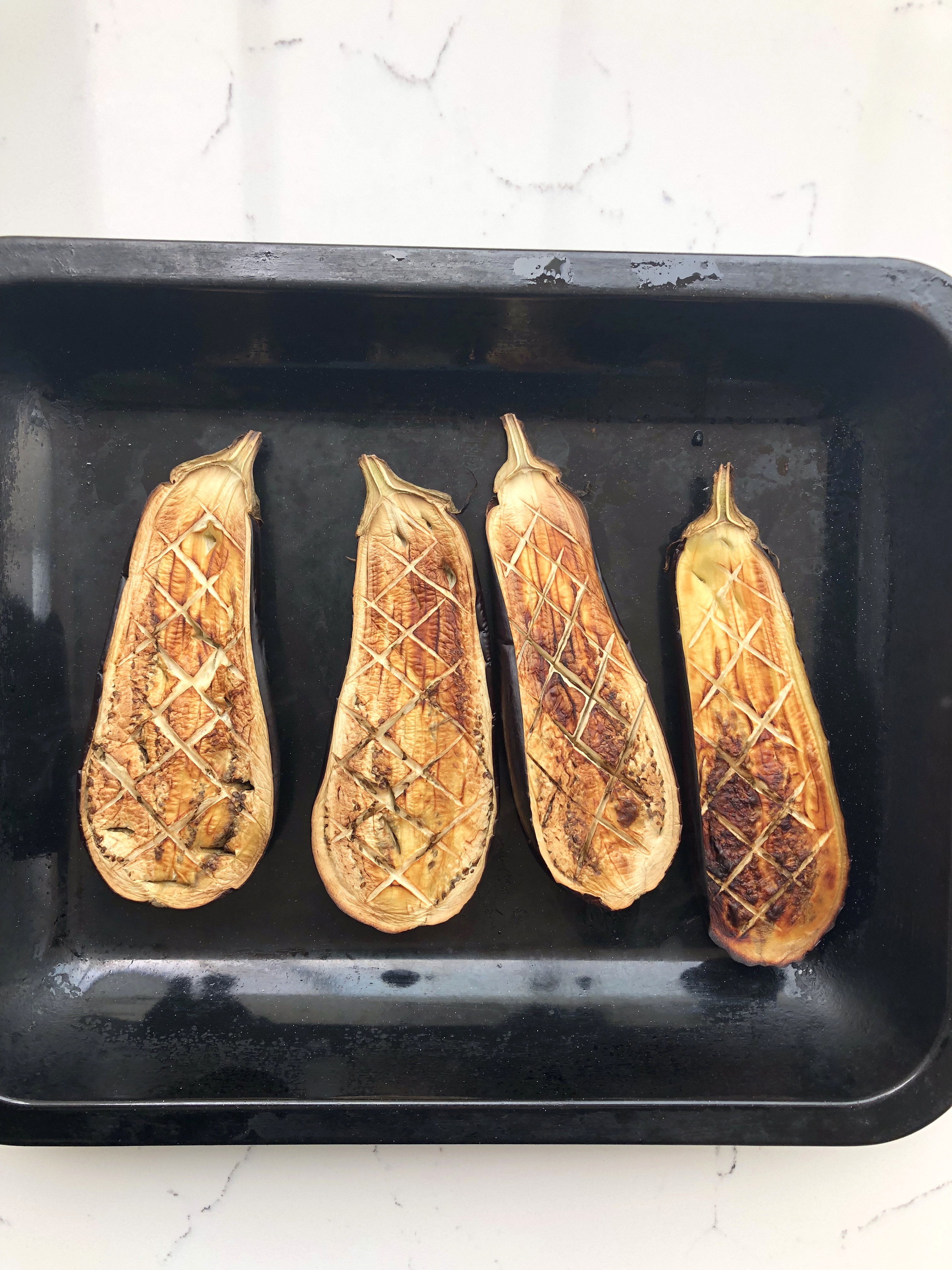
  2. Place the aubergines on an oven proof dish and score the top of the flesh along the top like a lattice (see the photo below)
  3. Evenly distribute the olive oil over the flesh.
  4. Place in the oven for 20-30 minutes so that the flesh has turned dark brown – to the point that it has almost blackened.
  5. Meanwhile in a bowl prepare the tomatoes, spring onion and flat leaf parsley.
  6. When the aubergine is cooked you can either allow the aubergine to cool down completely or serve it hot with a dollop of tahini on each aubergine half, followed by the tomato mix and a sprinkling of salt and pepper.

Two other suggestions when you go to Acre are:

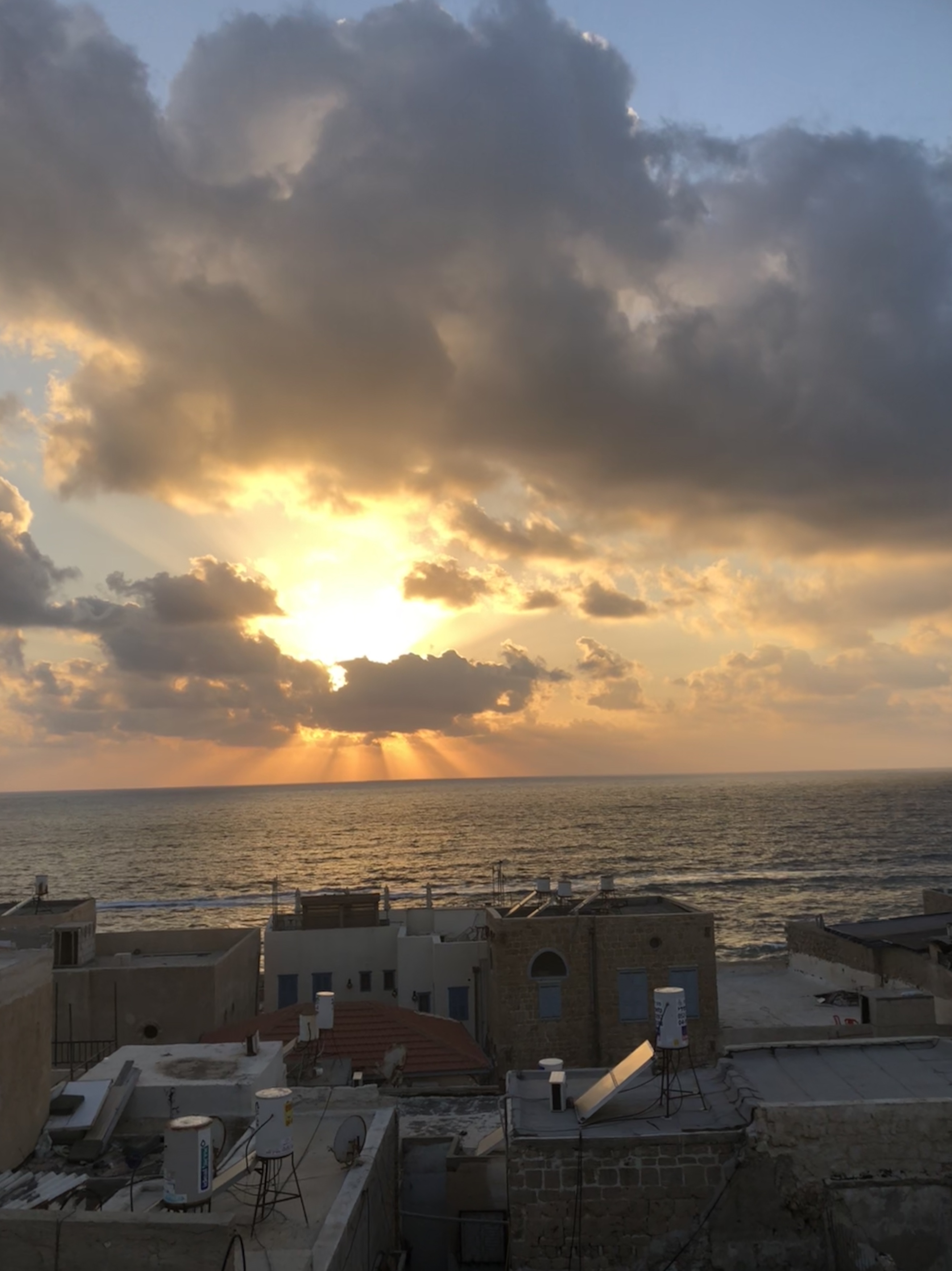
  1. Go and have drinks on the roof of the beautiful Efendi Boutique Hotel. It would also be another wonderful place to stay in Acre. The sunset views from the roof are pretty special.

2. Book a table at Uri Buri – the food at this restaurant was exceptional and the owner, the award-winning head chef  – Uri Jermia , is a larger than life, ‘Father Christmas’ looking culinary wizard. It was tricky to photograph all the food due to the light, but you can see them on my instastories under ‘Israel’ if you are interested. We opted for a tasting menu where they bought out dish upon dish of beautifully presented (and tasting) Mediterranean fish and seafood. This is not your typical Levant restaurant – it is more fine dining, but in a relaxed setting, overlooking the sea.