Exciting News: my NEW Cookbook has launched


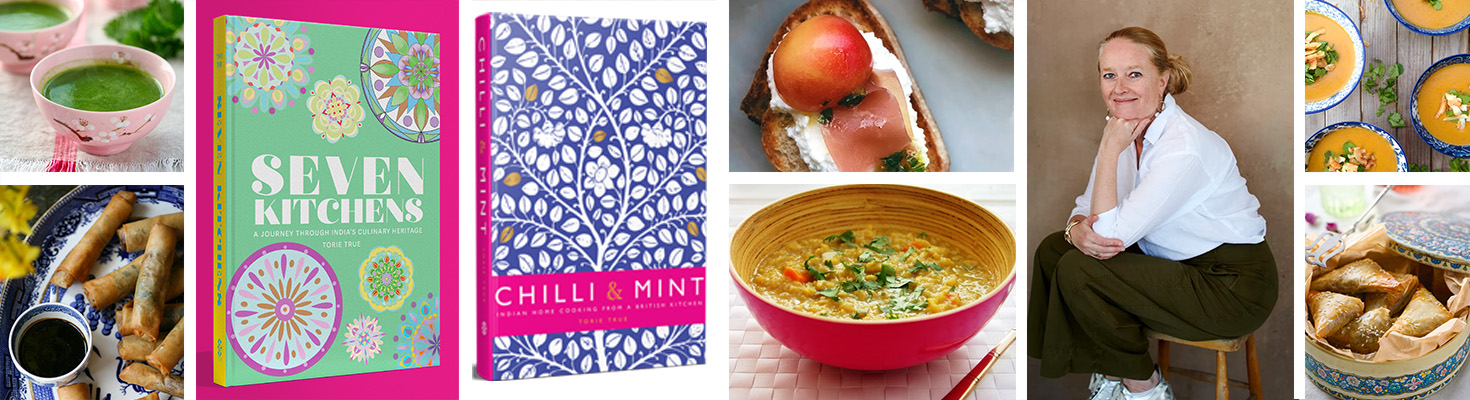
I know some of you only follow me on here and not on my other social media, so I wanted to let you know the very exciting news that my new cookbook ‘Seven Kitchens: A Journey Through India’s Culinary Heritage’ has just launched. It has been 2 years in the making and hours of writing, recipe testing and researching. I am really pleased with how it has turned out.

Let me tell you what it is about. The ‘Seven Kitchens’ refers to seven different groups of people who came and settled in India for a variety of reasons, which I explain in the book, and it looks at how these groups of people style of cooking, techniques, ingredients and influences merged with what was there to create ‘fusion’ cooking and what we now know as Indian cuisine. Did you know that before the Portuguese arrived in Goa tomatoes, chilli and potatoes were not used in Indian cooking? They were discovered in South America and with the trade routes the Portuguese were able to bring them to India.

The Seven Kitchens are:

Goan Portuguese

Indo Chinese

Anglo Indian

Parsi

Syrian Christian

Tibetan Nepalese

Mughal

There are 101 recipes (56 are vegetarian) and they all have photographs that were styled by me and my photographer Tim Green. We also did all the prop styling too which I really enjoy.

Let me show you a peek inside the book.


Colourful, eye-catching and importantly inviting – I hope – to inspire you to actually try making the recipes. I think you are going to love them.

It will make THE perfect gift (birthday/Christmas/any occasion) for yourself or friends.

Here are some of many options of where you can order it from (just click on the name of the shop). They are also available at ALL independent bookshops. IF they don’t have a copy in they can order it within 48 hours – so do support them if you can.

My publisher Meze Publishing

Hatchards

Waterstones

Bookshop.org

Amazon

Please leave a review (on Amazon – you don’t have to have bought from Amazon to leave a review – as it really helps  others find out about the book).

I’m off on the road again this week touring with my book so maybe I will see some of you at the various events that I will be at. Take care and thank you for all your support.


Visiting a Wasabi Farm in Hampshire

It’s not often you get the chance to visit a Wasabi Farm, especially in the UK, so when a call went out to members of the Guild of Food Writers to sign up, I was first in line.

Based in Hampshire, outside the village of Micheldever, the Wasabi Company’s farm, is located near bubbling brooks, on repurposed watercress beds. They still grow watercress too, but they have diversified to also include wasabi. The leaves are grown under protective black netting that keeps them shaded from the sun’s rays. Traditionally in Japan it grows alongside shady riverbanks high in the mountains. It is notoriously difficult, and indeed slow, to grow taking around 18-24 months until the rhizome is ready to harvest. There are two big planting periods from October/November then spring time when it is all hands on deck to make the planting run smoothly.

John Old, the farm’s affable owner, kicked off the proceedings with some background into the history of wasabi. It is native to Japan and archaeological remains have dated the first signs of consumption as far back as 14,000BC, most probably for medicinal purposes, instead of food. The word ‘wasabi’ however dates from the seventh century in Nara Prefecture. In the middle ages, recipes in Japan show Buddhist temples adding wasabi to cold soup and it is also mentioned in Japan’s oldest book of law stating that wasabi could be used to pay taxes.

We set off to see the plants close up starting with the young plants, which were on raised, well-drained gravel beds with fresh water gullies running in between their neat rows, similar to the traditional methods of natural mountain streams.

We then went on to the more mature plants who were almost ready to be harvested. We learnt that the whole plant can be used – not just the rhizome (which grows above the ground not as a root) but also the leaf stems and leaves, which we were all encouraged to try. Little delicate white flowers can be seen around March and April and these too can be added as garnishes or eaten raw or fried in tempura batter. The leaves and stems were delicately peppery with less of a pungent kick than the rhizome itself – which we enjoyed later with our lunch.

One of the highlights of our day, was being able to harvest a plant ourselves. Chaperoned by Josh and Leigh, we had to delicately ‘tug’ at the lower part of the leaf stems, near, but not on, the rhizome, gently manoeuvring it from its soil cocoon. There were squeals of delight all round, admiring the sizes of our rhizomes.

We learnt how to clean up the rhizome before we were able to try some with our amazing lunch spread that they had very kindly laid on for us all.

I was fascinated to read the chemistry behind wasabi and how the flavour peaks after 3-5 minutes after grating or chewing.

Whilst lunch was being prepared we also got to taste a wide range of products that the company offers – many of which have great taste award stars (all stars are given through rigorous blind tasting) and it is a huge accolade to receive 1,2 or 3 stars. You can see the full breadth of their  products here. 
A highlight for me was: ‘Sanbaizu – pure rice vinegar with delicate flavours of bonito and kombu.
For lunch we were treated to the most delicious cured trout, which was placed on top of some sushi rice. Wasabi leaves were in the middle and rice again underneath – it looked like a savoury Japanese birthday cake and tasted exceptional. We ate this alongside some freshly made chicken yakitori (more of this on my instagram) and some fresh watercress with a wide range of dressings and dipping sauces to choose from.
….and to finish off this fantastic experience we got to sample some beautiful chocolates made by Chris, founder of Teabites that were flavoured with wasabi, chilli, ponzu, and other wonderful sounding ingredients. They were almost too beautiful to eat ;o)
We were given such generous goodie bags filled with yuzu mustard, yuzu pepper and a delicious Sudachi-citrus and kombucha seaweed ponzu (all these you can find on their website here )as well as a fresh wasabi plant, a purple shiso plant, and off course, the one we pulled out earlier that day.
What a truly memorable experience. Thank you John, Lee, Josh and team.


NEWS ALERT: Indian Supperclub at Barnsgrove – Friday 8th November

photo credit: Robyn Liebenberg

Come join me at the stunning new Barnsgrove in Hampshire on Friday 8th November where I will be hosting a very exciting supper club, showcasing some recipes from my first book ‘Chilli & Mint: Indian Home Cooking from a British Kitchen.

We will kick the evening off with some ‘pani puri’ (also known as ‘gol gappa’), a delicious Indian street food snack that awakens the taste buds with a zingy, sweet and sour explosion in the mouth.

Next up is a range of chutneys to eat along side some crispy onion pakora, then onto some soothing Sri Lankan coconut dal, some smokey aubergine known as ‘baingan bharta’, a vegetable thoran from South India, a Chettinad pepper chicken and some cumin rice. Then for dessert you will be have some cinnamon, chilli and chocolate fondants with cardamom chantilly cream.

I would love to see you there. If you live in Hampshire or in the neighbouring counties please spread the word and bring your friends. Tickets are limited. To book sign up here.

Photo credit: 1st and 3rd photograph: Robyn Liebenberg. 2nd photograph of me: Kristin Perers


Another year on….and a second trip to Japan.

Hello everyone. How are you all? It’s been a while. My blog has taken a bit of a backseat since my cookbook was launched back in 2021 as all my attention has been focused on PR related to that and book tours across the UK. An invite to the Sharjah Book Fair last November for 5 days was a highlight as I was able to demo my recipes each day to a Middle East audience, as well as do some live radio and TV related slots.

Getting ready to go LIVE with 95 Pulse (96.1fm) in Sharjah in the Middle East

An incredible opportunity that I am forever grateful for and some lasting friendships with other book authors from around the world who were also invited.

With the fantastic team which made my demonstrations possible

Sales have been going well so a BIG THANK YOU to those kind folks who have been buying it, gifting it to friends, reviewing it and of course cooking from it. It gives me the greatest joy to hear you are loving the recipes and that they are easy to follow. After the first year the first print run sold out so it is already on its second. It is available at all good bookshops – if you local bookshop does not have a copy stocked, they can order it in from the wholesaler within a couple of days. It continues to be in Waterstones, Hatchards,  Foyles, Harrods, Selfridges in the UK as well as many place across Europe, US, Australia and online in New Zealand. You can also order direct from me here too if you want it signed to a particular person.

With my lovely translator Hend Saeed

Since July, I have been taking time off from my Indian cooking classes and spice tours – they resume in September – and then it is full steam ahead with some exciting collaborations and events in the run up to Christmas. I’m also researching book 2, which I am excited about. It will continue to be on Indian food – but from a totally different perspective from book 1. I am excited to share more about this with you next year.

Morning prayers in Koyasan

As daughter number 2 and I adored Japan so much last summer we decided to return with the rest of the family this summer. So for much  of July I was in Japan. We returned to Tokyo, Kyoto, Koyasan (the temple mountain which I loved so much  last year) and Osaka for a night. In addition, we also visited Kanazawa, Takayama and Shirakawa-go in the Japanese Alps, which were really interesting and less crowded (other than Shirakawa-go  which has a lot of day trippers – we stayed overnight and it was deserted) than well known cities such as Kyoto, which is overrun with  tourists – maybe to its detriment.

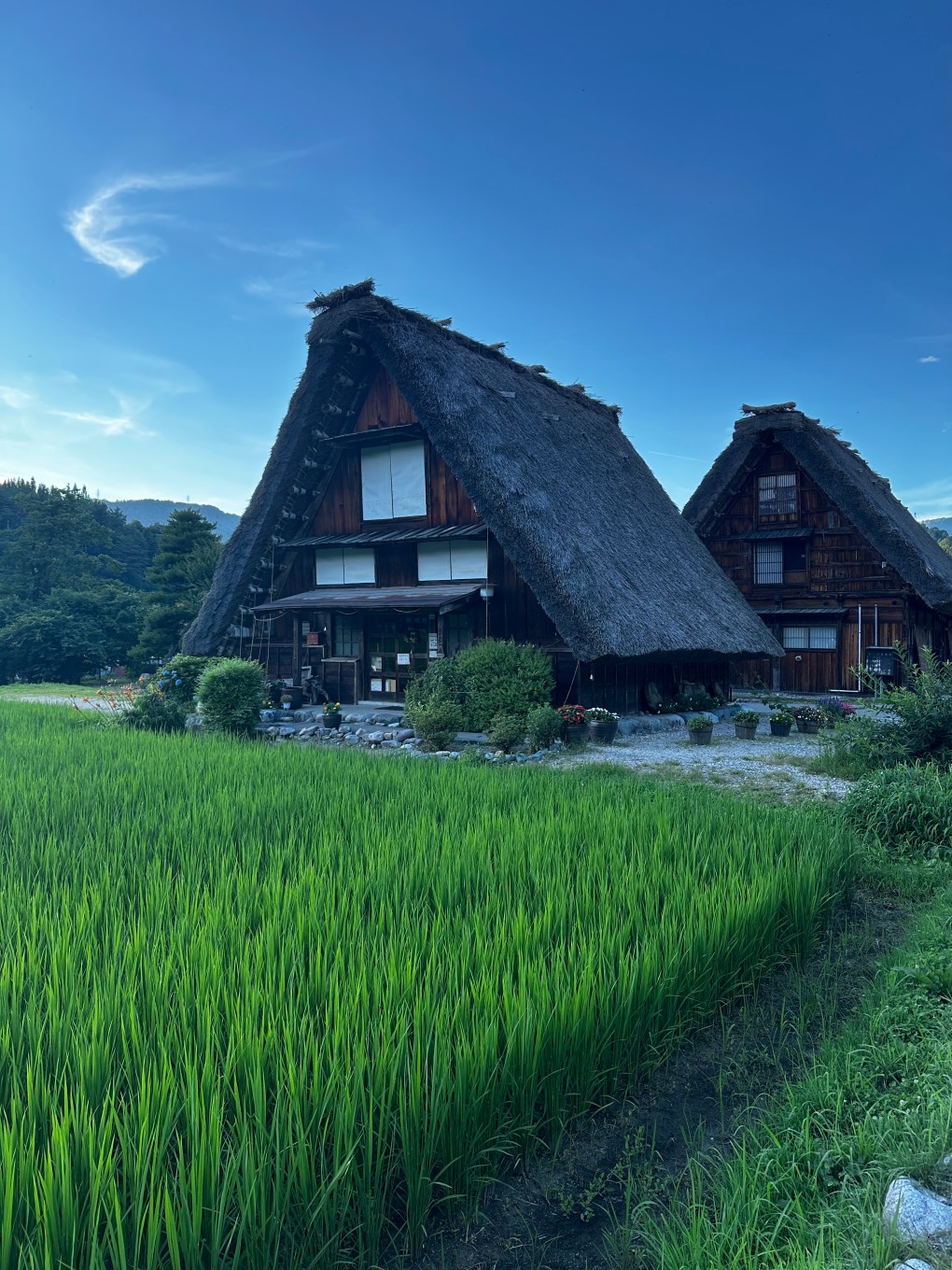
The beautiful village of Shirakawago in the Japanese Alps

I thought it might be helpful to outline 14 observations from my two trips to Japan.

  1. Eating out in Japan is reasonable and totally affordable. I know crazy right!!! I was always led to believe the opposite. For example: a ‘kitsune udon’ – a Japanese noodle soup in a umami-rich dashi broth topped with seasoned fried tofu in Koyasan came to £3.50.

A bowl of udon kitsune for £3.50 in Koyasan

Typically though you don’t need to spend more than £10 per person max on a meal – unless of course you want to eat fine dining, which is obviously completely different. One of the most flavoursome bowls of ramen I have ever eaten was Kanazawa and was a mere 980 yen, which is just over £5.

BEST RAMEN EVER at Menya Taiga in Kanazawa. The fresh ginger and lemon rind lifted it to new heights of deliciousness

2. Getting around Japan is SO DARN EASY. The train and bus system both within the cities and across the country is amazing. The subway is also relatively easy to navigate too, with the help of ‘google maps’. It literally feels they are a few decades ahead of us. We crossed the width of the country on the Shinkansen aka the bullet train in around 3 hours.

The famous bullet train (Shinkansen)

3. The bento boxes at the train stations are incredible. Normally no more than £10 a box they include a substantial meal that it really fresh and tasty. They offer everything from hot and cold food, salads, dumplings and sushi – deciding which to opt for takes time, so get to the station early to browse the possibilities.

4. The large train stations have a myriad of restaurant opportunities that the locals eat in and the quality of the food is really good.  Under cities like Osaka and Tokyo there are are huge walkways to keep cool from the humidity above ground and along these passages are numerous eateries, cafes and shops.

5. We found the Japanese so helpful and friendly.

The oldest sushi chef in Ishikawa Prefecture. Restaurant is called Sushi Tora and the experience is definitely memorable

Whilst perhaps a little guarded initially, when I asked locals if I was going the right way to X they invariable opened up, smiled and communicated with sign language or google translate. Speaking English is not a given.

I was overcome by how friendly and kind they were when I sat next to a lovely Japanese lady on the subway in Tokyo. She did speak a little English and told me she lived in Singapore with her family so was visiting. We chatted for a few minutes and I gave her a rough itinerary about our trip. Our next destination was Kanazawa, which was coincidentally her home town and where she was heading. I mentioned the little inn we were heading to in passing. We said our goodbyes after a couple of minutes and that was that. Fast forward a few days we arrive in Kanazawa in the evening at the Inn and the receptionist mentioned that I had a message from a friend. When she gave me the person’s name I remembered it must have been the lady from the train in Tokyo. Next thing I know this lovely lady is coming over to see me at the hotel (in the pouring rain) – I was wondering where this was going but was intrigued. Anyway she turns up and presents me with this beautiful box of cakes that she has had specially made for me from a patisserie in Kanazawa.

They take a while to make so she had put in the order the day before. I was so taken back by her kindness and sweet gesture. After chatting with her we exchanged numbers and she wished our family a happy stay in her hometown. The kindness of strangers. I don’t think I could ever imagine anything like this happening in the UK, after having spoken to someone for simply a few minutes. I will remember this kindness for the rest of my life.

6. I booked all our accomodation either through Airbnb or Bookings.com – both were excellent and very straightforward.

I opted for old inns and traditional houses and then we stayed in temple accomodation in Koyasan – a different temple this time – Sojiin – which was equally wonderful, but different, to last year’s temple.

7. Getting to Japan is costly and long. We travelled on BA direct. The flight back took around 14 hours as they can no longer fly over Russia, so instead go over Greenland and the Arctic.

8. To really appreciate Japan I would not travel with children under teenage years. July was a good month in that it is less busy than August but it is incredibly hot and humid. We walked around 20k steps per day and must have sweated a huge amount. Take an umbrella to shade yourself from the sun. Everyone carries one at all times – rain or shine.

9. Japan is really trying to encourage tourists to visit less well known places and I really think this is the way to go due to the deluge of tourists in some places really putting a strain on the local community and spirit. Kanazawa for example is only visited by 2% or all tourists and because of this it was really lovely to wander around and visit the temples and the geisha districts. I would have liked to have stayed for another day or so – we stayed 2 nights – 3 would have been perfect.

Kanazawa Castle Park

10. Don’t bother with a JR rail pass. The first time we got one of these for the period we were travelling around. This time we didn’t as they have gone up in price so exponentially it doesn’t make sense. Also some of the trains you will want to go on are not covered by JR Rail. It is easy to purchase whilst you go. When you are arrive in Tokyo buy a SUICA and PASMO  card. They are prepaid IC (stored-value) cards. They can be used for travel on JR, subways, buses and private railways in Tokyo as well as neighbouring areas. SUICA is issued by JR East and PASMO by private transport companies however they can be used interchangeably. They are available on Apple Wallet on your iPhone or Apple Watch so that may even be the easiest.

Mount Fuji as we whizz past on the bullet train

11. If you travel in the summer months, I would recommend only taking hand-luggage. We all carried one carry-on each for the trip. Most places we stayed had washing machines and tumble dryers, so we washed our clothes as we went along. Also when you stay at inns they give you yukatas and pyjamas to wear.

You can easily pick up another suitcase if you end up buying gifts along the way. Equally there is a ‘luggage forwarding’ option in Japan that is  highly convenient, reliable, secure, and very economical. Companies that offer the service, including Kuroneko Yamato, but normally your hotel or inn can sort this out for you.

a relatively short queue by Japanese standards

12. Invariably when you go to a restaurant there is a queue. This is totally normally so don’t be put off as they do go down pretty fast. People don’t loiter at restaurants – they eat their meal and leave. Obviously there are ones that you can go slower but a lot of the ramen joints operate in this way.

Watermelon cubes and pyramids

13. Fruit is expensive. As they rarely import it is down to what they are able to grow. Individual fruit  are wrapped with care and prices for fruit that is reasonable in the UK is relatively expensive in Japan. One of the most interesting observations were the watermelon cubes and pyramids. They are more for decorative purposes than to eat  I hear – costing around £100+. The regular round watermelons that we are all familiar with are expensive to what we have in the UK.

14. I adored all the food we ate in Japan but for me the vegan food given at the temples in Koyasan is standout. The flavours, textures and appearance are exceptional and it was a joy to have half board for the 2 nights when we were there.

Have you been to Japan or plan to go? What observations would you add?

Comments below please for all subscribers and readers to see.

I’ll be back soon with a recipe.


Staying in a temple in Koyasan – Japan

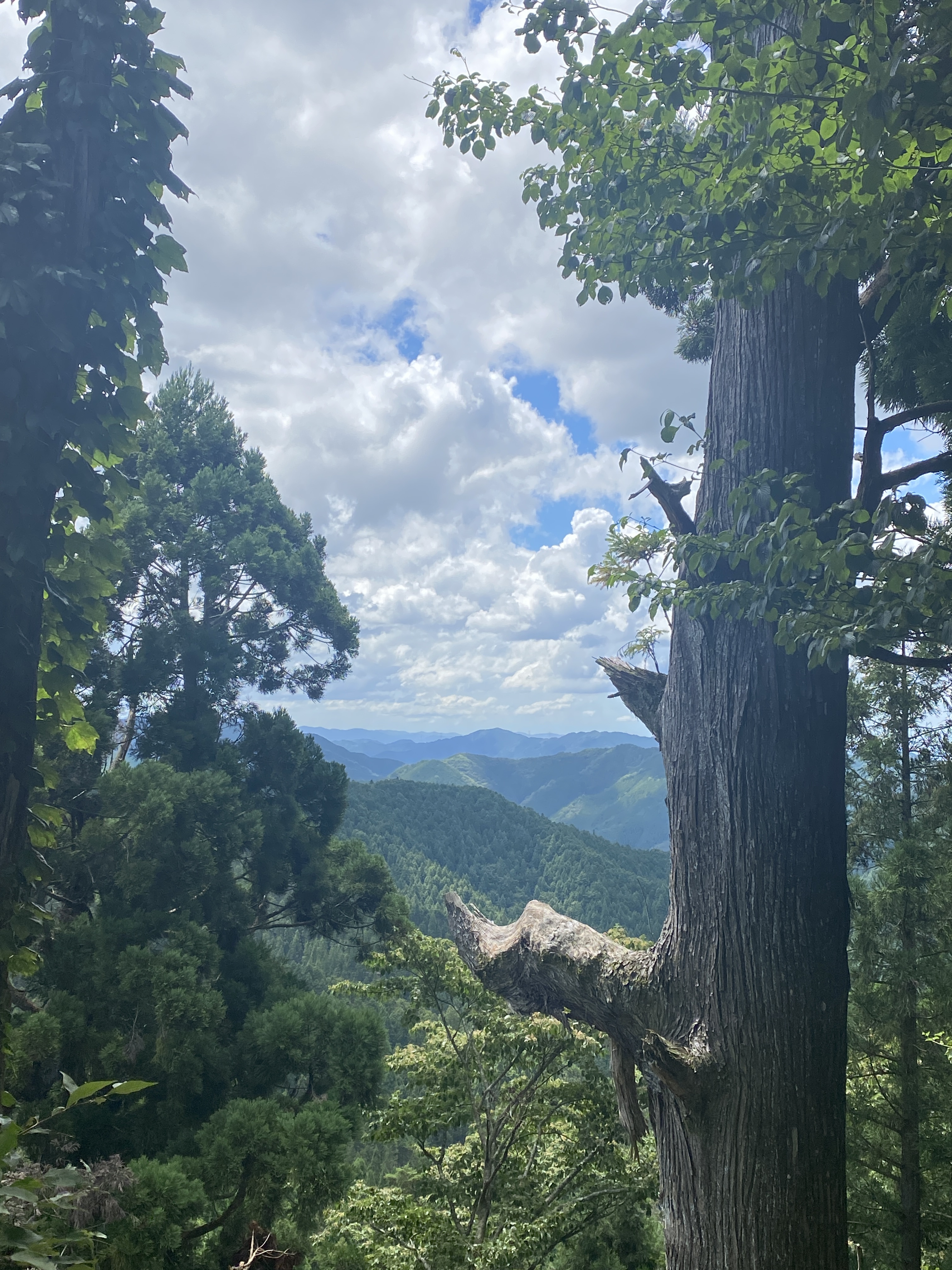
If, and when, you visit Japan may I strongly urge you to leave the bright lights of the cities for a few days and head into the countryside.  Make your way to the peaceful and sacred mountain temple complex, nestled on top of Mount Koya, known as ‘Koyasan’. Here the air is cooler and the smell of fresh pine lingers softly on the breeze.  It is considered the birth place of Shingon esoteric Buddhism. In 816, after years of study in Japan, the non-conformist priest Kobo Daishi was given special permission from the Emperor Saga to establish an isolated retreat. You will also find Japan’s largest cemetery. It is believed that Kobo Daishi never died, but instead is in eternal meditation  – you can visit his mausoleum, known as Okunoin (奥の院)  deep in the forest. It is one of the most sacred places in Japan and a popular pilgrimage site.

Getting there we took the train, cable car and bus, but it was so worth all the changes. You need to take the Nankai train heading to Koyasan, the final stop is Gokurakubashi Station. There you will need to transfer to the cable car – actually a funicular more than your typical cable car, which will then take you to Koyasan station. You then board the Nankai Rinkan Bus Line which takes around 10-15 minutes to get to Koyasan itself, stopping off at all the temple lodgings.

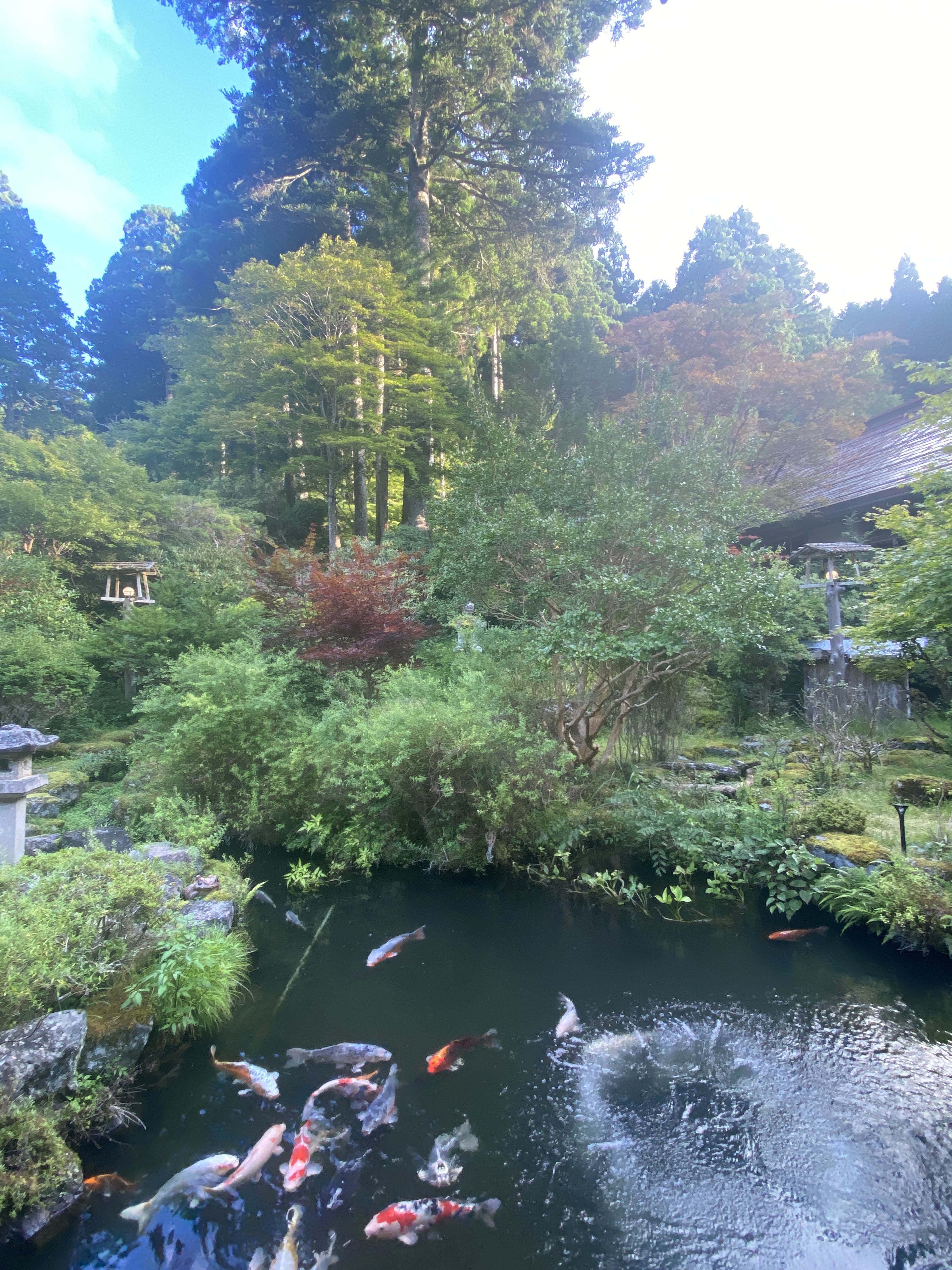
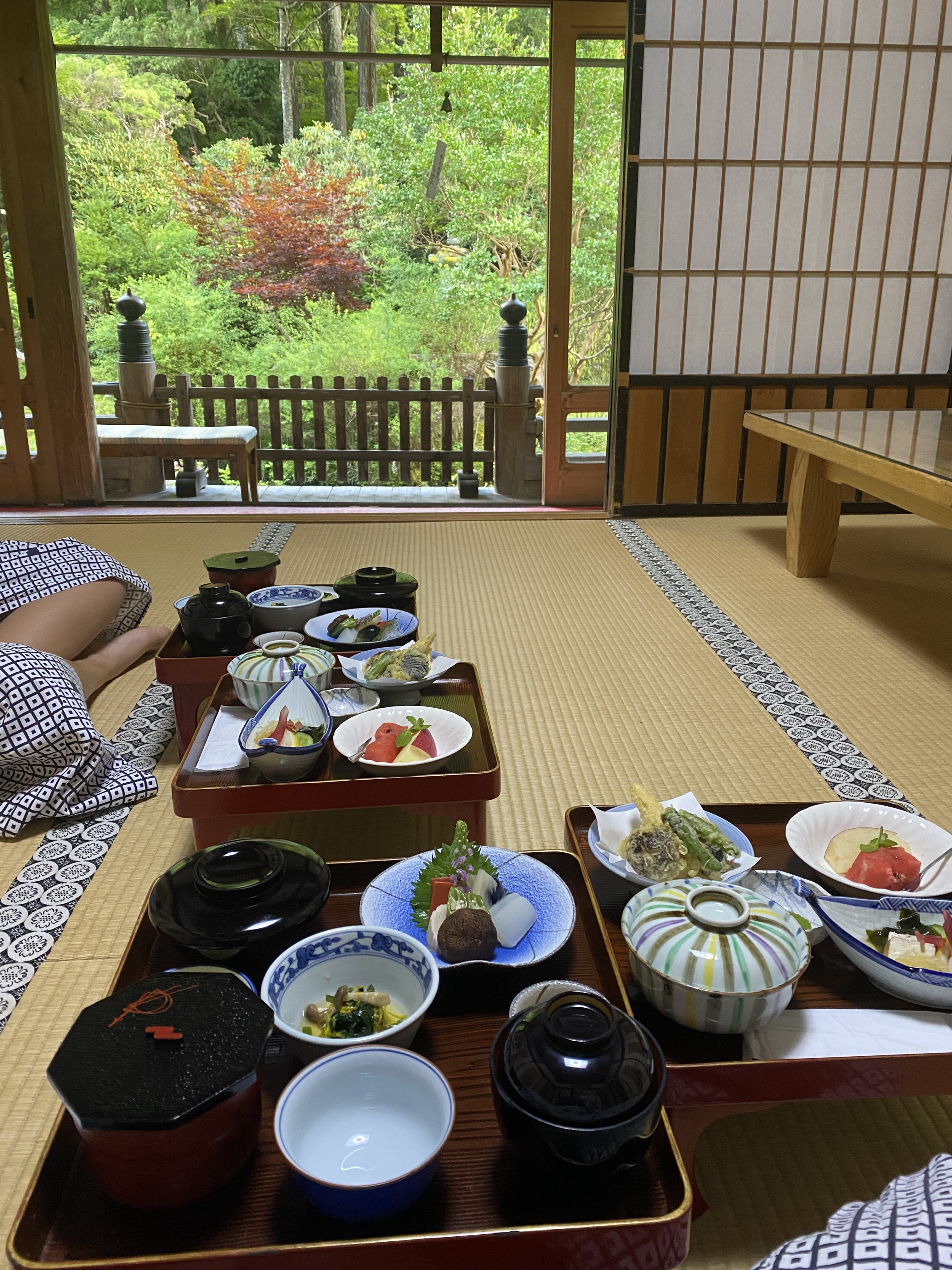
Deciding which temple to stay in was hard as there are so many to choose from (around 52) and to be honest they all looked really good.  Some however, only cater to Japanese pilgrims to so you do need to do a little homework first. We opted for Koyasan Shukubo Daimyououin as it was near to the entrance to the cemetery and I had pre-booked months before a night tour of the cemetery with one of the monks. I also loved the fact that it had an inner courtyard overlooking a koi carp pond with beautiful trees.  At all the lodging temples you are given an elaborate vegan breakfast and dinner, which looked almost too beautiful to eat. It tasted delicious and was surprisingly filling.


We slept on comfortable futons on tatami floors and each afternoon when we came back from our touring of the temples, one of the friendly monks would come and bring us some chilled green tea in our room to sip.

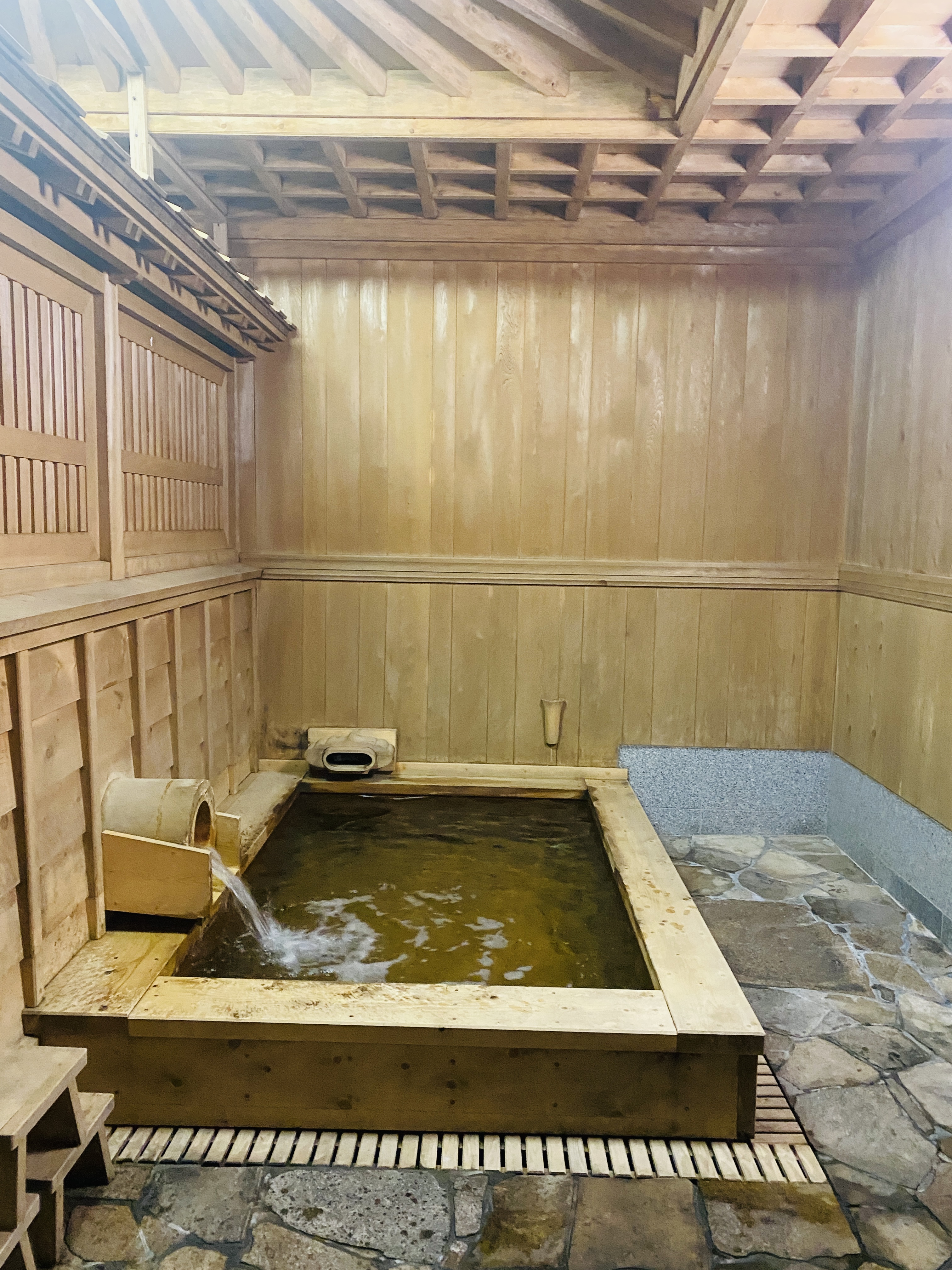
The walls are thin – as they are paper sliding doors – and on the first night it was a little frustrating that the family in the next door room had the TV on, which kind of spoilt the whole zen of the place. Thankfully the they left the following day and peace resumed. To be honest they really don’t even need to have TV’s at the temple. It is relaxing just to soak it all in, read a book and take a long hot bath (communal – women only/men only).

The temple operates to a schedule when it comes to morning prayer and eating. You can choose to join the morning prayers in the temple at 7am for 30 minutes. Breakfast is then at 8am and dinner is at 6pm. Our temple was small and intimate with perhaps no more than 15 or so guests. I only saw 3 monks living in the temple over the duration of our two nights stay. They were friendly and polite and kept themselves to themselves. Each guest is given a yakata robe to wear around the temple and little slippers. The yakata is a cotton summer kimono, typically worn in casual settings and to nearby bathhouses. They are very comfortable and cooling in the summer heat. I even bought a few home as gifts .

(one of my daughters – takes in her zen surroundings)

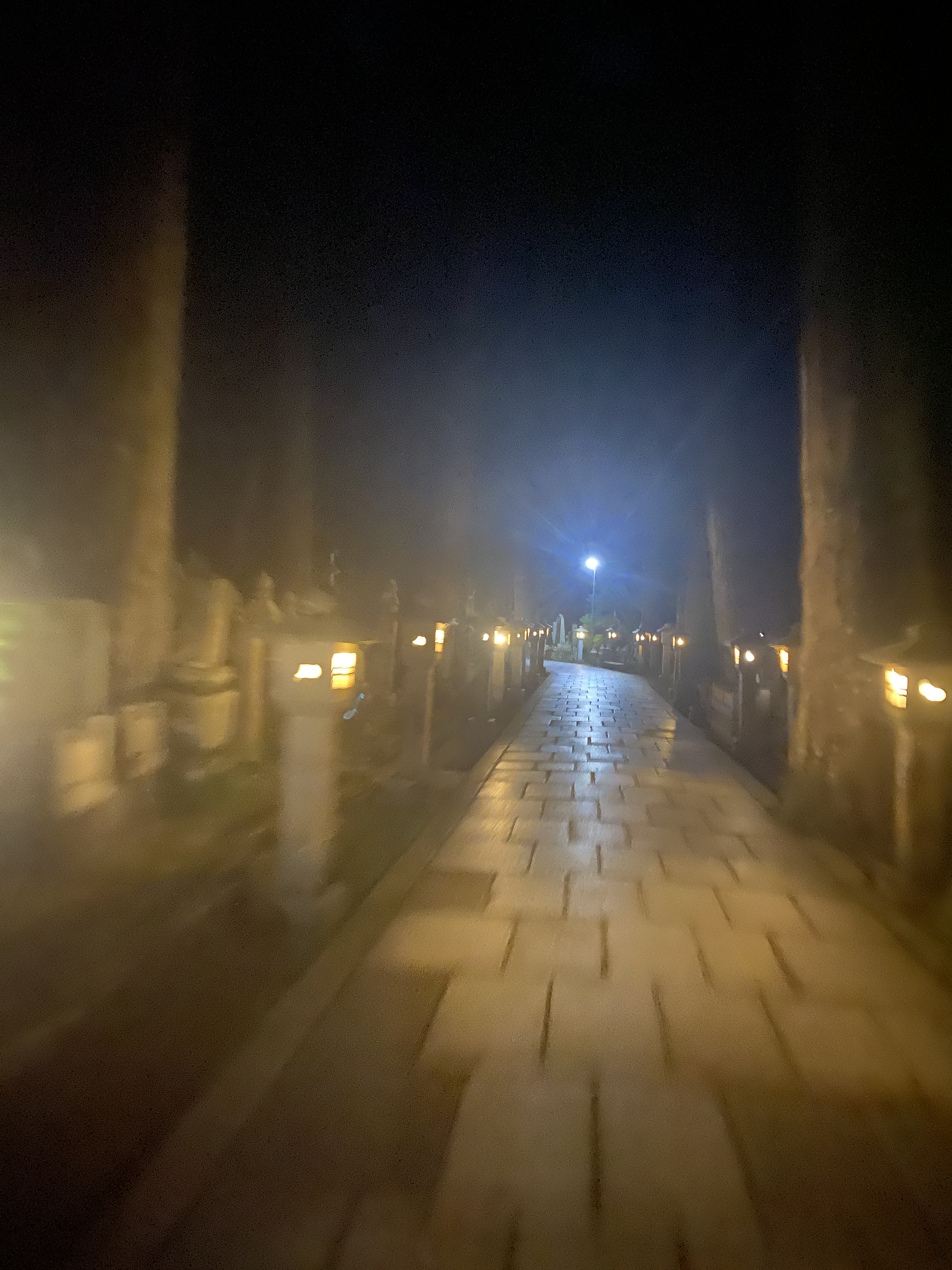
I also spent a little time at the temple next door, which was a lot bigger, with many more guests and monks who spoke really good English. That temple was called Eko-in and it offered meditation, free to guests, and a small amount to those staying in other temples. It was also from this temple that we started our night tour of the graveyard. You MUST  book months in advance as they are popular. There were a few people who turned up hoping to tag along and they were turned away as they like to keep the group to no more than perhaps 15-20 people, which is more than enough. The cemetery is surprisingly not at all spooky. Ancient trees line stone paths that weave through the forest. More than 10,000 lanterns are kept eternally lit to shine a light to those who enter the forest. After the tour we walked back alone with our new Belgian friends to the temples at the other end of the forest. You are welcome to catch the bus, but we felt it was more atmospheric to return on foot.

Eko-in also performs the  ‘fire ceremony’ (goma-taki, Shingon Buddhism’s fire ritual) every morning in a little shrine at the entrance to the temple. It was absolutely mesmerising and you feel very immersed in the ceremony as the beating of the drum increases in intensity as the fire climbs higher and higher. This all takes place after the first morning prayers  at 7.30am when you are still in a heady slumber from sleep. It is definitely otherworldly and something worth witnessing no matter where you sit on the religious spectrum.

During the day there are so many temples to visit around Koyasan that you can do them all on foot or jump on and off the bus that snakes its way through the town.

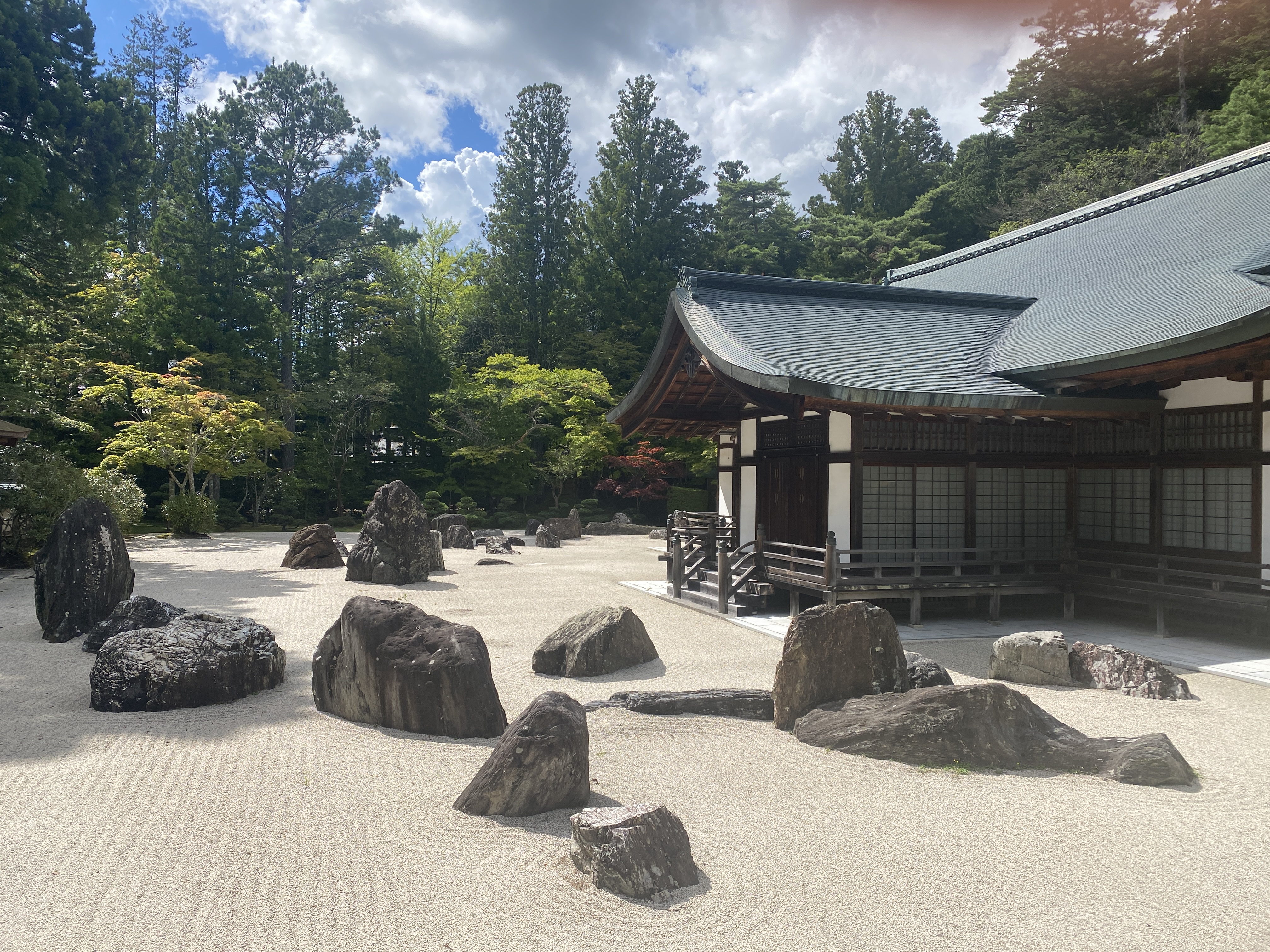
We enjoyed visiting the Kongobujo Temple, which is the headquarters of Koyasan Shingon-shu Buddhism. Within it you will find the largest rock garden in Japan – 2349 square metres. The design is of a pair of dragons emerging from a sea of clouds to protect the Okuden. The dragons are made of 140 pieces of granite brought from Shikoku and the white sand is from Kyoto.

It is also worth visiting the cemetery in the day time and exploring yourself. It is free to wander around, although to enter the temples there is a small fee. There are places to eat if you are feeling peckish, but to be honest after our breakfast and walking around in the heat, albeit less humid than back in the cities, we just fancied something cooling – think ice cream and a chilled drink.

If you have time on your hands, I think it would be great to explore the ancient hiking trails, known as the Kumano Kodo Hiking Trails that have been used as pilgrimage trails for over 1000 years and are now designated UNESCO World Heritage. They are mean’t to be challenging, but a great way to see the country. You need to book inns to stay in advance.  When I return to Japan I will definitely spend some days hiking. Read more about the hiking trails here.

Does Koyasan sound like a place YOU might like to visit on your trip to Japan?


Eating out in Japan

I had been told for years that eating out in Japan was really expensive, so I was pleasantly surprised to find that this was not really the case at all. Let me be totally transparent here though. I was not eating out at Michelin starred restaurants, instead opting to mainly dine in the type of eating establishments that regular Japanese folks eat at.  This involves queuing for a table and not lingering over the meal. You eat and go. On a couple of occasions we chanced our luck by turning up at a couple of restaurants recommended in our guide book. Big mistake as we were turned away both times, one we had needed to book 3 months advance (the guidebook didn’t mention that part unfortunately).

The sushi restaurant we went to in Kyoto – Pontocho Kappa Zushi, (160 Matsumotocho, Nakagyo-ku) our ryokan kindly helped secure the table, which can be tricky at short notice, so I guess we lucked out in that instance. Sushi restaurants tend to be more expensive than your average restaurant, which is understandable looking at the product it is selling – namely fish – and whilst you can eat at ones which are £100-200 a head, the one above came to not much more than £20 a head  for a tasty sushi experience that was freshly prepared before you as you sat at the counter.

At many restaurants the dishes within are presented in the window for customers to see what they are getting, which is really helpful. The food looks so life like (see photo above), but in fact is made of plastic or wax and made to emulate the texture, form and look of the meals. The term for this ‘fake food’ is ‘shokuhin sampuru’ 食品サンプル. It is a huge industry in Japan.

Most places you eat at – including street food, you need to queue, but whilst the length of them can sometimes look intimidating they tend to move relatively quickly. Equally you can aim to eat early to  miss the rush of lunch/supper diners.

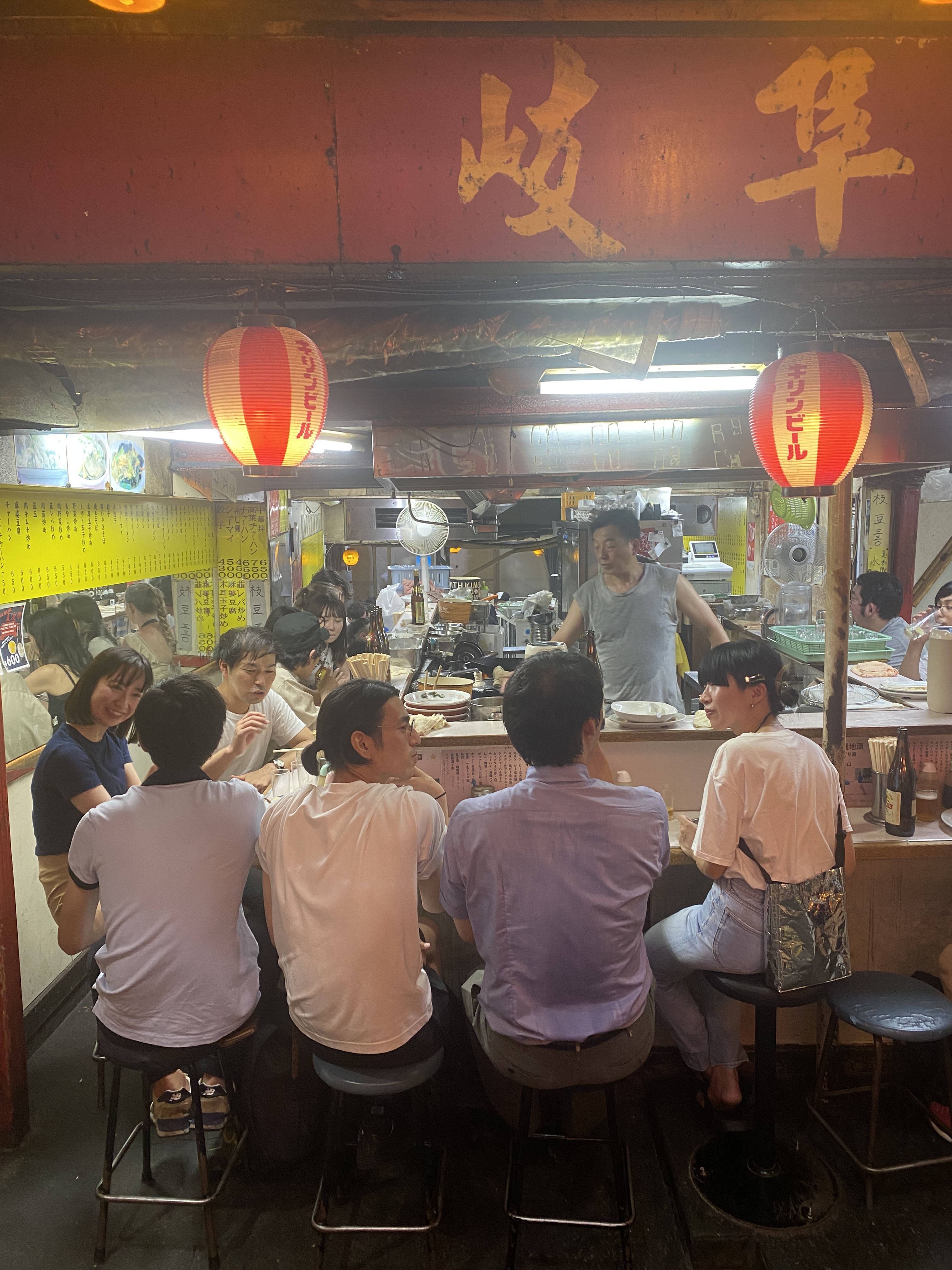
In Tokyo, one evening we headed to atmostpheric Omoide Yokocho area (‘yokocho’ loosly translates as ‘nostalgia’), which is in stark contrast to the futuristic Shinjuku neighbourhood that it is nestled in. It’s a rabbit warren of narrow alleyways crammed with eateries seating no more than 10 diners  around a small bar serving ramen, sushi and yakitori.

Paper lanterns hang overhead as steam and smoke wafts from the open kitchens. It is reminiscence of an old Japan, a bygone age, that is only just clinging on as the high rises climb ever further towards the nights sky.

We sat and dined at the Izakaya (above). They are similar to a European tavern or pub, but instead you all sit at a bar and face the kitchen. Everything was in Japanese so I just pointed to what my neighbour was having and said I’d have the same. Before long my neighbour was ordering extra food for us to try and we were conversing via our my portable translator I’d rented for the trip. It was fun and atmospheric and definitely hit the spot after a days sightseeing and being on our feet. Below are silken chilled tofu (perfect in the sweltering heat of summer) with bonito flakes,  wood ear mushroom mixed veg medley and gyoza – oh and a chilled cold beer!

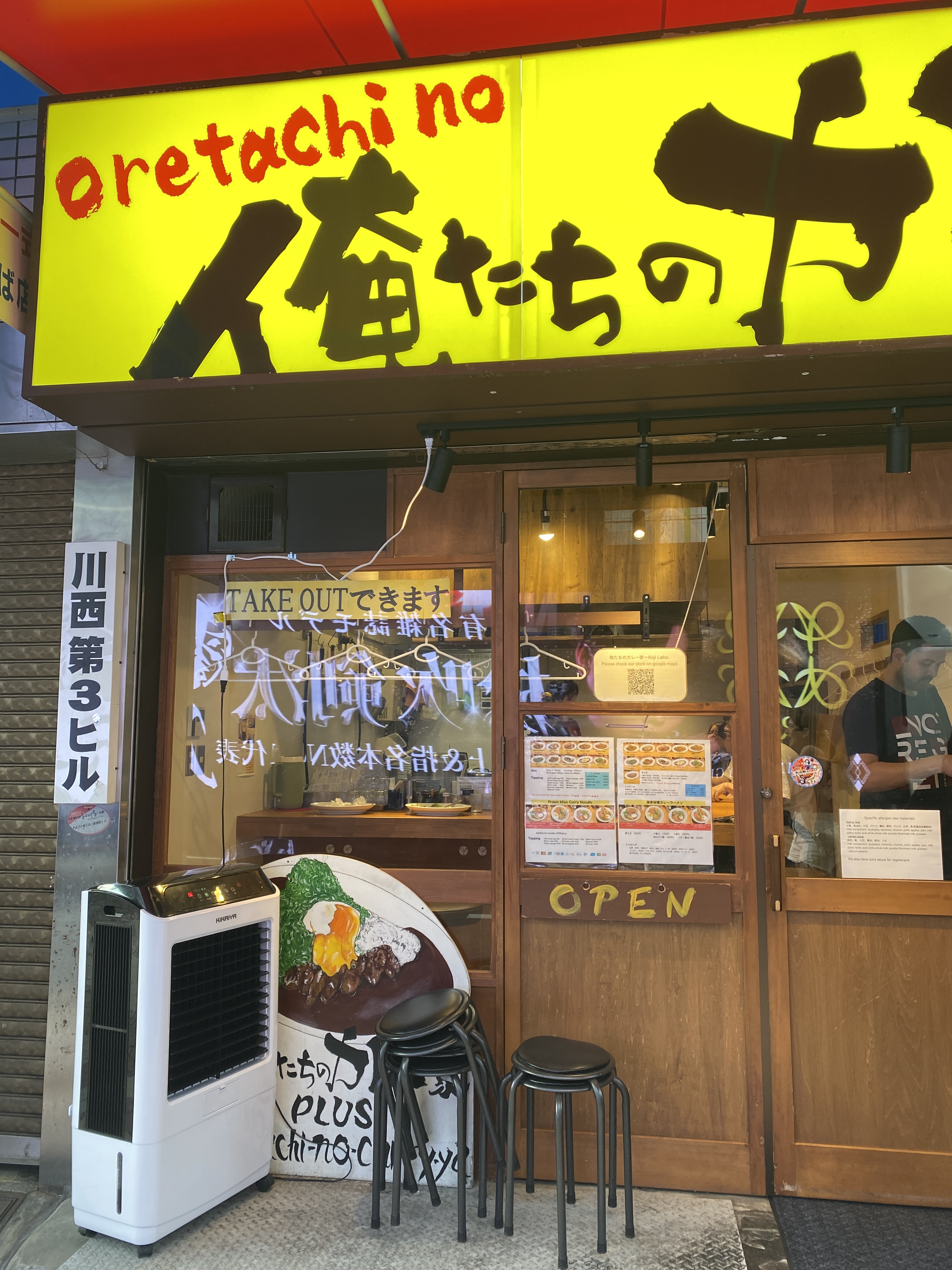
At some restaurants (the one below), you have to put your order into a machine instead of giving it to a human.  At first it seems a little intimidating, especially if others are waiting, but it doesn’t take long to get the hang of it. For the whole trip I was determined to find a great place to eat katsu curry.  Katsu curry is one of my childhood memory foods -click here to find out why. In Osaka, we headed to Oretachino No Curry Ya (14-13 Nanbasennichimae, Chuo Ward) that had come highly recommended.

We arrived early and were first in the restaurant as luck would have it – I think it was around 5.30pm. Not long after we were seated, others joined and before long the whole restaurant was full – it only sits around 12 people.

For the katsu option (you could also have ramen here) you choose between pork or chicken and a whole range for toppings. I opted for the chicken with a flurry of spring onion topping that did not disappoint.

Street food was plentiful and varied and each day we tried all manner of interesting looking delights. Near to our hotel in Tokyo was the tastiest deep fried pork mince and onion cutlet,  I have ever eaten. Juicy and succulent, they oozed with deliciousness from the first bite.  Head to  Asakusa Menchi – 2 Chome-3-3 Asakusa, Taito City, Tokyo they are open from 10am-7pm.

You’ll find it easily as everyone makes a bee line to this place. I popped a short reel on instagram about them and bizarrely it reached almost 50k views which baffles me if I’m honest as it was such a quick unedited reel – go take a look if you are on instagram.

When it came to sweet treats my favourite street food was Taiyaki (鯛焼き, lit. ‘baked sea bream’)  a Japanese fish-shaped cake, that imitates the shape of tai (鯛, red sea bream), which it is named after. They are filled with either pipping hot custard, red bean paste made from sweetened adzuki beans, chocolate, cheese or sweet potato.

I discovered I loved the texture of mochi pronouced (Moechee). It is Japanese dessert crafted from sugary glutinous rice flour. It is very chewwwwwwwy and squishy and probably best not eaten in one go. It comes in so many forms and flavours. Also known as Daifuku (大福餅) it can be plain or stuffed with red or white bean paste. Strawberry mochi were ever so delicious.

Mealtimes in the temple lodgings in the mountain town of Koyasan were a highlight of the trip. I can’t honestly tell you what we ate exactly, as I am not too sure myself, but each little bowl contained artistically arranged food that was almost too beautiful to eat. We sat on the tatami floor and small tables were brought in and placed in front of us. Miso soup, tempura and rice were always served and each meal varied from the last.

The monks provided us with breakfast and supper and during the day we ate a light snack, followed of course, by an  ice cream  to cool us down.

Black sesame for me and macha for my daughter.

Another tip when travelling around Japan is to consider eating food either in, or having take-out, from the large department stores food halls. One evening we decided to eat in our hotel room and bought all manner of goodies from the food hall of Takashimaya in Kyoto. Think Harrods Food Hall vibes – although on a slightly smaller scale, but you get the gist.  If you go in the last hour before closing time all the food is massively marked down.

Yes we did get some of this tasty strawberry cake below.


In Tokyo the place to head is Mitsukoshi .

I’m conscious that this post is becoming rather long, and I’m guessing few will get this far, so I will hold off mentioning a few other places just now and will absorb them in my future posts about Japan.

I will leave you with this Japanese proverb (a proverb in Japanese is called  Kotowaza) to ponder. 

“Eat it raw before all else, then grill it, and boil it last of all.”
Translation: Let no aspect of Japanese cuisine get overlooked. Consider everything – flavours, textures, colours, overall composition and presentation.

…..until the next instalment


Japan through my eyes – part 1 – a brief overview

For a couple of weeks this summer we headed off to Japan, a country that has always been up at the TOP of my list of places to visit. It did not disappoint. From the moment we stepped off the plane it was an exhilarating adventure 24/7. Wherever we went we found the Japanese extremely kind and helpful, even though many did not speak English. To truly explore and understand the country I think it would take more than a lifetime, but in our 15 days we crammed so much in we felt we had gone away for much longer.

A lot of friends have been keen to find out more about my adventure so I thought I would do a few posts to share my observations and help you  plan your adventure there in the future.

We went in August for just over two weeks and my goodness it was HOT and HUMID. We travelled light as we knew we would not need layers and jackets. We took only carry-on luggage for this trip (note* we did buy one extra carry-on a few days before the end as I bought so many vintage haori jackets, which I adore).

We decided to go to the following places: Tokyo, Kyoto, Koyasan, Osaka, Hiroshima, Nara. I booked it all through Booking.com, which was ridiculously easy. These places gave us a snap shot of Japan, but when I return I would like to see more of the countryside, stay at more ryokans with onsens attached – especially if we go in autumn, winter or spring when the days are less hot. Ryokans are traditional inns with onsens (hot springs) attached to them where you can bath. At the ryokans you are given a yakata to wear around the communal areas and you typically sleep in tatami-matted rooms (see a few photos below with me wearing a yakata beside my futon bed) and have communal baths.

Instead of going to Hakone – a mountainous region not too far from Tokyo, which is known for its hot springs, and Miyajima – an island near to Hiroshima, which again has a number of traditional ryokans, we went to Koyasan – which I have always wanted to visit. Hakone and Miyajama can wait for another visit but I do want to visit both places in the future.

Koyasan itself is a picturesque, secluded temple town, reached by cable car high in the mountains where the air is cooler and the smell of Japanese pine perfumes the air.

It is a very auspicious place being the centre of Shingon Buddhism, which was introduced to Japan in 805 by Kobo Daishi, one of Japan’s most important religious figures.  At one time there were close to 2000 temples, but today there are 200 and over 50 of those offer simple temple lodgings to travellers.


I will write a separate post all about this special place as it deserves more than a cursory mention.

Getting around Japan was far easier than I had imagined. Within Tokyo and Osaka we used mainly the tube/subway (occasionally the bus in Tokyo) which at first glance looks very confusing but as it is all colour co-ordinated and in English script, as well as Japanese, it is not too difficult to figure out. You can get day tickets or buy individually tickets. Please be aware that different companies operate different lines so you need to buy different tickets for those lines if you opt for buying tickets separately! Their carriages are air-conditioned, super clean and a little wider than than most of the lines in London.

There is even women only carriages too (although I didn’t realise this until someone pointed it out to me when I had returned home).

Getting to and from the major cities we used the bullet train, which was as efficient, streamlined and as fast as I had imagined. It made travelling huge distances very straightforward, until, that is, a typhoon hits, which in that case all trains in the whole of Japan are cancelled. We discovered this slight hicup on our penultimate day when we were in Hiroshima and needed to get back to Tokyo for our flight home. We ended up having to buy tickets on Nippon Air to fly back to Tokyo as the plane can go above the typhoon. Surprisingly the flight was smooth with no turbulence!

The JR ticket for two weeks unlimited travel is about £250 per person, which you need to purchase before leaving the UK. We found that on some journeys – for example a day trip to Nara from Osaka, we used a different line as it worked out more convenient and didn’t cost too much. In October 2023 the price of the JR pass is going to increase by 70% which makes me think that it probably is not worth getting. You’ll have to do the maths before you go but my sense is to buy tickets as and when you need them when you are there.

Posts to follow:

The Food

Staying in a Temple

Tokyo

Kyoto

Osaka, Hiroshima and Nara

I’ll try and do them weekly for some continuity. Have you been to Japan? What were your experiences? Would you recommend any particular places that stood out to you? Any observations worth sharing here?


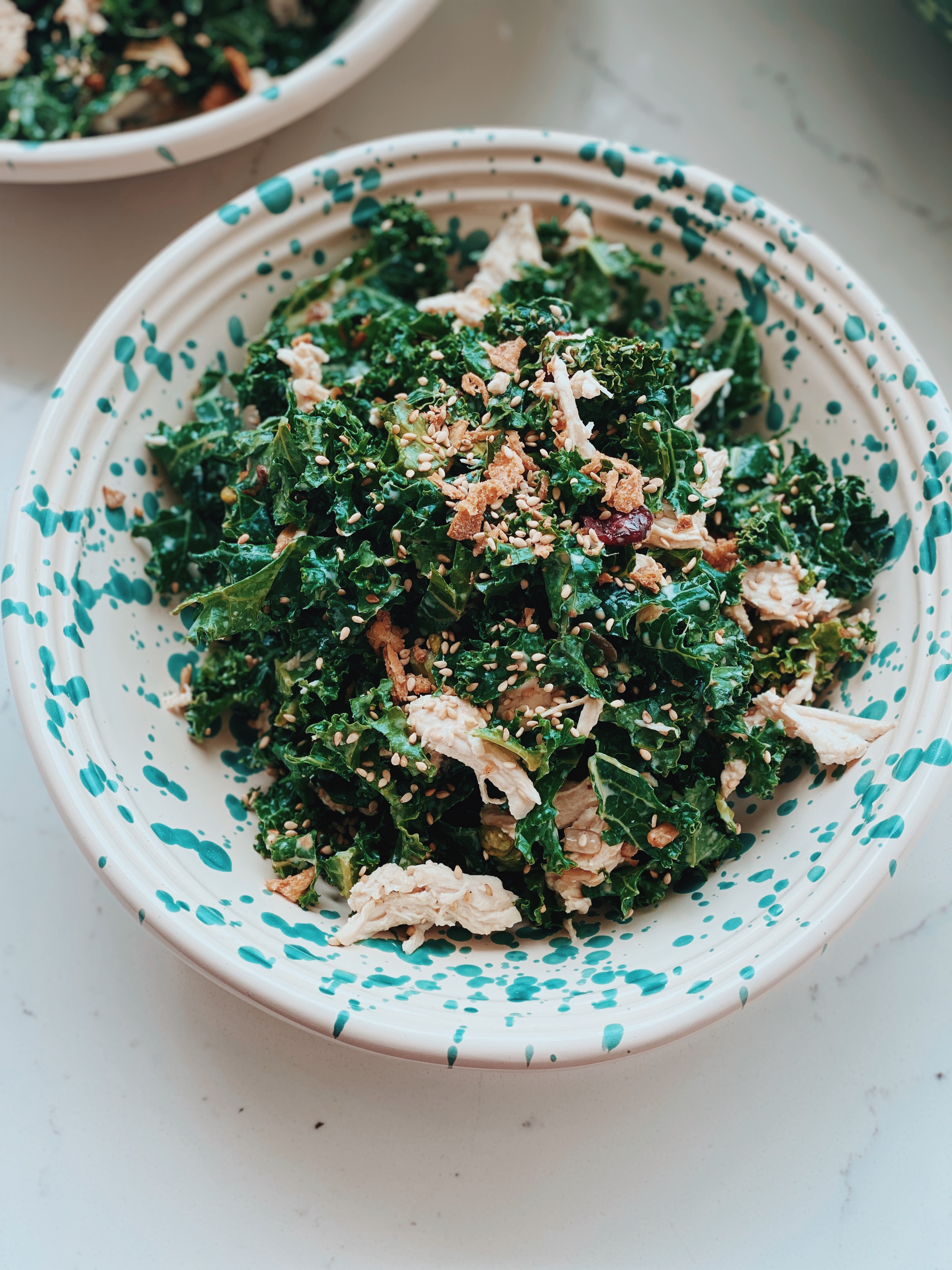
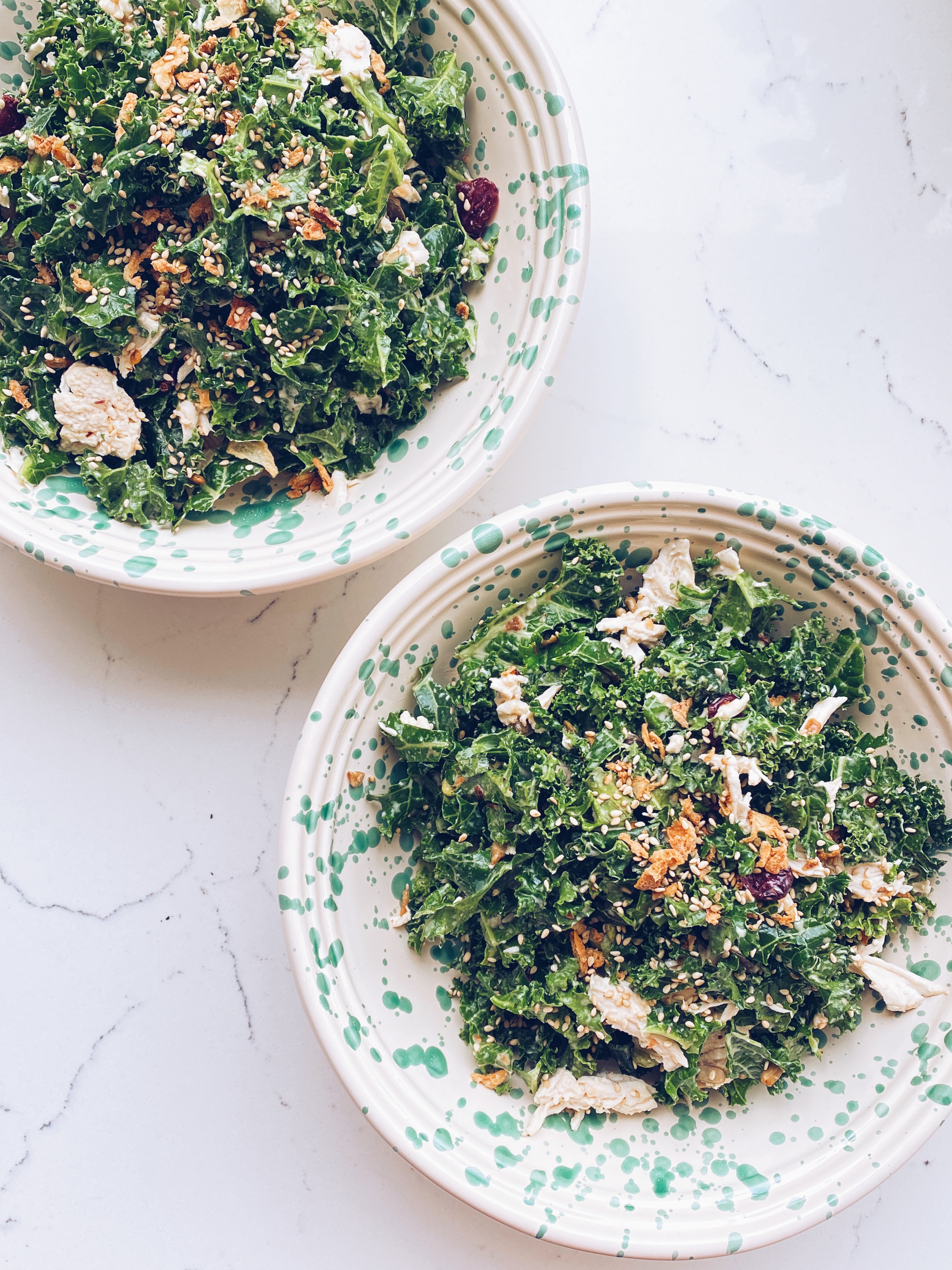
Kale, Chicken and Dried Cranberry Salad with a Spiced Tahini Dressing

It’s been a while I know. I continue to be very focused on marketing my cookbook ‘Chilli & Mint: Indian Home Cooking from a British Kitchen’  – have you got your copy yet ;o)? I’ll pop a branded tote in for free for those who order through me (whilst stocks last). If you are overseas then the best way is Book Depository which offers free shipping.

It’s on its second print run, which I am thrilled about and is now stocked in Selfridges and Harrods as of this January 2023, as well as Waterstones, Foyles, Hatchards, some Daunts stores and a number of independent bookshops and lifestyle stores. Physical copies are now being sold in bookshops in Australia and I was particular chuffed to see copies in Waterstones Amsterdam recently.

I’ve also been in India for part of February, researching more recipes that may find their way in book 2 in the future – watch this space.

For this post however, I thought I would tempt you with one of my go-to salads at the moment. I adore an interesting salad that is packed full of flavours and textures and is relatively quick to put together. This one is no exception and is perfect as a meal unto itself for lunch or supper. If you are vegetarian then obviously omit the chicken and add crispy tofu perhaps as an alternative.

You don’t even need to cook the kale. Instead it requires massaging with the dressing to soften it and break it down a little. Tahini is a staple in my house and you are always going to find a pot of chilli oil lurking in my fridge. For this recipe Lee Kum Kee’s – chi chow chilli oil – which you can find at most large grocery stores these days – works wonders with the tahini and rice wine vinegar. I urge you to pick up a pot next time you are doing the grocery shopping. The dressing was inspired by one I had seen in Nik Sharma’s fab new cookbook The Flavour Equation.

Added extra’s that would work a treat would be avocado and grated carrot. I leave it to you to get as creative as you see fit.

Kale, Chicken and Dried Cranberry Salad with a Spiced Tahini Dressing

Serves 4

2 chicken breasts, skin removed (do not throw them away)

250g kale, stalks removed and washed

small handful of dried cranberries

small handful of crispy onions 

1 tbsp white sesame seeds

3 tbsp super seeds salad topper by Good4u


Spiced Tahini Dressing

50g tahini

40ml rice wine vinegar

1-2 tbsp Lee Kum Kee’s chiu chow chilli oil

1 tbsp boiling water, to loosen

fine sea salt to taste


  1. Remove the chicken skin from the chicken breasts and place to one side. Place the breasts in a pan and cover with boiling water and simmer gently for 12-15 minutes. Remove from pan and then shred using two forks.
  2. If you have chicken skin do not throw it away. Instead, stretch it out on some baking parchment and sprinkle with a little flakey salt, black pepper, chilli flakes and olive oil. Place in a pre-heated oven – 180 degrees fan (or 200 if not using a fan) for 10-15 mins until crispy. You can then break this up and onto the salad before serving.
  3. Next make  the dressing. You want the dressing to not be too thick so add a little more boiling water if it needs loosening. Taste test to check the balance of the vinegar/tahini/chilli oil works for you and adjust accordingly.
  4. Remove any large stalks from the kale and wash throughly and then dry with kitchen paper. Then place into a large mixing bowl.
  5. Next pour 2/3 of the dressing over the kale and massage in with your clean hands.
  6. Add the shredded chicken, dried cranberries, sesame and super seeds. By all means add shredded carrots and/or avocado at this stage  if you wish to add more ingredients.
  7. Divide into bowls and top with a few more super seeds, the crispy onions and the crispy chicken skin if you have included this step.
  8. Drizzle over the remaining dressing and enjoy.


Quince Khoresh – an Iranian savoury dish

I have been absent from my blog now for far too long. Marketing my book has been my priority, and whilst it is very time consuming, I have been enjoying the process immensely. For those who have been hibernating in a cave for the past year my book –  ‘Chilli & Mint: Indian Home Cooking from a British Kitchen’ was published almost a year ago and has now been gracing the shelves of many a bookshop and online. I’ve just had a second print run released, which is great news (whoop for joy), so please do think about buying one if you haven’t already or to gift it to friends or family. It is available from all good bookshops  here in the UK, and the usual places online. For those in Oz, the best place to purchase is from Book Topia here, worldwide more generally – then either Book Depositary here , or of course Amazon.

Alongside my bookshop events and marketing the book in general, I am continuing to run my ‘spice tour and Indian cooking class’. The other day, one client noticed some quince sitting in my fruit bowl and asked me what I planned to do with them. Interestingly it had been on my mind as I did not want to go down the quince jam/jelly route. My client – who is of Iranian decent – suggested ‘Quince Khoresh’,  which is a meat and quince dish with sour, sweet and salty notes. Everything fell into place and she kindly sent me a recipe to follow.

In short, I adored the dish but the measurements of sugar, for me, were way too sweet, so I have adjusted here to what I think will be better. In the food notes of the actual recipe (whose recipe it does not say sadly) it talks about how quince was valued for its aphrodisiac powers and how it was customarily given to brides on their wedding nights. The seeds apparently are used in herbal teas to sooth coughs.

I’d love to hear how you get on with the dish and let me know what you think of the sugar balance. Do you need more than I suggest, which sugar do you use? Pop your thoughts and feedback in the comments below.

Quince Khoresh

Serves 6

3 onions, peeled and thinly sliced

1kg stewing lamb (you can also use chicken, beef or veal if you prefer)

6 tbsp rapeseed oil (or oil of your choice)

1 tsp salt

1 tsp freshly ground black pepper

1/4 tsp ground cinnamon

3 large quinces, peeled, core removed and quartered

50g sugar (I used caster but use what you have to hand – the original recipe asked for 150g of sugar but for me this was way too much – adjust according to your taste)

50ml balsamic vinegar

50ml fresh lime juice

1/4 tsp saffron dissolved in two tablespoons of hot water

100g yellow split peas (but you could also: toor or chana dal use jarred/tinned chickpeas)

1-2 potatoes, diced into bite sized (optional – I only added these as I had peeled ones which needed using up in the fridge. The original recipe does not mention potatoes


  1. Use a large deep caste iron pot, add 3 tbsp of the oil and then bronze the onions over the course of 8-10 minutes.
  2. Next add the lamb, salt, pepper and cinnamon and allow to brown on all sides. This will take around 10 minutes. Then add 800ml of water and simmer covered for an hour (30 mins if using chicken).  IF you are using yellow split peas, toor or chana, soak first for a few hours- or overnight if you are that organised – then add them to the pan at this early stage. If using jarred or tinned then add them at stage 4.
  3. Meanwhile, core and peel the quince and then quarter them. Using a skillet, add a couple of tablespoons of oil and allow them to brown on both sides, which will take around 10 minutes. Place to one side.
  4. After the meat has been cooking for an hour (30 mins if using chicken), add the sugar, vinegar, lime juice, saffron water and tinned/jarred lentils, quince and potatoes (if using – not a prerequisite for this recipe – see notes above). Allow to simmer for a further 45 minutes and add a little more water if required.
  5. Taste test and adjust the seasons as required.
  6. Serve alongside some steamed rice.


Book signings and a quick and easy brunch idea!


As Storm Eunice thrashes outside and trees are being uprooted (I hear a few planes fly over on their way to Heathrow and OMG I would not want to be onboard – those brave souls and skilled pilots). I realise it has been a long time since I last posted here so thought I would check in with you all and let you know what I have been up to and give you a very easy and delicious bunch option that is perfect for the weekend.

So since my book launch at the end of November it has been a whirl of promoting and marketing the book; in many respects the hard work has only just begun. I have learnt so much, and continuing to do so, about the publishing industry since embarking on this new venture. Book sales have been going well to date, but ultimately it’s all about getting the word out there to a wide audience and for people to be cooking the recipes and loving them and then gifting the book to their friends so on and so forth. Whilst my book can be found in all the wonderful large bookshops (Waterstones, Hatchards, Daunts and Foyles) the smaller independent bookshops are now getting in on the action, so as to speak, and are kindly selling my book too. I have been visiting some of them to sign some copies. 

Seeing your book in the window of a much loved bookshops is definitely one of those pinch me moments. The legendary ‘Books For Cooks’ in Notting Hill had it in the window along with some other wonderful books on recipes from India and Pakistan. I’ve been down in West Sussex for a few days this week so popped into both Petworth Bookshop and Steyning Bookshop to sign their copies. If you have a much loved bookshop near you do let me know in the comments below and I’ll make sure they are stocking a few copies. Also if you have bought a copy please please do write a review online aka Amazon. You don’t have to have bought from Amazon to write a review, as long as you occasionally buy items from there you can write a review and reviews REALLY help with the algorithms and getting word to a wide audience. For those abroad Amazon is a way that can easily get hold of a copy of my book for now. 

So a great brunch idea which is perfect for one or a bunch of friends is my take on the egg and avocado toast. My version has toasted seeded sourdough which is then layered with avocado cubes, diced tomatoes, finely sliced spring onions, crumbed feta and finely grated boiled egg and drizzled with a good quality extra virgin olive oil, sea salt flakes and black pepper. You can even sprinkle with dried chilli flakes or chipotle flakes if you fancy. The flavour combinations work so well and grating your boiled egg is a revelation. So simple to compile and tastes so good. 


Grated Boiled Egg, Avo, Tomato, Feta and Spring Onion Toasts

Makes 2 portions (or 1 if you are feeling hungry)

1 boiled egg

1 ready to eat avocado, skin removed and diced

2 small/medium tomatoes, diced

1 tbsp feta, crumbled

1 spring onion, finely sliced

2 pieces of toasted seeded sourdough

toppings: extra virgin olive oil, sea salt flakes, black pepper, dried chilli flakes or chipotle flakes


  1. Begin by boiling your egg. Place it in a saucepan of cold water and submerge it. Bring to the boil and then cook on a rolling gently boil for 8 minutes. Remove from the pan and run under cold water as you peel it. 
  2. Toast your sourdough and place on a plate(s)
  3. Dice the avocado and tomatoes and then add onto the toast. Add the feta crumbled and spring onions and then grate the hard boiled egg on top.
  4. Drizzle the extra virgin olive oil and add the salt, pepper and chilli flakes as you wish. 

Devour and enjoy.