Home cooked Chinese Food and Hot Pot Dining on Cold Blustery Days


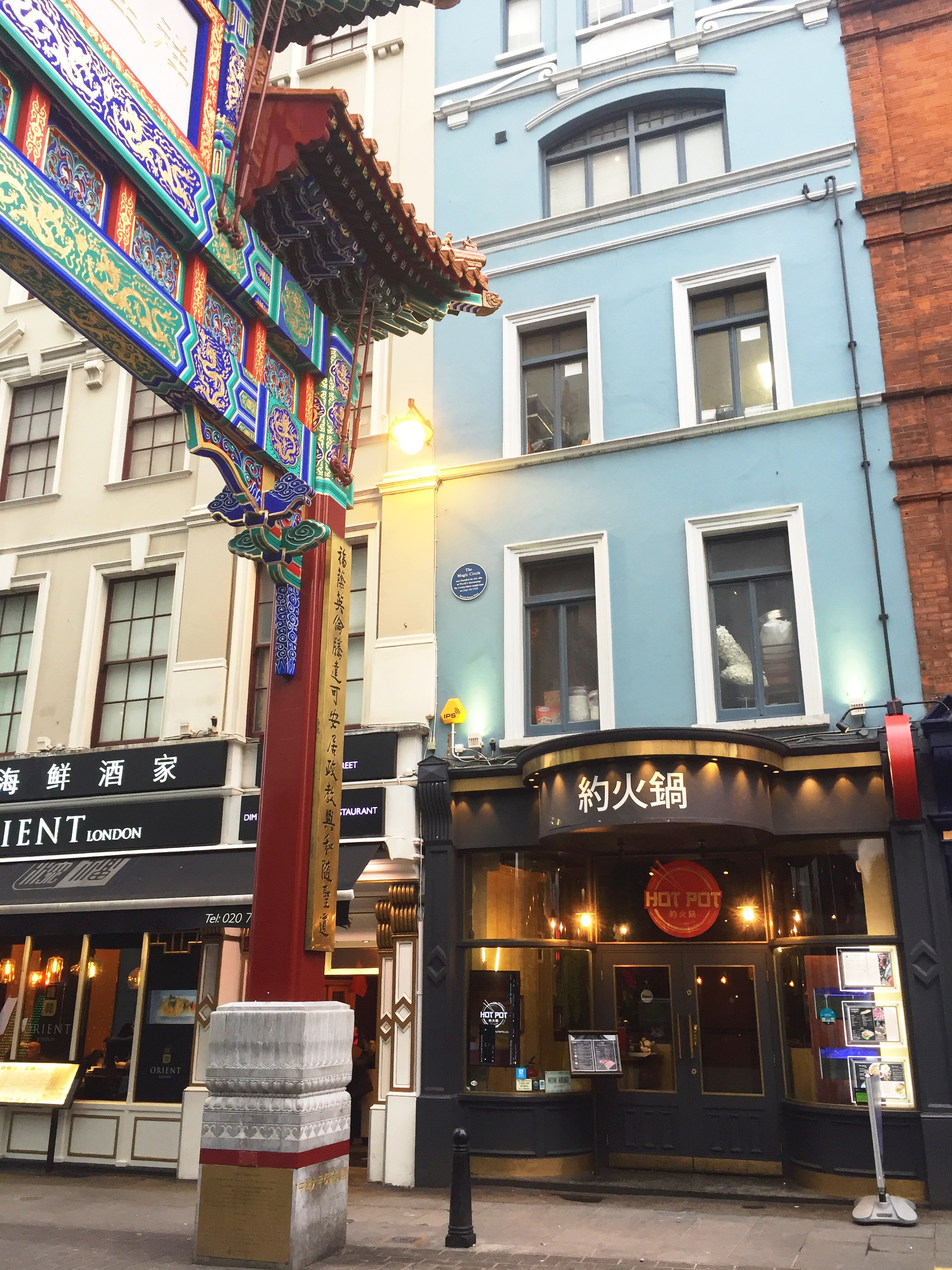
January is a month for nesting. The weather tends to be so cold and blustery, with the odd rain or snow shower, that I like to hibernate, wear thick wooly jumpers and keep warm. It’s the perfect time to cook hearty food, bake and make those chutneys, marmalades and pickles (I made a batch of my carrot and daikon pickle) that you’ve been meaning to do. I did venture out earlier this week however to try my first hot pot at a restaurant that opened last year by the same name. They have over 150 restaurants in Asia but this is their first foray on British shores. It’s at the gate of China town, near Soho, so is very easy to find. Hot pots are in many respects the Chinese version of fondu, although with fondu of course there is no broth to eat with your meat or cheese. They are a great social way to dine with family and friends as a great big pot of steaming broth is the centrepiece of the whole table. I guess they would also be a great date idea, as it’s a fun way to eat and there would always be something to talk about! From a health perspective, broths are a perfect way to strengthen your immune system, which often tends to be quite low at this time of year.

We were welcomed by friendly staff who were on hand to talk us through the menu. Now the menu can be a little daunting at first glance folks, but do not be phased by this hurdle. First you need to decide on which broth you want to go for. You can chose one or  two, the latter coming in one giant bowl with a clever partition in the middle (see photo below). We obviously went for the two option. There are 8 choices and they all sounded delicious.
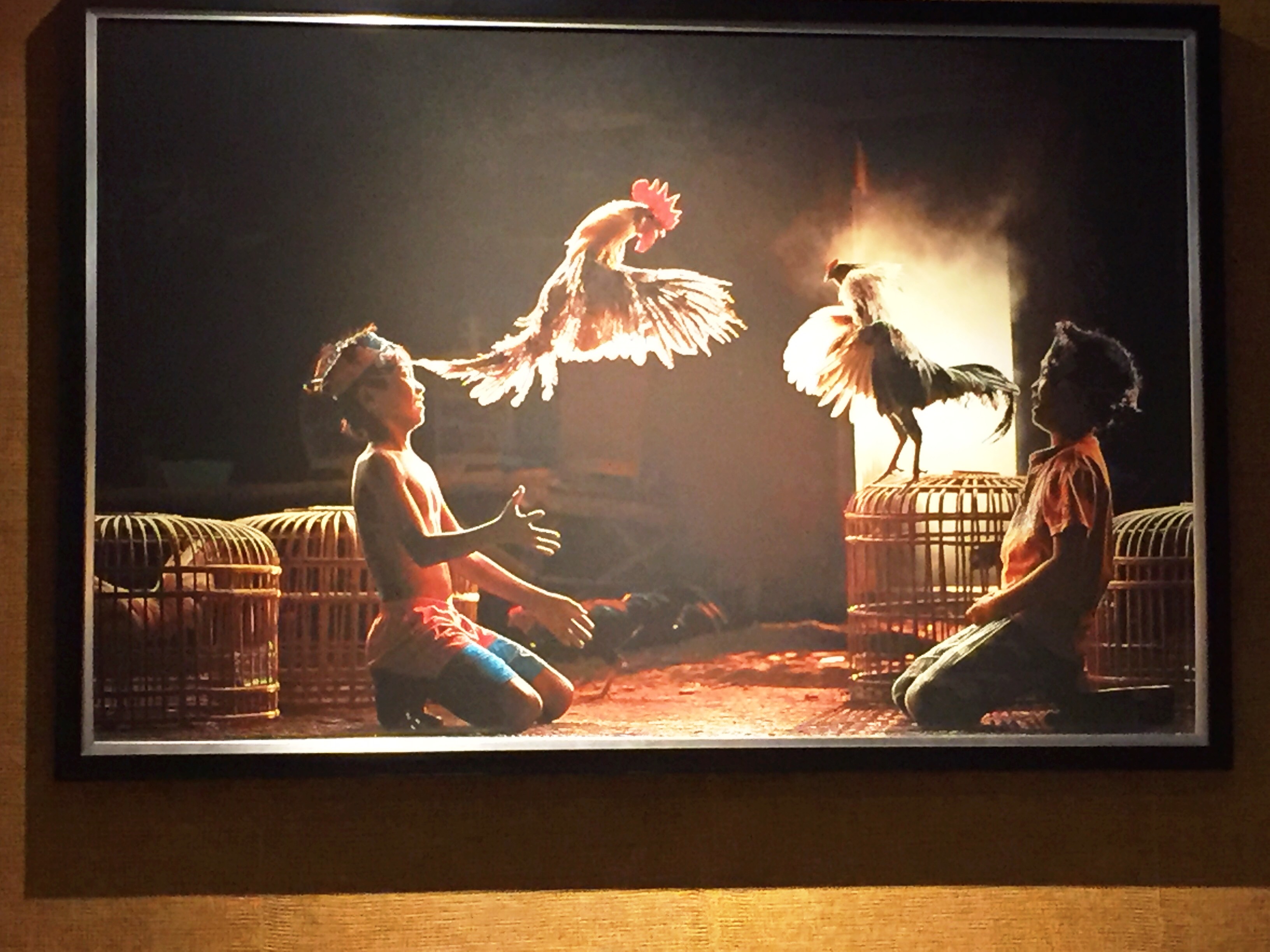
They ranged from the non-spicy to the kickass spicy. We decided to opt for two non-spicy ones – the vegan “longevity mushroom broth” – made up of a host of mushrooms and cordyceps flowers. It has a high content of antioxidants, minerals and vitamin D. Our other choice was the “herbal drunken chicken”. With a name like that how could we resist? It’s made from British free-range chicken that has been cooked in a broth for 4.5 hours with a range of herbs and tonics.

Next you need to choose what to put into the broth. There are a number of platter options, as well as individual plate options, which come in half plate or full plate sizes. We chose everything in half plate, which was more than enough for two people. We went for the sea bass fillets, the spicy marinaded pork, some king prawns, winter melon, Chinese cabbage, emerald spinach noodles and some fried tofu puffs. Whilst our order was being prepared we went over the self serving sauce station (now say that quickly 4 times ;o) where you can get as creative as you wish. The floors over in this section of the restaurant where rather instragramable don’t you think?

There were so many choices that we took a couple of little plates back to the table: soy sauce, chilli sauce, peanut sauce, garlic, spring onions, chillies, sesame seeds to name a few.
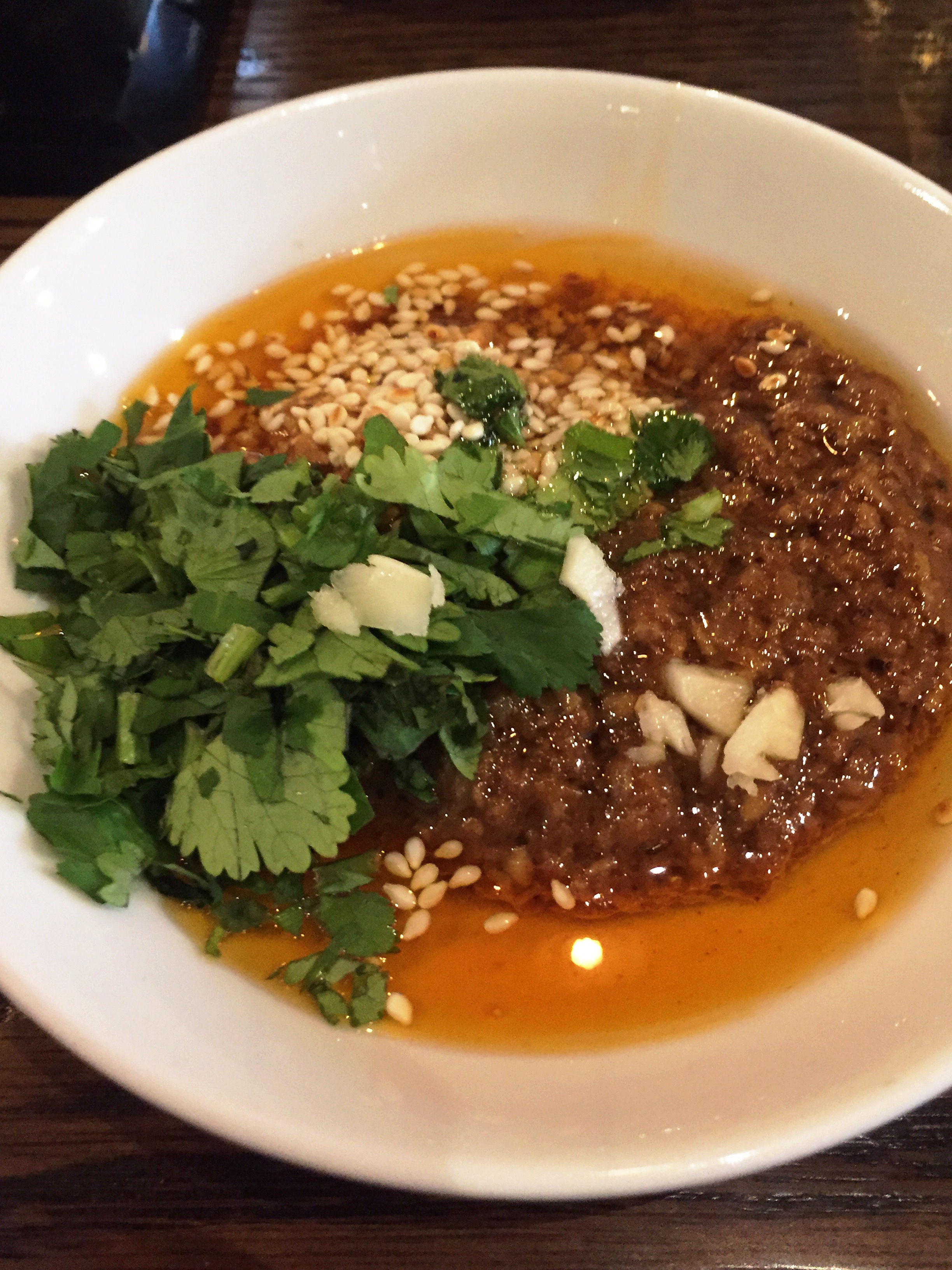
This was my favourite that I ‘created’ (see photo above). The waiting staff will turn on your hob on the table and then let the stock bubble away gently for a few minutes. You then start by adding your vegetables and some of your noodles and leaving them for a very short while before fishing them out and placing them in a small bowl to then dunk in your sauce and eat. Delicious. If you order the winter melon, don’t leave them in there for too long or they will begin to disintegrate, a mistake we made.  You can take a little broth as you go to slurp away, it really does warm you to your inner core. The longer the broth cooked, the more the flavours intensified. We then added the sea bass and prawns for a couple of minutes max before dunking in the pork  (which in fact didn’t taste spicy) for around 4-5 minutes cooking.

Both broths tasted really good and distinct from one another. I would happily choose both again. If I had to choose one over the other I think the herbal drunken chicken had the edge, but it really was a hard call. We ordered the right amount and couldn’t quite finish all of the broth. My dining companion lived in Hong Kong for many years and is in fact half Chinese and she was pleasantly surprised by how delicious both broths were. A real accolade if ever there was one.  The restaurant is over two floors (and sits up to 150 apparently), although only the downstairs tends to be open in the day time, largely owing the the footfall. The clientele ranged from families, couples, friends and Chinese business man, so I think it would appeal to anyone of any age. There is also a number of Thai food options as well as the hotpots, if someone in your party would rather eat Thai. I think my children would love it and perhaps it would make an ideal lunch spot after a morning at the British Museum.

Hot Pot Restaurant, 17 Wardour Street, London W1D 6PJ 

Tel: 020 7287 8881 (open facility from noon-12.30am)

http://www.hotpotrestaurants.co.uk / @hotpotlondon_

Thank you to Hot Pot Restaurant for my complimentary lunch. All opinions are my own and I would happily return again.

Back at home I have been working on my Chinese braised oxtails, which I cooked over Christmas for the whole family and wanted to improve upon. Now don’t get put off by the word “oxtails” folks. Ok, perhaps if you are vegan or vegetarian you can stop reading from now on, but for everyone else, they taste really good but there are a few tricks you need to know about when cooking them. The secret is to cook/braise them for a long time in a low oven – 5h30 mins at 150 degrees centigrade. You need to have it so that the meat is literally falling off the bone.
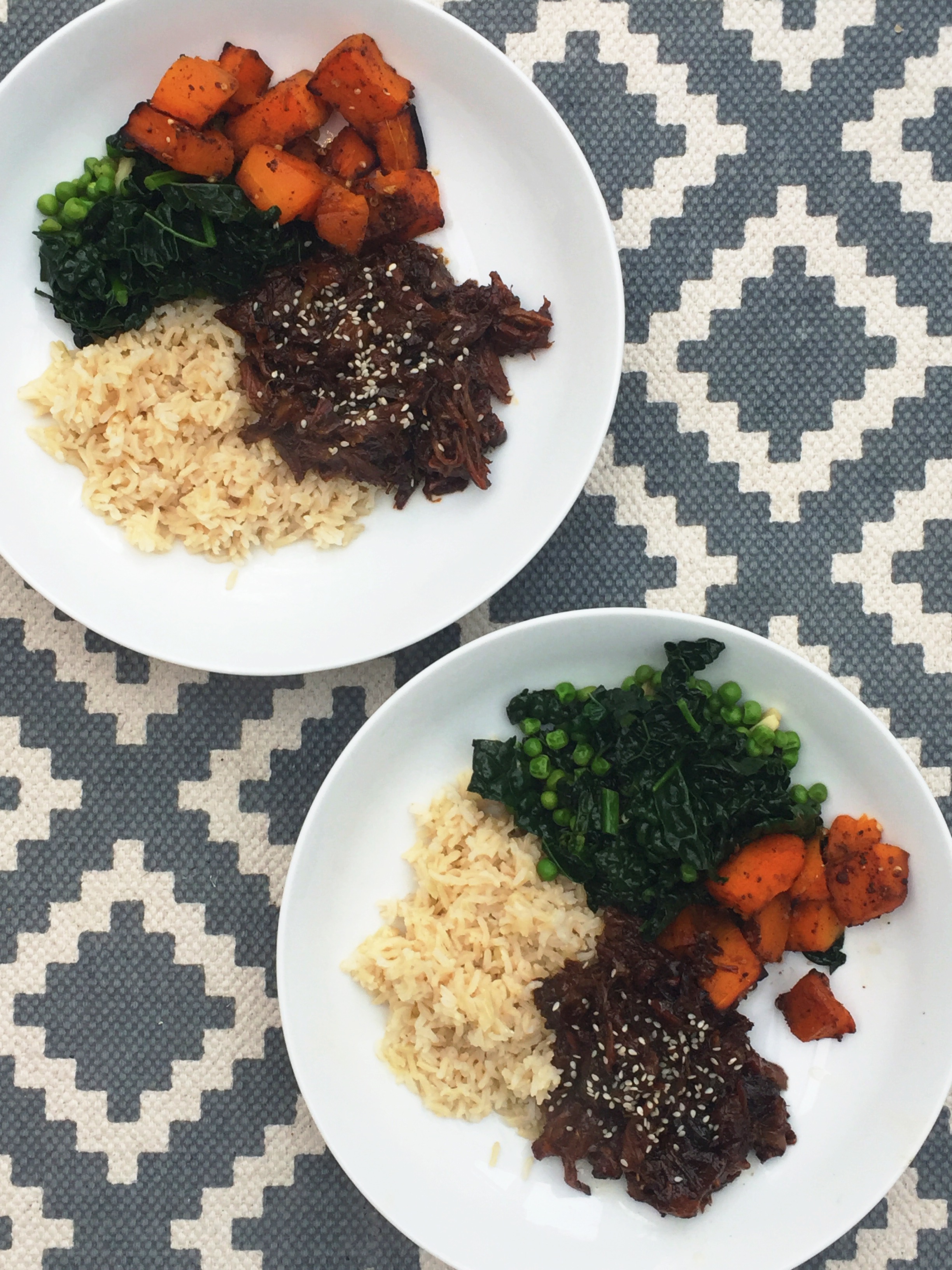
 

I served it with some brown rice, cavolo nero/pea/garlic medley and some roasted butternut squash, which I had coated with some freshly ground Sichuan peppercorns. It’s a complete crowd pleaser with all the family really enjoying it. I am sure it would work equally well in a slow cooker, but I don’t have one so cooked it in the oven in my trusted Le Creuset pot.

It literally cooks itself so you can get on with other things whilst it slowly cooks away. Easy cooking, albeit one that takes time.


Chinese Braised Oxtails

Serves 6

2 tbsp of oil

2.6 kilos oxtails, cleaned and dried

45g ginger, chopped into thin batons

12 garlic cloves, roughly chopped

10 cloves

5 star anise

4 bay leaves

240ml Shaohsing rice wine (you can pick this up in large supermarkets and small Asian grocers)

6 tbsp light soy sauce

4 tbsp dark soy sauce

2 tbsp jaggery or brown sugar

700ml water


  1. Preheat the oven to 150 degrees centigrade.
  2. On your hob, add oil to a large ovenproof pot and then add some of the oxtails and brown all sides before removing and placing on a plate whilst you do the next batch.
  3. In the same pan, keeping the heat low, add the ginger, garlic, cloves, bay leaves and star anise and move around the pan for about a minute before adding the soy sauce, Shaohsing, sugar and water. I do not add any salt as I feel that enough comes from the soy sauces.
  4. Add the oxtails to the pan and coat in the sauce. Add a little more water if necessary and transfer to the oven.
  5. Cook for 5hours 30 minutes, by which time the meat will be falling off the bone. Over the course of the five hours move the oxtails around a few times. If it is looking dry simply add a little more water.
  6. Once it has cooked. Allow to cool before removing the oxtails – keep all the juice – and then using your hands allow the meat to fall off the bones. When all the meat has been removed return it to the pan and then rewarm before cooking and serve with brown rice, roasted butternut squash with some ground Sichuan peppercorns and some greens. Warming food for this cold weather.


SaveSave

SaveSaveSaveSave

SaveSave

SaveSave

SaveSave

SaveSave

SaveSave

SaveSave

SaveSave

SaveSave

SaveSave

SaveSave

SaveSave

SaveSave

SaveSave

SaveSave

SaveSave

SaveSave

SaveSave

SaveSave

SaveSave

SaveSave

SaveSave

SaveSave

SaveSave

SaveSave

SaveSaveSaveSaveSaveSaveSaveSave

SaveSave

SaveSave


Cambodia, VB6 and a review of “My Vegan Travels” by Jackie Kearney

Sunset in Kep, Cambodia

Happy New Year everyone. As you’ve probably gathered from my lack of posts I have been off the grid for a few weeks, which has been bliss – although I was still posting on instagram so do check out my feed if you are interested. My family decided to cheat winter for a few weeks and headed off to Cambodia to see the ancient ruins, visit the capital and then head south to laidback Kep – which was once where the Cambodian royals and wealthy would head to relax and enjoy themselves; before the Khmer Rouge destroyed much of the town.

Angkor Wat Temple complex

Back in London and it has all been a bit of a shock with the cold, blistery weather and getting dark so early in the day. I reluctantly packed away my flip flops and got out my winter boots. January is a funny old month. We all start with such good intentions.

Most friends seem to be attempting a “dry January” and “veganuary” has now been thrown into the mix. Read more about it here if the term is new to you.

Sacred prays in Angkor Wat complex

I can get my head around being more vegetarian, or at least a diet which has a heavy vegetable focus, but vegan……now that involves a lot of thought and planning. Whilst I was pondering veganuary, I read about a rather interesting “diet” or let’s just say “way of life” which, in my view, seemed more attainable and realistic. There is a lot of chat about it in the media at the moment. It is called the VB6 diet. Now don’t get me wrong I do not follow diets and have never been on one, but this VB6 caught my attention.

Lotus flower arrangement in Siem Reap

The diet was given life by New York Times’ lead food writer Mark Bittman and literally means “Vegan Before 6pm”. I am increasingly convinced we all need to eat more vegetables and fruit and less meat and fish. Like Mark however, I am not going to become vegan anytime soon, but a swing of the pendulum towards more of a plant based diet is definitely attractive on many levels. I would prefer to eat meat and fish less often but the quality of what I eat to be high and ultimately know exactly where the produce has come from. By eating it less frequently does allow us to buy better quality meat and fish when we do actually buy it.

Drying out fish on the shores of Tonle Sap – the 4th largest freshwater source of fish in the world

The VB6 diet came about when Mark was told by his doctor that he was overweight, his cholesterol and blood sugar were too high and that intervention by surgery was one possible option. He discussed these findings with another doctor who suggested that becoming vegan was another way that could help him. Knowing that becoming a true vegan was out of the question he decided to adapt and become vegan throughout the day but in the evening from 6pm he could eat what he wanted. It made a lot of sense as he could be sociable in the evening with friends and eat how he always has done. He is also really realistic that sometimes he may deviates from the plan and he readily admits he has milk in his coffee in the morning, but for the most part he continues to be vegan in the day time.

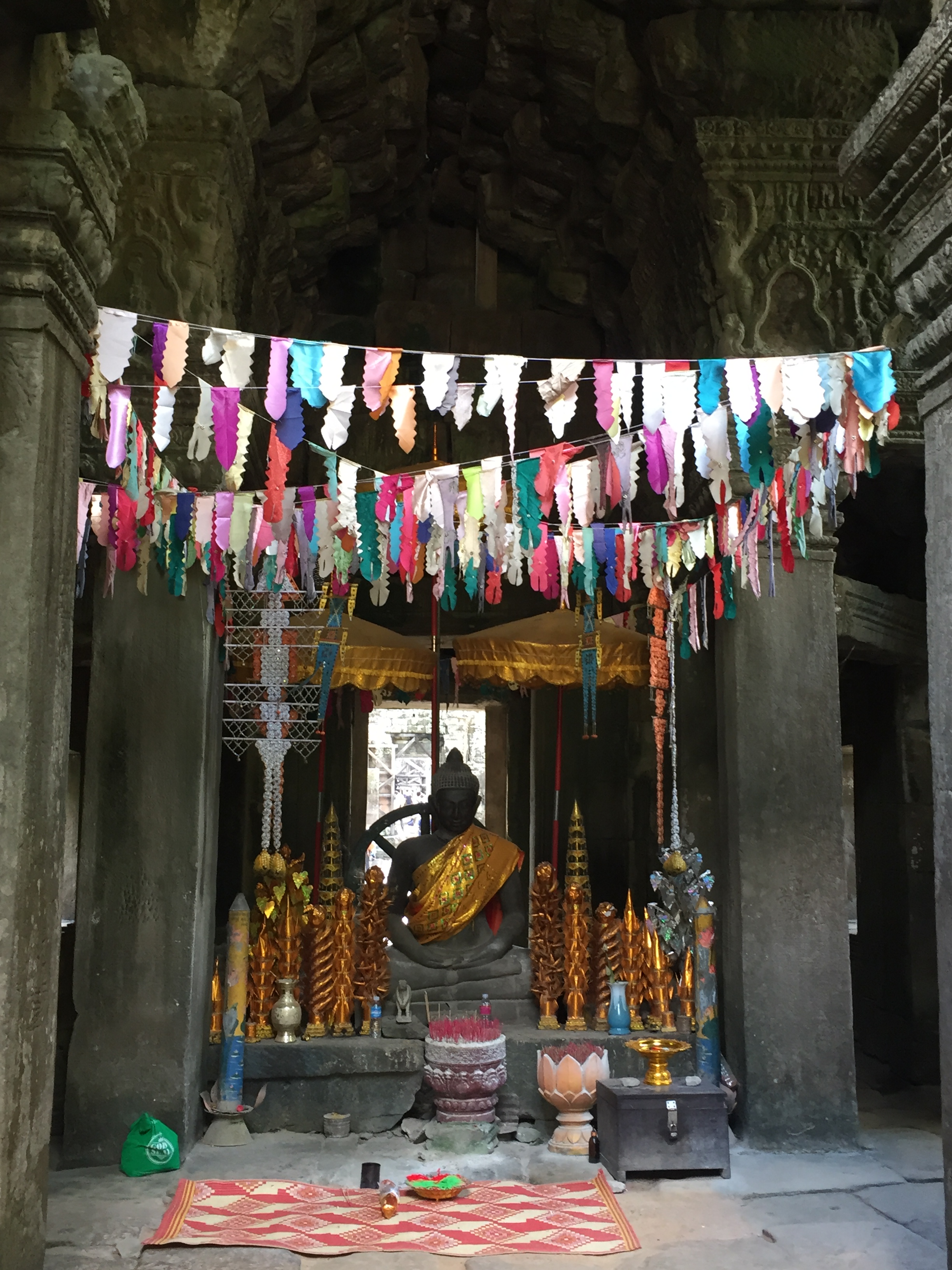
A shrine in Phnom Penh

So has it worked?

Absolutely. He has lost a good amount of weight – 36 pounds then gained a little to plateau to around losing 26 pounds. The diet seems sensible and also not really very restrictive in the grand scheme of things. He talks to the Huffington Post here about the diet. Have a read, it’s really interesting. I definitely plan to pick up a copy of his book and see what he has to say in more detail. You can order it here if you are interested.

Buddhist shrine in Angkor Wat

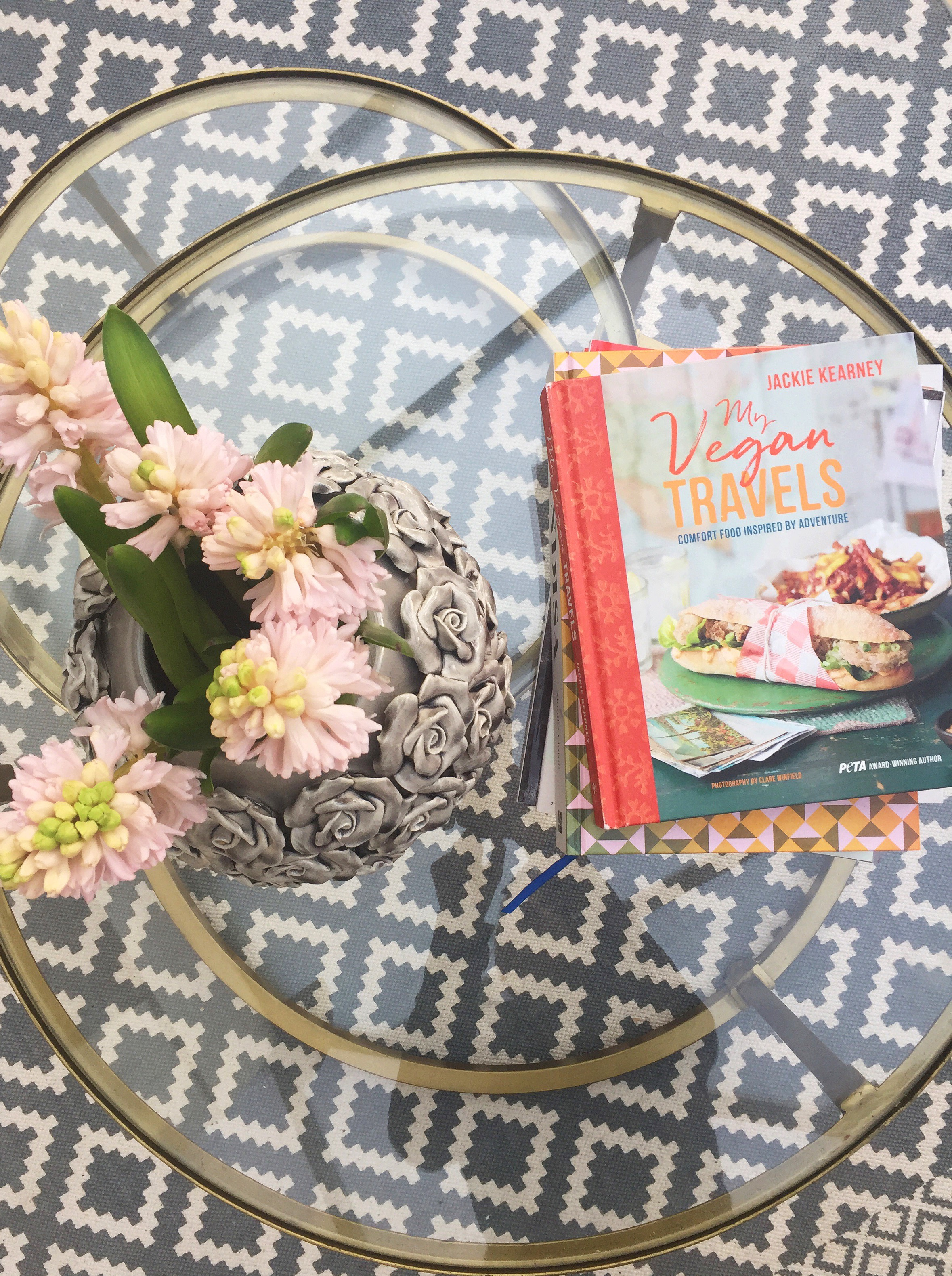
Which brings me to a rather lovely book that was recently sent to me, called “My Vegan Travels – Comfort Food Inspired by Adventure” by Jackie Kearney. I don’t own a vegan cookery book so was not too sure on what to expect. What I discovered is a hugely informative book with recipes that actually sound and look (if the five photos below are anything to go by) delicious.

Photography credit above: Clare Winfield, published by Ryland Peters & Small

At first glance there did seem to be quite a number of ingredients in each recipe but that has never phased me. If you are someone who likes 5 ingredients, then this book is probably not for you. For anyone who has a keen interest in cooking and a willingness to try something new then you will love it. The chapters are slit into “No Place Like Home”, “European Summers”, “Asian Comfort” and “Americana”. I obviously gravitated to the “Asian Comfort”.

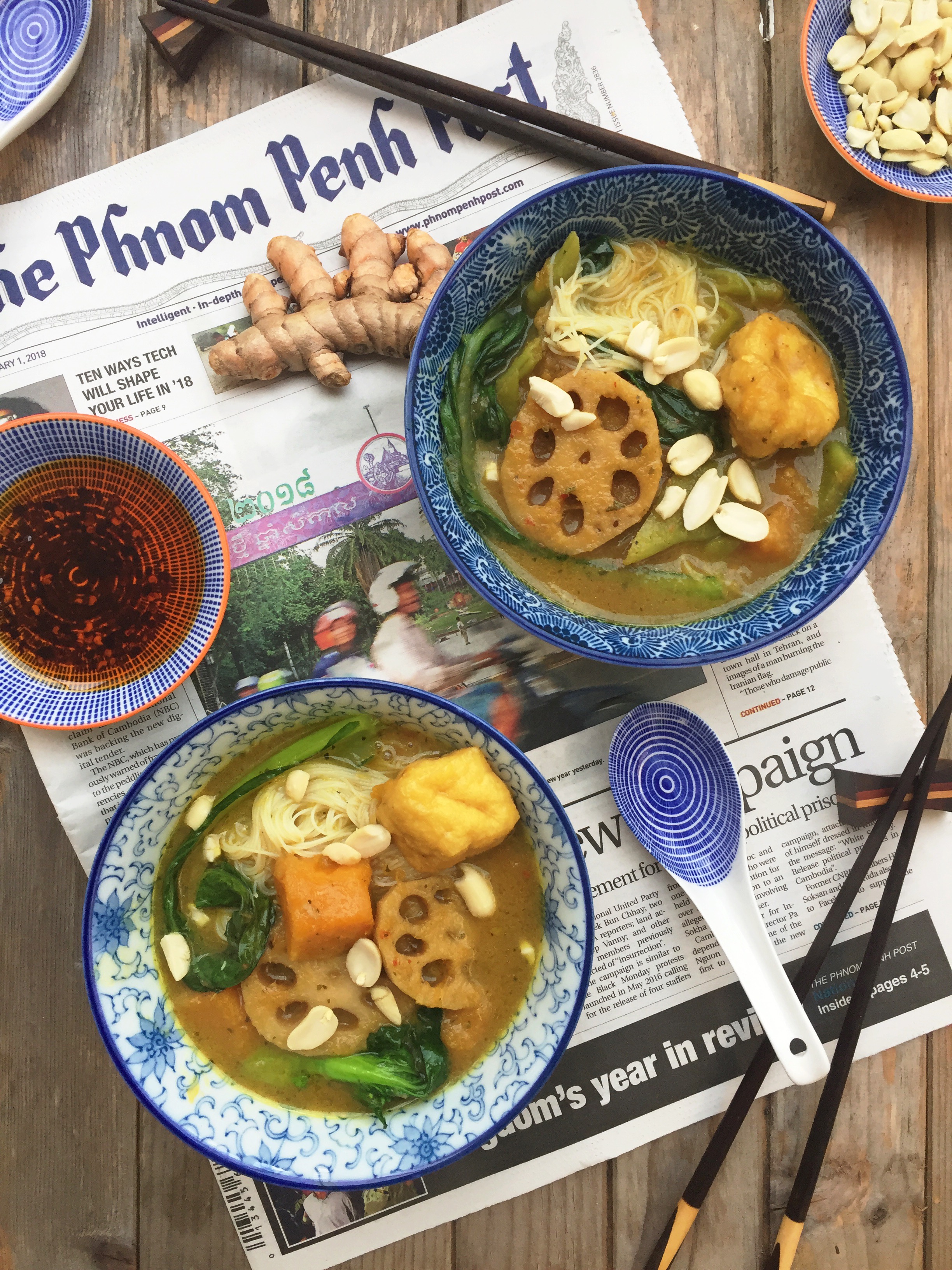
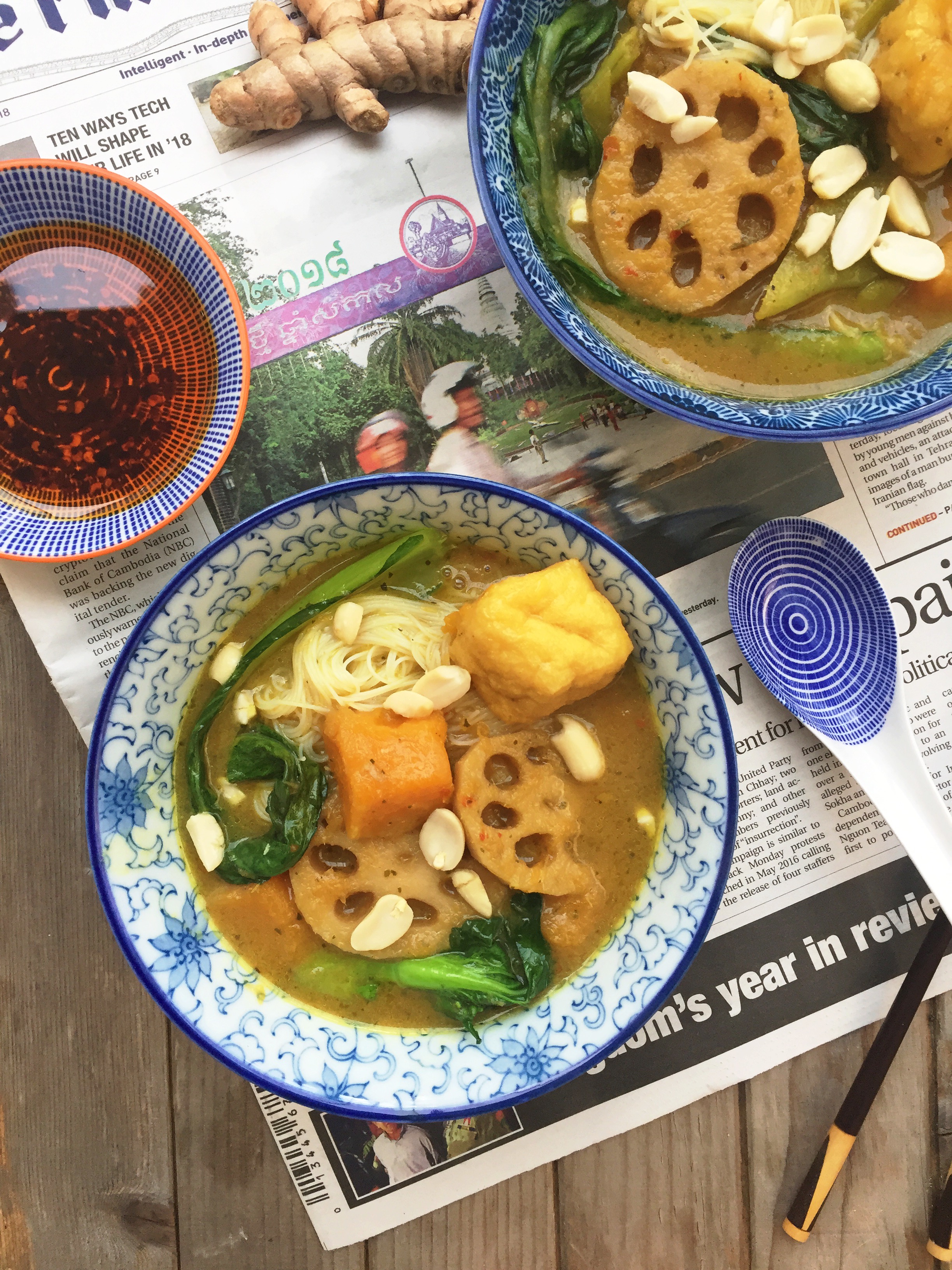
I think that to become full-time vegan does involve a commitment to actually stock your pantry/cupboard/fridge very differently. Leafing though the pages I found a couple of Cambodian recipes. Again I never come across Cambodian recipes so both of them really appealed to me. I opted on one though which I think is a real January mood-pick-me-up. It’s called “Num Banh Chok” – a Cambodian yellow curry with rice noodles and I cannot tell you how AWESOME this recipe is. I gave it to my father-in-law who has been recovering from a bout of flue and he couldn’t stop saying how delicious it was. It is now firmly part of my culinary arsenal and I will be cooking it again and again hence forth. I LOVED it.

I thought that the recipe tied in so well with this post and me having just come back from beautiful Cambodia, as well as the VB6 article, which I had been mulling over.

Now a couple of things to note. I made one change –  I added fried tofu instead of banana flower. I do love banana flower but it is tricky to find, certainly if you live outside London or not near any Vietnamese grocers. I thought it wasn’t very realistic for others to find if I found it tricky. Secondly, the vegetable with holes in it is called “lotus root”. I admit lotus root is also not that easy to find. My usual Asian grocers did not have it so they sent me off to a Chinese grocers that did. So folks aim for Chinese/Thai/Vietnamese/Japanese grocers near you. It is not stocked in your local supermarket. You can buy it online at places like Amazon and Fresh Oriental – here. You can also buy it frozen, but fresh is best if you can locate it. Galangal is not as hard to find, but again you may need to head to your South East Asian grocer.

Once you have the ingredients the recipe is a piece of cake to make. Do try it and let me know. If this recipe is anything to go by I can’t wait to try making the other Cambodian recipe “Khmer croquettes” (photo below) very soon. Don’t they look temptingly moreish.

Photography credit above: Clare Winfield, published by Ryland Peters & Small

Cambodian Yellow Curry with Rice Noodles

adapted from “My Vegan Travels” by Jackie Kearney, published by Ryland, Peters & Small

Serves 4

(1/2= half)

To make the Spice Paste

2 6cm/2 inch thumbs of fresh turmeric (or 1 1/2 tsp powdered)

1/2 tsp paprika

4 garlic cloves

5cm/2 inch thumb of ginger

5cm/2 inch thumb of galangal

4-6 dried red chillies, soaked in boiling water for 10 minutes

1 small red onion

2 lemongrass stalks, ends trimmed and outer layer removed

10 kaffir lime leaves


To make the curry

2 tbs coconut/vegetable oil

900ml/4 cups vegetable stock or water, plus extra if needed

2-3 tbs vegan fish sauce or light soy sauce

1 tbs agave syrup or brown sugar

200g/7oz lotus root, peeled and cut into thick slices (or use cauliflower florets(

1/2 butternut squash, peeled and cubed

150g green or runner beans, trimmed

400ml/14 oz can of coconut milk

1-2 rock salt, to taste

100g/3 1/2oz Chinese leaf, roughly torn ( I used choi sum, but chard, beet leaves also works)

100g fried tofu cubes (I picked this up at Hoo Hing)


To serve

1 packet of thin rice thread noodles, soaked in hot water for 20 minutes

drizzle of chilli oil/chilli (optional)

50g/1/2 cup of roasted peanuts, roughly chopped (optional)


  1. First place your rice noodles in a bowl and cover with hot water and leave whilst you get on with making the dish.
  2. New place all the spice paste ingredients in a blender/food processor and blitz until smooth. Easy hey.
  3. In a large non stick pan/wok, heat the oil and fry the curry paste.
  4. Add the stock/water, vegan fish sauce/light soy sauce and agave nectar/brown sugar and bring to the boil then add the lotus root and squash and simmer for around 8 minutes.
  5. Then add the green/runner beans and simmer for another couple of minutes before adding the coconut milk and more stock if needed; it should be a soupy consistency.
  6. Salt to taste and bring back to the boil. Make sure the butternut squash is soft. The lotus root will not be as soft!
  7. Stir in the choi sum and then remove from the heat, allowing it to wilt completely.
  8. Drain the rice noodles from the water. They should be soft and ready to eat.
  9. Place in a bowl and ladle the curry broth on top. Sprinkle with peanuts and chilli oil if necessary.

More instalments from Cambodia next week.

SaveSave

SaveSave

SaveSave

SaveSave

SaveSaveSaveSave

SaveSave

SaveSave

SaveSave

SaveSave

SaveSave

SaveSave

SaveSave

SaveSave

SaveSave

SaveSave

SaveSave

SaveSave

SaveSave

SaveSave

SaveSave