How are you all surviving with the deluge of rain that we are having in the UK? It’s relentless isn’t it. It’s no wonder that us Brits are renown for talking about the weather non-stop, as it is so pertinent to our very existence. At least I have opted for a relaxation/pastime that does not depend on the weather – swimming outside – rain or shine you are always going to get wet. Followed by a sauna, and you can guarantee that your day will always seem brighter.
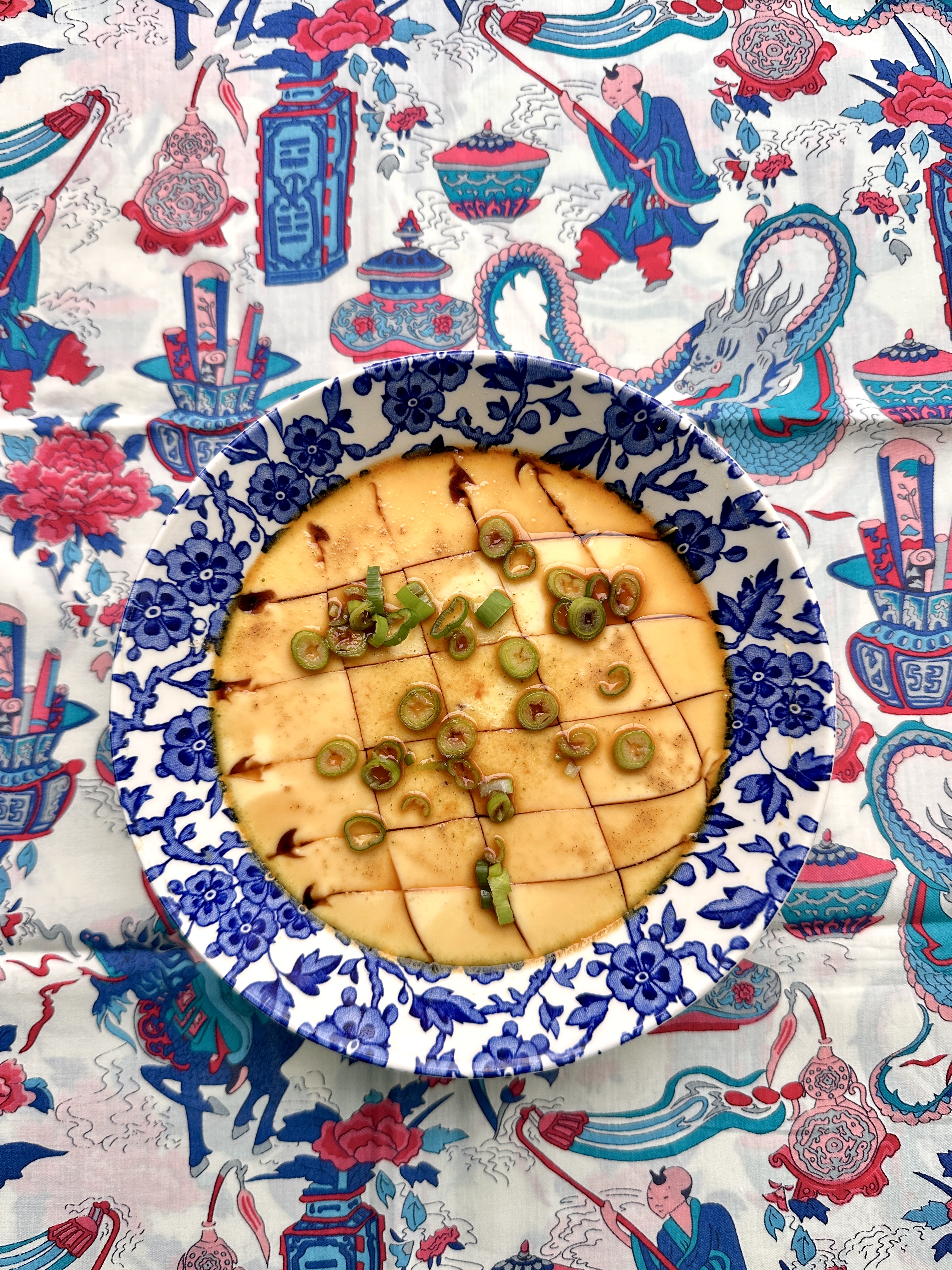
In a bid to be more consistent on here I wanted to kick off the weekend by sharing a super quick and tasty breakfast or lunch recipe for Chinese steamed eggs, which has a wonderful ‘mouthfeel’ to it. Fuchsia Dunlop talks about ‘mouthfeel’ in her excellent book ‘Shark’s Fin and Sichuan Pepper: A Sweet -Sour Memoir of Eating in China‘ – I highly recommend this book if you have not read it. In Chinese cuisine they have a specific word for mouthfeel – ‘kougan’ and this is often considered equal or as important to flavour. The mouthfeel for this dish comes in the form of a smooth and silky sensation – a term known as ‘hua’. The other sensations in the Chinese vocabulary are ‘cui’ – for anything that is crunchy or crispy, ‘Q’ for anything that is chewy, bouncy or rubbery in texture – noodles being a great example and ‘nuo’ for soft and gelatinous dishes – particularly braised dishes.
It takes around 15 minutes to make (including preparation) but there are a few important steps to remember.
1. After whisking the eggs it is important to strain them – this makes sure that the steamed eggs will be completely smooth.
2. The water that you add to the strain eggs need to be the same amount in weight to the eggs. It needs to be warm so I suggest half the amount is boiling water and the other half is cold. I like to add 1/4 cube of chicken or vegetable stock to the water. Give a good stir to allow the stock cube to dissolve, then strain into the whisked eggs.
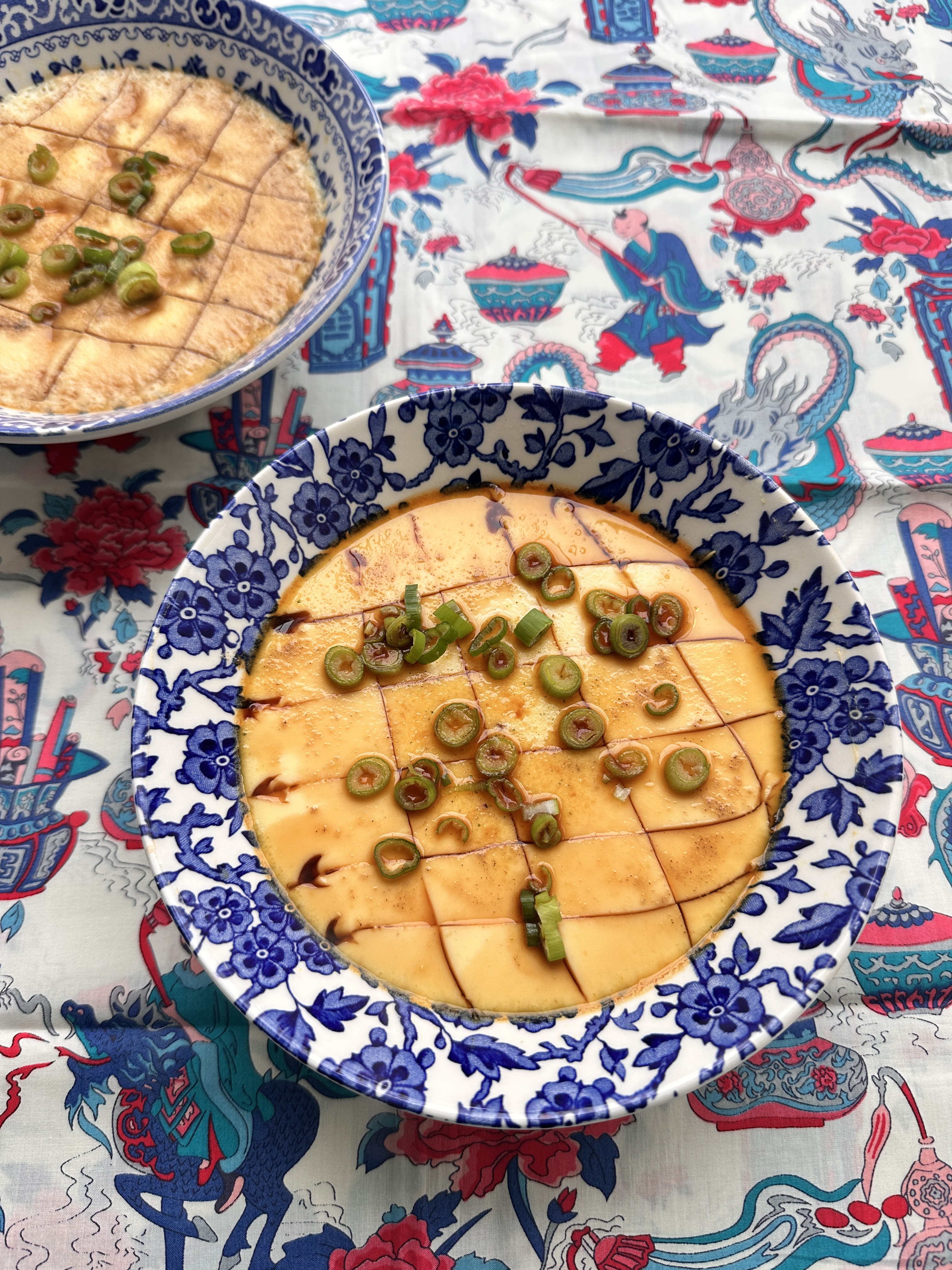
3. Cover the bowl with the egg mixture with some clingfilm with a few little holes in top – this is to prevent in water from the steam dripping into the bowl. (See the photo below which shows the bowl with steamed eggs that had clingfilm in the front of the photo and one without in the back. Without will make the eggs uneven on the surface.
4. Use a sharp knife to make incisions evenly across the top of the steamed eggs, then turn the bowl and make more incisions so that you have a lattice effect.
So below is the recipe in detail.
Chinese Steamed Eggs
Serves 1
2 eggs, whisked
warm water (weight of the eggs + half again 1:1.5 ratio)to get the right temp water mix half boiled water/cold water
1/4 cube of chicken or vegetable stock
1 small spring onion, green part only, finely sliced OR 1-2 chives, finely sliced
1 tsp light or dark soy sauce
1/2 tsp sesame oil
small pinch of white pepper, optional
- Place a bowl on a weighing scales and weight the eggs. Make a note of the weight.
- Whisk the eggs in a bowl and leave to one side.
- Using a separate bowl or measuring jug add the half boiling/half cold so that it is warm and add 1/4 chicken/vegetable stock cube (you don’t want it to be too salty). You are looking for a ratio of 1.5x the weight of the eggs (example: 100ml eggs add 150ml of warm water). Stir well and then add to the bowl with the whisked eggs.
- Sieve the eggs and stock and place into your serving bowl. Remove any bubbles that have come to the surface.
- Add boiling water to the bottom of your steamer. If you don’t have one simply use a pan that is wider than your bowl. Place a cookie cutter or trivet on the bottom of the pan and cover with boiling water so that the water is up to the cutter/trivet. Bring to a rolling boil.
- Cover the serving bowl with cling film and prick it a couple of times with a sharp knife. Gently place in the pan and cover with a lid with a small hole in the top to allow the steam to escape.
- Turn the heat down to medium/low and allow to steam the eggs for 9 minutes. Turn off the heat and leave to sit for a further 3 minutes.
- You will be able to see that the eggs are nicely steamed and will jiggle a little if you give the pan a little tap. (see the jiggle below)
- Be careful removing from the steamer. Remove the clingfilm and then use a sharp knife to make a series of straight incisions along the top and then turn by 90 degrees and make more incisions so that you have a diamond lattice effect.
- Spoon the soy sauce and sesame oil on top, followed by a pinch of white pepper and spring onions or chives and dive in and enjoy the ‘kougan’ and comforting taste. I love it and hope you will too.
Please note:I don’t add any salt to the eggs to begin with as I find the chicken/veg stock and soy sauce adds enough salt to the dish.
Have a great weekend everyone. Wrap up warm and stay dry.
Torie
 CHILLI & MINT