Christmas Check List

I’m back. My computer has been on the blink, coupled with the fact that Mr B, big A and little Z have been frolicking in the snow in Bavaria, which has made it harder than usual to blog.

It’s Christmas eve and the troops arrive at 2pm. I am hosting this year so it’s going to be full on. Thankfully Mr B is a very able pair of hands in the kitchen too, so together we’ll keep the food preparation flowing and the mulled wine topped up in everyones glasses. Am I prepared?

Presents wrapped – check

Food all delivered – check

Christmas foliage scattered around the house – check

Sufficient beverages to appeal to everyone – check

Carols on the ipod to the ready – check

Recipes all lined up – check.

I have had a few requests asking what I am cooking so here goes:

Christmas eve 

Starter: A medley of Thai starters -spring rolls, prawn toast,dim sum.

Main: Seabass with a chilli and ginger baste – (Daddy if you are reading this I promise there will not be too much chilli!) This is a recipe from my recent course at Billingsgate market fish course. I will post it up in the new year in more detail.

Pudding: a surprise (I am still working on this one)

Christmas Day

 Lunch-

Starter: smoked salmon

Main: Turkey, stuffing balls made of pork, fresh herbs and apple, sprouts with chestnuts and pancetta, bread sauce, roast potatoes,  parsnips, caramelized carrots, red cabbage

Pudding: Christmas pudding, mince pies, Bill Granger’s vanilla-poached apricots and cheeses

Supper – (if people are still hungry)

Bill Granger’s puy lentil soup, game pie, cheeses, fresh salad

followed by christmas cake and fruit

Boxing Day

Brunch: Eggs Florentine with my hollandaise sauce on toasted muffins

Looooooooooooooonnnnnnnnnnnnnnngggggggggggggg WALK

Supper:

Starter – Mushrooms with fresh herbs on toast

Main – Christmas ham with potatoes and my homemade chutney and piccalilli (recipe up on my site soon I promise)

Pudding – Leftovers from Christmas day

27th

Breakfast – Mexican toast (think French toast Mexican style!)

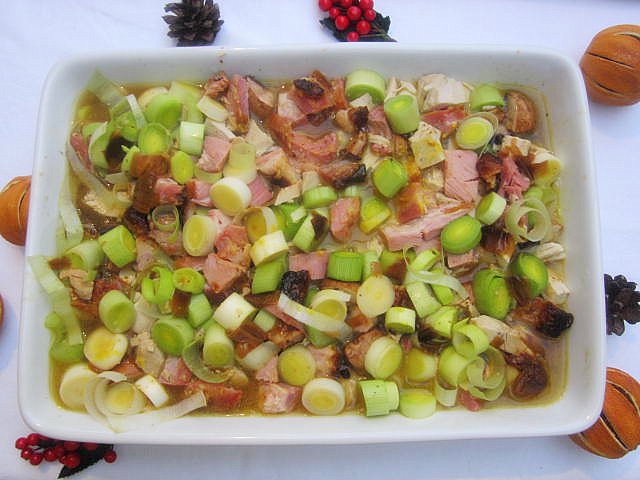
Lunch – Ham, Turkey and Leek Pie – recipe from lovefoodhatewaste.

The troops leave.

Have a wonderful christmas everyone and I’ll be back very soon with more recipes and photos.


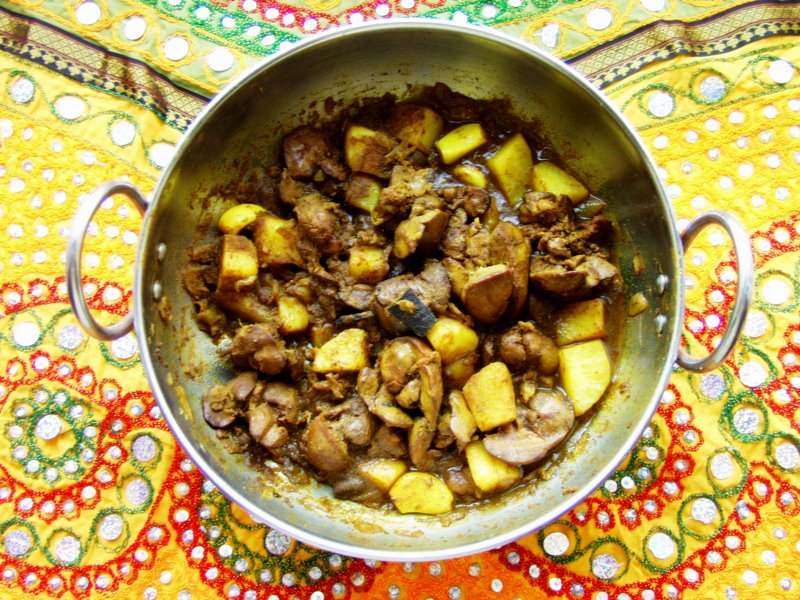
A special curry for REAL foodies

I’ve been procrastinating about sharing this blog recipe with you all for some time now as I know that if I mention three certain words I would guess that possibly 80% of you will just reach for your mouse or control pad and head straight out of this blog entry, quicker than you can say…….

CHICKEN

LIVER

CURRY

Ahhhhhh I said it. Is anyone still there?

Anyone?

Anyone?

Phew at least there are still a few of you still curious to find out more.

I think our fear and loathing of liver stems largely from our school days where it was rather unceremoniously dumped on our plates with some watery greens and some white looking mush that vaguely resembled mashed potato. It wasn’t great, I admit – and thats coming from someone who actually liked her school food.

My opinion of liver changed completely when my mother-in-law started cooking chicken liver curry for me. It completely took me by surprise, so much so that I thought that I would try and convert a few of you. A real bonus as well is that chicken livers are so cheap to buy that even if you give this a shot once and you absolutely loathe it (which you won’t) then you are not wasting loads of money. It’s not as if I am asking you to try making lobster thermidor!

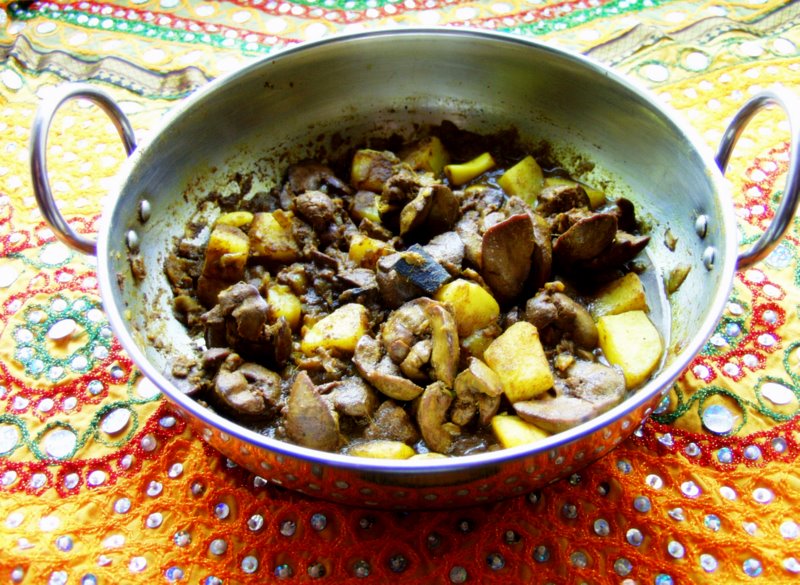
Chicken Liver Curry

Serves 4

Preparation time: 10 minutes

Cooking time: 35 minutes

1 large potato, diced

500g chicken livers

1 large onion, chopped

2 inch ginger, grated

2 small fresh red or green chilli (optional), chopped in two

1 large tsp of ground turmeric

1 tsp of ground coriander

1 tsp of ground cumin

1 tsp of salt

5 garlic cloves, kept whole

1 cinnamon stick, broken up

3 cardamom, opened up slightly

1 small tsp of vindaloo curry paste

100 ml water

a few glugs of olive oil

1. Peel and dice a large potato and then fry it gently in some olive oil for 5 minutes, stirring occasionally so that the cubes don’t get stuck at the bottom of your saucepan. Make sure that you are using a pan that is deep enough to hold all the ingredients and some water. After 5 minutes spoon out the potatoes and put to one side.

2. Fry the onions in the pan that the potatoes were in. You may need to add a little more oil at this stage.  After 6 minutes the onions should begin to be turning brown. At this stage add the grated ginger (and fresh chillies if you are using them – I tend not to for this curry) and stir into the onions.

3. Add the chicken livers and let them turn a whiter colour. Do not add any further ingredients until they have become paler in appearance, this should not take longer than 10 minutes. If you are cooking with rice, this is the perfect time to start boiling your rice so that the curry and rice are ready around the same time.

4. Now add the ground turmeric, ground cumin, ground coriander, salt, garlic and the potato to the chicken livers. Stir well, but gently, so that all the spices are mixed up evenly.

5. Add the broken up cinnamon stick, cardamom and vindaloo curry paste. Gently add a little boiling water – I tend to add the water in two stages of 50ml each. You may find that you do not need this much so add a little at a time. It will help soften the potatoes and garlic.

Serve with rice and dal.  I really think you will be pleasantly surprised. Let me know how you get on.


Birthday Celebrations


It was big A’s 6th birthday on Friday. I can’t believe the years have flashed by so fast. It feels like only yesterday that she was born. Without doubt the BEST day of my entire life (and the birth of little Z, of course). It changes your life so dramatically and the amount of love that pours from you to your offspring brings an indescribable warmth and happiness. Its sounds very cheesy I know, but I promise its true.  Even friends who swore they weren’t at all maternal have their first baby and then BOOM, it hits them like a bolt out of the blue and they too become completely and utterly smitten for their newborn. Our bodies work in mysterious ways. I have very fond memories of the day both my daughters were born.

As is tradition at my daughter’s school, the birthday boy or girl takes in cakes for the class to share after lunch. So yesterday I baked away using adorable Moomin cupcake cases designed and created by my favourite cake case accessory company Kala:s Farm, who are based in Sweden.

To hear how I came across this fabulous little company to begin with click here.

Anyway according to big A the chocolate cakes, with a simple butter icing covered in lilac, gold, pink and green edible glitter, were a huge hit and all her friends loved the moomin cake cases.

Chocolate Cupcakes with Butter Icing 

serves 24 hungry children 

180 degrees for 25 minutes

Sponge

225g butter/soft margarine

225g caster sugar

225g self raising flour

4 eggs

2 tsp baking powder

2 tbsp cocoa powder

3 tbsp of boiling water

Butter Icing

225g butter

35g cocoa powder

375g icing sugar, sifted

little milk

1. Mix the butter (I use half butter half soft margarine), caster sugar, self raising flour, baking powder and eggs together in a blender. Equally you can do this manually in a large bowl with a wooden spoon.

2. Put the boiling water with the cocoa powder and stir until it is no longer lumpy. Leave to cool and then add to the sponge mix.

3. Place two teaspoons of cake mixture into each cupcake case, if you are using the same size cases as pictured here.

4. Place on a tray in a preheated oven at 180 degrees for 25 minutes. When they are cooked leave to cool completely before icing.

5. To make the butter icing literally mix all the ingredients together except the milk, which is best to add in gradually to reach the consistency you require. You will find that you will need very little – possibly one or two teaspoons.

6. Sprinkle with edible glitter and serve to an audience of delighted children.


Chicken Noodle Soup – fuel for the festive season


I don’t know about you, but if your household is anything like mine, we ALWAYS end up with a little bit of chicken leftover after a sunday roast. The amount though is not enough to have a full on meal again, but there is enough to make a meal from it………………if you get my drift.

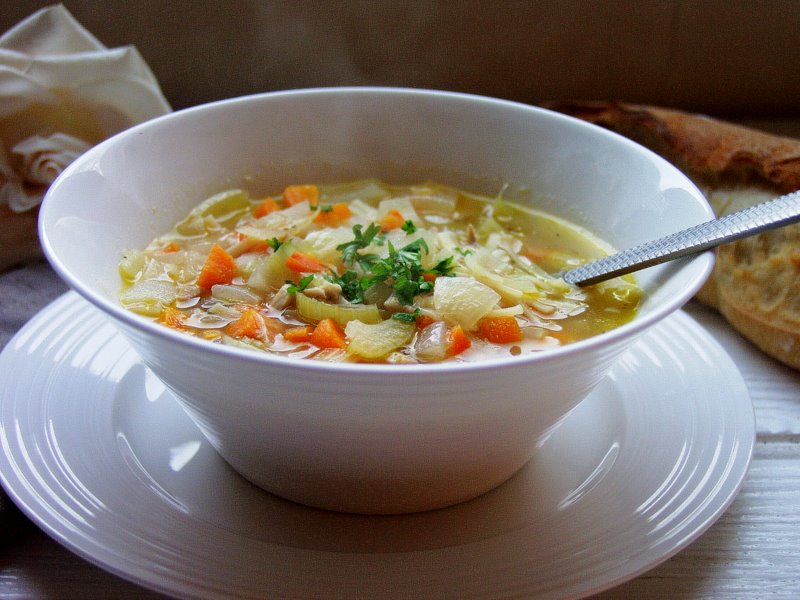
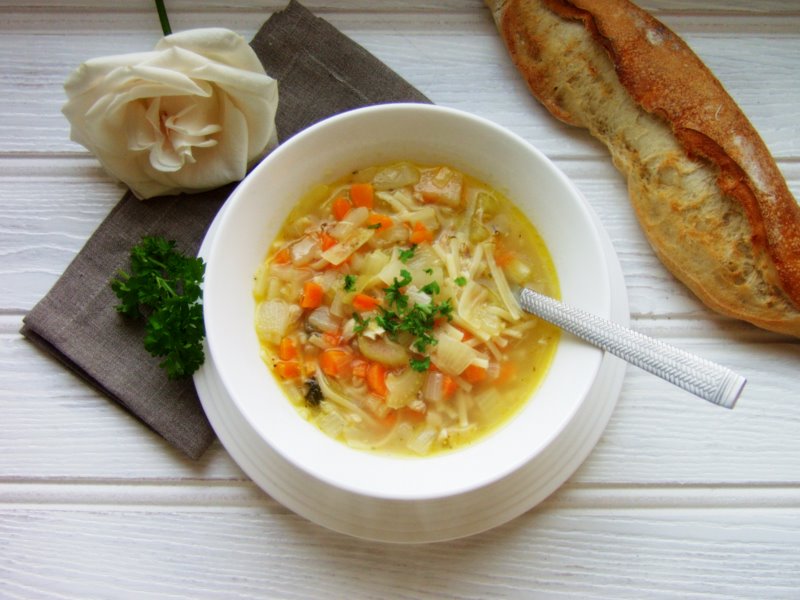
One dish which is great for leftover chicken (or by all means buy a couple of chicken breasts and create if from scratch) is ‘chicken noodle soup’, which accompanied with a fresh baguette to dunk in the juice, certainly hits the spot. Its a great Monday night supper and takes no time to prepare and is a feast for all the family to enjoy and share.

As November fades away and Advent waits eagerly in the wings, I am sure that some good old fashioned comfort food like chicken noodle soup will help us all get through those Christmas engagements that we eagerly accepted. It’s only when we have our diaries in front of us that it begins to dawn on us that perhaps we should have accepted less and had a night in. So, one and all, let us prepare our bodies, minds and spirits for the great social quest that lies before us: the month of December.

Do you have a favourite comfort recipe that warms your cockles and boosts your immune system?

Let the good times roll.

Chicken Noodle Soup

Serves 4-6

100g carrots, peeled and cut into small cubes

1 large onion, chopped finely

1 tsp of crushed garlic

2 celery stalks, chopped finely

glug of olive oil

1 tsp of rock salt

fresh black pepper

fresh sage

fresh parsley

2 tsp dried herbes de Provence

2 bay leaves

half a lemon

1 tsp of vegetable bouillon

1 left-over chicken/2 chicken breasts, chopped into bite sized portions/strips

handful of dried spaghetti or linguine

fresh baguette for dunking

1. Remove all the leftover meat from the chicken and cut into small bite sized mouthfuls and place to one side. Put the remaining carcass in a casserole pot and add the herbes de provence and bay leaves and cover with boiling water.  Simmer gently for 30 minutes and then strain off the liquid. This will become the basis for your soup. Discard the remains of the chicken. If you do not have a leftover chicken to make stock I find bouillon vegetable stock works wonders.

2. Using the same casserole pan, add a glug of olive oil – basically enough so that it pretty much covers the bottom of your pan. Add the onion and let them sweat on a low heat, stirring occasionally. After 5 minutes, add the garlic, carrots and celery stalks and continue to stir. ONLY if you are using fresh boneless chicken breasts – add them at this stage. Place the lid on the casserole pot so that the vegetables really get to sweat. After 3-4 minutes, add a couple of torn sage leaves, rock salt and a good amount of fresh black pepper.

3. Add the chicken stock, which should be between 3-4 pints. Put in a small amount at a time and continue to add until you have the consistency that you like for your soup. Please note, however, that when you add the dried pasta it will soak up a fair amount of the stock, so you need to put in a little more than you think. You will not need more than 4 pints though altogether. Even though I made fresh stock I often like to add a little vegetable bouillon (stock cube), to give it an extra boost. Apologies to you purists out there!

4. Break a handful of dried spaghetti/linguine into the pot. Keep the lengths around 3cm in length. Add half a lemon, squeeze it as you add it to the soup. Stir the soup and gently simmer for 10 minutes or until the pasta is cooked. In the final few minutes add the chicken to the soup and mix all the ingredients together.

5. Serve piping hot in bowls with a scattering of freshly chopped parsley and a baguette for dunking.


Kashmir Chutney – the perfect winter gift

There is always something rather heartwarming and homely when a friend surprises you with a gift of homemade chutney, jelly, relish or pickles. It doesn’t often happen, but when it does I love it all the more, (than a bought one that is!) as I know how much effort, love and precious time has gone into preparing it. I am wondering whether chutney making is a pastime that is more popular for those who live in the countryside than the city? Maybe the majority of city dwellers are busying themselves with the hustle, bustle and grind of daily life that the thought of chutney making just doesn’t appeal. Well I for one am bucking that trend!

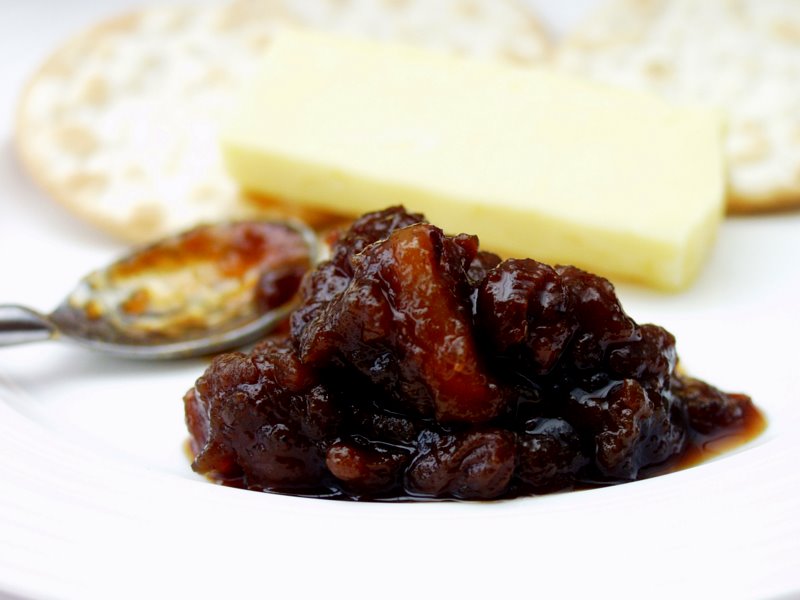
I have always been told that you are meant to give gifts that you would ultimately like to receive yourself, so I decided for this blog I would share the recipe of one of my favourite chutneys, known as Kashmir chutney. If they are properly prepared and stored they last up to a year, so I thought I would make a batch ready for gifts over the winter season. I plan to share a few more with you before Christmas, but thought that Kashmir chutney was the perfect one to get you into mood for chutney making.

They are perfect for bringing out at family gatherings such as Thanksgiving and Christmas and as well as cheese, they work wonderfully with hams, and grilled spicy sausages. I find that such condiments really lift a dish and give them that extra satisfying dimension. I hope that you agree.

The jars I use are not uniformly similar. They range from the traditional kilner jars, to the reused old jam jars. I use waxed discs and cellophane covers for some of the jars, but to point me in the right direction I really love the book by Catherine Atkinson and Maggie Mayhew called ‘The Complete Book of Preserves & Pickles’. They cover everything you need to know as well as a wide range of wonderful recipes. Its also a good idea to get hold of some labels so that you can mark the date and type of chutney;  some chutneys can last unopened for up to 2 years.  For all the equipment you need I order from the ‘Jam Jar Shop‘, which are efficient and offer a speedy delivery service.

Kashmir Chutney

Sourced from ‘The Complete Book of Preserves & Pickles’ 

Makes about 2.75kg (approx 8 jars, depending on size)

1kg green eating apples

15g of garlic cloves

1 litre/4 cups of malt vinegar

450g stoneless dates

120g preserved stem ginger

450g raisins

450g soft brown sugar (I usually use light but this time I used dark)

1/2 tsp of cayenne pepper

2 tbsp salt

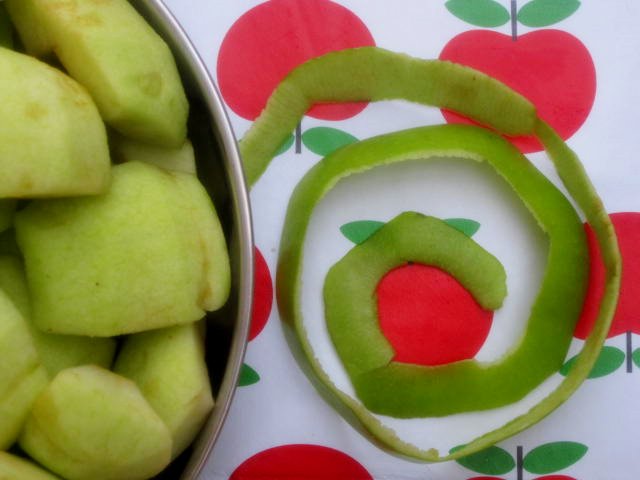
1. Peel the apples, quarter them and remove the cores. Then chop them into bite sized chunks. Peel the garlic and chop.

2. In a pan pour the malt vinegar to cover the garlic and apples, and bring to the boil for 10 minutes.

3. Meanwhile, chop the dates and ginger and then add them, along with all the other ingredients to the pan and stir. Simmer for 45 minutes.

4. Transfer the contents of the pan into warmed sterilized jars and place a waxed disc on top. Wipe clean any mess that has spilled around the top of the jars and then seal immediately. Rest in a cool place and leave ideally for a minimum of a month before opening.


Fishing for Inspiration

Billingsgate Fish Market

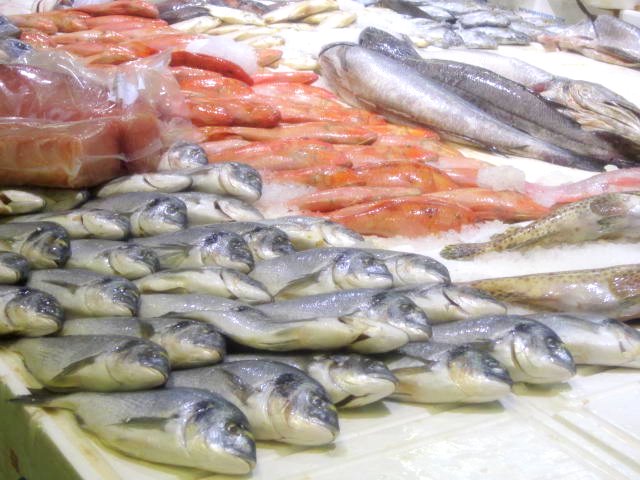
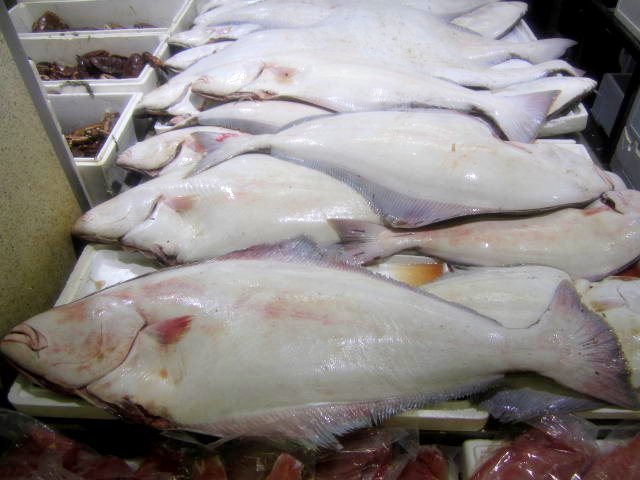
Mr B and I are buzzing. Yesterday we paid a visit to the oldest fish market in the UK, known as Billingsgate Fish Market. Its been operating for the past 800 years in Londinium and although the sites have changed over the centuries, the buzz and frenetic activity of buying and selling has no doubt remained the same.

Billingsgate Fish Market

Billingsgate Fish Market

As well as serving the fishmongers, caterers and restaurants around the country the general public are also welcome to come and buy an incredible variety of fish and shell fish at good honest prices – 50p an oyster anyone?

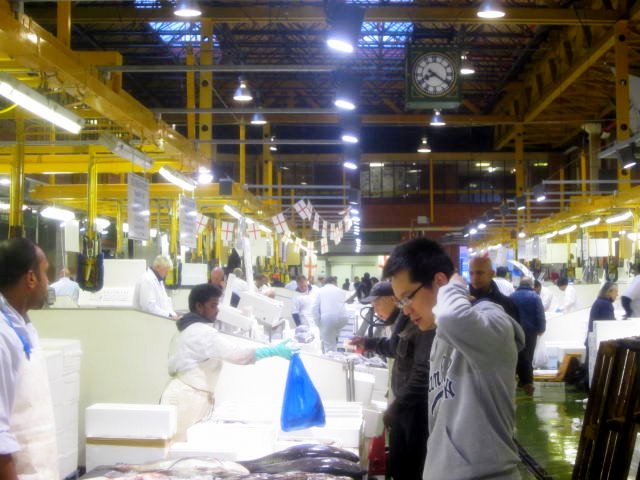
Its open from tuesday through to saturday from 5am until 8.30am – although the fish may have all been sold by 8am so its best to be there early. You’ll notice in the photo below the time was 8.20am on a Saturday and there were still some punters able to buy a good selection of fish. In the week though I hear the fish is all sold by 8am.

Billingsgate Fish Market

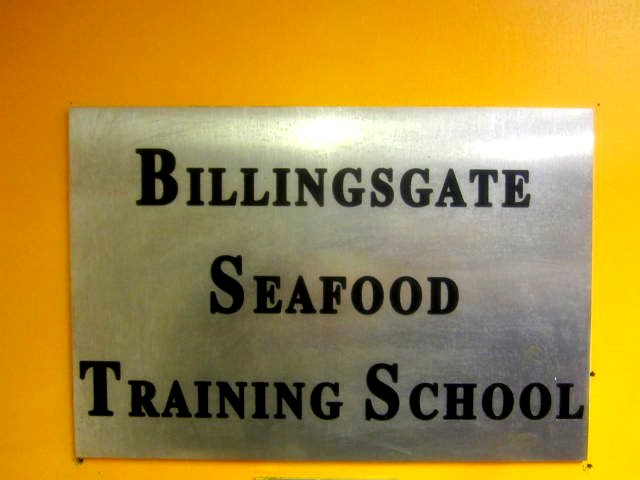
Situated just above the fish market is the Billingsgate Seafood Training School, which was set up 12 years ago as a charity to help educate the children from the local schools about fish and seafood and the benefits of eating it for a balanced diet. I should note that the market it right next door to Canary Wharf, which is one of the key financial districts in London. The local neighbourhoods however are much less affluent than this financial district, and it is these neighbourhoods that the training school was originally set up to benefit. In addition to introducing seafood to children, the school also offers a wide range of courses for adults who want to improve their fish skills. It was one of these courses that Mr B and I signed ourselves up for.

Billingsgate Seafood Training School

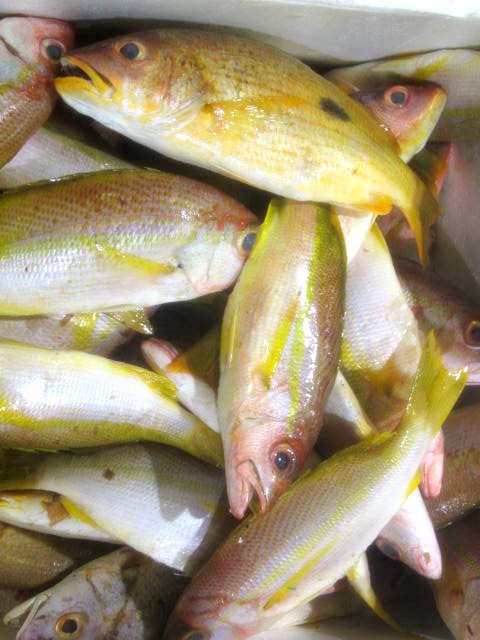
For six hours Mr B and I were treated to a range of informative demonstrations and tastings, followed by some hands on knife skills, where we got to gut squid, pocket plaice, fillet gilt-head bream and prepare gurnard. It was very satisfying to be able to actually fillet and gut your own fish. We learned so much that I only hope that we can retain it all and build upon it going forward. Like anything in life it requires practice, so Mr B and I are going to be eating even more fish going forward so that we can practice and finesse our new skills.

Here are a couple of new things we learned during the course:

1. You only need to cook squid for 30 seconds in a pan with a little hot oil. We had always cooked it for a few minutes, but it really is not necessary and tastes so much better if you fry it for a shorter amount of time. Equally you can braise it in an low oven for 1 hour 30 minutes – I have yet to ever try this. I’d love to hear from anyone who has a good braising recipe for squid!

2. Only fish that is going off smells fishy. Fish that is fresh has very little aroma, hence when we were in the market you could hardly smell fish.

3. When you buy squid in the supermarket it is often brilliant white in colour. This is because it has been submerged in water to give it more of a glow white look. Squid has more of a grey tinge when it is bought straight from the fisherman/market.

4. Fish requires no more than 10-12 minutes cooking time in a fan oven 200C, non-fan oven 210C  or gas mark 7.

5. When making fish stock do not cook the fishbones, head etc for more that 30 minutes as it may begin to taste bitter.

6. Avoid fish with cloudy and sunken eyes as it indicates they are losing condition. Buy fish that has bright eyes and a clear conea.

Billingsgate Fish Market

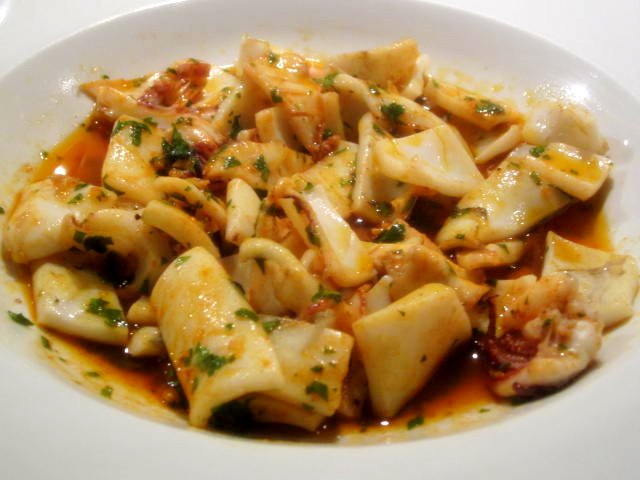
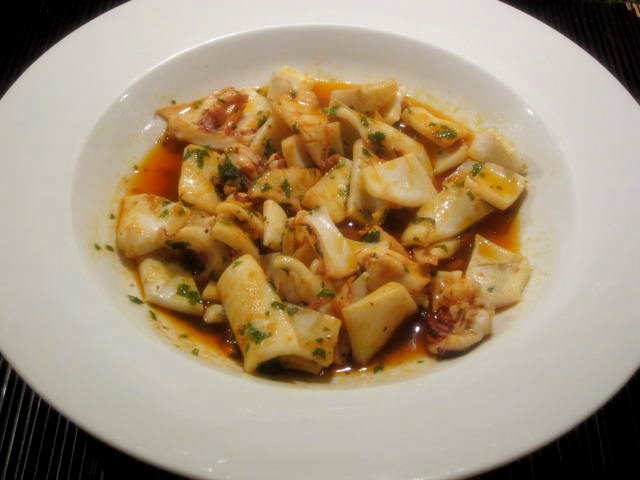
Each student was given a recipe booklet of the recipes we sampled during the course. We also all left with a huge bag of the fish that we had prepared during the course. So when Mr B and I arrived home we decided to prepare the marinated squid salad, which we had tried for breakfast in fact, earlier in the day. We were expecting a guest for dinner so thought that it would be a good starter to nibble on. I urge you to try this dish as it is absolutely divine and super easy to make.

Marinated Squid Salad

Marinated Squid Salad

Billingsgate Seafood Training School recipe

Serves 4

300g small squid (or cuttlefish or baby octopus)

7 tbsp olive oil

2 tbsp white wine vinegar

3 cloves of garlic, crushed

1 tsp of smoked paprika (non smoked is also fine)

salt and freshly ground pepper

handful of flat leaf parsley, finely chopped

1. Cut the squid into pieces, strips or rings or both, whatever takes your fancy.

2. Place 1 tbsp of olive oil in a frying pan and when the oil is hot (medium heat) add the squid and fry for about 30 seconds. Remove from the heat and transfer to a serving bowl.

3. Mix the remaining oil with the vinegar, garlic, smoked paprika, parsley, salt and pepper – stir the ingredients together thoroughly. Pour over the squid and mix together well. Leave to marinate for 20-30 minutes. Serve with fresh crusty bread and a green salad.

Marinated Squid Salad

So would we return for another course at Billingsgate? ABSOLUTELY. We can’t wait to return to do a full day course and learn more about preparing and cooking other fish and shell fish. Oh yes, I also now have the Billingsgate Market Cookbook on my christmas wish list!


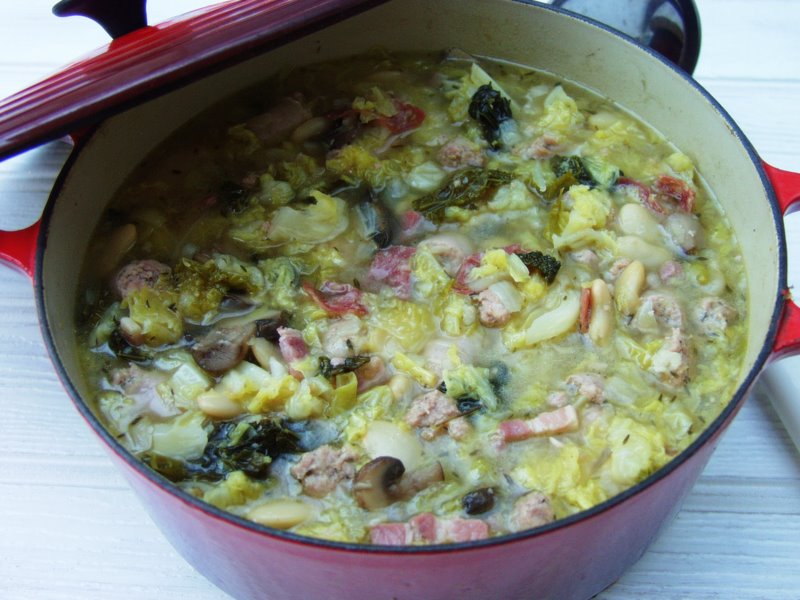
Caldo Verde

Caldo Verde

Caldo verde is otherwise known as Portuguese green soup, or broth, and whilst you can simply cook it as a soup, I tend to make more of a meal out of it and give it centre stage.  Its perfect for autumn or winter as it is satisfyingly hearty and filling. I deviate slightly from the traditional recipe of onion, garlic, cavolo nero/kale and potatoes by also adding 240g (basically one tin) of butter beans and spicy chorizo. It’s satistfyingly easy to make and guaranteed to be a crowd pleaser. If you are passionate, as I am, about stews and soups then this one will really appeal to you. I particularly like to add spicy chorizo to give it that extra kick, but if you cannot find the spicy variety you can simply use normal chorizo and add a sprinkling of paprika on the top before serving.

Caldo Verde

Serves 6-8

400g of spicy chorizo, chopped into slices

700g potatoes, peeled and diced

2 onions, chopped

4 garlic, chopped

200g cavolo nero/kale/greens, thinly chopped

1-2 pints chicken stock (depending on how thick you want the soup)

240g butter beans

3 bay leaves

4 tbs olive oil

pepper and salt, to taste

paprika, pinch on each serving (optional)

1. Place the olive oil in a deep pan – I use my Le Creuset casserole pot – and when it is hot add the chopped onion, on a low heat for 5 minutes. Then add the chopped garlic and stir into the onions.

2.  When the onions have become translucent add the spicy chorizo, which will begin to create a lovely red hue to the onions as the spicy chorizo begins to mix with the onions. Stir for a couple of minutes.

3. Add the diced potato, butter beans (tinned variety) and bay leaves and thoroughly mix into the onion, garlic and chorizo. Add 1 pint of chicken stock and let the soup simmer for approximately 10-15 minutes, by which time the potatoes should be soft.

4. Add the finely chopped greens. I use cavolo nero, which is black kale, but any type of greens works equally well. You may find you need to add some more stock at this stage, depending on how soupy you like your soup.

5. Season with pepper and salt to taste.

Serve piping hot with crusty bread on the side.

Caldo Verde


Stuffed Tomatoes, but no stew!

Autumn is definitely here, although we had a few false starts over the last couple of weeks. The bronzed autumn leaves are scattered all over the grass and the winds are definitely picking up, a cold chill is certainly in the air. The deer in Richmond park have started rutting, which is always a sign that autumn has arrived. So it’s time for the winter coats to be dug out of the closet, dear readers, and the scarves to make an appearance.

With the new season brings a host of new and exciting produce to our tables. Root vegetables, greens, game, and fruits such as succulent figs. Its comfort food time, stews and casseroles and filling soups – I am getting excited thinking about the culinary possibilities in the months ahead.  So let us go forth and seek out the autumn offerings.  I hope to inspire and motivate you all into cooking some recipes you may have not tried before, that will warm your cockles and lift your spirits as the nights draw in.

This recipe is perfect for a light autumn supper or lunch and can be found in Clarissa Dickson Wright’s ‘Potty! Clarissa’s One Pot Cookbook’. It’s warming and hearty and if you omit the anchovy fillets then it is ideal also for all you vegetarians and vegans out there. It can be eaten on its own or with a piece of grilled fish on the side or in my case I ate it with some asparagus and melted butter!

Stuffed Tomatoes 

sourced from Clarissa Dickson Wright – ‘Potty! Clarissa’s One Pot Cookbook’

Serves 4

8 large tomatoes

125g couscous

1 tbsp olive oil

100g stale country loaf

2 garlic cloves, finely chopped

bunch of spring onions, finely chopped

60g anchovy fillets in olive oil, mashed (optional)

30 g sultanas

handful of chopped parsley

1. Add boiling water to the couscous, as instructed on the packet. I normally use standard couscous, but for a change I used giant couscous and it worked a treat.  When it is ‘cooked’, if you are using normal sized couscous, add one tablespoon of olive oil to the couscous and stir it in with a fork to loosen it up.

2. Heat the oven to 190 degrees centigrade (170 degrees centigrade for a fan oven), or gas mark 5. Slice the ‘lid’ off the tomatoes and scoop out the interior and then mix the pips and juice into the couscous. Sprinkle a little salt into each tomato set them upside down to drain.

3. Crumble the bread (I use a hand whisk) and mix it with the couscous along with the chopped spring onions, garlic, anchovies (if using), sultanas and parsley.

Season to taste and then stuff your tomatoes and remember to place the lid back onto your tomatoes.

4. Place in a lightly oiled oven proof dish in the oven for 25 minutes. Serve immediately.

ps: for the really observant amongst you, I have intentionally only used 6 and not 8 (as the recipe states) tomatoes. I was feeding two adults and two children so thought 8 might be pushing it a little!


Trang’s Vietnamese Spring Rolls with Nuoc Cham dipping sauce

Not so many moons ago I met a Vietnamese lady when I was on a brief stopover in Singapore. We were both taking advantage of the hotel pool and as we pretty much had the pool to ourselves we struck up conversation. The topic of food naturally came up and I think she could sense my longing to experience the culinary treats of her native homeland. She spoke about her favourite Vietnamese spring rolls and I tried hard to take down a mental note of all the ingredients she was spinning off.

Later that day when I returned to my room I found a couple of hand written notes detailing her Vietnamese spring rolls, or Cha Gio to be precise. I was really touched that she had gone to the effort of writing it down and slipping it under my door. Life is clearly full of wonderful surprises.

Upon returning to London I sent her an email thanking her for the recipe and promising that I would try it out very soon. She then replied with a further recipe for the dipping sauce, known as Nuoc Cham, which would compliment the spring rolls to perfection.

So that brings me to today. Making spring rolls, much like making tortellini, is definitely a communal affair so I rallied the troops…..well slight exaggeration, I rallied a newlywed friend of mine who was up for the challenge.

They were really good fun to make although there are definitely some tips to take on board, before embarking.

Check them out.

1. Don’t wet the rice paper too much. Literally place it in a bowl of warm water and submerge it and spin it once and then remove it. If you leave it in the water for too long, it becomes very difficult and limp to handle.

2. There is definitely a skill in folding the rolls. Keep them tightly folded and secure and after the first turn tuck in both ends before proceeding to roll the rice paper further.

3. Don’t be greedy and overfill. Less is more, definitely comes to mind when rolling these beauties.

4. The oil must be very hot BUT on a low heat, that’s the trick folks. Place a crumb in the oil and if it fizzles, then the oil is ready.

5. The pork meat will cook beautifully, don’t worry that it won’t. 3-4 minutes and the spring roll will be ready.

6. Steaming is also an option – it will take 20 minutes, but I thought that I would try the less healthy option of frying for my first attempt.

So here are the ingredients for the spring rolls.

Vietnamese Spring Rolls  (Cha Gio)

Makes around 20

300g minced pork

120g crab meat, (tinned is fine)

150g bean sprouts

150g of fine rice noodles

1 handful of exotic mushrooms (ideally wood ear mushrooms), sliced

1 western onion, chopped finely

2 eggs

1 tsp salt

22 cm rice paper (I used the Banh Trang variety)

optional ingredient:

1 carrot, thinly sliced

1. Finely chop the onion and then combine it with the mince, egg, noodles, crab, mushrooms, beansprouts, carrots (if using them) and salt.

2. If you are going to use carrot then slice thinly into 2cm long straws.

3. If you are using wood ear mushrooms (I could not find them so opted for exotic mushrooms) you will need to soak them for 30 minutes before slicing them into strips. Similarly you may also need to soak your noodles for 20 minutes in cold water before cutting them to 10cm in length. I used Amoy  ‘straight to wok’ rice noodles, which do not need any soaking.

4. Place the rice paper into a bowl of warm water for no longer than 5 seconds. Then lay it out onto a flat surface and add a spoonful of the pork/crab mixture. Tightly roll the rice paper over the filling and after the first roll (so that the mixture is covered), fold in both ends before proceeding to finish the rolling. Rest aside on a plate, making sure that the spring roll is not touching another spring roll. They will tear each other apart from sticking if you place them side by side. I found that they stuck well together (only one broke in the pan, but that was from over filling the rice paper). However, if you find they need some help at sticking the ends together mix a little flour with some water to form a paste and dab a little of this past at the end of the rice paper.

I found a fellow blogger who has produced good step by step photos of the rolling if you care to take a look .

Once you have rolled them all up they should look something like this.

5. Heat a deep pan with vegetable oil. You need to have enough oil so that the spring rolls can be submerged under the oil. Heat the oil to a high temperature and then turn down the heat so that it remains cooking at this low, but hot, heat. If you drop a crumb in the oil and it fizzes you know that the oil is hot enough.

6. Place a couple of spring rolls in the oil at a time so that you can carefully monitor them. Turn them in the oil a couple of times. They should be well cooked through in 3-4 minutes. If you are going to use a steamer they will need 20 minutes cooking time.

Please note they will not turn a golden colour like they do when you go out to a chinese restaurant. This is because they are using egg roll paper, which is different from rice paper. With rice paper they will go crispy BUT will remain with a white ish hue. Let them cool on kitchen roll, which will soak up the grease.

7. Serve with nuoc cham dipping sauce.

If you are vegetarian these will taste really good with tofu as well, so give them a try.

Nuoc Cham Dipping Sauce

1 tbs fish sauce

3tbs boiled water

half a tsp sugar

1 tbs of rice vinegar (or lemon/lime juice)

5 garlic cloves, peeled and crushed

half a carrot, sliced and chopped into small pieces OR shredded

optional extras:

 1 small red birds eye chilli

half a kohlrabi, sliced and cut into small pieces

1 tsp of soy sauce (this will deviate from the traditional recipe but I like the salty balance)

1. Place all the ingredients in a jar with a lid on and give it a good shake. I could not source kohlrabi so simply omitted it and to really throw caution to the wind I added a tsp of soy sauce, apologies to all those purists out there, I could not resist. I also liked having a little chilli to spice things up a bit – sorry I can’t help it. I promise though that when I do a blog on game in the next month or so, I won’t be adding chilli!

2. Add additional sugar, salt, lime to taste.

I hope you will love this gloriously sweet, salty, sour and spicy accompaniment for the spring rolls.

I’d really like to hear how you get on so do post a comment.

happy eating


Pastry Heaven

P8093022

Every so often an invitation turns up that you simply cannot refuse.  I was very fortunate to receive one of these golden tickets recently. It involved what promised to be, and indeed was, a truly memorable occasion, on a balmy September afternoon at the stunning location that is the  French Ambassador’s residence in London.

The event was a ‘Charity Champagne Afternoon Tea’, with all the money raised from the tickets and raffle going to support the  Ashinaga Scholarship in Japan, a wonderful cause that supports children who lost their parents in the earthquake and tsunami with their studies.

The tea was no ordinary tea however. It was more ‘Alice in Wonderland’ in its manifestation than an English afternoon cream tea. The reason being was that it was meticulously prepared by London’s finest pastry chefs and chocolatiers. The roster included Lauduree, The Lanesborough, The Wolseley, The Langham, Claridges, The Arts Club, Inamo, Le Manoir aux Quat’saisons, Melt, Roux Fine Dining, Valrhona and Rococo Chocolates. In short, it was foodie heaven and an enormous privilege.

The sun shone and guests spilled out onto the lawns of the embassy. It had a wonderful Great-Gatsby-esqe feel , indeed I would not have been surprised had Jay Gatsby sauntered across the lawn with a macaroon in hand.

I had to share with you some of the pastries that had been prepared for the occasion.

IMG_1272

These stunning creations were prepared by Nick Patterson, Head Pastry Chef at Claridges. I loved the way they were presented, with the little pink lights reflecting through a glass platform.

IMG_1611

The ‘Japanese flag’ inspired pastries were eagerly devoured.

IMG_1611

Laurent Couchaux, principle chocolatier from Rococo Chocolates created these wonderful chocolates. You can see which ones I was eating.

P8093022

These chocolate mousses went down a treat.

IMG_1272

These chocolate dainties were going like hot cakes!

IMG_1313

Special thanks go to the organisers: Fabien Ecuvillon, Consultant Chef and Founder of Pastry Network, Miho Nozawa, Dana Arce and Sachiko Bush. A truly memorable event.