Decadent Dal Makhani

IMG_9781

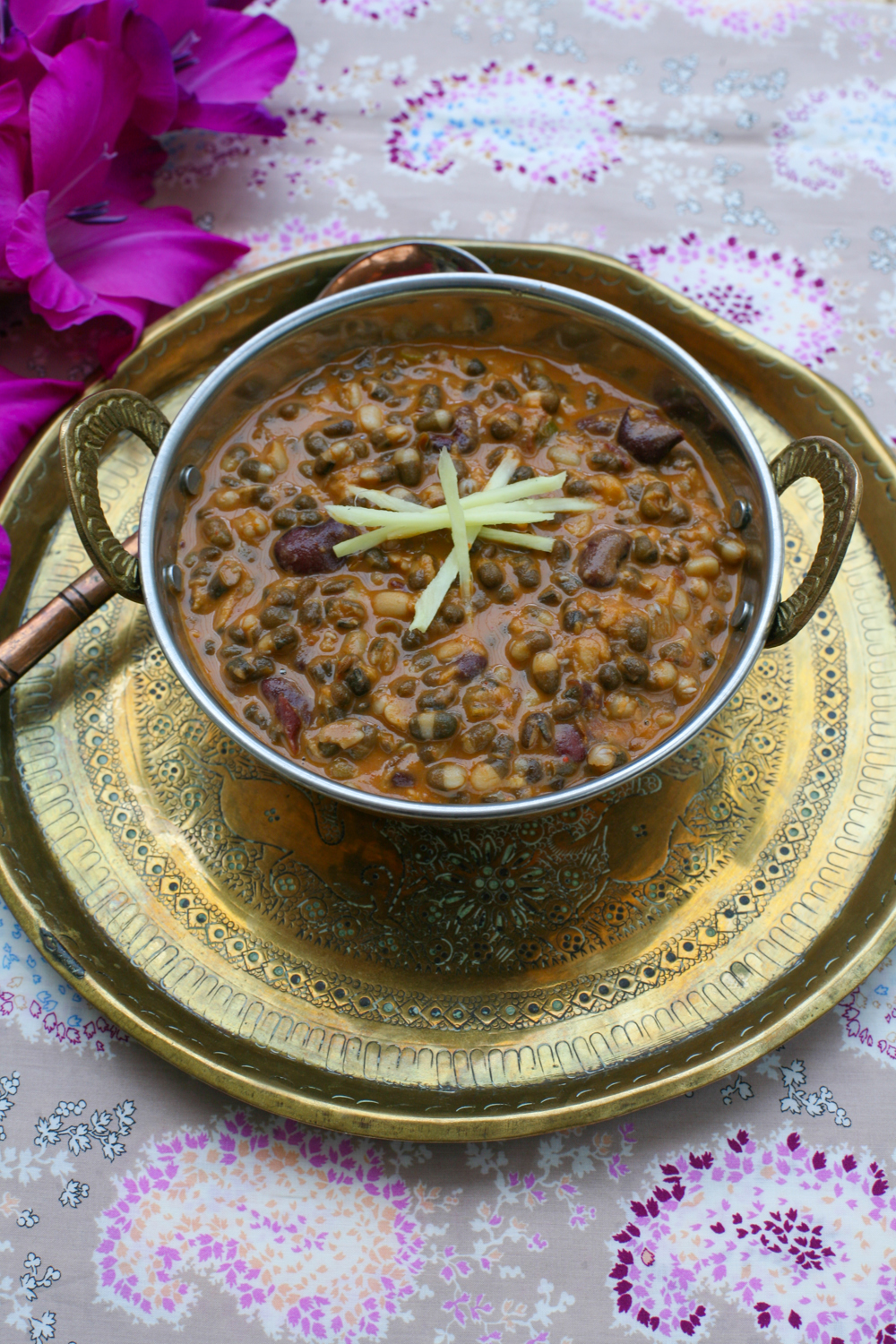
This gloriously decadent dal originates from the Punjab region of North India where black urid beans, also known as black gram, are eaten in abundance. It happens to be my husband’s absolute favourite king of dals. Creamy and rich from the butter, ghee (or oil) and double cream (oh don’t let that put you off!) and yet zings of ginger, garlic and tomato accompanied with a delicious spicy masala.

IMG_9792

Whilst we are lucky to still have some warm days, soon the weather will be turning and this dal is definitely one to bookmark for when there is a chill in the air.

IMG_9785

In the Punjab this dal is eaten on special occasions, such as weddings and religious ceremonies. When all the pomp and glory happens you can guarantee that dal makhani will be offered to guests. Do try it and let me know how you get on.

IMG_9808

Hope you all have a lovely weekend.


Dal Makhani

Serves 4-6

250g black urid beans (also known as black gram)

20g fresh ginger, peeled and grated

3 garlic cloves, grated

2 green chillies, finely sliced

241g tin of red kidney beans (this was the amount once drained)

1 tsp salt

*********************

tadka 

2 tbsp sunflower oil or ghee

1 tsp cumin seeds

1/2 tsp fenugreek seeds

pinch of asafoetida/hing

2 garlic cloves, grated

2 tbsp tomato puree

*********************

Just before serving

1 tbsp butter

40ml double cream

1/2 tsp Kashmiri chilli powder

1/2 tsp garam masala

salt to taste

1. Ideally soak the urid beans overnight submerged in a bowl of water. Equally if you plan on eating them in the evening you can soak them in the morning for around 6 hours.

2. Once the lentils have soaked (see above) drain them and then wash them with clean water and drain 3 times so as to get rid of any impurities.

3. Place them in a large deep pan and completely cover so that the water is just above the beans. You can always add more water during the cooking process if it all gets soaked up. Add the finely grated ginger and garlic as well as the green chilli and salt. Bring to the boil and then simmer for 20 minutes. The scum that comes to the top when cooking can be removed with a spoon and discarded.

4. After about 20 minutes the dal should have softened and much of the water reduced. Press a bean between your thumb and forefinger and it should easily be squashed. If it needs to soften a bit more leave it simmering for a further 5 minutes.

5. Strain the lentils and then place them back in the pan along with the drained tinned red kidney beans. Add 100ml of water and simmer for a couple of minutes.

6. In a separate small frying pan add the oil (or ghee if you are feeling a little bit naughty) and when it is hot gently add the cumin and fenugreek seeds. They will begin to pop after about 30 seconds so proceed to add the garlic, asafoetida and then after a minute add the tomato puree and stir in together. Simmer on a low heat for a further minute.

7. Place the contents of the frying pan into the large pan with the urid and red kidney beans and give a good stir. If it is too thick add a little more water. It is very much down to personal taste on how thick or soupy you wish your dal to be. Simmer together for 10 minutes.

8. A few minutes before serving add the butter, double cream, Kashmiri chilli powder and garam masala. Give a good stir and add more salt as required.

Oh so delicious. I hope you agree.

Do leave a comment below. I love to hear from my readers. 


Roasted Butternut Squash and Beetroot with Pistachio Pesto, Feta and Pomegranate Seeds from Persiana

IMG_9722


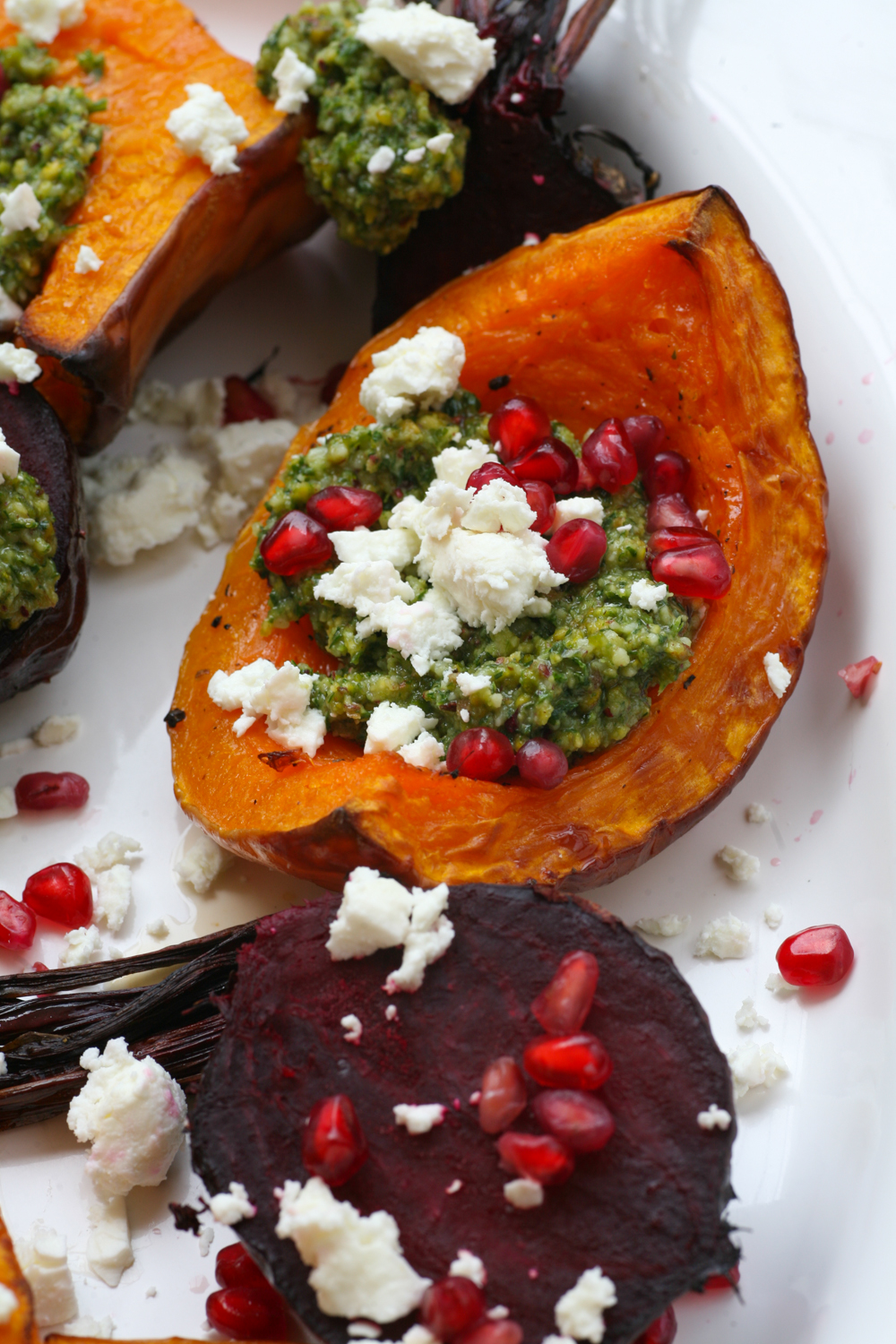
It was love at first sight. The vibrant butternut squash (the beetroot is my own addition) with dollops of pistachio pesto infused with fresh dill, coriander and parsley, crumbled feta and bejewelled pomegranate seeds. Simple and yet so very right. I did not even need to try it to know that I would love it and include it in my culinary repertoire from that day forth.


IMG_9731


It was served to me by the very likeable Sabrina Ghayour earlier this year at her hugely popular supper club that takes place in her west London residence. Twelve or so hungry diners feasted on a number of mouth watering Persian dishes that were lovingly prepared by Sabrina herself.  Her recipes and ingredients sing to me and I can honestly say that I actually want to cook and eat a large number of them. Dried lime, lamb and split pea stew or saffron chicken, fennel and barberry stew or bamia – bring it on.

IMG_9759

The recipes will really come into their own in the autumn and winter time as there is even a section dedicated  to ‘soups, stews and tanginess’, perfect to serve up and nourish the soul on cold, blistery autumnal days. That said, there are also sections on ‘salads and vegetables’,  ‘roasts and grills’, ‘mezze and sharing plates’, ‘breads and grains’ and finally ‘desserts and sweet treats’ so something for everyone no matter what hemisphere you are living in. The recipes are easy to follow and beautifully photographed. I also particularly love the cover which is not only eye catching with it’s title that rolls off the tongue, but it also has a very tactile cover.  As you pass your hand over it gives the impression that spices and rose petals have really been imbedded into it’s very cover.  Such a clever and original idea.

IMG_9770

This recipe you can eat as is, or accompany it with another in her book. I thought the ‘tray-baked rose lamb chops with chilli and herbs’ (above) would be a particularly delicious combination. If you want to learn more about Persian food and feel comfortable cooking it for yourself then I cannot recommend the book more highly. Sabrina’s chatty, informative and unpretentious style will connect with it’s readers and guide them through the very exciting world of food from Persia.

Roasted Butternut Squash and Beetroot with Pistachio Pesto, Feta and Pomegranate Seeds

adapted slightly from Persiana by Sabrina Ghayour

Serves 4 

1 butternut squash, halved and then chopped into about 6 large pieces (skin left on)

4 beetroot, gently cleaned (be careful not to damage the skin) kept whole and stems left intact

4 tbsp olive oil

sea salt

freshly ground black pepper

150g feta cheese

100g pomegranate seeds

*********

for the pesto

100g shelled pistachio nuts

70g parmesan chopped into rough chunks

olive oil

1 handful of fresh coriander

1 handful of fresh dill

1 handful of fresh parsley

2 tbsp chilli oil

juice of 1 lemon

sea salt

1. Preheat your oven to 180 degrees if using fan oven or 200 degrees if not/gas mark 6.  Place the chopped butternut squash and intact beetroot on a baking tray lined with non-stick baking paper and cover the vegetables in olive oil, pepper and salt. Place in the oven for 50 minutes so the edges of the butternut squash begin to char.

2. Meanwhile to prepare the pesto, place the pistachio, parmesan chunks and a glug of olive oil into a food processor and mix together. If it remains quite thick in texture add some more olive oil to soften it.

3. Add all the herbs, chilli oil and lemon juice and blitz together with a sprinkling of sea salt. Taste to make sure the flavour is well balanced. Leave in the refrigerator until ready to use.

4. To serve, place the roasted butternut squash and beetroot (now cut in two) on a serving platter. Place dollops of the pesto on each vegetable portion, crumble the feta on each portion and around the  platter. Finish by scattering the pomegranate on top.

Voila you have the most pleasing of meals to dive into.


Kale, Coconut and Durum Wheat Salad with a Sesame Oil Dressing

IMG_9528

Oh boy it’s been getting pretty hot here in London town. We’re almost hitting 30 degrees and that is pretty darn for HOT for England. All this humid weather means that the fresh water lido’s, that I love to swim in, are heating up nicely to a refreshing 21 degrees. I’ve also been doing a bit of sea swimming, which has been lovely.

When it comes to food and cooking though the hot weather really makes us a little sluggish and well hot, so the last thing we want to be doing is spending hours in a kitchen labouring over a stove.


IMG_9491

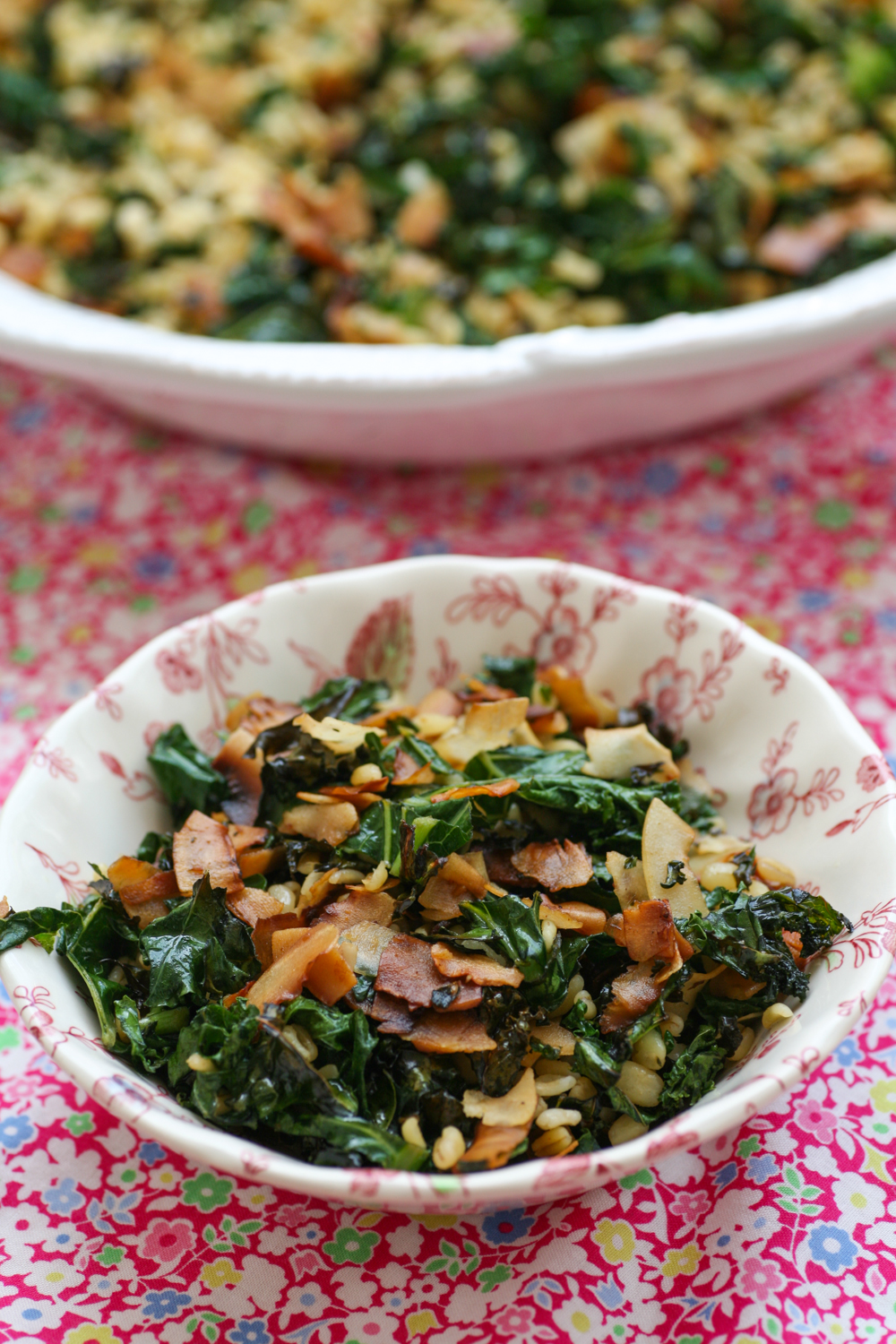
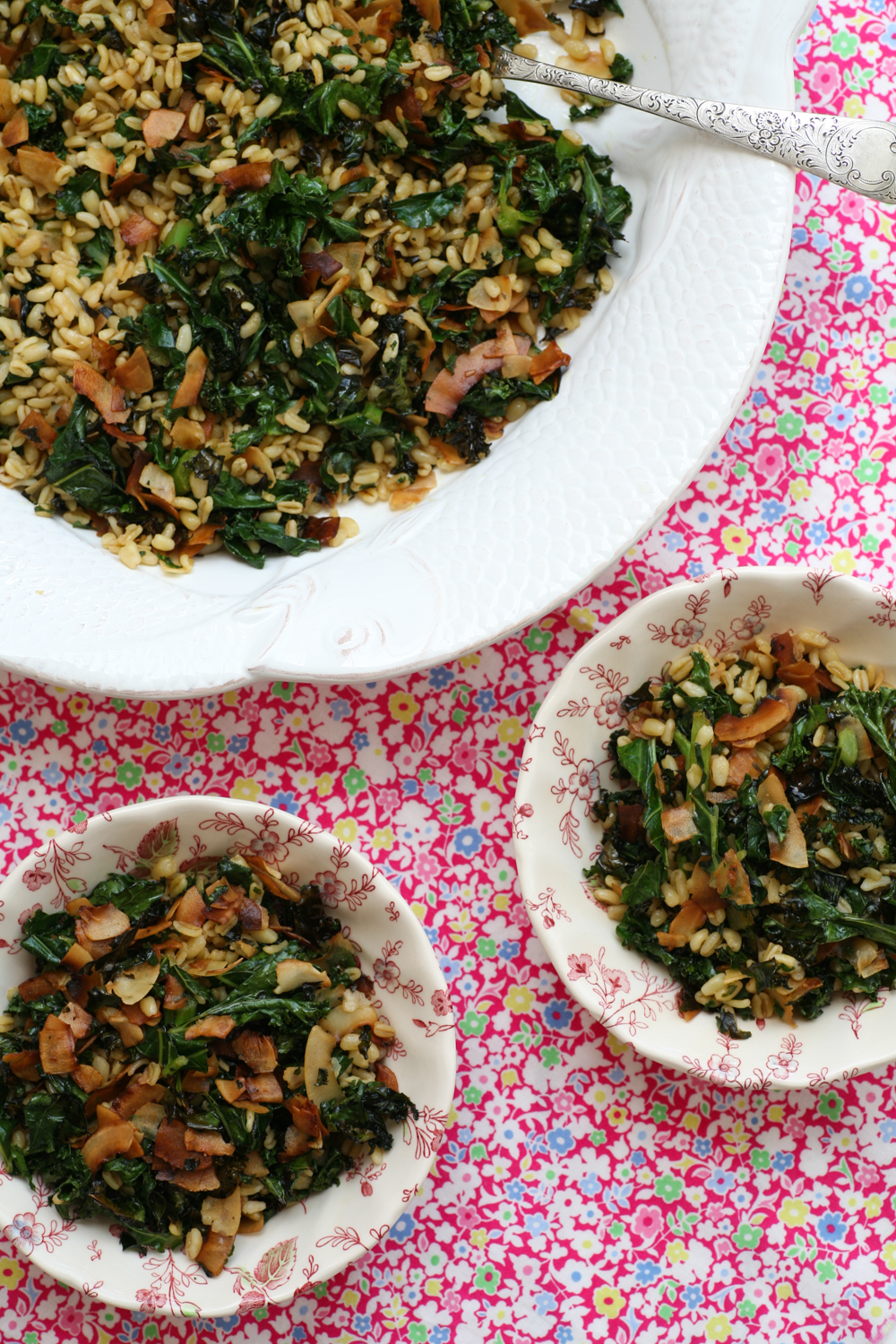
This recipe takes around 10-15 minutes to make from beginning to end. The combination of flavours and textures make it a joy to eat, and something a little different. It is simple and has few ingredients and requires no salt as that is provided by the tamari. I am a huge fan of kale and eat it through out the year in many forms – have you tried homemade crispy kale yet? After cleaning the kale, dry it thoroughly, add a tablespoon of extra virgin olive oil and massage it into the kale leaves (remove any thick stalks). Pop in a low oven – around 160 degrees centigrade is perfect – for 9-10 minutes, by which time it will have completely crisped up. Sprinkle with some rock salk and serve. Delicious snack.

IMG_9513

Anyway there is a super interesting article all about the benefits of kale written by Dana Gill – editor-in-chief of Healthyline.com. You can read her article here.

Now back to the recipe for today, if you want to make even more of a meal out of it you could add grilled tofu or some salmon or trout fillets. I added a sprinkling of chilli flakes, but it also works really well in it’s simplest form.


IMG_9515

If you can’t get hold of durum wheat you could use farro or another whole grain.

IMG_9503


Kale, Coconut and Durum Wheat Salad with a Sesame Oil Dressing

Inspired and adapted from Heidi Swanson’s Kale Salad in Super Natural Every Day

Serves 4

125g kale, chopped (stems removed)

100g unsweetened large coconut flakes

175g pure durum wheat  or farro

******

80ml  extra virgin olive oil

1 tsp sesame oil

2 tablespoons of tamari or soy sauce

******

chilli flakes, optional

1. Preheat the oven to 170 degrees centigrade.

2. Chop the kale and place in a large bowl along with the coconut flakes

3. Mix the olive oil, sesame oil and tamari together in a small bowl.

4. Pour two-thirds of the oil mixture over the kale and coconut flakes and really mix in thoroughly so that all the leaves are completely coated in the oil.

5. Place in the oven for 10-12 or until the coconut flakes begin to bronze and the kale begins to darken slightly. Keep an eye on it as they can get burn easily and the kale crisp up too much.

6. Whilst the kale and coconut are in the oven place the durum wheat in a pan of cold water and gently simmer for around ten minutes, or according to instructions on the packet. Strain thoroughly.

7. Return all the ingredients to the bowl and mix again with the remainder of the oil mixture.

Serve immediately.

It works wonderfully well on it’s own or equally you could add some grilled salmon or trout or possibly some grilled tofu. Experiment and let me know what works for you.

Notes: I have also made this replacing the coconut flakes with powa flakes, sunflower seeds and 1 tsp of maple syrup to the dressing. Worked equally well. 


IMG_9531

Happy summer days.

IMG_9569


IMG_9563


Spanish Baked Chicken and Pea and Mint Soup with Crumbled Feta

IMG_9453

It’s always good to have some quick, easy and tasty recipes up your sleeve if you feeding a crowd. I know how it is difficult to decide what to pair up with what in as far as a starter, main and dessert is concerned. I always find it helpful in cookery books when they give suggestions. It’s surprising how many do not actually do this!

IMG_9445

Both these recipes turned up on my blog when I first started back in 2011 and I felt that the photos needed a little improving so decided to re post with new ones that I recently took. They are both definitely ‘go-to’ recipes for me. Hearty food with wonderful herbs, but light and fresh – perfect for summer days.

IMG_9414

They are so quick and easy to prepare that if you have friends coming over or you are doing your own catering on holiday, they take no time and will not cause you any stress. The dessert I accompanied these dishes with was Rose and Summer Berry Skinnifreddo, which I found on fellow food blogger Kellie’s blog – kelliesfoodtoglow.com. It was wonderfully fresh, colourful and healthy and  complements my starter and main beautifully. Her blog is really rather lovely so do take some time to look around it – I am sure you will be inspired.

IMG_9440

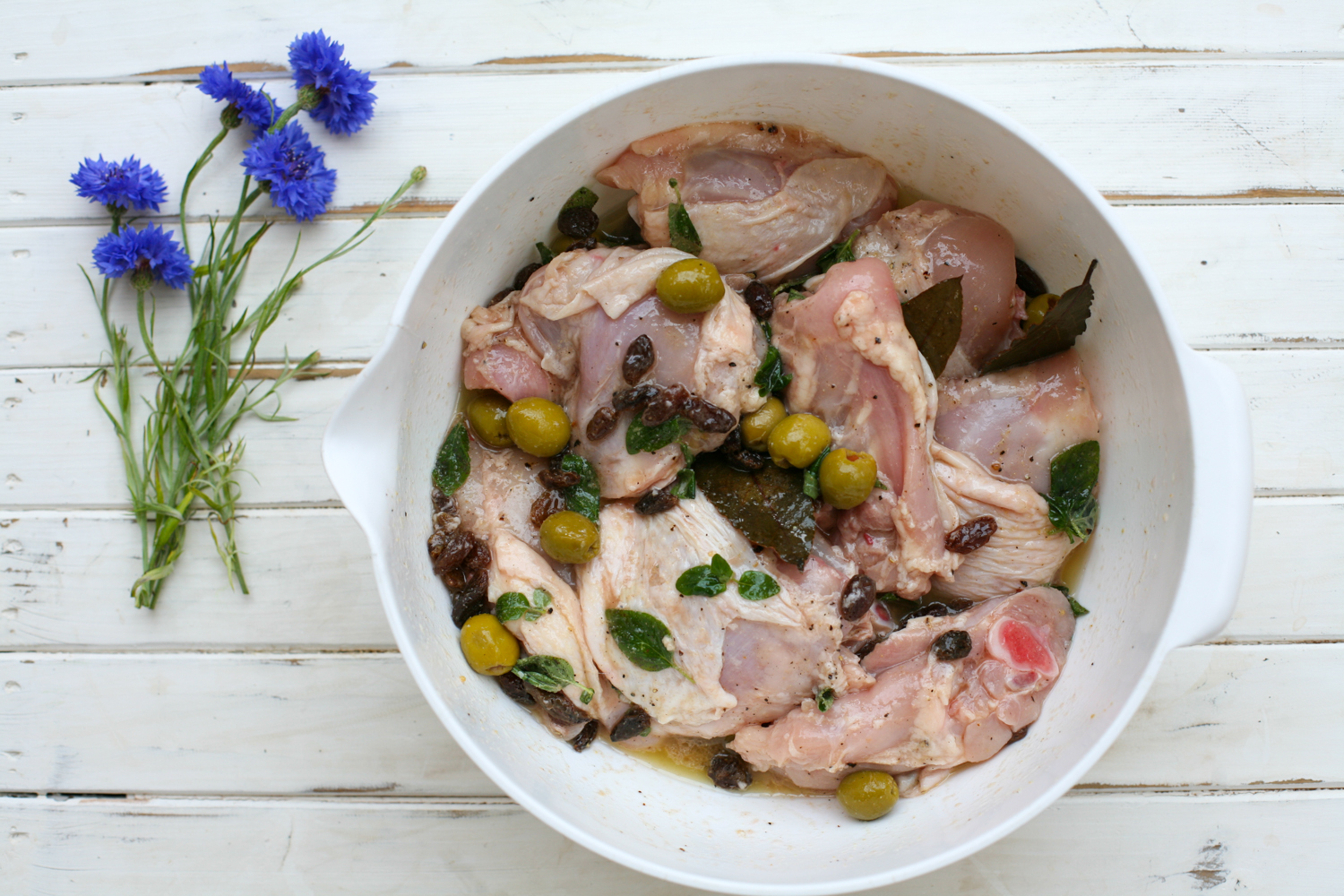
The above photo is of the chicken after marinading but before cooking

Spanish Baked Chicken

Sourced and inspired by Simply Recipes

serves 4-6

3.5 pounds/1.6kg  chicken thighs

100 ml red wine vinegar

100ml olive oil

1 handful fresh oregano

100g raisins/sultanas

1 tsp garlic powder

1/2 tsp salt

pepper

100g stoneless green olives

4 bay leaves

150 ml white wine

2 tbsp brown sugar

1. Cut the excess fat off the chicken thighs, pierce the skin with a fork and place in a large mixing bowl. Then add all the ingredients, except the white wine and brown sugar, to create the wonderful marinade. You don’t have to stick rigidly to the amounts for the olives and raisin/sultanas ingredients – if you love olives throw in a little more and same goes for the raisins/sultanas. Really mix all the marinade thoroughly over the chicken using your hands. Cover with foil and place in the fridge overnight or for as many hours as you can.

2. Transfer the chicken and the marinade to an oven proof dish. I often use a couple of dishes so that the chicken thighs are evenly spread out. Then pour the white wine and sprinkle the brown sugar over the chicken thighs.

3. Place in a pre-heated oven at 180 degrees centigrade for 50 mins remembering to spoon the marinade over the chicken during cooking. This will ensure the chicken has a golden brown glow when it is cooked.

****************************

Pea and Mint Soup with Crumbled Feta

Serves 4

4 spring onions, sliced

50g butter

700g frozen peas

1 pint/600ml milk

1 pint/600ml of vegetable stock

one handful of fresh mint (or two if you like it really minty)

black pepper

salt

75g feta

1. Melt the butter slowly in a pan, careful not to burn the butter. When melted add the sliced spring onions and stir into the butter for 5 minutes. Stir in the peas, vegetable stock and mint and leave to simmer for around 20 minutes (30 minutes if you are using fresh peas).

2. Puree the soup to the consistency that you require. Then add in the milk – if you like a thicker consistency then add less milk than the amount given above. Season to taste with salt and pepper.

3. Immediately before serving sprinkle each portion with crumbled feta.


Spicy Black Eye Bean Curry

IMG_9409

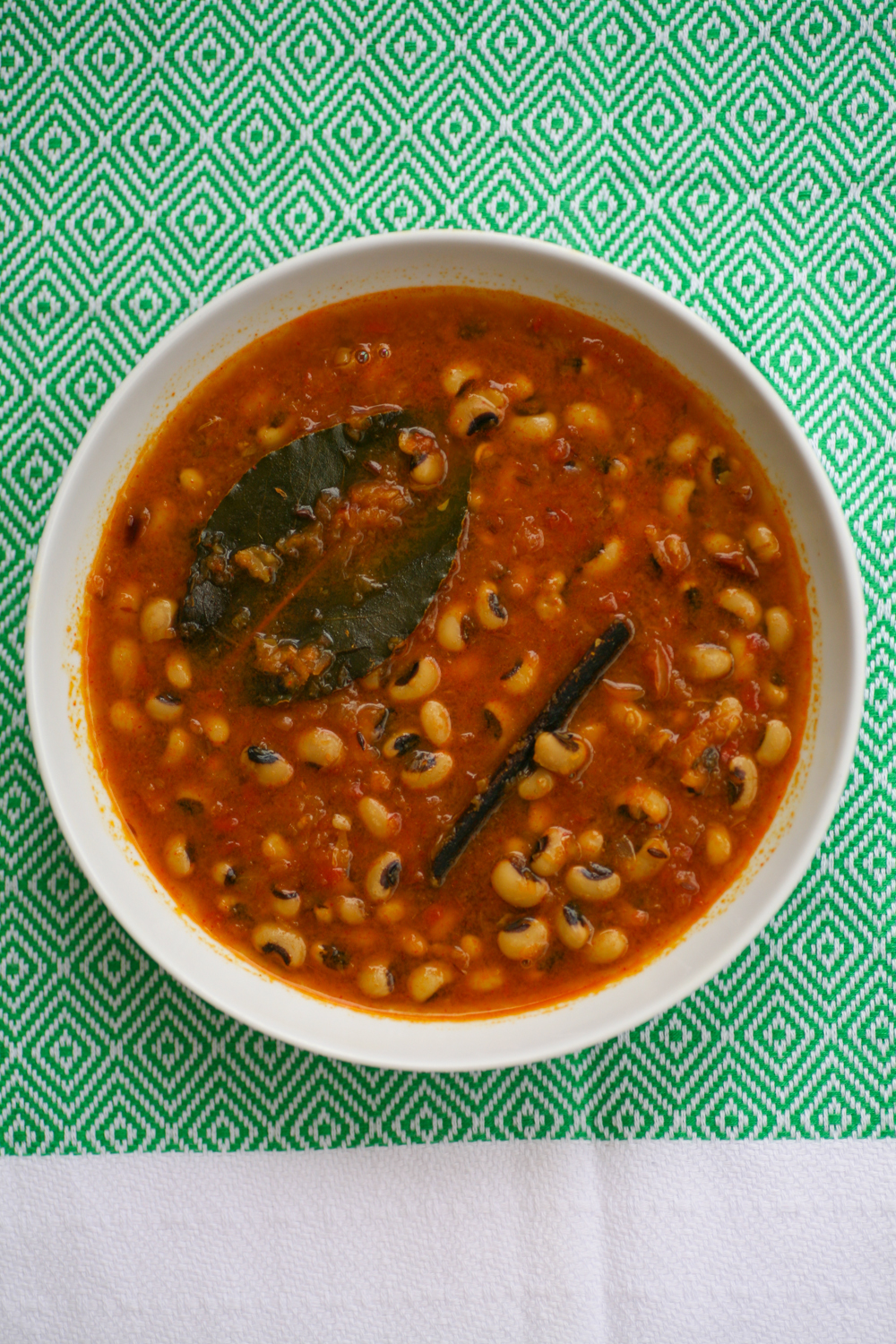
This is my final recipe for June supporting the ‘Curry for Change‘ – Find Your Feet campaign. I hope you have enjoyed my journey through the hamper of goodies kindly supplied to me by Natco Foods as part of the ‘Blogger’s Challenge‘. I have enjoyed experimenting with some ingredients that were new to me and as a consequence will be incorporating them as part of my diet going forward.

Out of the four recipes I posted I’m curious as to which YOU liked the look of most. Was it the Indian Powa Fuel, or my Lotus Seed/Phool Makhana Curry, my Dried Ginger and Lentil Spiced Chicken Balti or the one that I have posted today? Don’t be shy now…be brave and leave a little comment below.

I hope that I may have encouraged you to host a curry evening of your own to support the wonderful charity Find Your Feet – see details on the Curry for Change site. If you do I would love to hear how it went.

Over the next few weeks I will be tempting you with some refreshing, fragrant and tasty summer salads that you can pull together for a BBQ, summer picnic or a leisured lunch at home.

Now I must return to watching Wimbledon. The summer season has begun.

Spiced Black Eye Bean Curry

250g black eye beans

275g/3 medium sized red onion, roughly chopped

250g/3 medium tomatoes, roughly chopped

1 tsp garlic paste

3 tbsp vegetable oil

1 tsp cumin seeds

3 bay leaves

1 3inch stick of cinnamon

4 cloves

1 tsp turmeric powder

1 tsp coriander powder

1 tsp mango powder (also known as amchoor powder)

1 tsp Kashmiri chilli powder

1 tsp garam masala

salt to taste

500ml of cold water

1. Soak the black eye beans in a bowl of cold water overnight. Rinse them the following day and place in a saucepan along with boiling water to cover them. Simmer on a medium heat for around 30 minutes, or until the black eye beans have softened. Drain and place to one side.

2. In a blender add the onions and blend to a smooth paste. You may need to add a little water to help it become more paste like in consistency. Remove from the blender and place in a bowl to one side.

3. Rinse the blender and then add the tomatoes and blend so that a smooth paste forms. Remove from the blender and place in a bowl to one side.

4. In a deep pan or karahi add the vegetable oil and when it is hot add the cumin seeds, bay leaves, cinnamon stick and cloves. Stir them around the pan for 30 seconds.

5. Add the onion paste and a little salt to the pan and lower the heat so that the onion cooks through and begins to bronze slightly. This will take around 10 minutes.

6. Add the garlic paste, followed by the turmeric powder, coriander powder, mango powder, Kashmiri chilli powder and garam masala. Stir in thoroughly to the onion, garlic paste. Cook for a further 3 minutes.

7. Now add the tomato paste along with 50 ml water and simmer gently for a further 5 minutes.

8. Place the black eye beans into the curry and cover them in the sauce along with up to 450 ml of water, depending on how thick you like your sauce to be.

9. Simmer for a further 5 minutes and add more salt if necessary and serve.

Serve with a squeeze of lemon and a dollop of natural yogurt on the side. I like to make homemade chapatis to go alongside this curry. I realise I need to post a recipe on how to make them so watch this space….they are ridiculously easy and great fun for all the family to make.


Indian Powa Fuel

IMG_9365

This week I have another recipe for you that I created using some ingredients from the hamper that Natco foods sweetly provided me for the the Curry for Change bloggers challenge. For those who have not read my two previous posts (shame on you ;o), for the month of June I will be cooking recipes using the ingredients that Natco foods sent me to inspire YOU at home to cook your own Indian food to support ‘Curry for Change’ that in turn supports a wonderful charity called ‘Find Your Feet‘, which does exactly what it says on the tin….help rural communities in Asia find…..their….feet in order to bring them out of poverty and be self sufficient.

IMG_9354

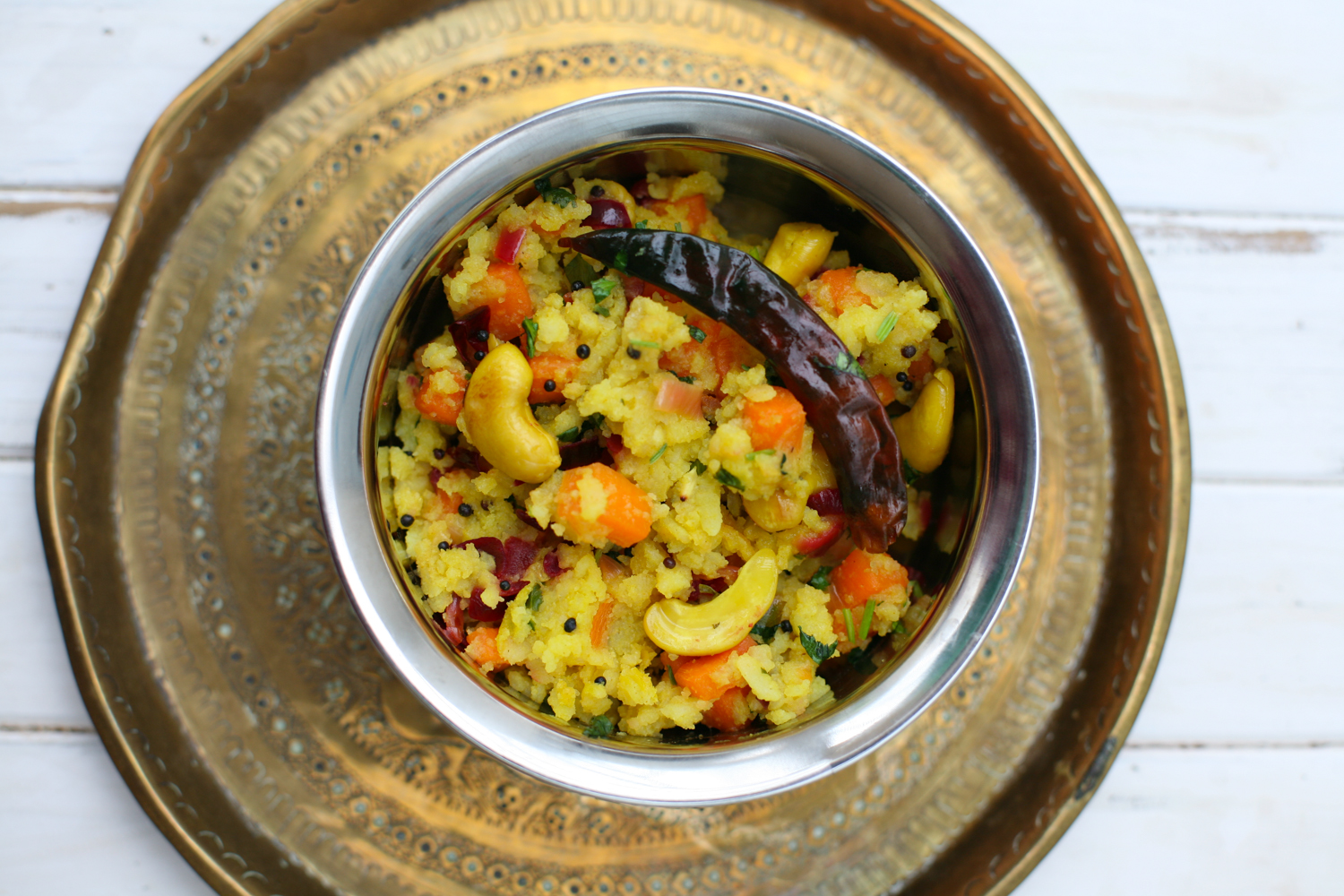
I pulled out a packet of powa flakes from the hamper and decided to create an appetising Indian inspired dish that you too could easily make at home. Powa flakes are flattened pre-cooked rice, that look fairly similar to white Kelloggs corn flakes. Similarly they can be used in sweet dishes, but can also be used in a number of savoury dishes and snacks. I have always tended to eat them as part of a crispy, fried snack, similar to a Bombay mix, but after a bit of researching I decided to use them in a more substantial meal. They are low in fat and high in fibre so tick many boxes from a health perspective. You’re probably wondering where on earth you can buy them. Well any Asian/Indian grocers will definitely stock them or you can order them online from Natco – here.

Unlike rice, that requires a little longer to cook, powa flakes only require soaking in cold water for a couple of minutes. Once they are drained, they only require a few minutes cooking before they are ready to be eaten. I honestly think that they are the perfect ingredient to use after a shattering day at work/looking after the kids (delete as appropriate) when you cannot be bothered to cook. Within 10 minutes this dish is cooked and it is so satisfying and filling. Seriously I think I am onto a winner here. I am totally converted and you will be too if you seek out the powa.

IMG_9378

My eldest, who is 8 years old, absolutely loves this meal and eats it exactly as I do (with chilli). However, it has only really been in the last year that she has been able to eat many of the same curries as me and Mr B. She has been gradually weened on over the years. Children can and do enjoy spice, however, it is best to gradually build up their tolerance and love of spices. My four year old in comparison has made it very clear that she only likes traditional English food and not spicy Indian food. More left for me, Mr B and Big A then.

***********

Indian Powa Fuel

Serves 4

125g powa flakes (medium thickness)

3 tbsp vegetable/olive oil

1 tsp black mustard seeds

1 dried red chilli

2 fresh green chilli, finely chopped

1/8 tsp hing/asafoetida

1/2 (half) tsp of ground turmeric

30g cashew nuts

10 fresh curry leaves

1 small red onion, finely chopped

1 tsp salt

1 lemon, juice only

150g of finely cubed carrots

handful fresh coriander, finely chopped

1. In a bowl cover the powa flakes with cold water.

2. In a karahi, wok or frying pan, add the oil and when it is hot, but on a low heat, add the mustard seeds. They will begin to pop after about 10 seconds.

3. Immediately add the dried chilli, turmeric, hing/asafoetida, cashew nuts, green chilli, curry leaves and stir together. Stir in the pan for a minute.

4. Now add the onion and salt and stir well into the ingredients in the pan. Fry the onion for 5 minutes until softened and then add the lemon juice.

5. Add the finely cubed carrots and place a lid on the pan so that the carrots soften. As they are small this will not take more than a few minutes.

6. Add the drained powa flakes and gently mix into the ingredients in the pan, without making them too stodgy. Sprinkle the fresh coriander around the pan and serve warm immediately.

********

As for the ‘Curry For Change’ competition, well my recipe, which was this one,  sadly did not win. However, two out of the three winners I am twitter friends with so I am thrilled that their recipes made it through. They have now been filmed cooking their winning recipes, so am looking forward to seeing the result, when it goes live on the curry for change site. In the mean time check out their recipes on their sites below and try making them. I would love to hear from you if you try any of the recipes I am cooking this month or any of the winning recipes below. Leave a comment below.

· Ellie Matthews with ‘Spiced Roast Lamb with Butternut Squash and Spinach Dhal’ – http://theyoungdomesticgoddess.blogspot.co.uk/

·         Deena Kakaya with ‘Black Eyed Bean Pakora and Coconut Kadhi’ – www.deenakakaya.com

·         Zoe Perrett with ‘Bombay Bad Boy Chocolate Cheesecake’ – http://culinaryadventuresofthespicescribe.wordpress.com  and http://culinaryadventuresofthecocoanut.wordpress.com


IMG_9380


Red Thai Tofu, Aubergine and Egg Curry

IMG_9119

Over the past couple of weeks I’ve been cooking loads of Indian food – recipe testing mainly. I  had been sent a fabulous hamper from Natco foods as part of the Curry4Change competition that I’m taking part in –  details on this will follow in June as YOU too can get involved.

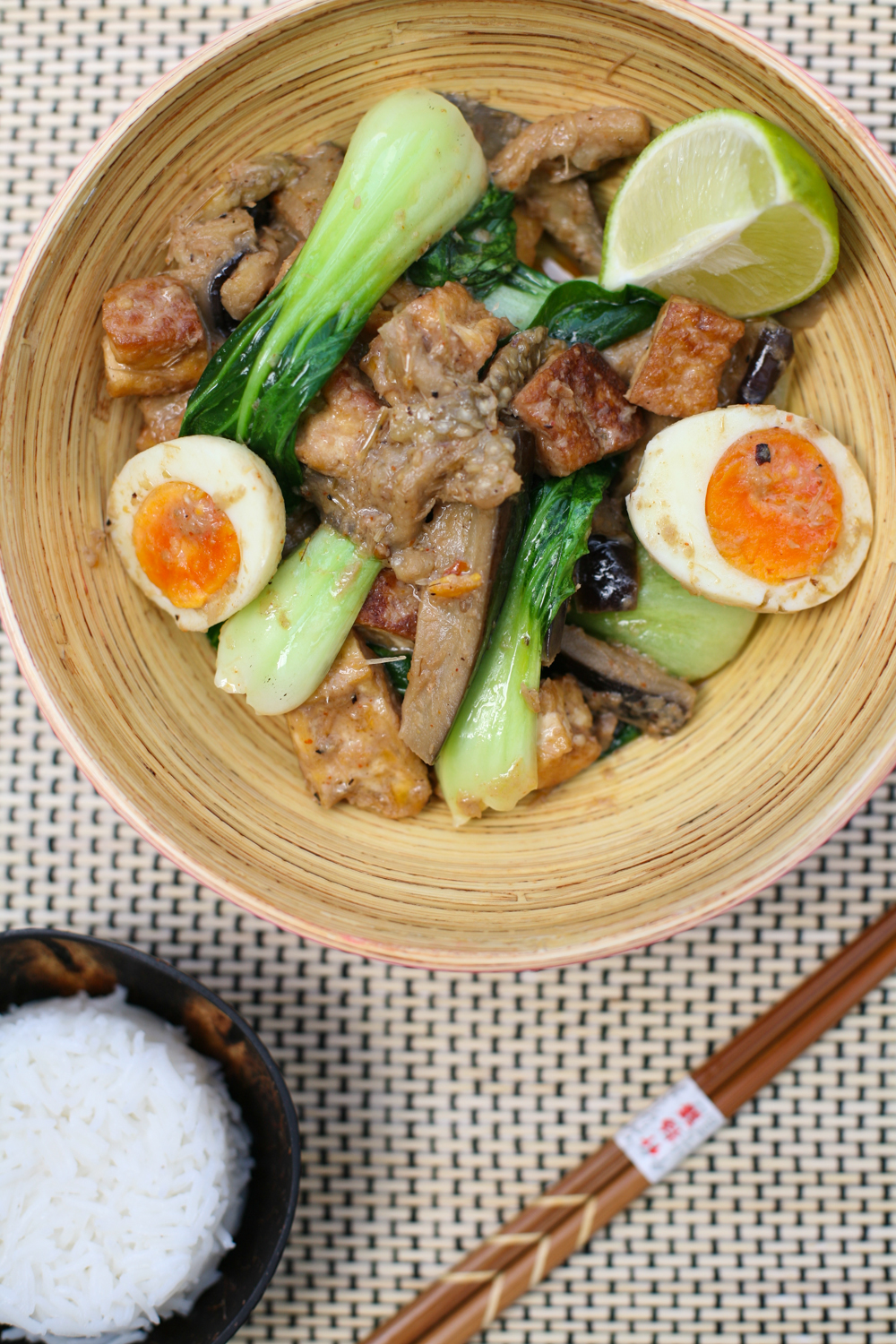
I am now craving food from a different region and a rather delicious vegetarian Thai dish caught my attention recently, cooked by John Torode as part of one of the invention tests in the 2014 Masterchef series. I find the series completely addictive and a pleasure to watch. The invention test in particular is always rather exciting as it really demonstrates how much flair and knowledge of cooking the contestant really has. Basically the contestants get two boxes to chose from, one savoury and the other sweet – no prizes for guessing which I would always choose! After electing a box they have to create a dish using some of the ingredients within the box as well as a few staple ingredients that they are all given. Before the contestants dive in John has a go at choosing one of the boxes (away from the contestants), typically he too always chooses the savoury box. This time he created a red Thai aubergine, tofu, egg curry, which I thought looked delicious, spicy and relatively light – a dish that was beckoning me to cook.

Here is my version of the dish inspired from the John Tororde’s creation. I have a feeling that John may have included red peppers in his paste but I opted to not put them in – I leave it to you to decide.

IMG_9135

Red Thai Tofu, Aubergine and Egg Curry

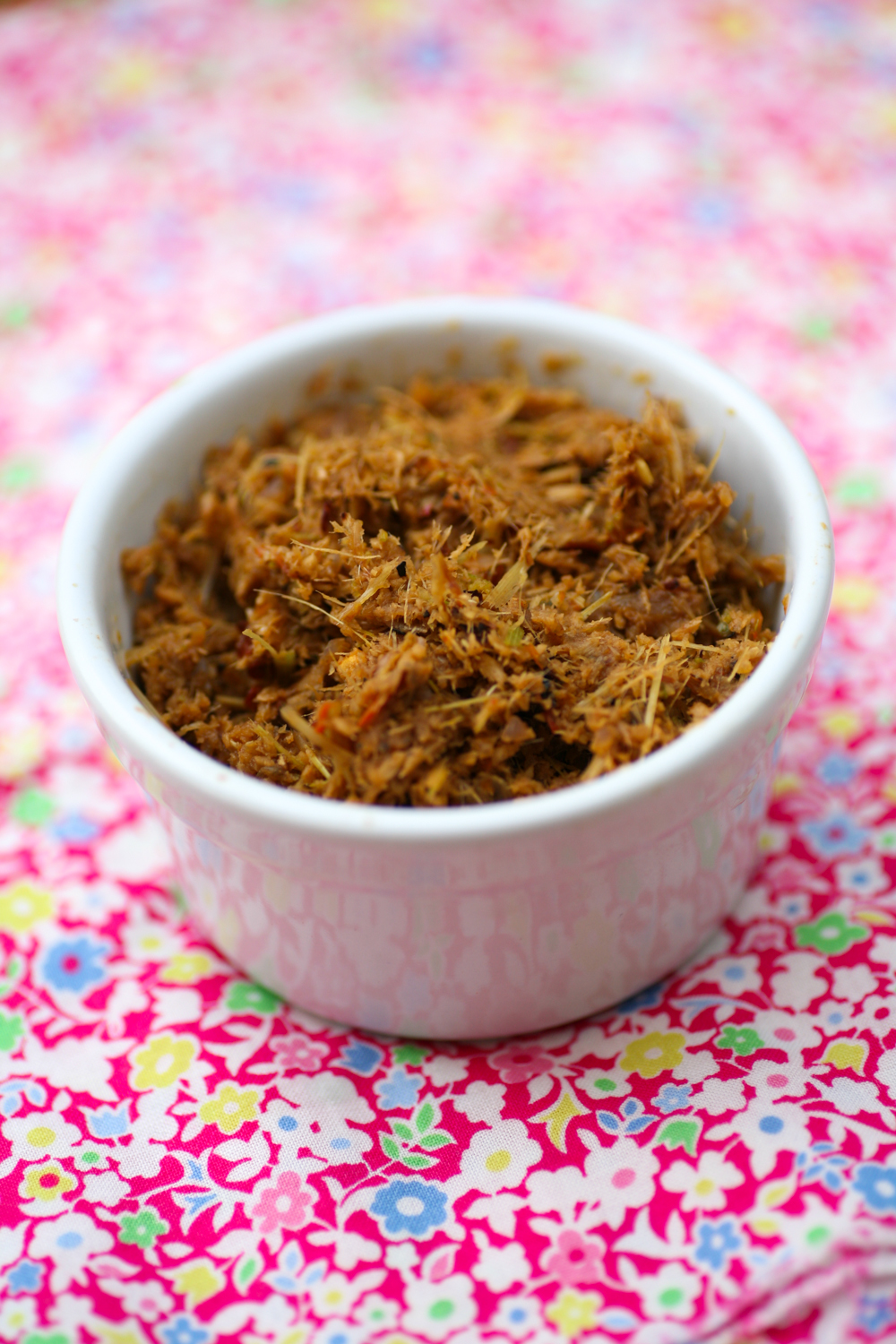
The proportions below will allow you to cook this dish a few times – freeze the paste left over.

To make the paste

5cm fresh galangal

5cm fresh ginger

3 cloves of garlic

13 small shallots (half that if they are larger in size)

3 small piece kaffir lime peel

4 large dried red chilli, soak for 10 mins in warm water to soften

2 fresh small red chillies

2 lemongrass sticks

1 tsp shrimp paste

1. If you have a gas hob, simply place all the ingredients, aside for the shrimp paste, on a rack and place over the flame so that the ingredients char slightly. This will give the paste a lovely smokey flavour. I did exactly the same thing when I was in Vietnam and made Pho – see here.

2. If you do not have a gas hob, simply place them into a pan (do not add oil) and let them heat and char this way.

3. Once the ingredients have charred and cooled, place into a blender and add the shrimp paste. Blend until you can get it as smooth as you can.

IMG_9087

IMG_9100

***************

To make the curry itself

Serves 4

5 tbsp vegetable oil

800g firm tofu, cut into 3 cm cubes

4 tsp homemade curry paste

300g aubergine – if using baby aubergines cut into quarters, otherwise cut into 7x2cm matchsticks

400ml creamy coconut milk (1 tin)

4 eggs

1 tbsp caster sugar

1 tsp salt

3 pak choi

100ml water

1/2 lime, juice only

1. Firstly make sure the tofu is completely dry as it will then fry a lot better. I usually take the tofu out its packet a couple of hours before using and then place on kitchen roll so that it soaks up all the excess water.

2. Using a non-stick pan place a couple of tablespoons of vegetable oil into the pan and when it is hot carefully add the tofu cubes. Fry on a low heat so that the tofu bronzes delicately. This should not take much more than 10 minutes.

3. Meanwhile on a low heat, in a wok or karahi, add a couple more tablespoons of vegetable oil and add the thai paste. Stir around in the oil and add the aubergine and coat in the paste. You may find you need to add another tablespoon of oil at this stage as the aubergines do need quite a bit to cook.

4. As the aubergines begin to soften add the creamy coconut milk and the eggs in their shells. They will become hard boiled from cooking gently in the coconut milk.

5. Add the caste sugar and salt to taste.

6. Add the lime juice and then five minutes before serving add the pak choi and a little extra water. Remove the shells from the eggs and cut in half.

7. Serve in a bowl with a small bowl of rice on the side. John added roasted sesame seeds in his, which is a nice touch.

NB: My local Thai grocers said that they do not use fresh chillies in their red thai paste, but I decided to add a couple of help with the heat and colour.

IMG_9115


PS: I realise I’ve been cooking rather a lot of  dishes that include aubergine/eggplant lately. I do apologise if you can’t stand the vegetable. I don’t actively come up with recipes that include it but realise this is the third recipe that includes aubergines that I’ve cooked in the last month or so.  I promise there will be no aubergines for a while as you are probably being polite and are actually really sick of them ;o).


Spiced Aubergine, Cavolo Nero and Mushroom Spring Rolls

IMG_8913

It’s the Easter holidays so my daughters have some wonderful leisured weeks ahead of them. They love to cook too so we decided to make these spiced aubergine, cavolo nero and mushroom spring rolls together. Rolling spring rolls is a great communal activity and actually rather calming and therapeutic. It is very satisfying to make a tightly rolled and neat spring roll – seriously you’ll know what I mean when you give this recipe a go.

IMG_8940

I hope that it gets a big thumbs up from all my vegetarian and vegan followers. The filling is deliciously tasty and even if you do like your meat I think you will be pleasantly surprised by how tasty these little spring rolls actually are.

IMG_8881

Once the filling has been prepared  and roasted the actually filling of the spring rolls is relatively quick. You can make them ahead of time and then leave them in the fridge until you are ready to fry them. Equally you could freeze them to use in the future – they are pretty versatile. IMG_8886

I adore cavolo nero and added to the aubergine, mushrooms and the spiced sauce, it makes for a very tasty filling.

IMG_8901

The trick to rolling spring rolls is to keep the rolls tight and well folded so that none of the filling escapes when frying. Don’t overfill or you may find the rolls cannot be rolled tight enough – I know it’s tempting but do restrain yourself ;o)

IMG_8912

Frying takes a couple of minutes and I tend to do a few at a time. Once they have bronzed, remove from the oil and place on some kitchen roll to cool and to soak up any excess fat. Diving in too quickly will burn your mouth, so let them rest for a short while before feasting. I like to dip them in tamarind chutney or some chilli sauce – the recipe for the former is noted below.

IMG_8925

Spiced Aubergine, Cavolo Nero and Mushroom Spring Rolls

Inspired by a similar recipe from Wild Garlic, Gooseberries and Me by Denis Cotter

Makes 22 rolls

1 aubergine (weighing 300g), diced

200g cavolo nero (black kale), chopped  and stalks removed

100g mushrooms, roughly chopped

1 tbsp olive oil

1 tsp tomato puree

2 tsp light soy sauce

1/2 tsp caster sugar

2 spring onions, thinly sliced

1/2 large red chilli, deseeded and finely sliced

1 tbsp coriander seeds

4 cloves

pinch of fresh nutmeg

22 spring roll pastry sheets

vegetable/sunflower oil for frying

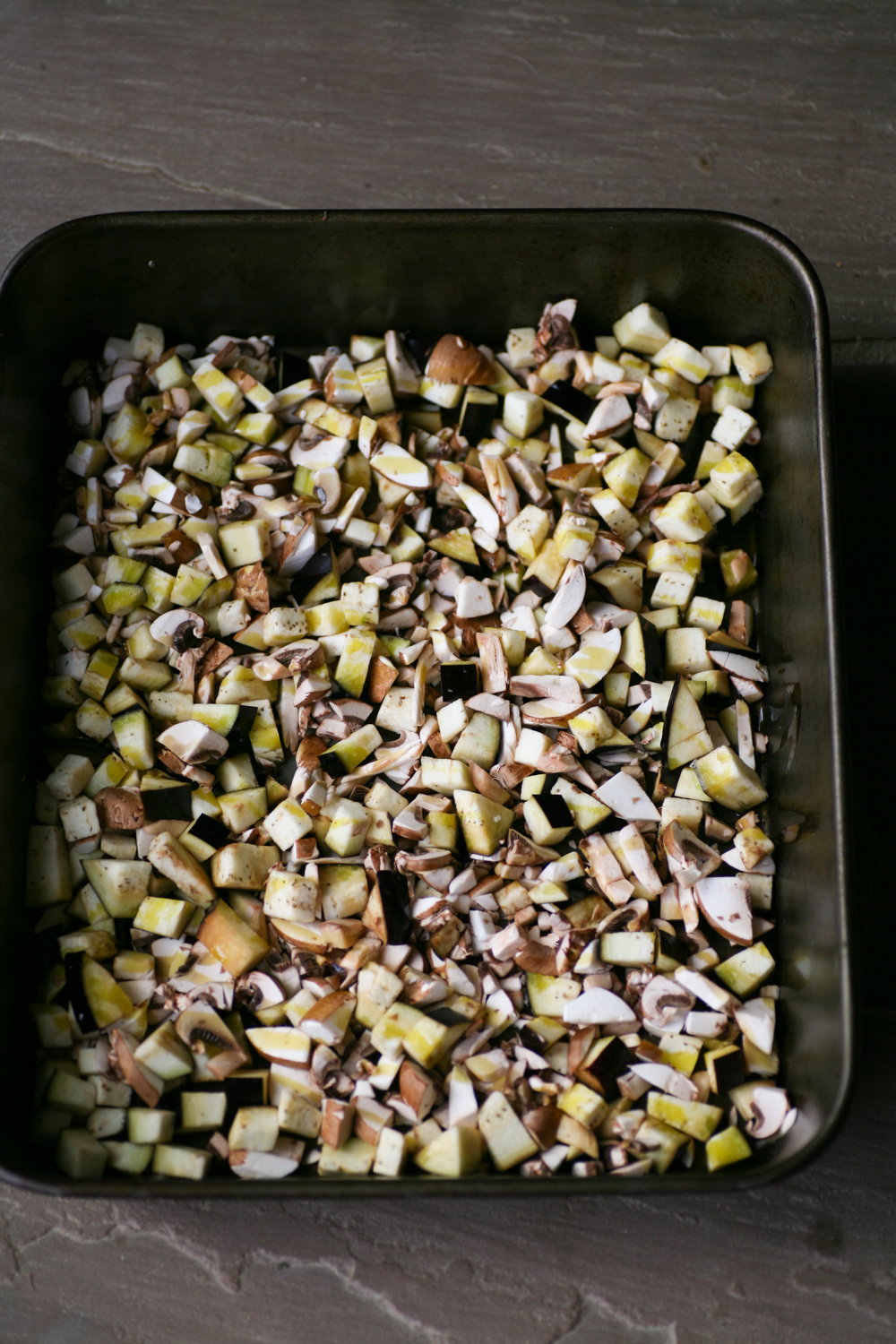
1. In a roasting tray layout the aubergine and mushrooms and scatter with a little olive oil. Roast in oven for 15 minutes, tossing at intervals so that all the ingredients cook and soften.

2. Whilst the aubergine and mushroom are roasting, heat a pan of boiling water and submerge the cavolo nero within it. Cook for 1 minute before straining under cold water and squeezing out the excess water from the cavolo nero. Place to one side on some kitchen paper to dry out thoroughly.

3. Mix the soy sauce, light soy sauce and caster sugar together and when the aubergine and mushrooms are sufficiently cooked transfer them to a bowl and mix in the sauce using a spoon.

4. Using a spice mix or pestle and mortar grind the coriander seeds and cloves together and add the nutmeg. Transfer these and the sliced spring onions and finely sliced red chilli also to the bowl along with the now dry cavolo nero.

5. Lay out a spring role pastry sheet and using your finger or a brush lightly wet the sides of the square. Add a tablespoonful of the aubergine, mushroom and cavolo nero mix towards the bottom of the sheet and then fold over tightly once and then fold in both ends   so that the roll is tightly packaged and then roll until the sheet has been used up. The water that you place on the end will sufficiently hold the spring roll together when cooking.

6. Once all the filling has been used up, heat a deep pan with sunflower/vegetable oil and when it is hot (drop a pinch of flour into it and if it fizzles it is ready) add a couple of the spring rolls at a time. They should take around 2 minutes each to cook. Once they have lightly bronzed place on a plate with kitchen roll to soak up any excess oil.

*************

Tamarind Chutney

Makes half a ramekin full

1 tsp roasted cumin seeds, ground

1 tbsp vegetable oil

2 tsp tamarind concentrate

500ml boiling water

45g palm sugar

1 tsp salt

1. In a pan dry roast the cumin seeds for 30 seconds so that the aromas are released. Place in a pestle and mortar or spice grinder and grind to a powder.

2. In a deep pan add the oil and when it is hot add the ground cumin and move around the pan.

3. Add the tamarind concentrate and boiling water and stir so that the concentrate is dissolved. Keep on a medium heat.

3. Add the palm sugar and salt and allow to dissolve into the liquid.

4. Simmer for 25 minutes by which time the liquid will have thickened, although it will still be relatively runny. As it cools it will begin to harden.

5. Store in the fridge in a sealed container for up to two weeks if not consuming immediately.


Spiced Chickpea and Coriander Soup and Spinach Pakoras

IMG_8826

 I had some fresh spinach in the fridge what was beginning to turn so thought that making some spinach pakoras would be the perfect way to save them and accompany my homemade chickpea and coriander soup. I always have tinned chickpeas in my store cupboard as I find them so useful to throw into a number of dishes, be it a casserole, soup or salad. Similarly I had some fresh coriander that needed eating so decided to throw them into the soup as well to add a lovely balance.


IMG_8808

This whole meal takes a short time to prepare so is great to cook for a light lunch or a speedy supper when you have had a hard day at work. The soup does have a very satisfying kick, so if you prefer a less chilli buzz just reduce the amount of dried chillies you use. If you do use the same amount as me you’ll find that the yoghurt softens the chilli a little making the soup very satisfying and delicious.

IMG_8835


Pakoras – vegetables dipped in a spiced batter and then fried – are a hugely popular snack in the Indian sub-continent. Whilst perhaps not the most healthy out there they are extremely moorish and addictive.  In India you will find numerous street stalls selling them in little paper cones, similar to the one that I prepared for the photos above.  They are rather similar to my coriander fritters which I posted a couple of years ago on this blog – see here. Get creative and try making them with a mixture of vegetables. I’ll show you how to make different types in time. Watch this space.


Spinach Pakoras

Serves 4

75ml water

80g chickpea flour

1 pinch of baking powder

1 tsp turmeric

1/4 tsp Kashmiri chilli powder

1/2 tsp salt

160g fresh spinach, roughly chopped

vegetable oil for deep frying

1. To make the batter mix the water, chickpea flour, baking powder, turmeric, chilli powder and salt together in a bowl. If the batter is still a little too thick simply add an extra drop of water.

2. Add the fresh spinach leaves to the bowl of batter and mix in thoroughly.

3. In a deep pan or karahi heat some vegetable oil. When it is hot – you can test by placing a pinch of flour into the oil and if it fizzes then it is ready, add a tablespoonful of the spinach batter. Depending on the size of your pan you can do a number at a time. Leave the pakora to cook for a minute before turning over for a further minute. They should have gently bronzed by this time.

4. Place on a plate with kitchen paper to soak up any excess oil. Eat whilst still hot.

*******************

Spiced Chickpea and Coriander Soup

Serves 6

4 tsp coriander seeds

2 tsp cumin seeds

5 large dried red chilli

2 tbsp desiccated coconut

****

4 tbsp olive oil

650g fresh tomatoes, boiled to remove the skins

50g fresh coriander

2x400g tins of chickpeas, drained and pureed using a hand blender

1 tsp turmeric powder

900ml water

6 tbsp yoghurt

juice of 1 lemon

salt to taste

1. Place the cumin and coriander seeds and dried red chilli in a warmed up frying pan and move around the pan for a minute to realise the flavours. Place into a spice grinder along with the desiccated coconut and whizz to form a powder.

2.  Having removed the skins of the fresh tomatoes (I find boiling them for a couple of minutes allows the skins to be easily removed) place them in a blender along with the chickpeas and fresh coriander.

3. Heat the olive oil in a large deep pan and when it is hot add the spiced powder along with the turmeric powder and stir around for 30 seconds before add the pureed chickpeas/tomatoes and coriander.

4. After a minute add the water and stir together well. Simmer on a medium heat for 15 minutes and then add the yoghurt, lemon juice and salt to taste.

Serve with the spinach pakoras on the side for a tasty vegetarian meal. I often tend to make chapatis as well to dip into the soup.


Chicken, Ginger and Spring Onion Gyoza/Jiaozi/Pop Sticker

IMG_8706

Mention the worked ‘gyoza’ in my household and you will hear yelps of delight – and that’s not just from the children. These moreish savoury dumplings are incredibly addictive and are a great little starter or snack, although you can off course have them as a main meal along with some steamed greens with soy and garlic perhaps.

Japan and China both have their version of the dumpling, although these dumplings first originated from China and were then adopted by the Japanese. The Chinese dumplings are known as jiaozi if they are boiled or steamed and guo tie if they are fried, in Japan – gyoza and the US – pot sticker.

The Chinese variety have slightly thicker wrappers and have a far wider combination of fillings than their Japanese counterparts. They are often steamed, whereas the Japanese gyoza are fried for a few minutes and then steamed for a further few minutes. The fillings I typically use for the vegetarian are tofu and shiitake mushrooms, or the meat variety filled with pork, chicken or duck or the seafood version, which tends to be prawn. Whatever takes your fancy these little dainties will be forever cherished by those who sample them.

IMG_8670

Now the question is to lovingly prepare your own wrappers or to buy some from your local Asian grocers or online. Basically it will come down to time on your part. Making your own takes a little time, but its the perfect activity to do with a mate who comes over for coffee – just rope them in they’ll love the experience or even with the kids. Shop bought is pretty cheap, as you can see for the price sticker I left on above, and are likely to be more uniform in thickness, but I’ll leave it to you to decide which suits your lifestyle.

IMG_8662

For those who wish to make their own it is SO simple. Seriously you only need a couple of ingredients and then a bit of kneading.

IMG_8653

Homemade Gyoza Wrappers

Makes around 20

210g plain flour, seived

125ml warm water

 pinch of salt

1. Stir the salt into the warm water until it completely dissolves.

2. Place the sieved flour into a large bowl and add the warm water. Using a wooden spoon mix the flour and water together and then use your hands to create a ball.

3. Kneed the dough on a cold surface for around 10 minutes, when it will be soft and springy to touch. Sprinkle more flour onto the dough if it is getting too sticky.

4. Wrap in cling film and place in the fridge for 30 mins.

5. Take small balls of the dough – about the size of apricot – and flatten it with your hand. Gently roll the dough into a round shape, turning it after every roll. Using a round cookie cutter (or the bottom of a saucer) cut out a round circle and cover gently with flour and place in a pile.

6. Continue until the dough has been used up. You should make around 20 dough wrappers with the proportions above. Whilst you prepare the filling place a damp cloth over the wrappers so they do not dry out.

IMG_8655

So now you have the wrappers ready to go you need to prepare the filling. Whether you want to use chicken, pork mince, prawn, duck or shiitake mushrooms and tofu the rest of the ingredients remain the same.

IMG_8680

Whilst using Chinese cabbage is the most authentic, use whatever green cabbage you have in your fridge. Place two large leaves in a pan of boiling water for 1 minute and then drain and pat completely dry with kitchen paper. You then want to slice and cut them up as small as you can. You can blitz everything in a blender but I tend to often take the slightly slower version of cutting by hand. Today I used chicken and as I tend to find minced chicken hard to source so I bought boneless chicken thighs and cut up them up into small pieces. I also added spring onions, chopped garlic, finely grated ginger, soy sauce, sesame oil, salt and pepper and hey presto you have your filling. You can get creative and add any other ingredient you think might work – how about carrot, fresh chilli, five spice.

IMG_8687

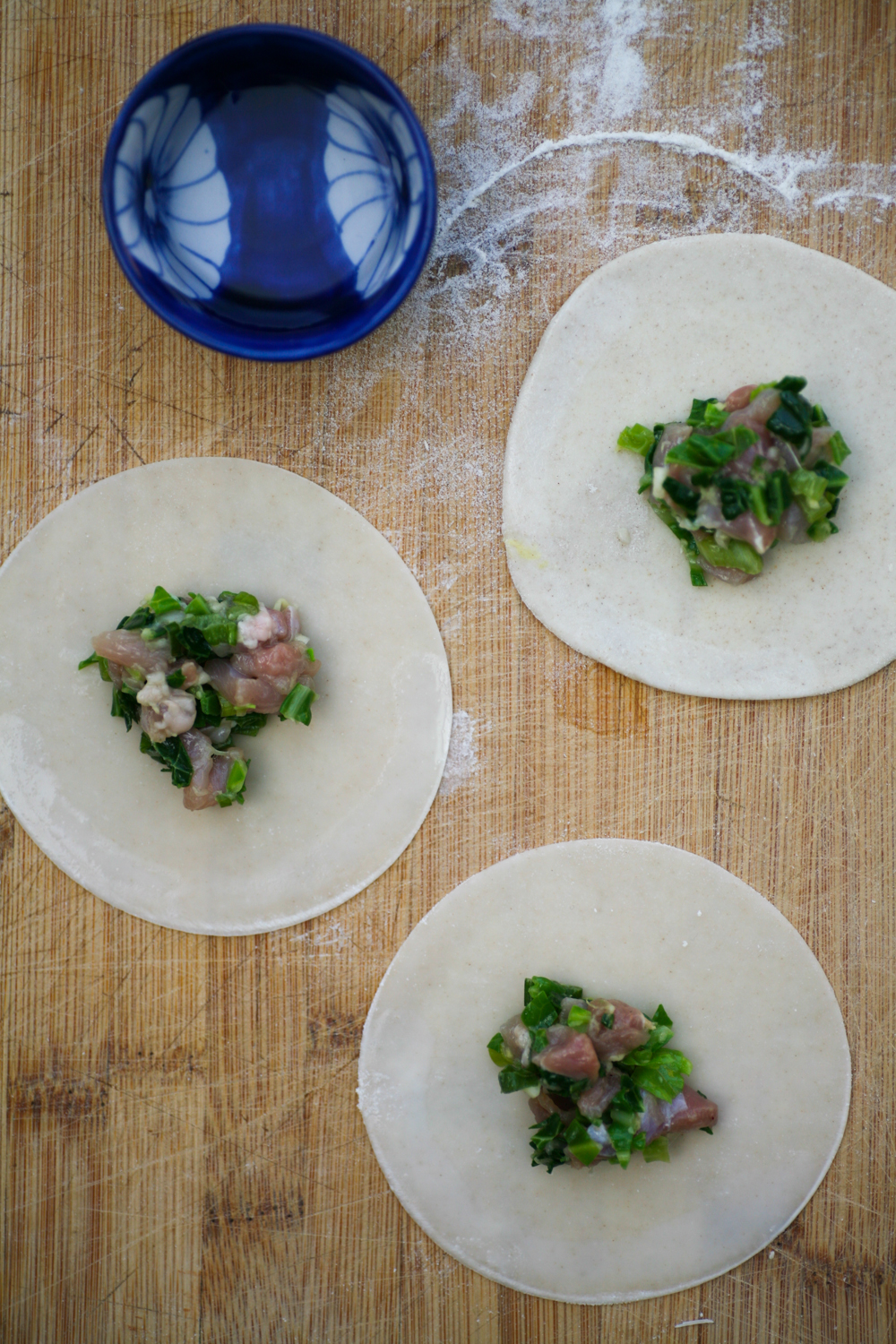
Wrapping the dumplings is rather satisfying and you will begin to get into a rhyme with them. Don’t overfill the gyoza, instead putting a teaspoonful in the centre and then, using your finger tip, wet the low half rim of the circle. You then want to fold over the gyoza in half and then begin to pleat from left to right, making sure the filling is securely inside the parcel. It is definitely a case of the more you do the better you become. My 8 year old is a complete natural and can do multiple pleats across the top. You only pleat one side of the gyoza s0 do not turn over and attempt to do more on the other side.

IMG_8721

The above photo shows half of the gyoza pleated. I finished doing this row, but did not turn it over to attempt to do the other side. To pleat you simply use your thumb and forefinger to make small pleats going over the last. Make sure you press the top together so that it is firmly stuck together – you don’t want them opening up in the pan.

IMG_8693

So you can see some are neater than others above. They will still taste delicious even if you haven’t got the perfect symmetrical pleating!

IMG_8708

Dumpling Filling

to fill around 20 dumplings

2 large leaves from a green cabbage/Chinese leaf cabbage

2 garlic cloves, finely sliced

20g ginger, peeled and finely grated

3 spring onions, finely sliced into small pieces

1 tsp sesame oil

1 tsp soy sauce

1 tsp mirin rice wine

275g boneless chicken thighs/or chicken mince (or duck, pork mince, tofu and shiitake mushrooms)

100 ml water

************

Dumpling Dipping Sauce

3 tsp rice vinegar

6 tsp soy sauce

1 tsp chilli oil (optional)

1 tsp sesame seeds

**********

1. Finely chop all of the ingredients and then bind together using your hands.

2. Place a heaped teaspoon of the ingredients onto one of the wrappers in the centre.

3. Wet the rim of the lower half of the wrapper using your finger.

4. Fold the wrapper in two and then pleat from left to right across the top, making sure to firmly seal the top of the wrappers.

5. Bend the wrapper slightly so that it is in a crescent moon shape and so it can stand up unaided. Place to one side whilst you prepare the rest.

6. Using a large nonstick pan add a tablespoon of sesame oil and when hot add the dumplings so that they are standing up and not sticking to one another. Fry them for 3 minutes, by which time they will have bronzed underneath. If they have not bronzed sufficiently leave them to fry for a little longer.

7. Add 100ml of water to the pan and place a lid on the top. Leave to steam for a further 3-4 minutes so that the water has completely dissolved.

8. Mix the ingredients of the dipping sauce together and then place to one side in a little bowl.

9. Serve immediately with the dipping sauce.

IMG_8719