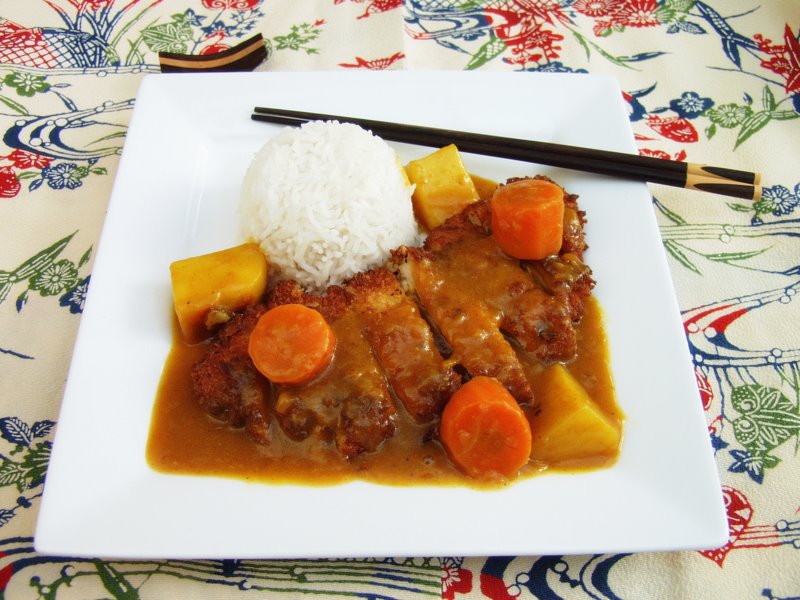
Childhood memories – Japanese Chicken Katsu Curry

chilliandmint's avatarCHILLI & MINT

OLYMPUS DIGITAL CAMERA

This post is dedicated to my sister who has always adored Japanese Chicken Katsu Curry. That’s not to say that I don’t, because I certainly do, but not in the same way as my sister. A few years ago when I visited her in Vancouver she ordered it in a Japanese restaurant hoping that it would bring back the same happy childhood  memories of the dish. Sadly the disappointment on her face when she tried their offering was plain to see, so I made it my mission there and then to try and find the recipe of our youth.

You may be wondering why we were eating such cosmopolitan food at such a young age in 80’s rural England. Our blessing was that my family had close links with a Japanese boarding school called the Rikkyo School. Most half term holidays we would welcome a couple of Rikkyo students, who were…

View original post 993 more words


Indian Inspired Cucumber, Apple and Red Onion Salad

IMG_0217

I’ve just returned from 10 glorious days in the Schwarzwald – or German Black Forest to you and me.

IMG_9957

Days were spent hiking through dense forests where gentle streams turned into ferocious waterfalls.

IMG_0097

 We climbed many a hill and marvelled at all the spruce and pine trees peppering the landscape. Dramatic scenery at every turn.

IMG_0022

Picnic lunch stops afforded us spectacular vistas, stretching for miles and the best thing was that we were completely alone – over the time we were there we passed only a couple of other walkers, one of which was a nun from the local nunnery. We live in such a frenetic, fast paced world that taking time out and spending time with nature away from the crowds is wonderfully cleansing for the mind and soul.

IMG_9971

Upon returning to our gasthof we would often treat ourselves to the local speciality…….Black Forest Gateaux,  because when in Rome…..

IMG_0113

After resting our weary limbs we prepared for serious dining in the evening. The food was exquisite, refined and yet hearty – the lemongrass creme brule and the wild garlic soup being highlights.

IMG_9946

Upon returning back in the UK however, I was ready to have a vegetarian spell. I began to crave green vegetables (I eat a lot of spinach) and fruit with a spice injection and simple Asian food. In fact the first thing I cooked for myself when we returned to Blighty was this.

With the bambinos having just returned to school and the sun giving us a lovely, welcome dose of vitamin c – check out the blossom and blue skies

IMG_0208

I wanted to eat a lovely salad that I was given recently when I was in Kerala. It’s lovely on it’s own or eaten to accompany all manner of Indian, meat, fish or veg curries – see my recipe library. The crunch from all the different textures and the flavours sing sweet notes as you dive into this salad. Give it a whirl and let me know if you agree.

IMG_0218

Indian Inspired Cucumber, Apple and Red Onion Salad

Serves 4 with another dish or 2 on it’s own

2 crunchy green apples, cored, skin removed, quartered and chopped into 3

1 cucumber, skin removed, halved and chopped into half moons

1 red onion, finely sliced

1 handful of fresh coriander, roughly chopped

1/2 tsp salt

1 tbsp agave nectar/honey

  1. Skin, slice and cut the ingredients as specified above and mix altogether along with the honey and salt. Simple and utterly delicious.

This salad would also be perfect with meat, fish or vegetables off the BBQ.

IMG_0219


Coconut, Coriander and Mint Cod and an exciting competition

IMG_9515Being an island nation we tend to be more conscious of our seas and the fish within them than perhaps landlocked countries. That said I have always wondered why, like the Japanese, we don’t eat more fish in our diet. Growing up my parents would always have fish on Friday, which was pretty typical of Christian families of their generation. Today however, I don’t wait for Friday to have fish and on average we probably eat seafood a couple of times a week.

IMG_9511

I try to be as innovative as possible (see here for my post on foraging for cockles)  in the way that I prepare and cook it. Grilled or baked fish with a squeeze of lemon or fish pie is all very delicious but there are so many other ways to cook seafood that I hope the recipe that I will show you today will encourage you to give it a try and that it will become part of your culinary repertoire.

Recently I was contacted by LOAF App, (short for ‘love of all food’),  to come up with an exciting recipe focusing on the theme of ‘fusion’ that will go onto the app and be part of a competition (more about that in a moment). For those of you who have not yet heard of LOAF, it is a fabulous new recipe app, that is free to download, that has a wide range of recipes from bloggers and chefs, in a standardised format that is easy to follow and replicate at home. You can even add your own recipes and share them with other users. (Write ups on the app here and here).

IMG_9495

LOAF is working in partnership with the MSC Fisheries Standard (Marine Stewardship Council) on an exciting campaign, which gets the public cooking whilst being more informed on which seafood we should be buying. As part of the competition I have focused on fish that has the MSC Fisheries Standard blue label (see photo above). My recipe is now live on the LOAF app site for you to cook at home. You then need to photograph your efforts of my recipe, put them up on the LOAF site and I will then judge the winner of who I think made my dish best. The winner will be awarded £75 worth of free food shopping from either Sainsburys (UK), Wholefoods (US) and Coles (Australia).

IMG_9498

85% of the worlds’ seafood are either at capacity or over fished. Buying seafood therefore that has the MSC blue label sticker on it is something that we all need consciously to do if we are to protect our oceans for future generations. The label tells the consumer that the seafood product you are buying is ‘certified sustainable seafood’. Fisheries are assessed to check if they are well-managed and sustainable. I urge you to look at the following Youtube video explaining the Fisheries Standard’s principles and scoring.

The standard has been developed in consultation with scientists, the fishing industry and conservation groups. Today we are all more conscious of food origin and therefore by buying MSC blue label food is a no brainer as it is fully traceable to a sustainable source. The MSC Fisheries Standard have also put together a product finder so that you can find sustainable fish and seafood wherever you are in the world. Take a look here to see how it works.

IMG_9502

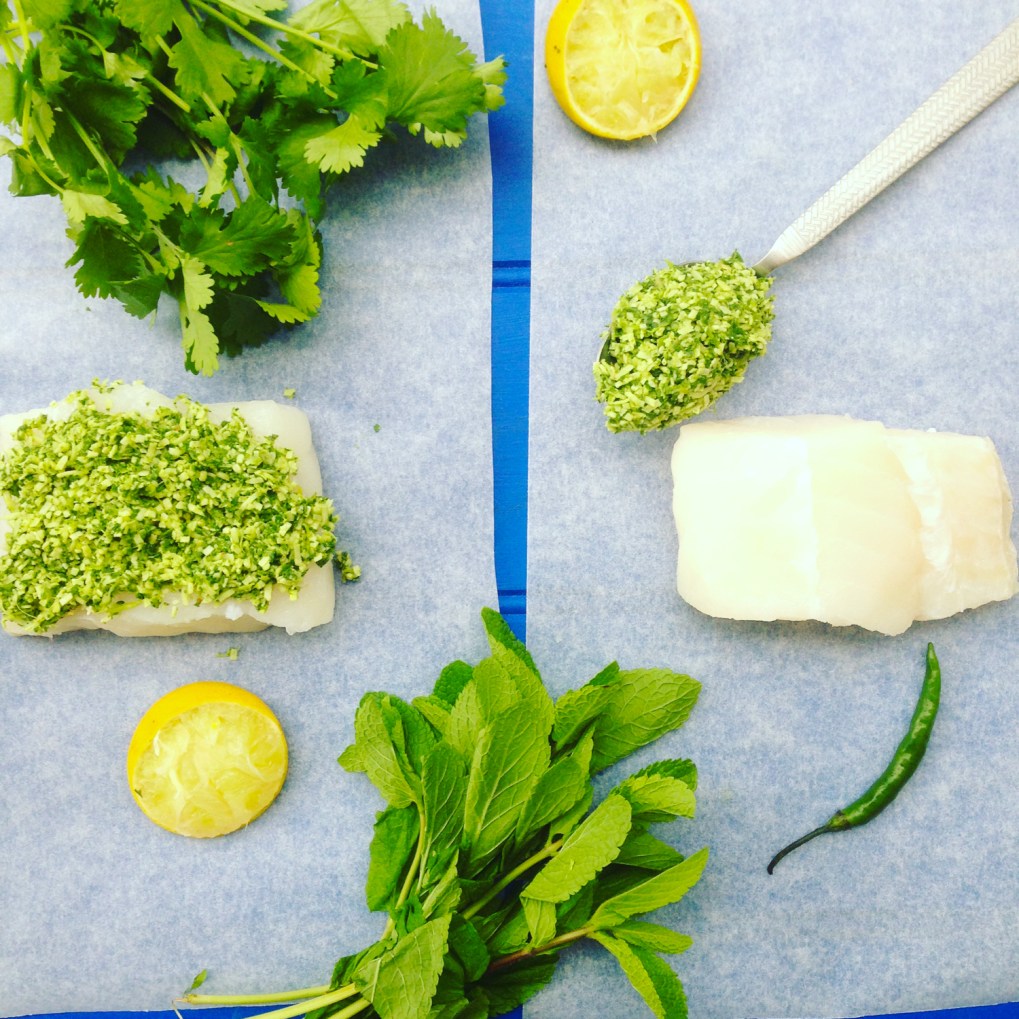
So the recipe that I have come up with takes 15 minutes max to prepare and half of that is making the paste. It’s origin is from Kerala and I recently watched a similar recipe being made. I have been doing something similar for years, albeit without the coconut addition. It is steamed as opposed to baked, grilled or fried. If you want to be truly authentic you can source a banana leaf to wrap it in, failing that baking parchment works just fine. Rice would be perfect to accompany this dish. So what are you waiting for? Give it a try and post your photograph up on the LOAF app site. EASY.

Coconut, Coriander and Mint Cod 

Paste ingredients

2 large handful of fresh mint leaves, stems removed

1 large handful of fresh coriander leaves, stems can remain intact

1 tsp of fresh grated ginger

1 tsp of grated garlic

1 green chilli, finely chopped

50g either freshly grated coconut or desiccated coconut

 1 limes, juice only

salt, to taste

******

1kg cod loins (MSC blue label)

baking parchment

  1. Put all the paste ingredients together in a blender to make a fine paste. Add salt to taste at the end.
  2. Cut the baking parchment so that it wraps over the cod loin completely.
  3. Place the paste all over the top of the fish and lay it in the centre of the baking parchment.
  4. Carefully wrap the fish so that the ends are completely enclosed.
  5. Warm a frying pan (or Indian tawa if you have one) and when it is hot lay the cod parcel onto the pan. It will cook by the steam that will be created within the parcel. After 4 minutes turn the fish parcel over for another 4 minutes. If it looks as if it needs a little longer leave it for another minute and it should be ready.

Note: You can also use banana leaf instead of baking parchment. If using a banana leaf you need to hold the leaf carefully over a gas flame in a sweeping motion so that it softens. Do this on both sides and then cut it down to size so that the fish can be completely covered by the leaf.

You can bake the fish in the oven (180 degrees) for 15 minutes if you prefer but I suggest wrapping the fish in baking parchment papillote style – see here so that it does not dry out and steams itself whilst cooking.


Almond Milk and Vanilla Panna Cotta with a Strawberry and Black Pepper Coulis

IMG_9740

Panna cotta is a delightful pudding. Sweet but not too sweet, relatively light and ridiculously easy to make, but shhh don’t tell anyone. Instead of using cows milk I opted for delicious almond milk to give it a slight nutty undertone to accompany the vanilla.

IMG_9738

The Pressery has just relaunched with a pure, long-life organic almond milk, which is utterly delicious and perfect for this recipe. The list of London locations where you can purchase the milk is growing by the week so I am sure there will be somewhere near you where you can pick up a carton. Take a look here to find out the locations.

IMG_9739

I love the combination of strawberries and black pepper, so thought I would accompany the panna cotta with a smooth coulis made from the two ingredients. Equally you can simply just serve the panna cotta with fresh strawberries with a pinch or two of black pepper.

IMG_9737

This sweet delight is perfect after a number of dishes from my recipe library – here are a few to point you in the right direction.

slow cooked lamb with tomatoes, dried fruit and spices, warm lentil and goats cheese salad with a fresh basil dressing, chickpea, chorizo and cod stew, umami rich portable mushrooms, sun dried tomato and black garlic pesto

Let me know how you get on. Do you like the strawberry and black pepper combo?

Almond Milk and Vanilla Panna Cotta with a Strawberry and Black Pepper Coulis

Serves 4-5 (depending on the size of your ramekins)

250ml  almond milk

250ml double cream

2 tbsp agave nectar (or 25g white sugar)

2 vanilla pods or 1 tsp vanilla extract with seeds

3 gelatine leaves

******

60ml water

30g caster sugar

150g fresh strawberries, stems removed and sliced

1 tsp of freshly ground black pepper

  1. Place the gelatine leaves in a bowl of cold water for 4 minutes.
  2. In a pan gently heat the almond milk, cream, agave nectar/sugar and vanilla (if using pods split them lengthways and scoop out the seeds and leave the pods in the milk to infuse). Let it simmer gently for 5 minutes.
  3. Squeeze the water out of the gelatine leaves and place in the pan with the almond milk. Stir well so that it dissolves into milky liquid.
  4. Sieve all the liquid into a jug and discard the vanilla pods if using, and then pour even amounts into your ramekins. Allow to cool before placing in the fridge for a couple of hours.
  5. In a new pan add the water, caster sugar and fresh strawberries and gently heat so that the sugar dissolves.
  6. Use a hand blender to create a smooth sauce. If you find the sauce is too thick do add a little more water at this stage. You are aiming to have a sauce that is the same thickness as a single cream.
  7. For the final stage you have two options. Either sieve the strawberry coulis into a serving jug or if you prefer to have the black pepper bits in the coulis do not strain. Both ways work well, that latter naturally having more pepper bite, which I personally love.
  8. Place the coulis in a serving jug and when it is cools place in the fridge.

To serve the panna cotta, gently use a sharp knife to loosen the top rim of the panna cotta. Then place the bottom of the ramekin in a bowl of hot water for a couple of seconds maximum. Place the serving plate on top of the ramekin and then turn over and gently shake the ramekin so that the panna cotta gently slips onto the plate.

Either allow guests to serve the coulis themselves or place a little around the edge of the panna cotta. Equally you can add fresh fruit as well as the coulis or instead of. Strawberries or blueberries would work beautifully.

As an alternative idea to turning the panna cotta out onto a plate you could serve them in vintage mismatched tea cups.


Vietnamese Prawn, Mango, Lemongrass and Coconut Curry

IMG_2436

Don’t ever throw away coriander stalks as they are bursting with flavour and are perfect for making a delicious paste to go in all manner of curries. Today I wanted to show you one of my Vietnamese inspired prawn curries that combine lemongrass, ginger, garlic, chilli, coriander stalks, jaggery (palm sugar – or you can just use caster sugar), fresh mangoes and coconut milk.  To say it’s sublime would be an understatement. It is so downright delicious that you’ll be wanting to make it on repeat.

IMG_2430

I always seem to have frozen prawns in my freezer as, once thawed, they are hugely versatile to make all manner of curries or prawn cakes and generally speaking I find that most people like prawns. I had some fresh mangoes and lemongrass that were needing to be eaten so I thought that I would work the recipe around my three main ingredients – prawns, mangoes and lemongrass.

My hand blender is back in action (rejoice – how I missed it) so it took no time to whizz up a paste that tasted of the exotic Far East. By adding a little coconut milk allowed the paste to become smooth, whilst retaining its thickness.

My mother-in-law modelled the mangoes and I bought king prawns that had already been deveined and peeled to save time. So all in all from start to finish this is definitely a 15 minutes tops kind of meal, unless you are slow at peeling and cutting up your mangoes, which in that case might add on another 5 minutes or so.

If you love prawns you might also like Bengali Chingri Maach or perhaps Keralan Prawn and Kokum or my Prawn and Tamarind Curry or if you buy prawns with shells on don’t forget to keep the shells and heads so that you can make a heavenly Prawn Bisque

Happy Easter All.

IMG_2422


Vietnamese Prawn, Mango, Lemongrass and Coconut Curry

paste

40g coriander stalks

2 lemongrass stalks, outer layers removed and finely chopped

1 red chilli

1 tsp ginger paste

1 tsp garlic paste

1 tsp jaggery/palm sugar or caster sugar

a little coconut milk from a 400ml tin

*****

2 tbsp vegetable/coconut oil

15g shallots, finely sliced

1 tsp salt

700g king prawns, deveined and peeled

2 mangoes, cut into bite sized pieces

the remaining coconut mil from the 400ml tin

  1. Place all the paste ingredients into a hand blender and whizz them up to form a smooth paste. Adding a little of the coconut milk will loosen up the ingredients and help the paste to become smooth.
  2. In a deep pan or karahi add the oil and when it is hot add the shallots and salt. Move them around the pan for a couple of minutes, being careful not to let them burn.
  3. Now add the paste and simmer gently for 3-5 minutes before adding the rest of the coconut milk. Let the coconut milk heat up before adding the prawns.
  4. Move the prawns around the pan until they become pink. This will take no more than a few minutes. Simmer for an extra couple of minutes before adding the mango.

Serve with rice with some fresh lime on the side and a sprinkle of fresh coriander on the top.

If you like this recipe I am sure you will love my Butternut Squash, Lemongrass, Coconut and Coriander Curry


Greek Stifado and Broth by Vicki Edgson and Heather Thomas part 2

IMG_9570


Continuing from lasts week’s post where I told you all about the book ‘Broth’ by Vicki Edgson and Heather Thomas and then made a fusion of their classic beef bone broth and rich bone marrow broth I wanted to show you a recipe from their book that used the broth as the foundation to another dish. There were so many options from ‘gulyas’ to ‘osso bucco with gremolata’ to ‘Chinese braised oxtail’ making the decision on what to cook really hard. In the end I opted for ‘stifado’.

IMG_9568It was a stew that was very similar to ones that I had eaten as a child at my maternal grandmothers, but this version was Greek and had some interesting twists that appealed to me. I liked the fact that cinnamon, allspice berries and raisins were added alongside rosemary, bay leaf and shallots. The beef broth that I had laboured over the few days previously also made the dish somewhat delicious. I also found that there was lots of broth left to freeze and use in the future. Result.

IMG_9566

In Greece, Stifado is eaten all year round and is, according to Edgson and Thomas, often a permanent fixture on the menu of most tavernas. It is often made with rabbit or veal, but since we now have rabbits as pets, rabbit on the menu at home has become strictly off limits (understandably) and I wanted to follow the recipe that was in ‘Broth’. I loved the fact that other than a brief amount of cooking on the hob, the rest can be slow cooked in the oven, freeing me up to get on with other things.

The result was a really hearty and delicious stew, where the meat was tender and flaking and the sauce rich and delicately spiced from the herbs and spices. I chose to accompany the dish with Italian orzo, which is similar, albeit slightly larger, to rice in appearance, and found in Puglia in southern Italy. Equally a crusty loaf would work well with this dish, allowing for lots of dunking of the delicious juices.

IMG_9564


Greek Stifado

Adapted from ‘Broth by Vicki Edgson and Heather Thomas, published by Jacqui Small’

4 tbsp olive oil

600g round shallots, peeled

1.5kg lean stewing/chuck steak

4 garlic cloves, halved

125ml of red wine

500ml of beef bone broth

3 tbsp red wine vinegar

3 medium sized tomatoes chopped

1 tbsp tomato puree

1 bay leaf

2 sprigs of rosemary

1 cinnamon stick

3 allspice berries

2 tbsp raisins

salt and fresh ground black pepper, to taste

orzo pasta to serve – optional

  1. Heat the oil in a casserole pan – my Le Creuset is my trusted friend – and on a low heat cook the shallots for 10-15 minutes so that they begin to bronze. Remove from the pan and set aside.
  2. Using the same pan, turn up the heat and add the beef  so that it browns all over.
  3. Then add the garlic and red wine and allow it to bubble away for a few minutes.
  4. Add the beef bone broth, wine vinegar, tomatoes, tomato puree, herbs and spices. Stir all the ingredients together well and then simmer for 1 hour OR place in a preheated oven at 140 degrees (I did the latter)
  5. Add the raisins and shallots and then continue cooking for a further 45-60 mins until the meat is tender and the sauce rich and reduced. Season to taste.

Edgerson and Thomas suggest serving with orzo pasta, which is a great idea. All in all it makes for a really wonderful, hearty dish that feeds the whole family.


IMG_9560


Broth by Vicki Edgson and Heather Thomas – Book Review Part 1

IMG_9486

I managed to lay my hands on an exciting new book that is hot hot hot off the press. From the title, front cover, recipes and photographs this was a book that I knew that I would instantaneously love. Broth by Vicki Edgson and Heather Thomas, published by Jacqui Small and photographed by Lisa Linder, does what it says on the tin. It shows the reader how to cook all manner of broths from ‘classic beef bone to ham hock, white fish bone to vegetable top and tail broth.

IMG_9488

Once you’ve decided which broth to prepare you can then use that broth in one of the many ‘soups, stews, sauces, casseroles, rice and grains’ recipes further on in the book.

IMG_9489

Simple but wonderfully user friendly. Unlike many of the cookery books being published at the moment Broth consists of 50 recipes (instead of the ubiquitous 100) with a photograph accompanying each recipe.  Joy of joys! There is enough to whet the appetite and to encourage you to try the recipes that having 50 as opposed to a 100 options is irrelevant.

IMG_9487

Now cooking broth is nothing new. I recall my grandmother and mother for that matter regularly preparing broths, or stocks as they are also called. Whist some are a labour of love not all take hours to prepare – chicken and white fish bone broths being a good example. In the last couple of years though  boiling your bones and making your own broth has become more talked about and dare I say ‘trendy’. This has been largely helped along by cooks such as the glamorous Hemsley sisters, whose motto is quite simply ‘boil your bones’.

IMG_9491

The reason for this upsurge in making our own broth is down to the healthy qualities and nutrients that are found within the bones themselves. Nutritionists (such as Edgson who has been a practicing nutritional therapist for over 20 years) have given the nod to the wider populous that bone broth is a tool for gut healing and giving us an inner glow or as Edgson and Thomas put it broths are ‘nutritional powerhouses that contain the building blocks of good health’. As such more and more of us are pausing before throwing away the chicken carcass and instead putting it in a deep pan along with some celery, onion, carrot, garlic, pepper, salt, a bay leaf and covered with water and then simmer for an hour or so and you will have a magnificent chicken broth packed full of nutrients for the body.IMG_9493

 So ‘Broth’ is both timely and a much needed book to help steer us with ideas once we have made the broth but are unsure of what to do with it. The first few chapters elaborate on the health benefits of broth and effectively set the scene, both concise and readable, they focus on the salient points keeping the interest of the reader.

IMG_9530

They have then created a chart which lists the nutrients, what they are required for and then coloured dots representing the different broths that the nutrients are in. Further on in the book the recipes then have one of two coloured dots, showing which broth is used in the recipe. This is a great idea, however I almost feel that one extra page outlining the broths and then which recipes correspond to that broth and the page of the recipe would have been helpful.

IMG_9528

I opted to make a combination of the classic beef bone broth and the rich marrow bone broth – the one on the right (although as you can see from the photo above I also had a white fish bone broth on the stove at the time). My butcher only had bone marrow and not T-bone or knuckle, otherwise I would have stuck pretty much to the classic beef bone recipe. A few differences I made were that I used red onions, leeks and bay leaves, as specified in the bone marrow broth but omitted the bouquet garni, although the fresh herbs that I added are pretty similar to a dried bouquet garni. I also did not add paprika/cayenne pepper.

IMG_9534

The result approximately 24 hours later was a delicious tasting broth. Part of the broth I used in a recipe that I will share with you next week from the very same book. It’s a good one so make sure to come back and visit then.

IMG_9536

I am curious on how many of my readers make their own broths already. Please please let me know by leaving a comment below. If you do make them, which ones do you typically make? For those who do not, have I convinced you to try making one? The book ‘Broth’ retails at £20 and I think is a great addition to your cookbook library, I am certainly glad it is part of mine. Our culture for the past couple of decades has been dominated by speedy, convenience foods but the realisation has set in that this is not good for our health and long term wellbeing – as seen by the rising rates of obesity and diabetes. We need to take a step back from our busy lives and invest time to create good nutritional food and preparing homemade broths is one way we can all do this for our families. They freeze well so separate them into a number of portions ready to use over the months ahead.

IMG_9539

(left is the white fish bone and the right is my bone marrow broth)

A combination of Classic Beef Bone and Bone Marrow Broth

adapted from Broth by Vicki Edgson and Heather Thomas 

Makes approx 1.2 litres/2 pints

1.6kg beef bones (if you can use T-bone or knuckle, if not bone marrow like mine)

2 celery sticks, chopped

2 carrots, chopped

2 medium red onions, chopped

2 leeks, chopped

3 bay leaves

1 mixed bunch of fresh thyme, sage and marjoram tied together by string

2.25 litres/4 pints water and more during the cooking

4 tbsp red wine vinegar or apple cider

freshly ground black pepper

1 tsp salt

  1. Preheat the oven to 180 degrees/375 F/gas mark 5. Spread the bones out on a large roasting tray and cook in the oven for 45 minutes allowing the fat to drain out of the bones. Drain the fat and set aside.
  2. Place all the vegetables and bones in a large pan and cover with water so that the bones are completely covered.
  3. Bring the pan to the boil and then turn down and simmer for approximately 24 hours or longer if you can (the longer the broth the richer it will be). Make sure to turn off the pan at night for safety. You want to top up the water regularly to ensure it always covers the bones.
  4. Allow the broth to cool and then strain through a muslin and sieve into a large bowl. Then transfer to freezer proof storage containers. The broth will last for up to 5 days in the fridge and 5 months in the freezer.

Yes it takes time, but it is very easy to do as you can see.

 Note: I found marjoram hard to find so left it out. You can always replace the fresh herbs with a bouquet garni!


The Little Viet Kitchen – Islington

IMG_9415

For those who have a weakness for seriously tasty Vietnamese food, as I do, you need to pay a visit to Chapel Market, a stone’s throw away from Angel tube station. As you stroll through the market, past the famous Pie & Mash and Eels restaurant M.Manze you come across a shining beckon of shabby chic cool with a mint, grey and wooden exterior. The name ‘The Little Viet Kitchen’ is etched above the door. Once you enter a wave of calm serenity washes over you. This is a place to lunch and take your time.

The first thing that hits you is how charming and well thought through the restaurant is. From the stunning chandeliers, to the beautiful vases of fresh flowers on each table, to the wooden ceilings, the bar stools and the lights above the bar.

IMG_9416

Everything oozes with considered cool. It’s a place that immediately puts you at ease. There is no frenetic lunching here.

IMG_9417


The restaurant is the brainchild of Thuy Pham-Kelly, who launched the restaurant last year, having previously run a successful Vietnamese supper club. She still continues with her supper clubs each month where dinners arrive at 6pm and are treated to a surprise Vietnamese banquet that changes each month. Her passion and love of Vietnamese food is clearly evident both in the cooking but also the way that she has injected so much of her own personality into the restaurant. She wants diners to feel they are dining in her own home.

IMG_9421

We started our Vietnamese feast with non-alcohol cocktails. For me a ‘Lemongrass Ginger Sherbet Colada’ and for my partner in crime ‘Cucumber Mojito’. I had never tried anything like my sherbet colada before, but I must say it was addictively good. It reminded me vaguely of those wonderful sherbet fountains I used to eat as a child. You know the ones that you dip a liquorice stick in.

We then opted for today’s special starters (they change daily), which were king prawns and a spider crab each on a Vietnamese salad bursting with flavour. It was a great taster of what was to come.

IMG_9422

As a side note I wanted to mention the stunning, tactile crockery that the food was served in. Not only did the bowls and plates have weight they also kept the food hotter for longer, owing to the fact that they were made of clay. Sourced from Japan, they complement the food perfectly.

IMG_9411

One of the statement dishes (the other being Pho, but I shall have that on my return visit) is Banh Xeo – Vietnamese Pancakes – which was larger than life as you can see. We opted for the one filled with pork belly and prawn. It’s a great dish to share and allows you to get really stuck in as you need to eat it with your fingers. After cutting a bite sized portion of the pancake you wrap it in a lettuce leaf and add some fresh herbs – mint and coriander. You then roll it up slightly before dipping it in the nuoc cham sauce. If you want to know how to cook them yourself, albeit a lot smaller ones than the one I ate, take a look at my recipe here.

IMG_9420

Next up was the ‘Coconut Poussin Curry’ that packed a delicate chilli punch. All the meat sourced is organic  and consequently has flavour and tastes good. The coconut infused broth was deliciously creamy and nicely spiced. Nothing bland about the cooking here.  The dish does require quite a bit of concentration to eat as there is a generous portion of noodles sitting in the bowl. Transferring noodles to mouth without any contact with one’s pristine top/blouse/shirt (delete as appropriate) is quite a skill. I think I just about managed it!

IMG_9419

We were then treated to Thuy’s special ‘Vietnamese Fried Spring Rolls’ that were filled with pork, water chestnut and glass noodles. They were utterly delicious and I liked the fact that they had water chestnuts in them, a first for me.

IMG_9418

Needing to digest we drank cups of lemongrass and green tea, the perfect beverage to finish off a very filling and delicious lunch. Will I be returning? Most definitely YES and I plan to entice more of my south London friends to join me. The northern line really does make it very easy.


The Little Viet Kitchen

2 Chapel Market, Angel Islington

London, N1 9EZ

Tel: 0207 837 9779

Monday             Closed

Tuesday             12:00 to 15:00, 18:00 to 22:00

Wednesday       12:00 to 15:00, 18:00 to 22:00

Thursday           12:00 to 15:00, 18:00 to 23:00

Friday                 12:00 to 15:00, 18:00 to 23:00

Saturday            12:00 to 23:00


Parmesan, Chive and Truffle Madeleines and a Paris Snapshot

IMG_2373

Despite Paris being so close to London – three hours on the Eurostar – we had never been with big A and little Z. Mr B and I had been on numerous occasions in the past both for work and pleasure, but we were long overdue a visit with all the family. Good friends had recently moved there – well to the pretty town of Versailles to be exact, so the decision to visit was very easy.

IMG_9202

We decided to show our girls (aged 10 and 6) a snapshot of Paris so that they could soak up the atmosphere and see some of the sights; the most famous of all being the Eiffel Tower. I had always admired it from afar but never ventured to the top. A flurry of light snow began to fall, despite the pretty blossom making an appearance, and we climbed (well Mr B and big A did – Little Z and I took the lift) right to the top. The view was spectacular, despite it being rather overcast. As we made our way down in the lift we were told that we could get out on the first floor if we wanted the ice rink – pretty impressive I thought to have a rink actually on the tower.

IMG_9242

After a stroll around the Louvre we made our way to a charming and very buzzy French restaurant called Bistrot Victoires on 6 rue Vrillère – about a 10 minute walk from the Louvre. Here you can indulge in traditional gallic fare accompanied by a bottle of red wine and some great tasting baguette to munch on whilst you wait for your food. The restaurant is famous for its steak frites that comes with burning thyme on top. IMG_9210

The smell, pomp and visual spectacle of it all is very memorable so I would urge you to order it if you go. We had a portion each and I must say I think it was the most tasty I have ever had.

IMG_9217

Here is a close up to make you hungry!

I rather loved their old till, which looks so much grander than the hand held card reading device that they use to day. Old and new sitting side by side. IMG_9240

We walked off our lunch with a visit to the wonderful Musee D’Orsay which is housed in the former Gare D’Orsay, a Beaux-Arts railway station built between 1898 and 1900. A must if it’s your first time to Paris, and slightly more manageable than the Louvre in as far as size. Thursday nights are late opening so a nice thing to do before heading out to dinner perhaps.

IMG_9193

The following day we headed back into Paris – a very short 20 minute journey on the RER. I rather loved the old school look of this carriage that looked like it was a travelling library carriage  – how very civilised.

There is nothing quite like a crepe to kick start your day. The girls were thrilled with their nutella ones whilst Mr B and I went for the ham and cheese.

IMG_9263

Bellies full we headed to the spectacular French gothic cathedral of Notre Dame, which stood in all it’s glory in the cold, crisp February sunlight. The girls were familiar with this building owing to the fact that they have watched the  Disney movie ‘The Hunchback of Notre Dame’ more times than I care to remember. We walked off breakfast within its walls, marvelling at its grandeur and beauty.

IMG_9256

An absolute must if you are visiting Paris is Sainte-Chapelle, which is literally a stones throw away from Notre Dame. It was built by King Louis IX of France to house his collection of passion relics, including the Christ’s Crown of Thorns. You need to climb up the winding narrow staircase but once you’ve reached the top you will be rewarded with one of the most extensive 13th-century stained glass collection anywhere in the world. It is utterly breathtaking, especially when the sun is shining and reflecting through all the coloured glass in all it’s brilliance.

Another pit stop for food was required so we headed to A La Biche Au Bois on Avenue Ledru-Rollin, which offers hearty, honest French food away from the typical tourist trap restaurants.

IMG_9273

The staff at this restaurant were both jovial and charming and coupled with the fact that the food was great, it makes it a restaurant worth seeking out, and indeed booking as it gets packed.

Creme caramel or ile flottante anyone?IMG_9290

After all good lunches a walk is required so we sauntered over to my favourite and indeed oldest square in the whole of Paris…..Place de Vosges. After ambling around the square we decided to head north to Sacre Coeur in bohemian Montmartre. The sun was shining so we felt it was worth the effort to head there so we could admire the view of Paris and Sacre Coeur.

IMG_9307

The next few days we spent time relaxing in Versailles with our friends and visiting the famous Palace and grounds of the Versailles Palace. IMG_9337

If you ever find yourself in Versailles for the evening and want to splash out, the bar at the Trianon Palace Versailles is worth a visit as they serve delicious cocktails, but then again at €22 you would expect them to be pretty outstanding. If you are in town and want something more hip and low key on ambiance and price then I can recommend La Conserverie   a bar in the 2nd arrondissement. From the outside you probably wouldn’t notice it, but don’t be put off. For the brave who venture in you’ll find elegant, longing surroundings with a relaxed vibe. Needing a bite to eat then head to Restaurant Victor 101 bis, rue Lauriston in the 16th district of Paris. It has an old school French vibe, dishing up all the French classic with style and panache. IMG_2336

Back in Blighty I decided to continue with the French theme by rustling up some little french fancies known as ‘madeleines’. Small, bite size and wonderfully moist in the centre and a little crispy on the outside. They are best eaten straight from the oven. Deliciously warm. They often come in sweet flavours but work equally well savoury. I naturally gravitated towards making them savoury, although I think next time I will try cardamom ones. You can play around with the fillings by adding pancetta, sun-dried tomatoes, sage, rosemary or whatever takes your fancy.

IMG_2336

They take a matter of minutes to whisk together and then another 12-14 minute to cook in the oven. A perfect tea time treat.

Parmesan, Chive and Truffle Madeleines

2 eggs

50g parmesan, finely grated

100g plain flour, sifted

1/2 tsp baking powder

40ml truffle oil

3 tbsp butter, melted

2 tbsp chives, finely chopped

1 tsp salt

freshly ground black pepper

2 tbsp milk

  1. Preheat the oven to 180 degrees (if using fan or 200 if not).
  2. First blend the cheese and eggs using an electric whisk if you can (or by hand if you haven’t).
  3. Then add the flour, baking powder, salt and pepper.
  4. Now add the truffle oil, melted butter and chives.
  5. Finally add the milk and whisk so that it is smooth but still quite firm.
  6. Lightly grease the madeleine tray and add a heaped teaspoon of mixture to each compartment. Smooth the top where possible.
  7. Place in the oven for 12-14 minutes, or until bronzed on top. Use a tooth pick to see if it is done – it should come out nice and clean.

Eat immediately if possible whilst they are still warm with a cup of tea.

Note: instead of truffle oil you can use extra-virgin olive oil, chilli oil, basil oil. Experiment and see which you like. 

Paris Restaurants and Bars:

Bistrot Victoires – 6 rue Vrillère (R)

A La Biche Au Bois – 45 Avenue Ledru-Rollin (R)

Restaurant Victor – 101 bis, rue Lauriston (R)

Trianon Palace Versailles – 1 Boulevard de la Reine, Versailles (B)

La Conserverie Bar – 37 Rue du Sentier (B)

It was simply by chance that two of the restaurants I visited had part of my name in the title ;o)!

IMG_2369


Softened Cucumber with Chinkiang Vinegar, Sichuan Pepper and Red Peanuts

IMG_2322

There is a dish that I always order when I visit Silk Road restaurant in Camberwell. The main ingredient is cucumber. Yes cucumber folks. I think they even call the dish ‘cucumber salad’. Doesn’t sound that appealing does it at first glance, but let me assure you that cucumber that has been delicately softened or rather smashed with a small ‘s’, then doused in Chinkiang vinegar, soy sauce and sichuan pepper marinade elevates the humble cucumber to something quite extraordinary.

IMG_2329

It is quick to rustle together and is the perfect snack when you have the munchies or if you want to accompany it with perhaps Chinese spiced roast pork or chicken, ginger and spring onion jiaozi or dan dan noodles. Give it a go next time you find a cucumber lurking in your fridge. Chinkiang vinegar (also known as Chinese black rice vinegar) you can get at the larger supermarkets, or you can get online here . Sichuan peppercorns can also be found here.

IMG_2330

I adore the different textures and tastes dancing around on my tongue. Sichuan pepper is seriously addictive – in a good way, so it is worth sourcing it if you can.

Softened Cucumber with Chinkiang Vinegar, Sichuan Pepper and Red Peanuts

1 cucumber, bashed lightly with a rolling pin

4 garlic cloves, finely chopped

1 tbsp Chinkiang vinegar

1 tbsp soy sauce

1 tsp caster sugar

1 tsp ground Sichuan peppercorns (optional)

1 tsp salt

50g red peanuts

  1. Using a rolling pin gently bash the cucumber so that it begins to soften slightly. The reason for doing this is to create a slightly softer texture which will then absorb all the delicious flavours of the marinade more easily.
  2. Cut the cucumber lengthways and halve it again and then cut it on the diagonal into 1 inch pieces. Place in a large mixing bowl.
  3. In a separate bowl add all the other ingredients, aside from the red peanuts, and stir so that they are all mixed together well. Add a little more sugar or salt as needed.
  4. Place the red peanuts into the cucumber bowl and then add the marinade and throughly mix it together so that the cucumber is fully coated with it.

You can prepare this ahead of time or eat it immediately.

IMG_2323