Mexican Tortilla Soup

IMG_5849

It’s been half term this week so until now I ‘ve not had a second to sit down and actually write a blog post. I had wanted to put up one of my ‘en papillote’ recipes, but although I ended up eating three fish meals ‘en papillote’  this week each time it was in the evening and by the time the little parcels of deliciousness came out of the oven the lighting was frankly too dark to get a good shot. Lightening or rather natural lightening is key to good food photography and whilst I am still learning I feel it is important to heed this one basic rule. When I started food blogging two years ago, virtually to the day, my food photography was pretty appalling and whilst I have not got to where I want to be quite yet, it has at least improved. This shot was taken at night and I look back at it now and cringe – in fact I think I may even re blog the recipe – Chilli Crab Linguini – with more appealing photographs as the recipe is a keeper and perfect for a midweek supper.

Anyway I digress, the recipe for today’s blog is straightforward and perfect for a light lunch. It uses a spoonful of the chipotle sauce that I blogged about a couple of months ago – hands up whose attempted to make it? I made another batch of 7 pots the other day as all the others had finished. By all means buy a ready made chipotle sauce but if you have a little bit of time (it really does not take long) I really urge you to try making your own chipotle sauce – recipe here.  The chipotle gives the soup an earthy, delicately spiced flavour – for those who have not tried chipotle chillies before they are NOT ‘blow your mind’ type of chillies but more of a smokey, gently spiced chilli that keeps you coming back for more. My seven year old loves the soup and does not find it too spicy for her palate.

Mexican Tortilla Soup

adapted from Thomasina Miers – Mexican Food Made Simple

Serves 6

4 tbsp olive oil

2 onions, sliced

3 garlic cloves, chopped

1 corn tortilla, broken up

1 tbsp of chipotle sauce

2 (400g) tins of tomatoes

1 tbsp brown sugar

1 tsp fresh oregano (or dried)

1.5 litres chicken/vegetable stock

salt and pepper to taste

Garnish

2 corn tortillas, chopped into 1 inch strips

vegetable oil, for frying

4 pasilla dried chillies, deseeded and stems removed (or you could use ancho)

100g feta cheese, crumbled

handful of fresh coriander, chopped

half a lime per serving

(You can also add avocado and sour cream although I omitted them for this shoot)

1. In a large pan – I find my large casserole Le Creuset pot is perfect for this – add the olive oil and when it is hot add the onion and gently cook for around 10 minutes before adding the garlic and the broken up corn tortilla. Leave these three ingredients to cook for another five minutes.

2. Now add the chipotle sauce, brown sugar, tinned tomatoes, oregano and a sprinkling of salt and pepper. Leave to cook for another 10 minutes before adding the stock and simmering for a further 10 minutes.

 3. Using a hand blender, blend the soup until smooth and then let to simmer gently for a few more minutes.

4. While the soup is simmering, place the pasilla chilles in a bowl of warm water for 10 minutes and then remove the stems and deseed. Pat dry with kitchen paper.

5. Heat up some vegetable oil in a small pan. You want to make sure that there is enough vegetable oil so that the tortilla will float on the top. I find that 200ml is more than enough – (you can reuse this oil fyi!). When it is hot and small bubbles are rising to the surface, gently add the strips of corn tortilla. They will sizzle immediately and begin to bronze quickly so move them around the pan for a few seconds so that they are bronzed all over. Remove with a slotted spoon and place on kitchen paper before transferring to a bowl.

6. Delicately place the chillies in the remaining oil. If they are still wet at all they will spit so be vigilant when placing them in the oil. Move them around in the oil for a few seconds then also place on kitchen paper. Chop up into bite sized portions and place into a bowl.

7. Crumble the feta, roughly chop the coriander and half the limes. (if you are using avocado – chop this is up into small cubes). Place in bowls on the table so that the hungry masses can add whichever garnish they wish to their Mexican tortilla soup.

Also if you are using sour cream, place in a bowl so those who wish can an add a dollop to their soup. I had this all ready and then forgot to photograph the sour cream on the soup as well. A case of being hungry so quickly wanting to photograph the soup and then eat with the rest of the family!

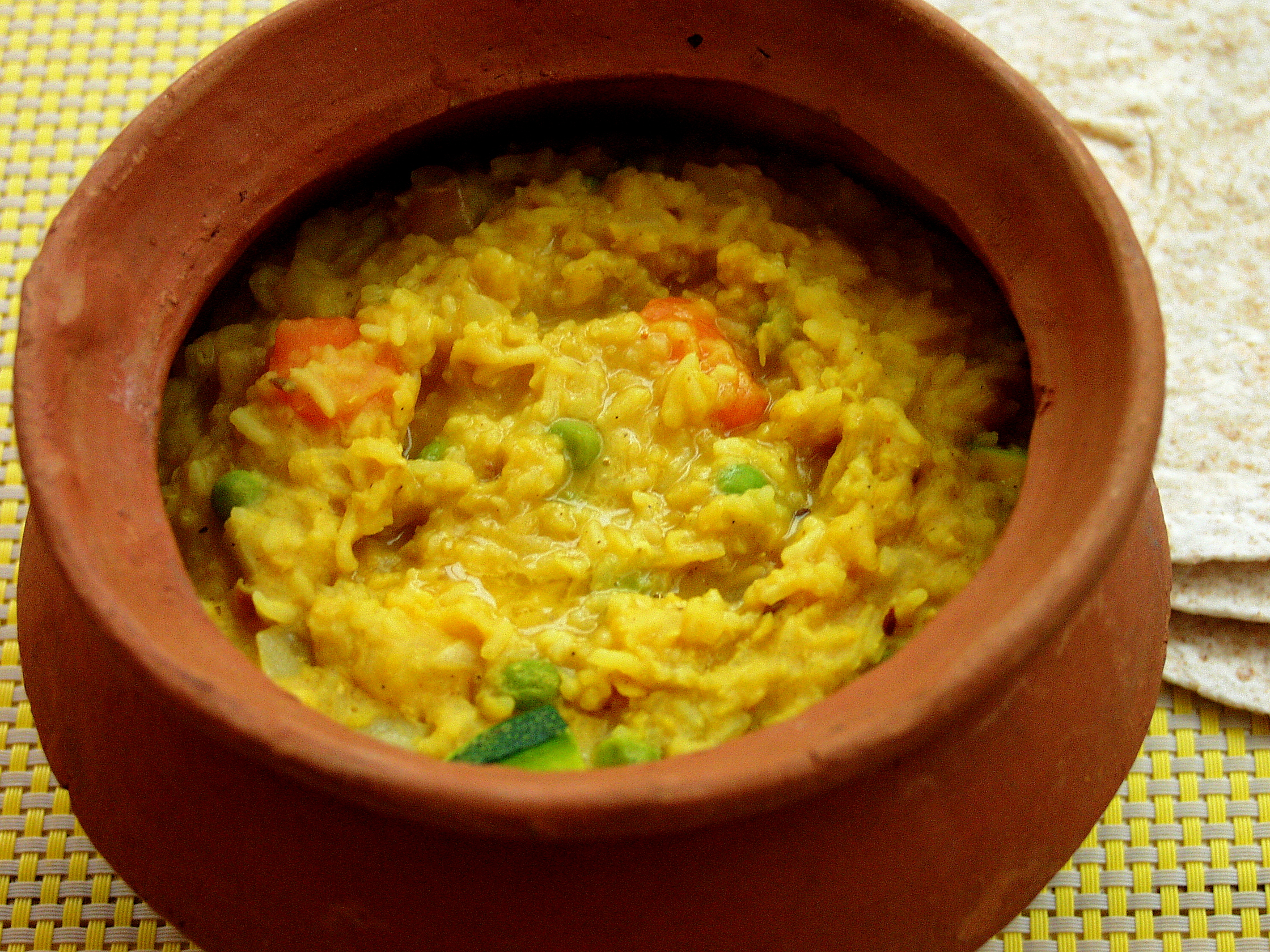
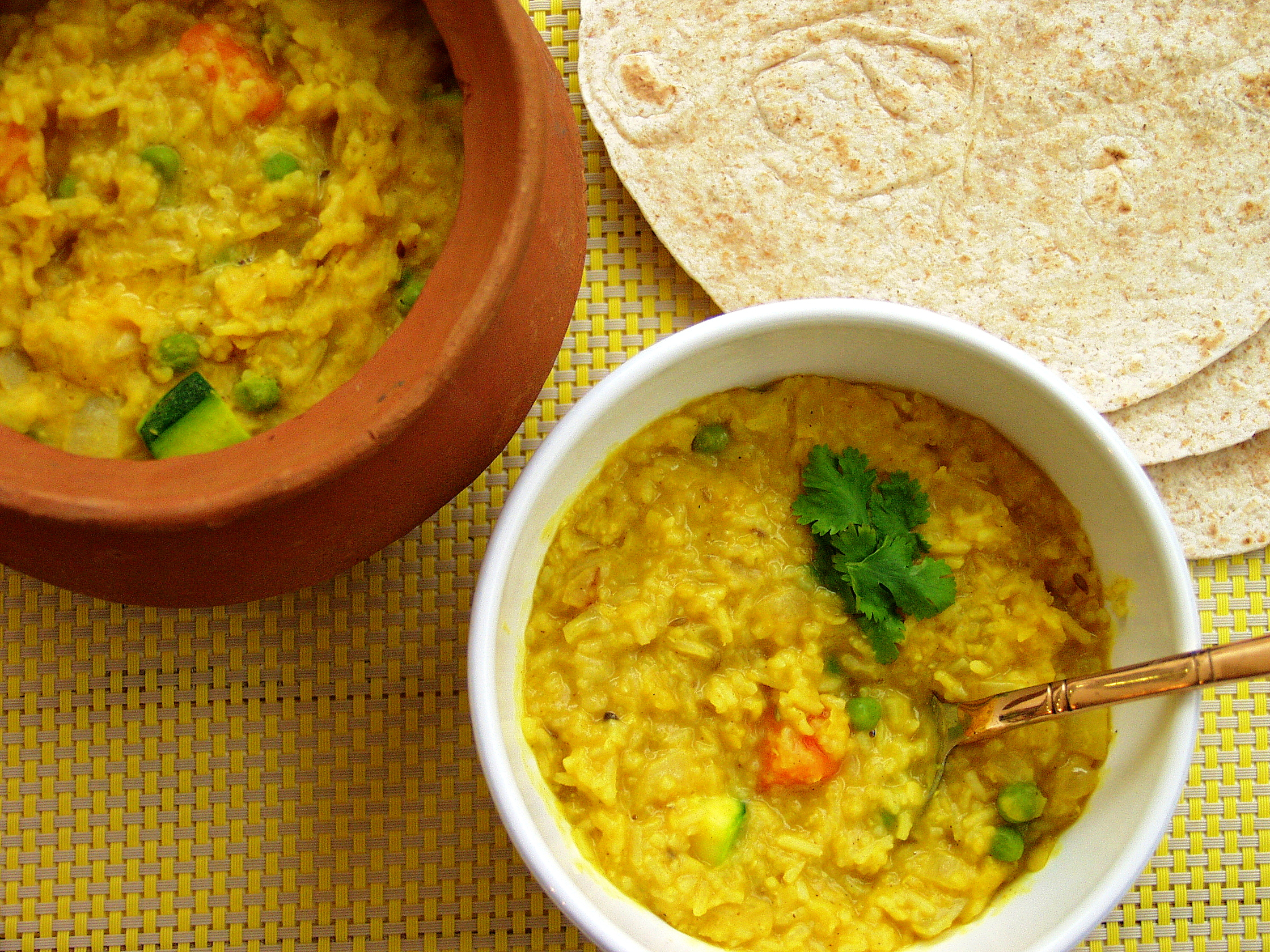
Bengali Khichuri – perfect for convalescing and detoxing

OLYMPUS DIGITAL CAMERA

If you are feeling a little under the weather, have the winter blues or just fancy some good old Indian comfort food, then read on, this post is especially for YOU>>>>>>>

Khichuri is a traditional Ayurvedic Indian dish, consisting of rice and lentils, that is given to those who are convalescing, detoxing  or fasting, it’s also really popular during puja time. Whilst it can be eaten in its pure form of rice and lentils (no onions or garlic), most khichuri that I have eaten consists of a vegetable or two thrown in as well. It’s the perfect dish to prepare if you need to use up any vegetables before they go off.  The Anglo-Indian dish of ‘kedgeree’ was inspired from khichuri and although it tastes very different the consistency is similar.

My eldest daughter (Big A) has been poorly recently and this is what I prepared for her as it is both nourishing and easy to digest.

There is no set rule on which lentil you need to use or vegetable for that matter. I tend to opt for red split lentils as they are the quickest to cook and need no soaking, although mung beans are also good to use (they do need soaking) as they are known for their ability to remove toxins from the body. My version includes carrot, courgette and and peas. Other vegetables would work equally well so if you have squash, marrow, cauliflower, pumpkin, green beans in the fridge (garden) pop one or two of them in and it will taste divine.

I have not included chilli in this dish as I was feeding it to my daughter, however, if you need a chilli buzz yourself just pop it in (whole or chopped) during  number 2 on the steps below.

OLYMPUS DIGITAL CAMERA

Bengali Khichuri

Serves 2-4

100g red split lentils

100g white rice (if using brown it will take twice as long!)

900ml boiling water

1 carrot, peeled and diced

1 large handful of fresh/frozen peas

1/2 courgette, partly peeled and diced

1 tsp of fresh ginger, finely grated

1 tsp garlic paste

4 green cardamom pods

1 tsp cumin seeds

1/2 white onion, finely chopped

1/4 tsp of garam masala powder

1/2 tsp turmeric

pinch of asafoetida/hing

1 tsp salt

freshly ground pepper

1 tbsp ghee/butter/or a splash of oil

fresh coriander to garnish

1. Rinse the rice and red spilt lentils a couple of times in cold water so as to get rid of any impurities and than place in a large saucepan with 900ml of boiling water and the chopped carrots and simmer gently for 15 minutes.

2. Meanwhile place the ghee/butter/oil in a saucepan and gently fry the onion. After 5-7 minutes add the cumin seeds, ginger and garlic and mix into the onions. Following this add the turmeric, garam masala, asafoetida and stir once again. Take a spoonful of the boiled rice and lentils and mix into the saucepan ingredients and then return it back into the main rice and lentil saucepan.

3. Stir all the ingredients together and add the courgettes and peas (or any other greens you need to finish up). Simmer for a further 5-7 minutes and add salt and freshly ground pepper to taste. You may find you need to add a little more water, but just enough to make sure that the rice and lentils do not stick to the bottom of the pan. It is not meant to be the same consistency as a soupy dal.

4. Serve into bowls with a sprinkling of fresh coriander.

OLYMPUS DIGITAL CAMERA


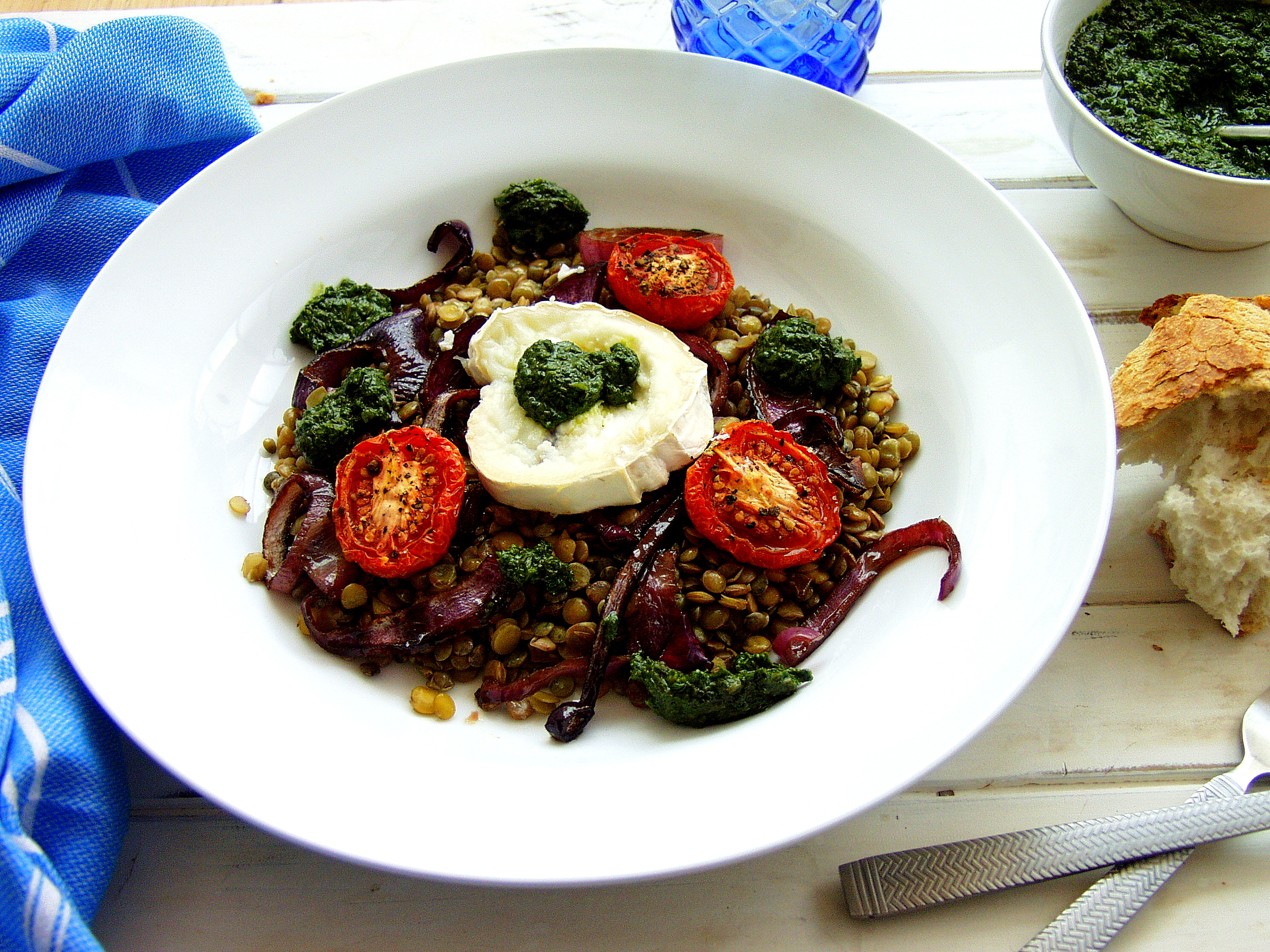
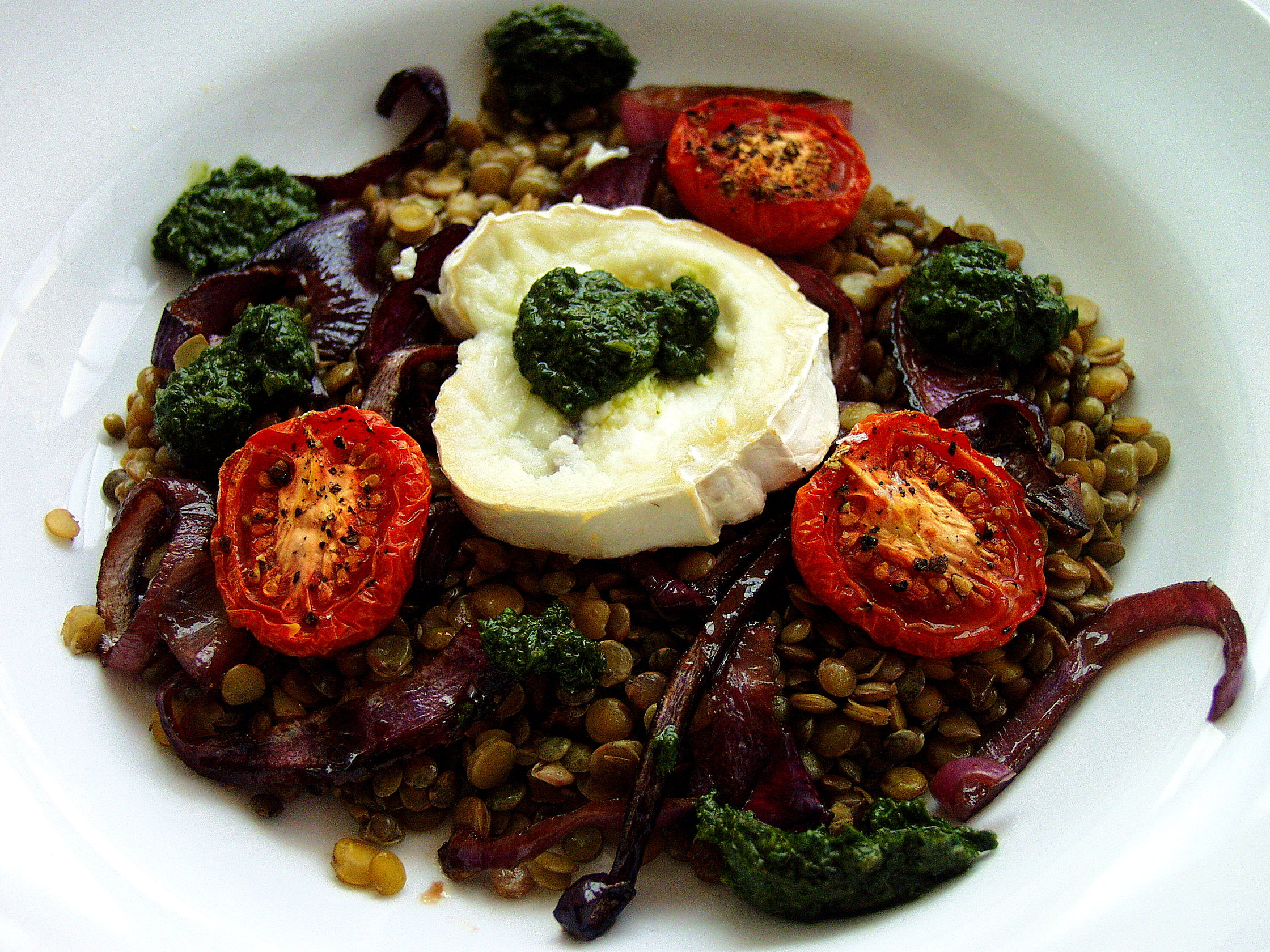
Wintery Warm Lentil and Goats Cheese Salad with a Fresh Basil dressing

OLYMPUS DIGITAL CAMERA

We’ve been having some glorious flurries of snow here in the UK, which has been rather exciting for us all. A blanket of snow makes London look magical and the silent, crisp air entices you outside to enjoy what nature has to offer. Whilst it is bitterly cold, returning to the warmth after some jollities in the fresh air is a welcome respite and I for one like nothing more than getting stuck into some cooking and baking. Big A and Little Z set about baking some biscuits, in fact lots of biscuits – I’ll blog this recipe once I have completely perfected it for you. Eating some warming, comforting food is totally necessary in this weather and lentils are the perfect food to tuck into.

The recipe today is great for the winter months, but can also be a fantastic dish in the spring and summer months eaten at room temperature and simply crumble the goats cheese instead of warming it. So if you are reading this in a hotter climate, fear not, you too can also cook the dish and be equally satisfied.

The trick though with this ‘salad’ is in the timing.  So if you are going to eat it warm please read the following.

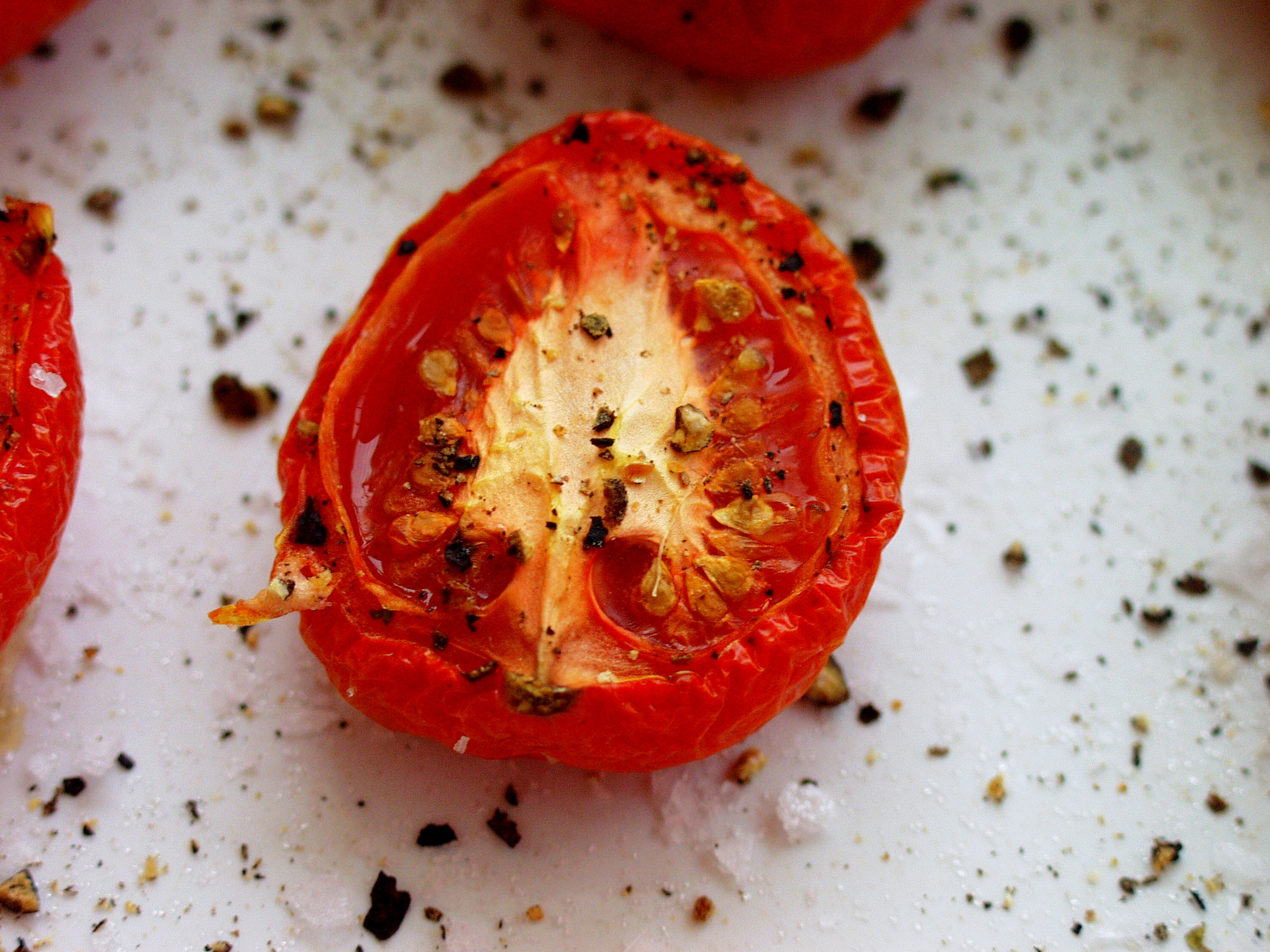
1) A few hours before you intend to eat the salad place the tomatoes sliced in the oven and cover with caster sugar, salt and freshly ground black pepper. Put them on a low heat (100 degrees centigrade or less even) to gently slow roast away. You want the tomatoes to shrivel up at the sides and the slow roasting will give them an incredible depth of flavour. Seriously off the charts kind of taste. 

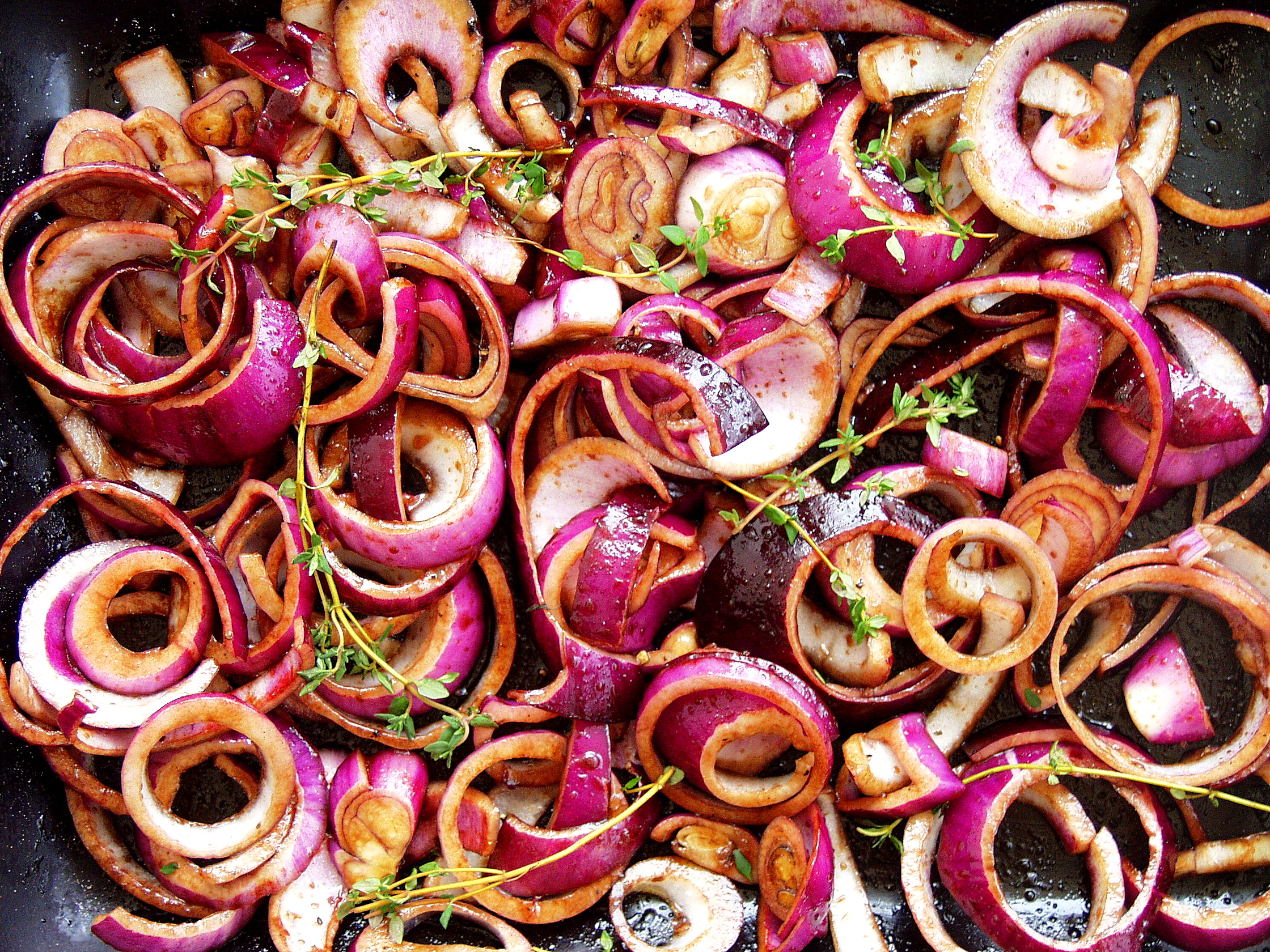
2) Place the sliced red onion rings on a baking tray covered in balsamic vinegar, caster sugar, olive oil, fresh thyme, salt and pepper and roast in the oven (180 degrees centigrade) for 25 minutes. If you do not have a separate oven to do this – as the tomatoes will need a lower heat – cook the onions first and then just heat them up in the low heat oven when the tomatoes are cooking to re-warm them.

3) Wash the lentils thoroughly then add cold water to cover them along with all the ingredients (listed below) and gently let them boil away for around 20 minutes. It is really important not to over cook them as they will become soft and soggy. You want to have them so that they still keep their shape.

4) Blend up the basil oil while the above is cooking away.

5) Plate up and whilst you are doing this place the goats cheese in a warm oven for a minute or two to warm it up then place on top of the lentils and drizzle with basil oil.

Whilst the ingredients length looks rather long…..please do not be put off as it really takes no time at all – bar the slow roasting of the tomatoes, which need to be cooked slowly over time. Everything, except warming the goats cheese in the oven, can be done ahead of time and then simply warmed up for a few minutes in the oven prior to serving.

Wintery Warm Lentil and Goats Cheese Salad with a Fresh Basil Dressing

adapted from Skye Gyngell’s recipe in her book ‘A Year in My Kitchen’

Serves 4-6

roasted tomatoes

6 plum tomatoes, halved

1 tbsp caster sugar

1 tbsp rock salt

liberally ground black pepper

———————————-

roasted red onions

5 red onions, sliced into circles

75g caster sugar

3 tbsp olive oil

3 tbsp balsamic vinegar

handful of fresh thyme

salt and pepper

————————————-

flavoursome lentils

400g lentils (I used a combination of green and small darkish green lentils but puy is also good!)

1 white onion, peeled and quartered

handful of fresh flat leaf parsley

2 garlic cloves, peeled

1 carrot, peeled and cut into three parts

2 inch piece of fresh ginger, peeled and cut into a few pieces

1 red chilli, kept whole

2 bay leaves

1 tbsp of fresh coriander stalks

———–

2 tbsp tamari (or soy sauce)

2 tbsp sherry vinegar

1 tbsp sesame oil

—————————————

basil oil

2 bunches of fresh basil

150ml extra virgin olive oil

1 garlic clove, peeled

salt and pepper

————————————

fresh goats cheese

6 slices of fresh goats cheese

—————

1) In the order of the above. Place the halved tomatoes into an oven proof dish and scatter with caster sugar, salt and pepper and place in the oven at a low temperature – 100 degrees centigrade works well – for up to 2 hours.

before slow roasting

OLYMPUS DIGITAL CAMERA

slow roasted to perfection!

OLYMPUS DIGITAL CAMERA

2) Slice the onions into circles and scatter in a roasting tin along with the balsamic vinegar, caster sugar,olive oil, salt, pepper and thyme and mix together well with your hands. Place in an oven at 180 degrees centigrade for 25 minutes.

before roasting

OLYMPUS DIGITAL CAMERA

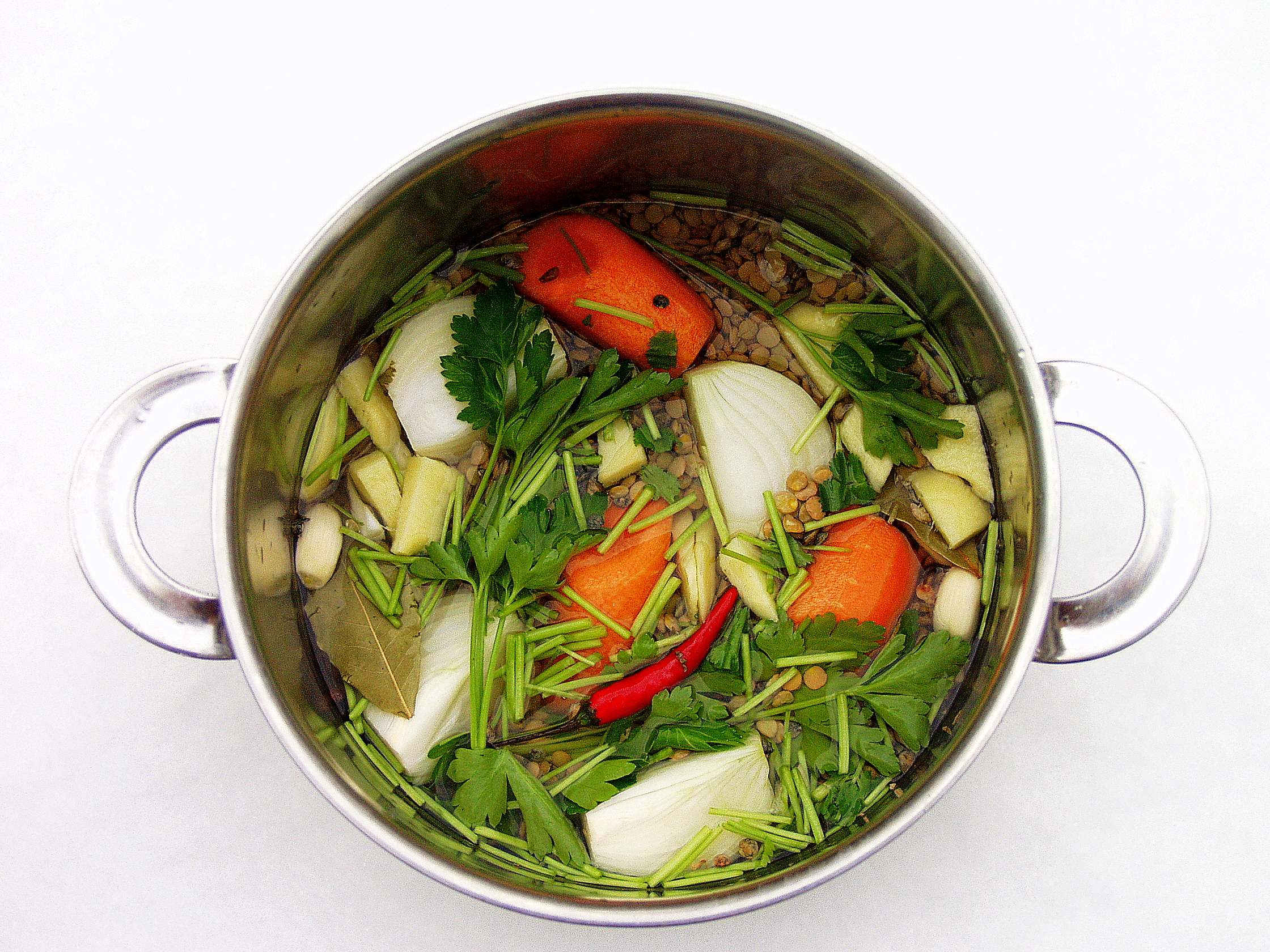
3) Wash the lentils and then cover with cold water. Add the carrot, red chilli, onion, garlic, ginger, fresh parsley, bay leaves, coriander stalks and bring to the boil and then gently simmer for 20 minutes (or what is advised on the packet). Be careful not to over cook the lentils. 

lentils ready for the boil

OLYMPUS DIGITAL CAMERA

4) Place the fresh basil in a food mixer and blend. Slowly add the olive oil to the chopped basil and add salt and pepper to taste. If you prefer to have more of an oily basil then just add a little more olive oil. I rather like to have it so that you can add little dollops to the plate. (see below)

OLYMPUS DIGITAL CAMERA

5) Drain the lentils and remove the added ingredients as their job to flavour the lentils is now complete. When the lentils are still hot add the tamari, sherry vinegar and sesame oil and mix together.

6) Slice the goats cheese and place on an oven proof dish and place in the oven for a minute or two.

7) Plate up the lentils and add a generous helping of roasted onions, tomatoes and the goats cheese in the middle on the top with some dollops or drizzle of fresh basil oil and leave the rest in a separate bowl for guests to help themselves to more as they see fit.

8) Tuck in and enjoy along with some fresh bread on the side. It is absolutely heavenly. I know I often say that but seriously all the above effort is SO worth it.

Aside from the roasting of the tomatoes, this dish took me 30 mins to cook and plate up.


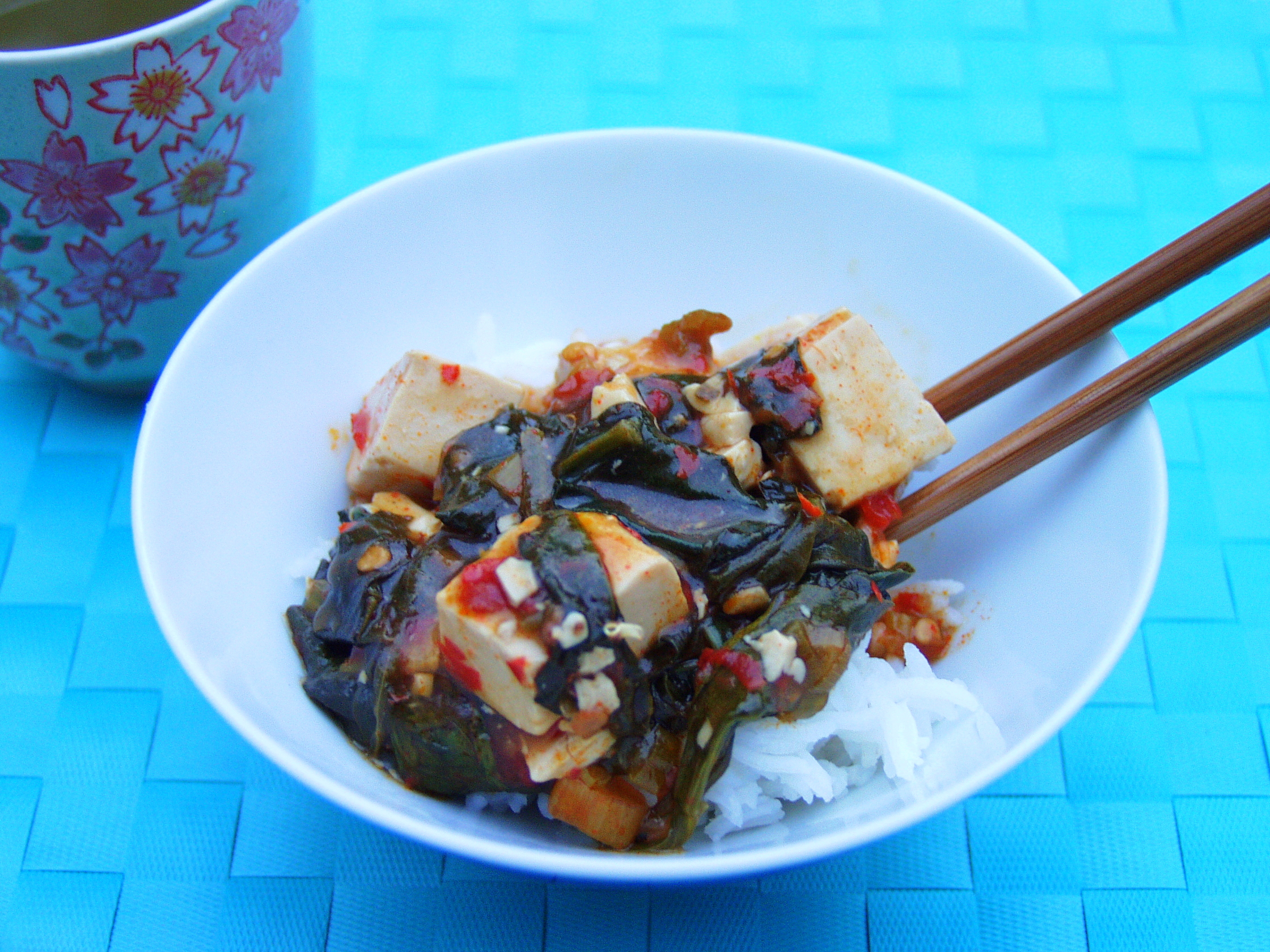
Vegetarian Ma Po Tofu


OLYMPUS DIGITAL CAMERA

In my first months of blogging, way back in the middle of 2011, I posted one of my absolute favourite recipes, Ma Po Tofu, which is a Sichuan classic and is seriously addictive – if you like chilli that is. It is incredibly easy to cook and after a manic day it is the perfect pick-me-up-food that takes no time to prepare. Over the years however, I have found that I am increasingly making it without the pork mince element and keeping it to a more vegetarian dish by including simply tofu and fresh (or sometimes frozen) spinach.

Recently in Hong Kong I began to judge eating establishments on how well they could cook Ma Po Tofu and Dan Dan Noodles as I had a acquired a taste for both dishes.

OLYMPUS DIGITAL CAMERA

Tofu I know divides opinion, but I am definitely in the camp of someone who loves it. It wasn’t an immediate love affair, but one that has grown over time to the extent that I always have tofu in the house, ready and waiting for me to make a last minute Ma Po Tofu dish or my other favourite tofu dishes, roasted harlequin squash with tofu, kale and coriander in a miso curry paste, black pepper tofu and soba noodles with tofu, aubergine and mango. Seriously give them all a try – I don’t think you’ll be disappointed.

OLYMPUS DIGITAL CAMERA

Tofu, or bean curd as it is also known, is hugely nutritious, versatile and a great vehicle for flavour. It’s rich in protein and low in fat, especially saturated fat. Yes, eaten on its own it is rather plain, but the point of tofu is to incorporate it with other flavours which it will help to enhance and lift. There are a myriad of different types of tofu, but the one I tend to use the most is ‘firm, silken tofu’ . I am going to be cooking some more tofu dishes over the course of this year, hoping that I may convert a few followers to the joys of tofu eating.

So here is what you need for the vegetarian version of the dish.

OLYMPUS DIGITAL CAMERA

Vegetarian Ma Po Tofu

Serves 2/3

349g silken tofu (or a similar amount)

2 large handfuls of fresh spinach

1 tbsp vegetable oil

1 clove of garlic, finely chopped

2 spring onions, chopped

2 tbsp of chilli bean sauce (Lee Kum Kee’s I find works really well)

125ml of vegetable stock (fresh or a cube)

1 tsp shaoxing wine

1 tsp of soy sauce (light or dark)

2 tsp of sugar

1/4 tsp of sea salt

a good pinch of crushed Sichuan peppercorns

1/2 tsp of sesame oil

1. Cut the tofu into small (2cm) cubes and place to one side.

2. In a shallow pan heat the vegetable oil and then add the garlic and spring onions, stirring for around 30 seconds. Then add the chilli bean paste and mix into the garlic and spring onions.

3. After a minute add the vegetable stock, shaoxing wine, soy sauce, sugar and salt and bring to the boil.

4. Add the spinach to the pan and gently fold into the hot sauce.

5. Once the spinach has begun to wither add the tofu and carefully spoon the sauce over the tofu, making sure not to break up the cubes. Leave to gently simmer for a couple of minutes.

6. Serve into a large bowl and sprinkle the Sichuan peppercorns and sesame oil and gently mix together.

Serve alongside small bowls of rice and hot cups of piping Jasmine/Chinese tea.

Perfect for this cold snowy weather.


First impressions of Hong Kong and getting over jet lag

IMG_6478

There is always something rather thrilling about going on a trip or a journey, but when you’ve never visited the destination before there is an added level of excitement and anticipation. The smells, sights, sounds and general fever of the place seize you almost immediately as soon as you step foot on to Hong Kong soil. I always knew that the place would be frenetic with activity but seeing and experiencing it in the flesh is another thing. Hong Kong is buzzing and bustling with people. An initial impression is the sheer number of people who all live here side by side, or perhaps more aptly I should say – on top of, in huge towers reaching to the stars. Vertical living is very a la mode and living in dinky dwellings is standard practice.

IMG_6397

Whilst a lot is packed into Hong Kong there are also places to be found where there is an element of calm and serenity and to watch the world go by. One of the first places that I went to visit was the Man Mo temple, which is the oldest temple in Hong Kong, having being built in 1847. I thought it was necessary to experience the old if I was to truly understand and appreciate the new and besides I always enjoy visiting temples and churches when visiting a new country as I find it helps to better understand the underlying fabric of that country.

IMG_6399

The temple did not disappoint and as I strolled around it I particularly enjoyed the heady aromas from the incense coils that hung from the ceiling. From the outside the temple stands surrounded by tall tower blocks, which makes a slightly surreal sight.

IMG_6400

IMG_6395

Near to the temple I came across this wonderfully vibrant street art that really appealed to me; I think Banksy would definitely approve.

IMG_6427

Getting to know a city I like to amble around on foot as this not only helps me get my bearings but also see what the locals are up to. Street food sellers were out in abundance selling all manners of temptingly delicious snacks to feast upon.

IMG_6456

As our body clock is a little confused at the moment, we are eating at rather random times of the day, that said little Z and big A always seem to be hungry around tea time and therefore are ready for a little cake to give them some energy before more sight seeing then supper. We have come across a number of bakeries selling all manner of wonderful tasting cakes. Egg tarts are popular here as well as buns filled with red bean paste.

IMG_6454

We visited a fish market, but it is unlike the fish markets we have in the West as the fish here were not to eat. Oh no, if you want to find fish and meat to eat as well as vegetables and fruit you need to visit a ‘wet market’ which are scattered all over Hong Kong. I hope to take some photos of these over my stay so watch this space for more on this soon.

IMG_6421

Tropical fish for sale at the Fish Market in Mong Kok

Our first evening meal out in Hong Kong was dim sum at the very popular Din Tai Fung, which is in fact a Taiwanese import. It’s famous for it’s Xiao Long Bao, which are steamed pork dumplings filled with broth and dipped into vinegar and ginger – basically little mouthfuls of joy! I liked the way that they had instructions on how to ‘eat’ the little darlings. How very thoughtful!
IMG_6381

The winner on the dim sum stakes so far though comes from Hutong where we ate delicious tasting dumplings filled with pork and fennel – ones I wouldn’t mind attempting to make when back in London. Another favourite at Hutong was the Chicken Pot with Sichuan peppers, addictively delicious and not as ‘hot’ as you would think!

IMG_6491

As I mentioned we have all been experiencing a bit of jet lag so I decided to make a southing, homely broth for our first lunch on Hong Kong soil. After gathering a few ingredients I made the following dish, which seemed to hit the spot after a long journey. I kept ours vegetarian, but it would taste equally good with a bit of salmon or trout thrown in for a couple of minutes. Here is how to make it.

IMG_6378

Jet lag Noodle Broth

Serves 3 (and enough for seconds)

splash of olive oil

3 garlic cloves, sliced

1 inch of fresh ginger, peeled and thinly sliced

3 tbsp light soy sauce

1 heaped tsp of vegan Bouillon/vegetable stock

boiling water (to cover veg and noodles)

generous handful of Chinese broccoli (Gai Lan) or regular broccoli/spinach/pat choi

6 small tomatoes, halved

3 eggs, boiled, shell removed and halved

2 packs of udon noodles (or 3 if you are serving just adults)

1. Place the eggs into a pan with cold water and when the water has boiled cook the eggs for 4 minutes, less if you like it soft boiled.

2. Meanwhile place a little oil in a medium sized deep pan and when it is hot add the garlic and ginger and stir for a minute before adding the soy sauce.

3. Next add the boiling water so that it reaches a quarter of the way up the pan – you can add more a little later. Add the Bouillon or vegetable stock that you are using and stir well.

4. Add the Chinese broccoli and after 2 minutes add the udon noodles. You may wish to add a little more boiling water at this stage. Taste to see if it requires a little more soy sauce. Add the tomatoes no more than a minute before serving so that they still hold their shape. If you prefer softer vegetables then cook the Chinese broccoli for a little longer, but I find a couple of minutes is more than enough.

5. Serve with a slice or two of boiled egg.

Warming, delicious and ever so quick, before you collapse and have another little sleep.

Other ingredients that would be great to add: fresh chilli, spring onions, fresh salmon/trout, mushrooms.

IMG_6483


Curried Potatoes and an Award

There has been a whirlwind of activity in my household this week, getting ready for our departure to Hong Kong for the Christmas holidays. Big A and little Z breaking up from school and I have been doing last minute Christmas shopping – all done now, big sigh of relief – on top of that the ‘outlaws’ are spending this week with us, which means there is a lot of feasting and fragrant Indian cooking smells coming from the kitchen. A sprinkling of Christmas drinks with the traditional mulled wine (blog post for christmas 2013 I think) and carol concerts have added to the Christmas spirit and excitement.

Out of the blue this morning I received a ‘Blog of the Year Award’ from the lovely Charu who writes Soul of Spice, and whose blog I enjoy following immensely.

As part of the honour I must bestow the award on others that stand out for me. It’s a tough call as there are many strong contenders out there, but there are two obvious ones for me:

1) The Garum Factory. Written by husband and wife, Ken and Jody who are based on the east coast of the US.  Importantly the recipes are temptingly delicious and ones that I actually want to cook (mainly savouries, which suits my palette) The photographs always inspire me to try and improve mine ;o) and the narrative is always very amusing. I also mentioned The Garum Factory in a past post here

2) The other one I always enjoy reading and perusing over is The Hungry Australian written by Christina. She always seems to have a million things going on at once (running Eat Drink Blog conferences, the food blogger hop, writing articles for magazines, being a good mother, wife etc)  but is consistent at posting interesting blog posts with bright, impressive photos and interesting recipes, many with an Asian twist – which is  a winner in my book.

So I pass on the honour to both of you. Congratulations.

Blog of the Year Award 1 star thumbnail

The rules to accept this award:

1. Select the blog(s) you think deserve the ‘Blog of the Year 2012’ Award
2. Write a blog post and tell us about the blog(s) you have chosen – there’s no minimum or maximum number of blogs required – and ‘present’ them with their award.
3. Please include a link back to this page ‘Blog of the Year 2012’ Award – and include these ‘rules’ in your post (please don’t alter the rules or the badges!)
4. Let the blog(s) you have chosen know that you have given them this award and share the ‘rules’ with them
5. You can now also join our Facebook page – click the link here ‘Blog of the Year 2012’ Award and then you can share your blog with an even wider audience
6. As a winner of the award – please add a link back to the blog that presented you with the award – and then proudly display the award on your blog and sidebar … and start collecting stars…

6-stars-image

Yes – that’s right – there are stars to collect! Unlike other awards which you can only add to your blog once – this award is different! When you begin you will receive the ‘1 star’ award – and every time you are given the award by another blog – you can add another star! There are a total of 6 stars to collect. Which means that you can check out your favourite blogs – and even if they have already been given the award by someone else – you can still bestow it on them again and help them to reach the maximum 6 stars!

We all love potatoes right? So I thought that a new way to cook them might appeal to you all, hence the curried potatoes recipe below. I am sure I am not alone in saying that potatoes and rice are the two staples that you will always find in households, so if you want to cook an easy, cheap and quick supper making this dish, along side a dal for example, makes a really filling and tasty supper/lunch.

Curried Potatoes

Serves 4

2 tbsp mustard oil (or vegetable oil if you don’t have mustard oil)

500g small potatoes (I use Charlotte, but new would be good too)

1 tsp mustard seeds

1 onion, finely chopped

1 green chilli, chopped in half

4 inch piece cinnamon bark, broken into pieces

3 curry leaves

2 cloves

1 tsp turmeric

150 ml water

1 tbsp yoghurt

1/2 tsp sugar

1 tsp salt (to taste)

1. Boil the potatoes until they are softened – this will take around 10 minutes. Drain and place to one side.

2. In a pan gently heat up the mustard oil and when it is hot add the mustard seeds and stir for 10 seconds, then add the chilli, cloves, salt, sugar, cinnamon bark and curry leaves and stir once again.

3. Add the onion to the pan and stir into the spices. When they have softened and begin to bronze add the turmeric followed by the potatoes and stir in together so that they are properly coated in the spices.

4. Place the water and yoghurt in the pan and gently simmer  with the lid on until the water has almost completely been absorbed.

Serve immediately with some Indian bread, such as luchi or paratha. It would also go very well with a cinnamon and ginger dal


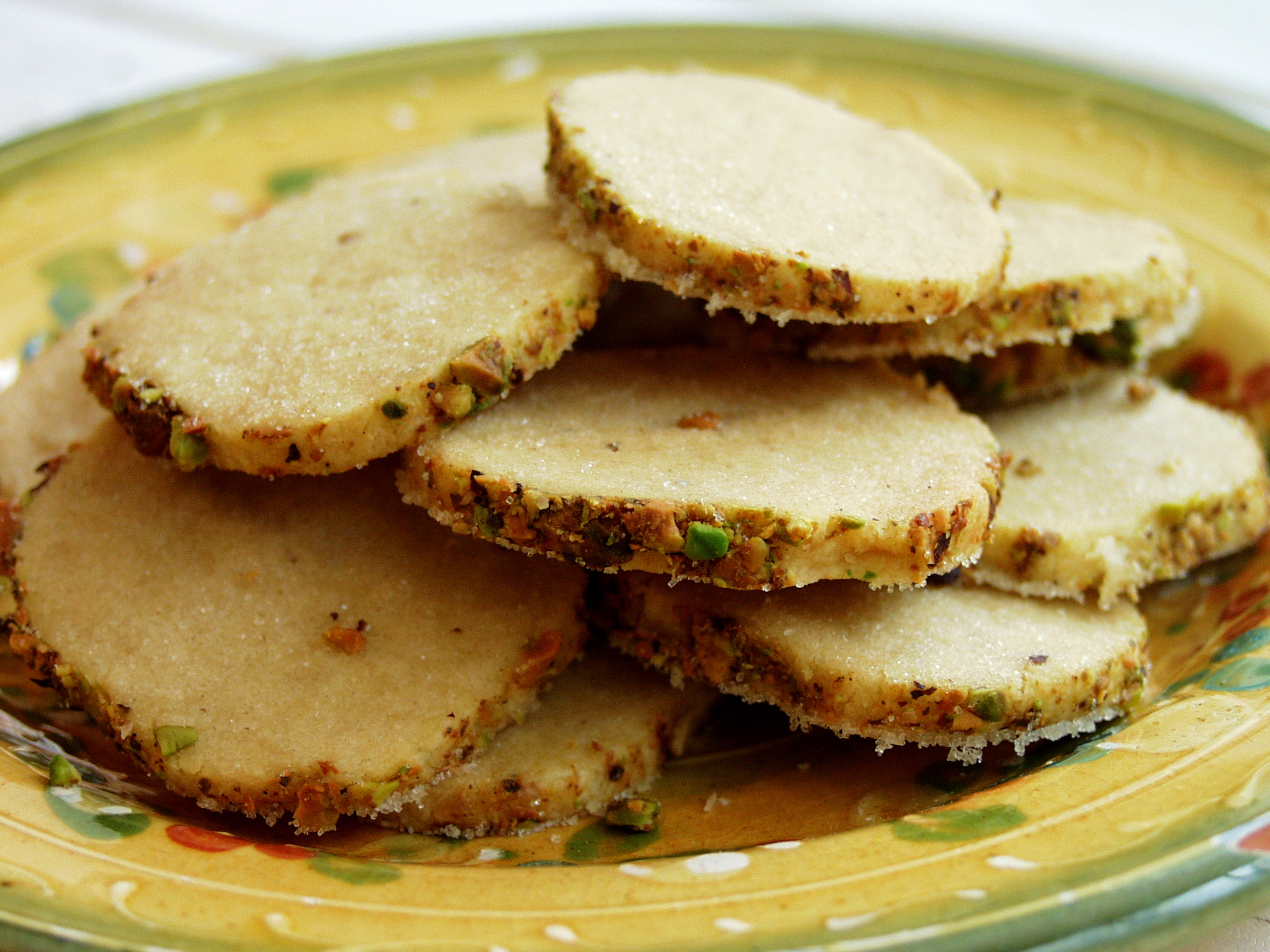
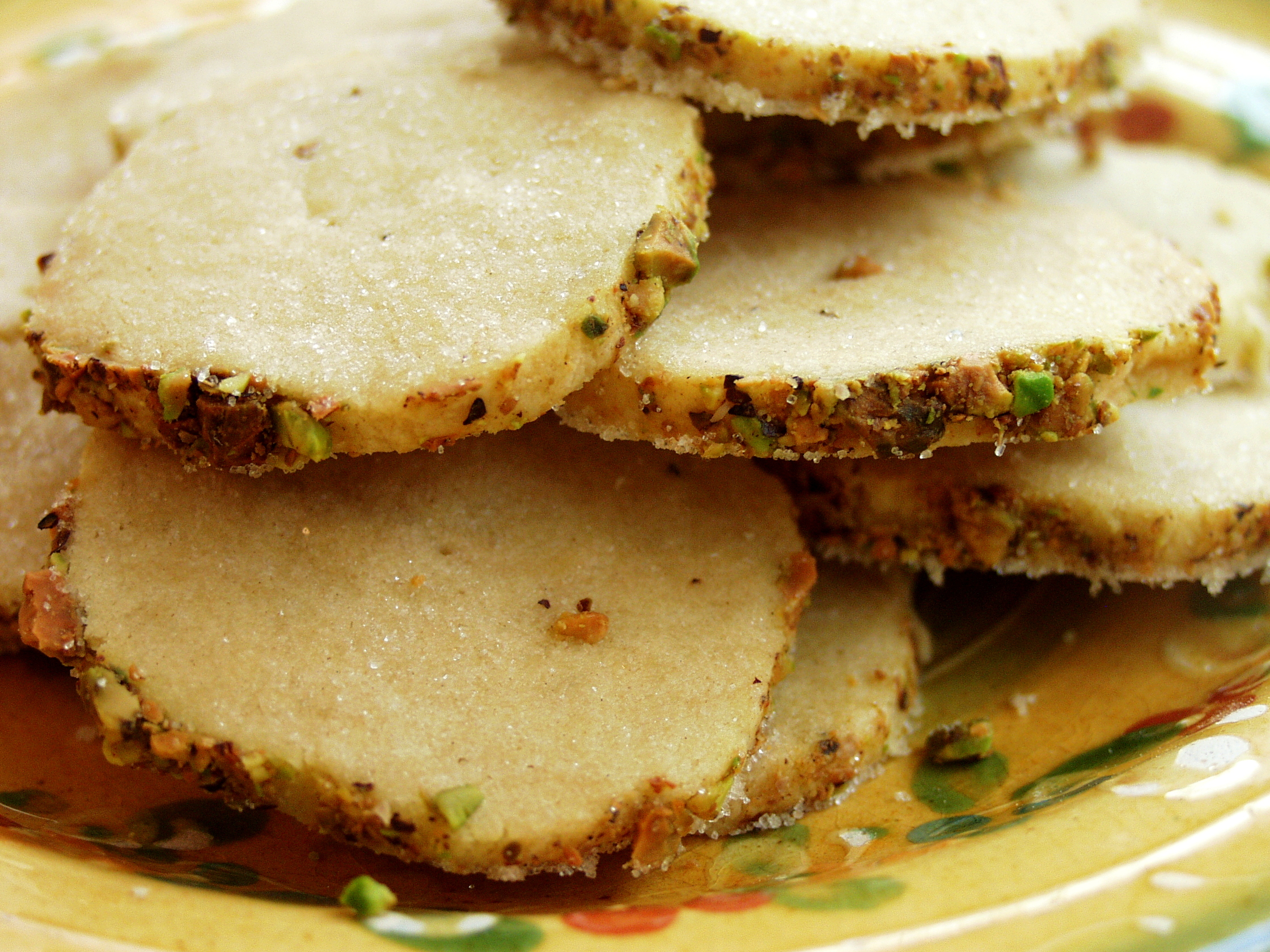
Pistachio and Cardamom Shortbread Biscuits

It’s always good to have a go-to biscuit that is straightforward and not too time consuming to make, but also has an added complexity in taste that makes it stand out from the crowd. This shortbread biscuit ticks all those boxes with flying colours. The flavours of cardamom and pistachio sing to me and the partnership is one to be jubilant about. I find it’s great to make a batch and freeze (before cooking) some of the dough, wrapped in cling film, that you are not needing, until you want to make another batch at a later date. At this stage simply remove from the freezer and let it defrost before making incisions into the dough to make your biscuits.

With the festive season almost upon us, I also find that they are a great offering to give to friends that you are visiting either wrapped in brown baking parchment, tied with some vintage twine or red ribbon, or placed in a sealed jar. Either way, the effort and initiative will definitely bring a smile upon the receiver.

Pistachio and Cardamom Shortbread Biscuits

sourced from Ottolenghi The Cookbook

Makes around 30

8 cardamom pods

200g unsalted butter

25g ground rice

240g plain flour

1/2 tsp of salt

35g icing sugar

60g shelled pistachio nuts

1 free-range egg, lightly beaten

2 tbsp vanilla sugar

1. Crush the cardamom pods, using a pestle and mortar and once the seeds have been released remove the skins and then crush the seeds into a fine powder. The smell is sensational.

2. Place the butter, ground rice, flour, salt , ground cardamom and icing sugar in an electric mixer and whisk until the ingredients have bound together to create a ball shape and immediately transfer the dough onto a cold surface sprinkled with a little flour. (see photo below)

3. Using your hands roll the dough into a log shape. If you want really large round biscuits then keep the the log short in length, however, if you would prefer small or medium sized biscuits then elongate the dough further. There is no hard and fast rule on how large the biscuits need to be. Wrap in cling film and place in the fridge for over an hour.

4. Meanwhile, place the pistachio nuts into the electric mixer and give them a quick wizz so that they are broken up slightly. If you do it for too long they will become too fine!

5. Place the crushed pistachio nuts on a flat surface and take the cling film off  the dough (and place the cling film to one side) and brush the log with the beaten egg. Now roll the dough over the top of the pistachio nuts; you may need to give a helping hand and place a few pistachio nuts into the side of the dough. Put the same cling film back on the dough log and place back into the fridge for a further 30 minutes.

6. Preheat the oven to 150 degrees. Remove the cling film and using a sharp knife cut the dough log into even slices and place them on a baking tray lined with baking parchment, placing them 2cm apart. Dust the biscuits with vanilla sugar and place in the oven for around 20 minutes so that they are golden, but not bronzed. Keep a close eye on them.

7. Remove from the oven and allow to cool completely as they will harden as they cool. If you pick them up before they are cool they may well crumble. Once they have cooled store in a sealed jar or container for up to a week.

Rolled out the dough log on a cold surface sprinkled with flour

Roll out the cold dough log over the pistachio nuts

Place the biscuits slightly further apart (2cm) than I have done above or they will begin to join together.

I was pretty lucky but it got close ;0)

Baked and ready to eat


Baba Ganoush – it definitely has a ring to it!

I have to admit that it was initially the name of this wonderfully smokey aubergine (eggplant) dip/appetizer that caught my attention. I know you probably think I’m mad and just another one of those English eccentrics, but seriously saying ‘Baba Ganoush’ out loud has a wonderful ring to it – give it a try and you’ll see what I mean. You’ll want to keep saying it again and again, I promise you it’s rather addictive sounding. Coupled with the smokey undertones of this pureed roasted aubergine with tahini (sesame paste), lemon, garlic and olive oil and you have a perfect little dish. The name itself means ‘father pampered or spoiled’ in other words, it’s a dish that will please and delight and give great joy to those who feast upon it. It will bring smiles, rest assured!

It is common place in Lebanon, Israel, Turkey, all the Arab countries and North Africa, with each region taking their own spin on the  added extra ingredients. For example, in Palestine, yoghurt is often added to the mix, whilst in Lebanon pomegranate juice is sometimes added instead of the tahini and in Iran tomatoes, onion and turmeric is added. Some people like it to add cumin but I find that the perfect dish is one that is not too over complicated with different ingredients. The simplicity of it adds to it’s appeal.

We ate it on a number of occasions this summer in Turkey, cooked outside on an open fire. It tasted delicious and I made a note to myself there and then to share this recipe with you all. My recipe is very similar tasting to the one that I used to buy in those Middle Eastern supper markets around the Edgware Road in London. I acquired a taste for that style of Baba Ganoush, so when I started making my own homemade version the one I wanted to replicate was the one I used to eat in my youth – or perhaps I ought to say  early 20’s!

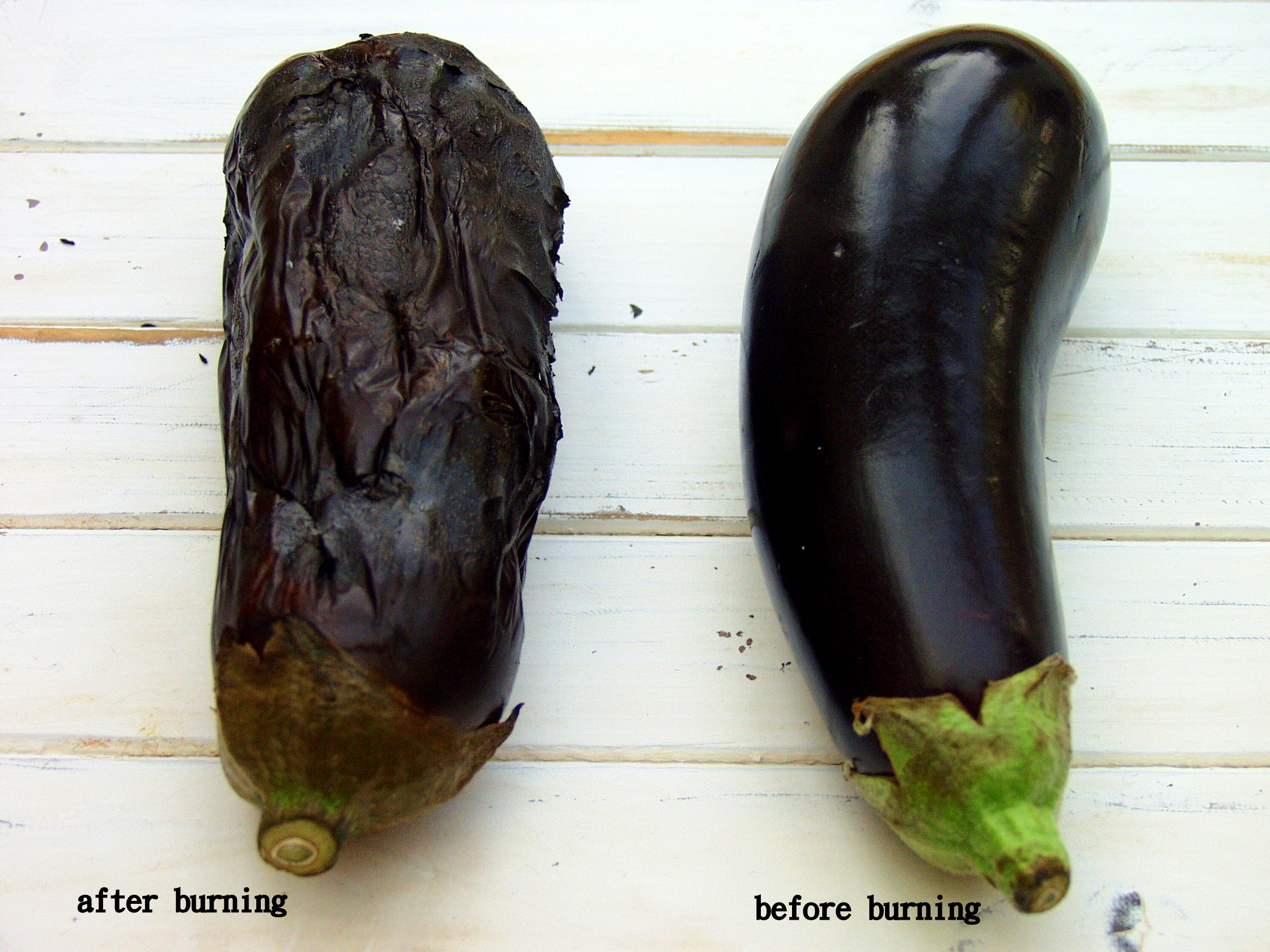
There is no hard and fast rule to making Baba Ganoush, so experiment and get creative and see which type really works for you. What I will say however, is that if you like it smokey – which is kind of the point of the dish – it is important to really burn the outside of the aubergine. Using tongs I roast them initially over a gas flame on my hob before putting them in the oven for 25 mins to soften them completely. If you don’t have a gas flame, placing them under a high grill so that the skins blacken and burn slightly, will have a similar smokey effect, but don’t forget to turn them regularly if you do this!

Baba Ganoush

Serves 4

3 large aubergine/eggplant

3 tbsp tahini (sesame paste)

juice of one and a half lemons

1 large tsp rock salt (or to taste)

3 garlic cloves, crushed

2 tbsp olive oil

1 pinch chilli powder

1 pinch sweet paprika

1 small handful of chopped flat leaf parsley

1. Preheat an oven to 180 degrees. Using tongs hold the aubergine over a gas flame so as to burn and blacken the skin. The more the skin burns the more smokey your Baba Ganoush will be. The skin should be sufficiently burned from between 6-10 minutes.

2. Place the aubergines on a baking tray and place in the oven for 25 minutes or until the aubergine is completely soft.

3. Leave to cool and then peal off the aubergine skin and discard the skin.

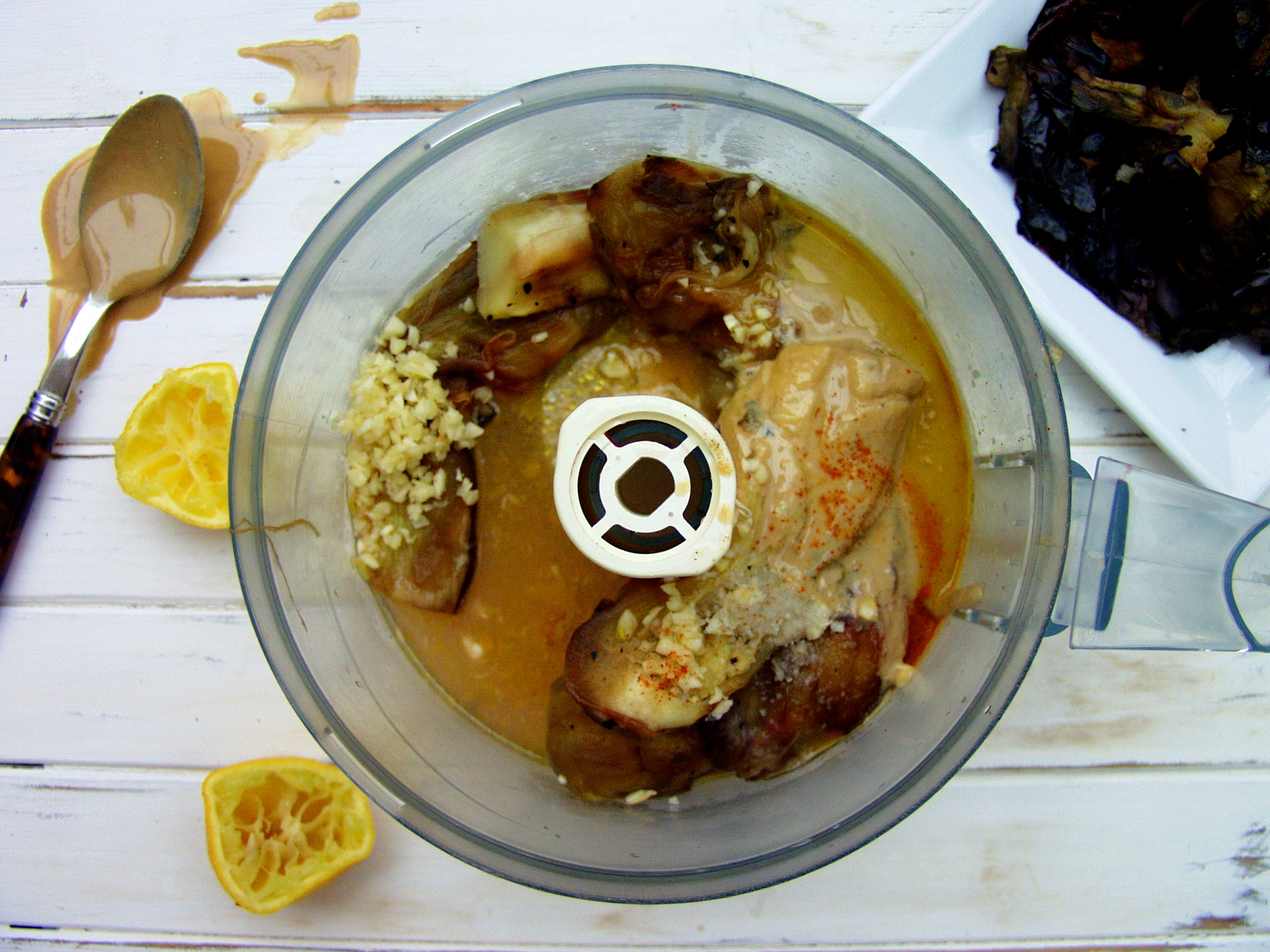
4. In a blender add the smoked aubergine flesh, tahini, lemon juice, chilli powder, salt and  half the olive oil and blend to a pulp. Taste and add more lemon juice/tahini/salt if required.

5. Place in a dish and add a pinch of sweet paprika, flat leaf parsley and the remaining olive oil and serve with toasted pitta bread, chapati or middle eastern bread.

It stores well in the fridge for a few days so great to cook in advance.

As you gently singe the skin of the aubergine the lovely smokey smells will come through.

After 25 minutes in the oven the aubergines will be very soft. Leave to cool before peeling off the skin, which should come away really easily. If they are at all hard in places, leave to cook for a further 5 minutes before checking again with a sharp knife. If the knife easily pierces the skin and goes through the aubergine then it is ready.

Into the blender goes the smoked and oven baked flesh of the aubergine, tahini, garlic, pinch of chilli powder, lemon juice, salt and olive oil.

I couldn’t resist a photo of my recent antique find – a c.1860 French steel and rosewood handle herb chopper, with the chopped flat leaf parsley ready to go on the top of the baba ganoush.


Mung Bean and Cumin Dal and Durga Puja Festivities

This past weekend has been one of celebration as it was Durga Puja. For Bengali Hindus (my husband’s side of the family) Durga Puja is the biggest religious festival in the Hindu calender. In Kolkata, which is the heart of Bengal, I am told it is taken to another level altogether, when families feast, dance and pray to the goddess Durga – the conquerer of good over evil and the mother of the universe, as well as her children: Ganesh, Saraswati, Lakshmi and Kartik. Schools close and everyone takes time off work to celebrate.

The statue of goddess Durga on her lion fighting the demon Mahishasura in the Hounslow Pandal

Tooting Goddess Durga 

The making of the statues is a hugely lucrative business in India and at the end of the six day festival the statues are ceremoniously carried to the Ganges and left to drift away and be reabsorbed into the Ganges. The statutes themselves are made of straw and mud from the Ganges and then glazed with paint to give them that glossy shine; the craftsmanship and detail never ceases to impress me.

There are thousands of Durga Puja pandals, which are basically huge structures housing the goddess and her children, erected all over the different Kolkata neighbourhoods. It’s all hugely competitive and each pandal competes for attention in beauty and innovation. I visited two different ones in London – one in Tooting and the other in Hounslow and both were very spectacular in terms of colour and design, the latter I know had been shipped from Kolkata.

Ganesh – one of Durga’s offspring in the Hounslow Pandal

The banging of the drums, the blowing of the conch shell, the incense, the chanting of the prays and hustle and bustle of people coming and going really transports you to India. It’s all rather frenetic and yet very warm and inviting at the same time. In the Hounslow pandal alone thousands of visitors came and went over the course of a few days. Catering for that number must be rather daunting but I was very impressed by the taste and quality of the food and the fact that it was all hot. It was the longest queue for food I have ever witnessed, but it moved quickly and before long we were given a plate of tasty vegetarian food.

Some vegetarian cuisine given to those who attended the Hounslow puja in London

Back at home I have been cooking an endless amount of Indian dishes from: methi and pomegranate pork curry to amma’s chicken curry, red lentil dal with spinach, yellow dal with courgette, Bengali fish curry and mung bean and cumin dal.

It is the mung bean dal recipe that I wanted to share with you all today. Unlike red split lentil and some yellow dal it does require a little more forward planning as it needs to be soaked, ideally overnight.

It’s delicious, nutritious, cheap to make and other than the soaking of the mung beans, is very straightforward. My mother-in-law makes a completely different tasting mung bean dal, which I will post another time, but to get you started try this one and let me know how you get on. It’s perfect for a week night vegetarian supper.

Mung Bean and Cumin Dal

Serves 4

250g mung beans (also referred to as moong bean), soaked overnight

3 tbsp mustard oil

1 white onion, finely chopped

1 tsp cumin seeds

1 tsp turmeric

half tsp red chilli powder

half tsp garam masala powder

half tsp cumin powder

1 tsp salt

juice of half a lemon

fresh coriander to serve

1. Place the pre soaked mung beans in a pan and cover with water and gently simmer until softened. This will take around 40 minutes.

2. Meanwhile, place the oil in a pan and gently fry the cumin seeds for a minute or so until they begin to bronze. Immediately add the onion and mix together with the cumin seeds.

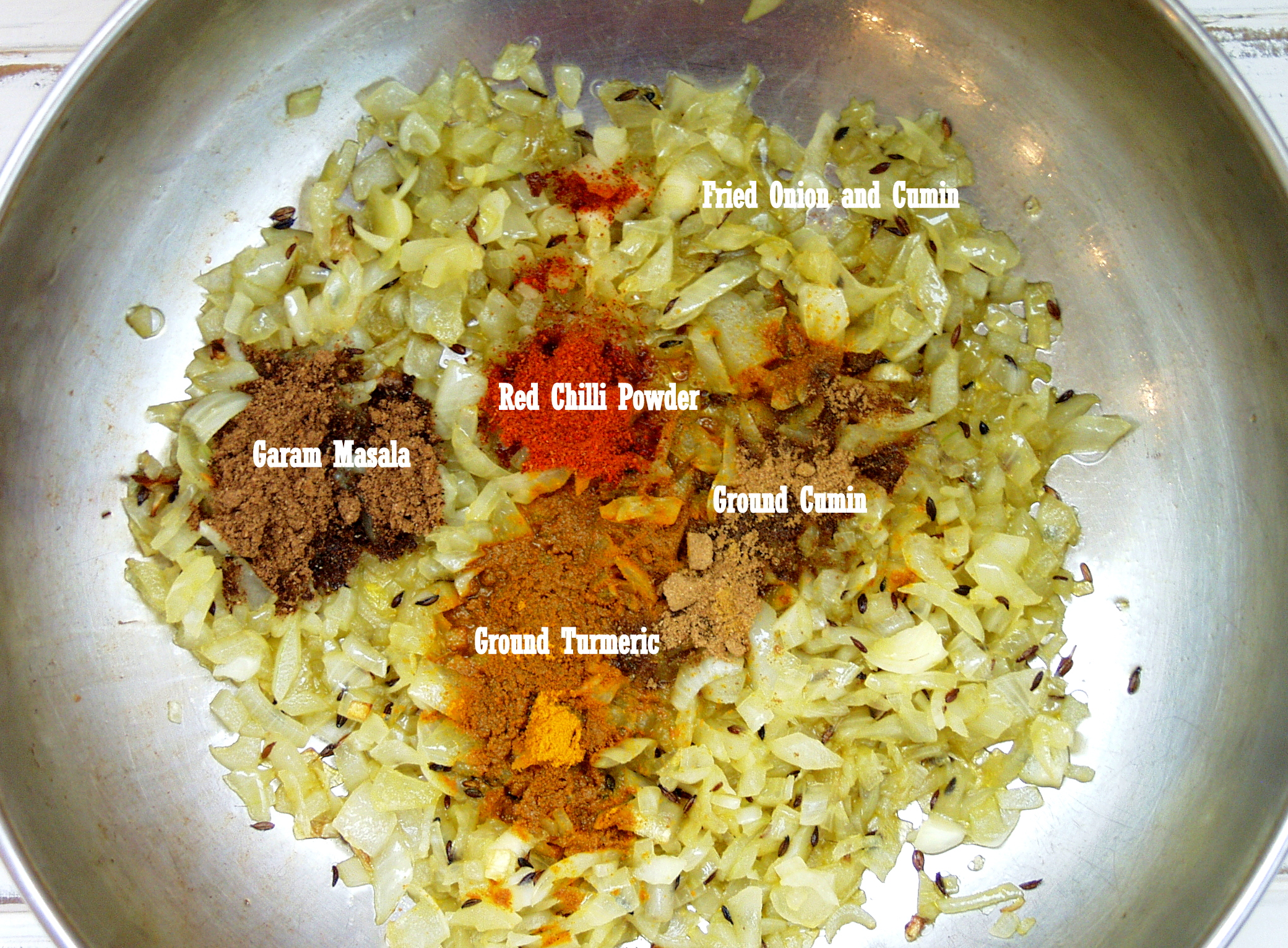
3. When the onions have softened and become translucent add the cumin powder, red chilli powder, turmeric and garam masala and stir together.

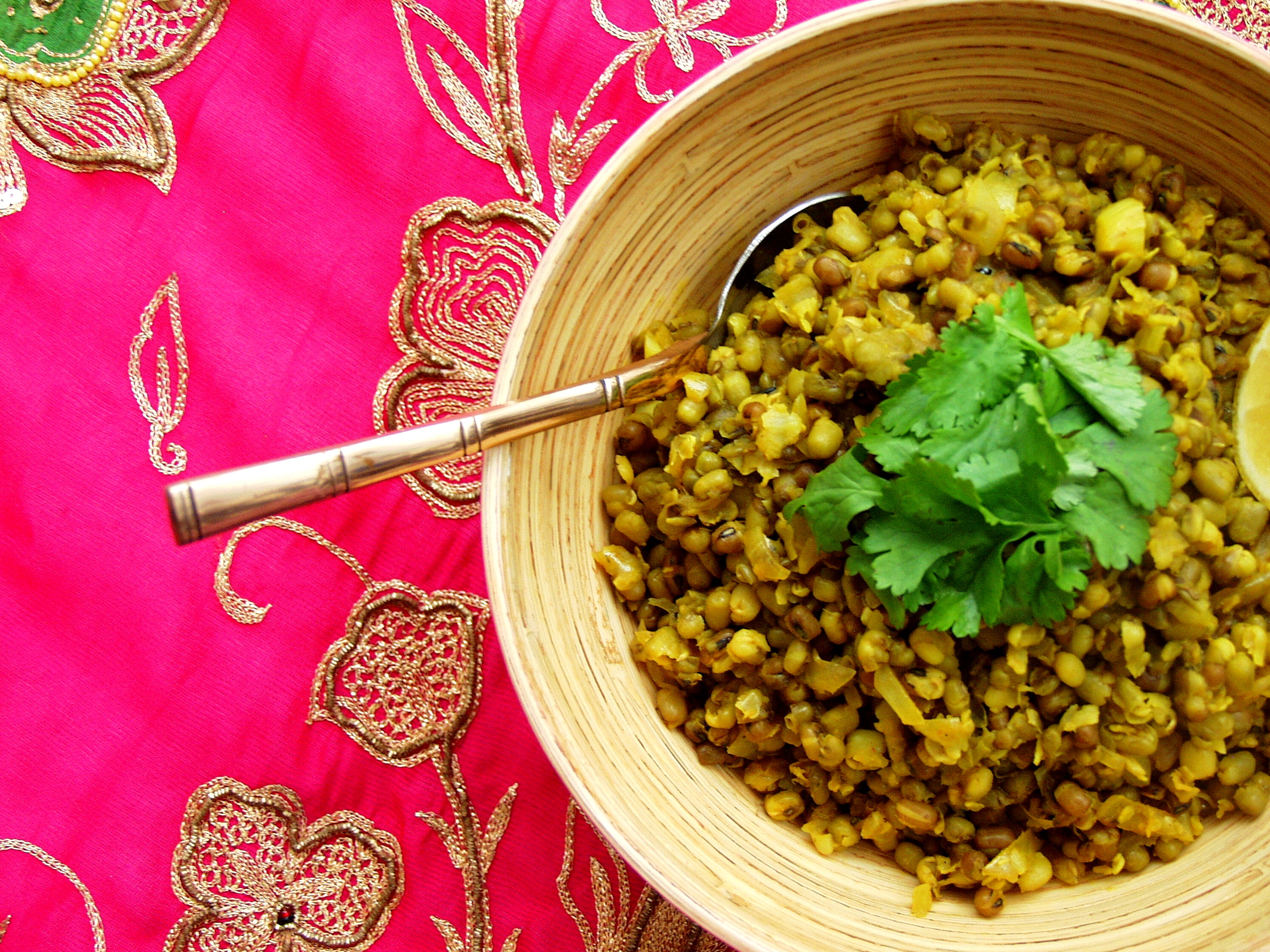
4. Drain the mung beans and then transfer them to the pan with the onions and fold in thoroughly. Add the salt and lemon juice and simmer together for a further 5-10 minutes. You may need to add a little more water at this stage.

Whilst it is delicious to eat on its own or with a chapati it is also great to accompany it with a fish, meat or vegetarian curry (see my recipe library) if you wish to make a more substantial Indian feast.

Mung beans soaked overnight

Step 3 above


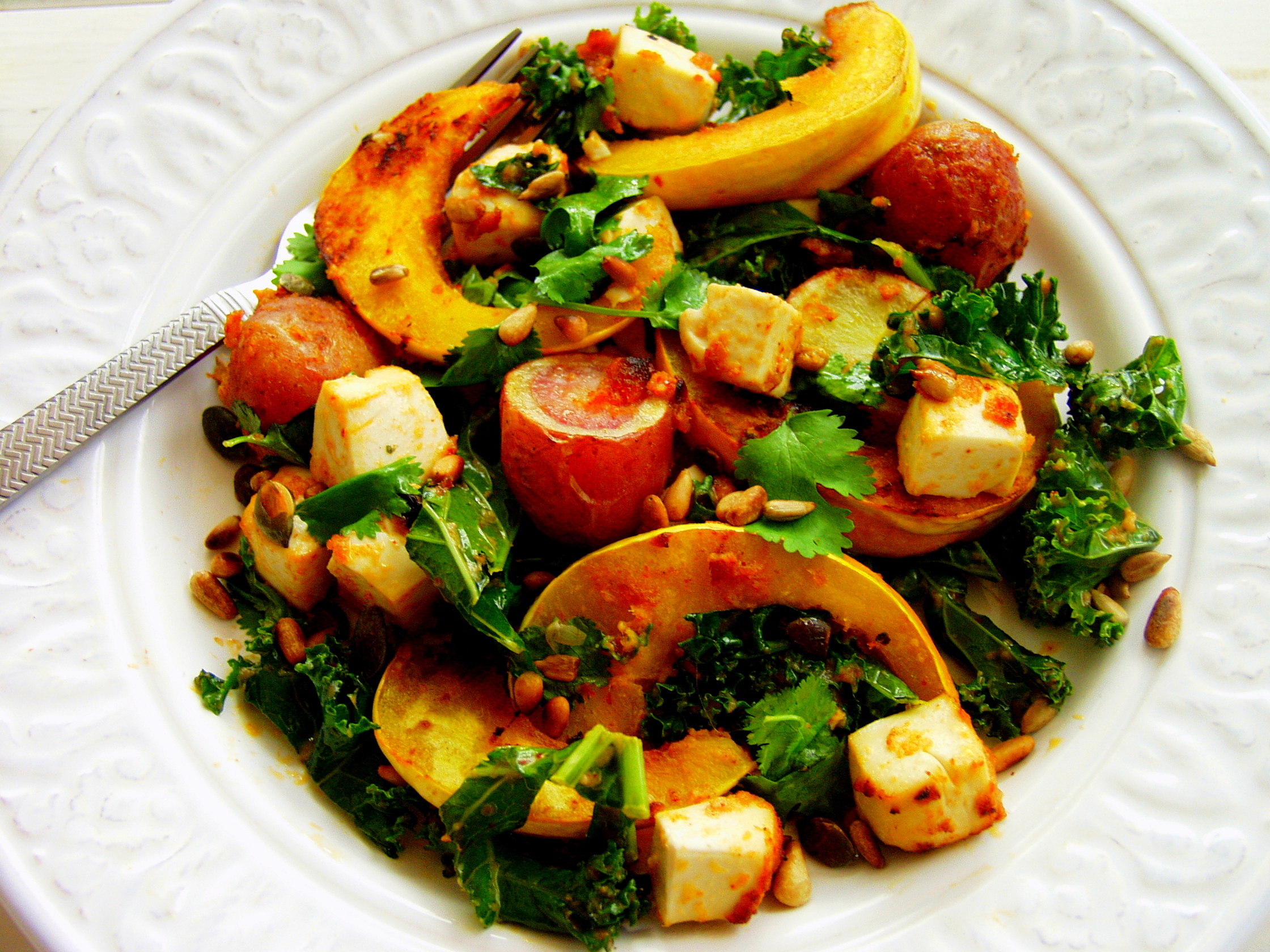
Roasted Harlequin Squash with Tofu, Kale and Coriander in a Miso-Curry Paste

I am a big advocate of eating a few meals a week that are vegetarian. In the past I think the general public felt rather limited on what vegetarian meals to cook that were satisfyingly tasty. Times have changed however and today a whole universe into vegetarian cooking has developed and become mainstream. There are countless possibilities of what to cook and a wonderful array of cook books and blog posts giving us ideas of new food combinations to try out.

A fabulous success story in the blogging world is the vegetarian food blogger Heidi Swanson from San Francisco, who writes 101cookbooks.com and already has a few cookbooks to her name. I managed to pick up her latest book Super Natural Cooking in Vancouver last year when I was visiting my sister. Her photos always impress me and I like the way they have a matt finish in her book.  Understandably she cooks with a wide range of lentils, beans and grains and has some excellent ideas of pairing them with various vegetables and sauces.

This recipe is very seasonal and is perfect for Autumn time as it requires you buying squash. Heidi uses ‘delicata squash’  for it’s buttery flavour and wonderful green stripes, adding a vibrancy to the dish. Sadly I could not find any at Pimlico farmers market so bought a harlequin squash instead, which worked equally well. Basically any squash that you don’t have to peel (which is actually quite a large number) will work.

I also used roseval potatoes as I adore their red skin and yellow flesh, but any other small variety of potato will work – Heidi uses new!

Finally the only other change I made to Heidi’s original recipe is that I used more tofu as I wanted to use up a whole packet.

The dish is perfect for a weeknight meal as it is very easy to prepare and takes no time to  actually cook. I also love the fact that it requires no peeling of the squash – result !

Miso-Curry Harlequin Squash

Adapted from Heidi Swanson’s book ‘Super Natural Every Day’

Serves 4

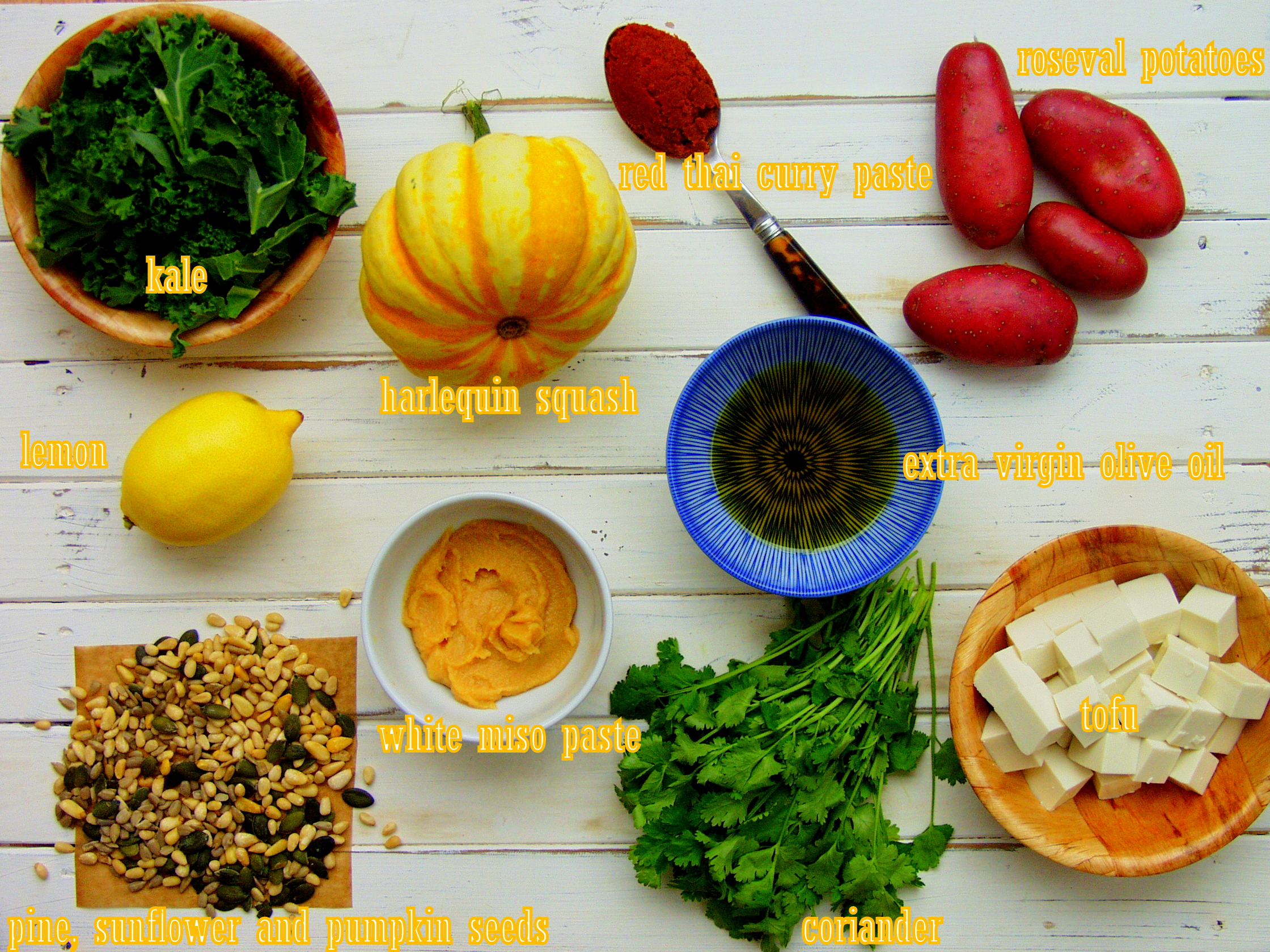
350g harlequin squash (or delicata or any that require no peeling)

60 ml extra virgin olive oil

70g sweet white miso paste (I buy mine from Sainsbury)

1 tbsp red Thai curry paste

349g firm tofu (or whole packet equivalent), cut into small cubes

4 medium Roseval potatoes, unpeeled and cut into chunks

2 tbsp fresh lemon juice

45g chopped kale, tough stems removed

45g seeds (pine nuts, pumpkin and sunflower seeds), toasted

30g chopped coriander/cilantro

1. Preheat the oven to 200 degrees centigrade.

2. Carefully cut the harlequin squash into 1cm thick half moons.

3. In a bowl whisk together the oil, red thai curry paste and sweet miso paste.

4. Gently fold the squash, potatoes and tofu into 80ml of the miso-curry paste using your hands, making sure that you do not break up the tofu. Spread out the ingredients onto a baking sheet and place in the centre of the oven for 25-30 minutes. Toss a couple of times during cooking once the ingredients begin to bronze.

5. With the remaining miso-curry paste whisk in the lemon juice and then stir in the kale (uncooked!).

6. In a heavy skillet gently toast the seeds and nuts over a medium heat until they have bronzed and become fragrant. This will only take a couple of minutes. Do not leave them as they will burn.

7. When the squash, potatoes and tofu are cooked, gently toss all the ingredients together including the nuts and seeds, coriander/cilantro and kale. Serve hot onto warm plates.

The potatoes, squash and tofu coated in the miso-curry paste

Ready to eat – once I’ve got the perfect shot!