The Little Viet Kitchen – Islington

IMG_9415

For those who have a weakness for seriously tasty Vietnamese food, as I do, you need to pay a visit to Chapel Market, a stone’s throw away from Angel tube station. As you stroll through the market, past the famous Pie & Mash and Eels restaurant M.Manze you come across a shining beckon of shabby chic cool with a mint, grey and wooden exterior. The name ‘The Little Viet Kitchen’ is etched above the door. Once you enter a wave of calm serenity washes over you. This is a place to lunch and take your time.

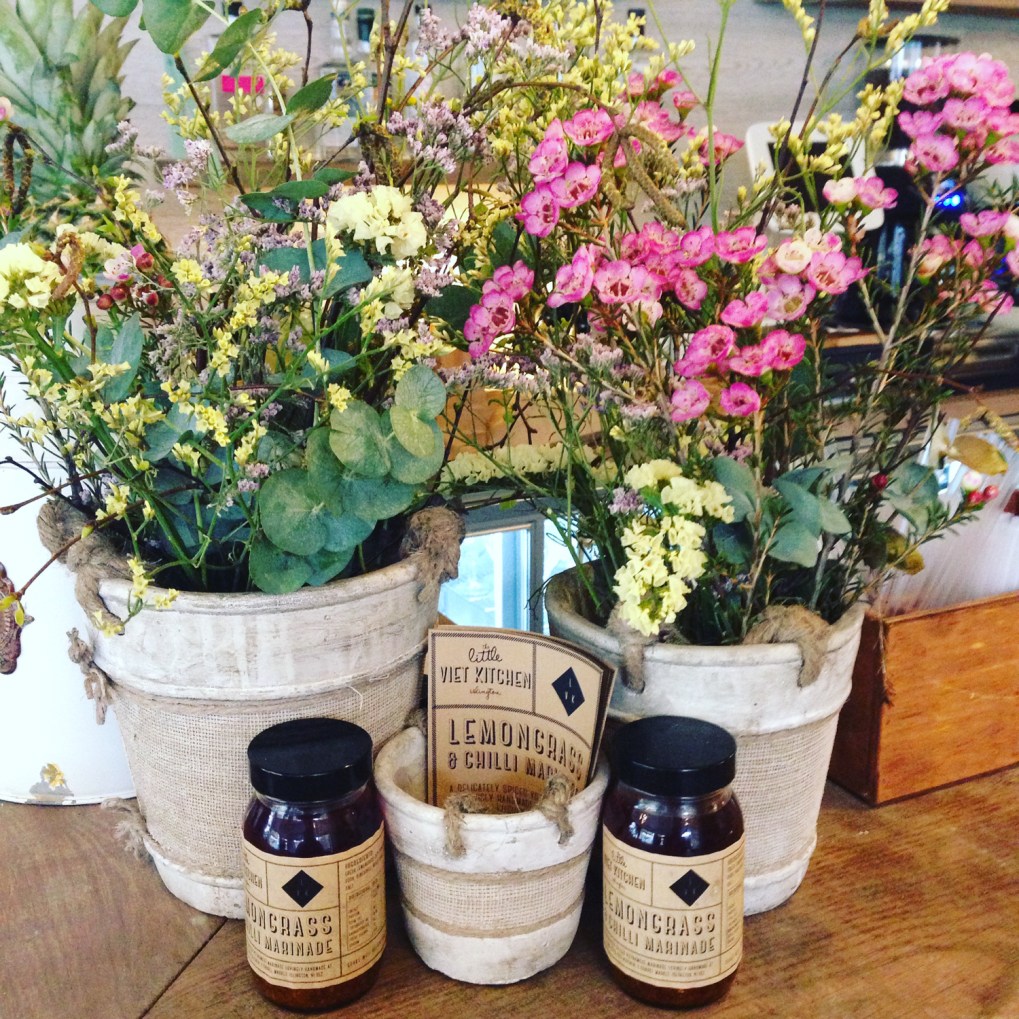
The first thing that hits you is how charming and well thought through the restaurant is. From the stunning chandeliers, to the beautiful vases of fresh flowers on each table, to the wooden ceilings, the bar stools and the lights above the bar.
IMG_9416

Everything oozes with considered cool. It’s a place that immediately puts you at ease. There is no frenetic lunching here.

IMG_9417


The restaurant is the brainchild of Thuy Pham-Kelly, who launched the restaurant last year, having previously run a successful Vietnamese supper club. She still continues with her supper clubs each month where dinners arrive at 6pm and are treated to a surprise Vietnamese banquet that changes each month. Her passion and love of Vietnamese food is clearly evident both in the cooking but also the way that she has injected so much of her own personality into the restaurant. She wants diners to feel they are dining in her own home.
IMG_9421

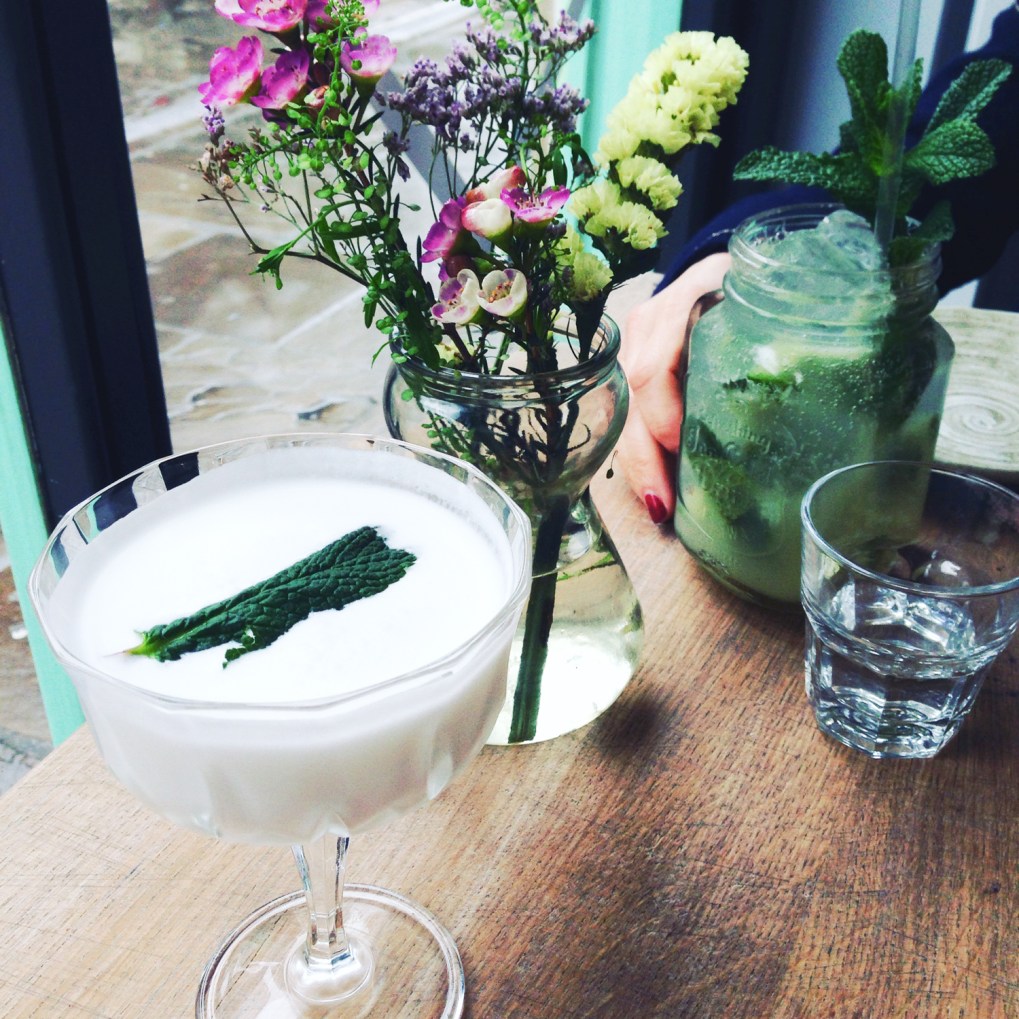
We started our Vietnamese feast with non-alcohol cocktails. For me a ‘Lemongrass Ginger Sherbet Colada’ and for my partner in crime ‘Cucumber Mojito’. I had never tried anything like my sherbet colada before, but I must say it was addictively good. It reminded me vaguely of those wonderful sherbet fountains I used to eat as a child. You know the ones that you dip a liquorice stick in.

We then opted for today’s special starters (they change daily), which were king prawns and a spider crab each on a Vietnamese salad bursting with flavour. It was a great taster of what was to come.

IMG_9422

As a side note I wanted to mention the stunning, tactile crockery that the food was served in. Not only did the bowls and plates have weight they also kept the food hotter for longer, owing to the fact that they were made of clay. Sourced from Japan, they complement the food perfectly.

IMG_9411

One of the statement dishes (the other being Pho, but I shall have that on my return visit) is Banh Xeo – Vietnamese Pancakes – which was larger than life as you can see. We opted for the one filled with pork belly and prawn. It’s a great dish to share and allows you to get really stuck in as you need to eat it with your fingers. After cutting a bite sized portion of the pancake you wrap it in a lettuce leaf and add some fresh herbs – mint and coriander. You then roll it up slightly before dipping it in the nuoc cham sauce. If you want to know how to cook them yourself, albeit a lot smaller ones than the one I ate, take a look at my recipe here.

IMG_9420

Next up was the ‘Coconut Poussin Curry’ that packed a delicate chilli punch. All the meat sourced is organic  and consequently has flavour and tastes good. The coconut infused broth was deliciously creamy and nicely spiced. Nothing bland about the cooking here.  The dish does require quite a bit of concentration to eat as there is a generous portion of noodles sitting in the bowl. Transferring noodles to mouth without any contact with one’s pristine top/blouse/shirt (delete as appropriate) is quite a skill. I think I just about managed it!
IMG_9419

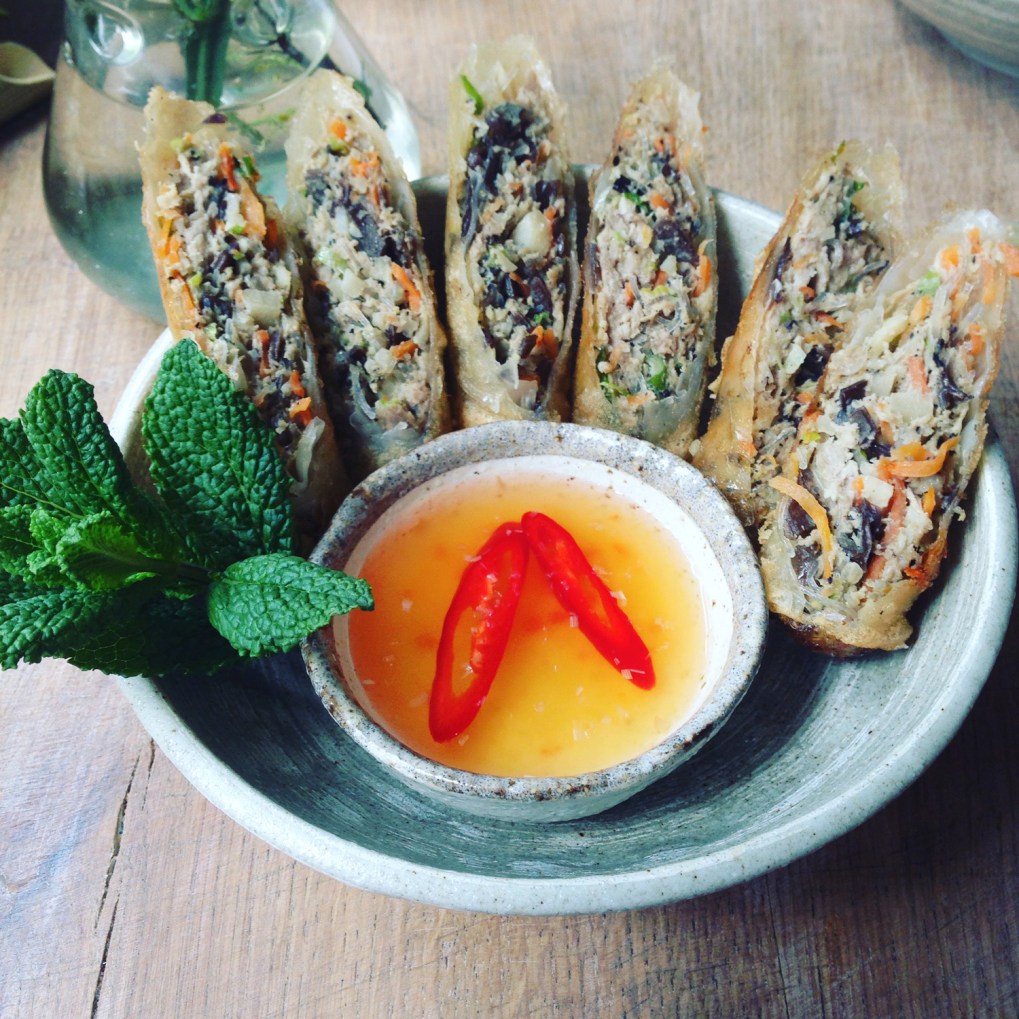
We were then treated to Thuy’s special ‘Vietnamese Fried Spring Rolls’ that were filled with pork, water chestnut and glass noodles. They were utterly delicious and I liked the fact that they had water chestnuts in them, a first for me.
IMG_9418

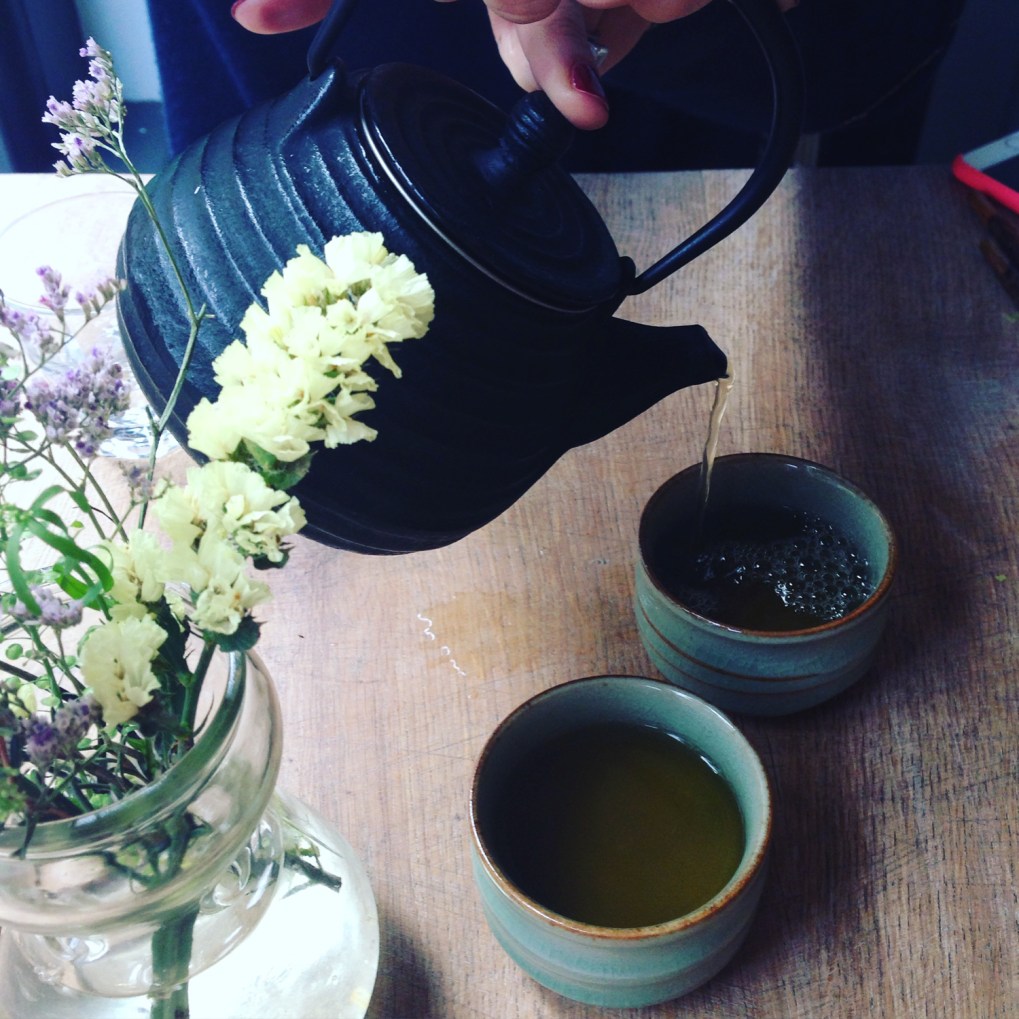
Needing to digest we drank cups of lemongrass and green tea, the perfect beverage to finish off a very filling and delicious lunch. Will I be returning? Most definitely YES and I plan to entice more of my south London friends to join me. The northern line really does make it very easy.


The Little Viet Kitchen

2 Chapel Market, Angel Islington

London, N1 9EZ

Tel: 0207 837 9779

Monday             Closed

Tuesday             12:00 to 15:00, 18:00 to 22:00

Wednesday       12:00 to 15:00, 18:00 to 22:00

Thursday           12:00 to 15:00, 18:00 to 23:00

Friday                 12:00 to 15:00, 18:00 to 23:00

Saturday            12:00 to 23:00


Parmesan, Chive and Truffle Madeleines and a Paris Snapshot

IMG_2373

Despite Paris being so close to London – three hours on the Eurostar – we had never been with big A and little Z. Mr B and I had been on numerous occasions in the past both for work and pleasure, but we were long overdue a visit with all the family. Good friends had recently moved there – well to the pretty town of Versailles to be exact, so the decision to visit was very easy.

IMG_9202

We decided to show our girls (aged 10 and 6) a snapshot of Paris so that they could soak up the atmosphere and see some of the sights; the most famous of all being the Eiffel Tower. I had always admired it from afar but never ventured to the top. A flurry of light snow began to fall, despite the pretty blossom making an appearance, and we climbed (well Mr B and big A did – Little Z and I took the lift) right to the top. The view was spectacular, despite it being rather overcast. As we made our way down in the lift we were told that we could get out on the first floor if we wanted the ice rink – pretty impressive I thought to have a rink actually on the tower.

IMG_9242

After a stroll around the Louvre we made our way to a charming and very buzzy French restaurant called Bistrot Victoires on 6 rue Vrillère – about a 10 minute walk from the Louvre. Here you can indulge in traditional gallic fare accompanied by a bottle of red wine and some great tasting baguette to munch on whilst you wait for your food. The restaurant is famous for its steak frites that comes with burning thyme on top. IMG_9210

The smell, pomp and visual spectacle of it all is very memorable so I would urge you to order it if you go. We had a portion each and I must say I think it was the most tasty I have ever had.

IMG_9217

Here is a close up to make you hungry!

I rather loved their old till, which looks so much grander than the hand held card reading device that they use to day. Old and new sitting side by side. IMG_9240

We walked off our lunch with a visit to the wonderful Musee D’Orsay which is housed in the former Gare D’Orsay, a Beaux-Arts railway station built between 1898 and 1900. A must if it’s your first time to Paris, and slightly more manageable than the Louvre in as far as size. Thursday nights are late opening so a nice thing to do before heading out to dinner perhaps.

IMG_9193

The following day we headed back into Paris – a very short 20 minute journey on the RER. I rather loved the old school look of this carriage that looked like it was a travelling library carriage  – how very civilised.

There is nothing quite like a crepe to kick start your day. The girls were thrilled with their nutella ones whilst Mr B and I went for the ham and cheese.

IMG_9263

Bellies full we headed to the spectacular French gothic cathedral of Notre Dame, which stood in all it’s glory in the cold, crisp February sunlight. The girls were familiar with this building owing to the fact that they have watched the  Disney movie ‘The Hunchback of Notre Dame’ more times than I care to remember. We walked off breakfast within its walls, marvelling at its grandeur and beauty.

IMG_9256

An absolute must if you are visiting Paris is Sainte-Chapelle, which is literally a stones throw away from Notre Dame. It was built by King Louis IX of France to house his collection of passion relics, including the Christ’s Crown of Thorns. You need to climb up the winding narrow staircase but once you’ve reached the top you will be rewarded with one of the most extensive 13th-century stained glass collection anywhere in the world. It is utterly breathtaking, especially when the sun is shining and reflecting through all the coloured glass in all it’s brilliance.

Another pit stop for food was required so we headed to A La Biche Au Bois on Avenue Ledru-Rollin, which offers hearty, honest French food away from the typical tourist trap restaurants.

IMG_9273

The staff at this restaurant were both jovial and charming and coupled with the fact that the food was great, it makes it a restaurant worth seeking out, and indeed booking as it gets packed.

Creme caramel or ile flottante anyone?IMG_9290

After all good lunches a walk is required so we sauntered over to my favourite and indeed oldest square in the whole of Paris…..Place de Vosges. After ambling around the square we decided to head north to Sacre Coeur in bohemian Montmartre. The sun was shining so we felt it was worth the effort to head there so we could admire the view of Paris and Sacre Coeur.

IMG_9307

The next few days we spent time relaxing in Versailles with our friends and visiting the famous Palace and grounds of the Versailles Palace. IMG_9337

If you ever find yourself in Versailles for the evening and want to splash out, the bar at the Trianon Palace Versailles is worth a visit as they serve delicious cocktails, but then again at €22 you would expect them to be pretty outstanding. If you are in town and want something more hip and low key on ambiance and price then I can recommend La Conserverie   a bar in the 2nd arrondissement. From the outside you probably wouldn’t notice it, but don’t be put off. For the brave who venture in you’ll find elegant, longing surroundings with a relaxed vibe. Needing a bite to eat then head to Restaurant Victor 101 bis, rue Lauriston in the 16th district of Paris. It has an old school French vibe, dishing up all the French classic with style and panache. IMG_2336

Back in Blighty I decided to continue with the French theme by rustling up some little french fancies known as ‘madeleines’. Small, bite size and wonderfully moist in the centre and a little crispy on the outside. They are best eaten straight from the oven. Deliciously warm. They often come in sweet flavours but work equally well savoury. I naturally gravitated towards making them savoury, although I think next time I will try cardamom ones. You can play around with the fillings by adding pancetta, sun-dried tomatoes, sage, rosemary or whatever takes your fancy.

IMG_2336

They take a matter of minutes to whisk together and then another 12-14 minute to cook in the oven. A perfect tea time treat.

Parmesan, Chive and Truffle Madeleines

2 eggs

50g parmesan, finely grated

100g plain flour, sifted

1/2 tsp baking powder

40ml truffle oil

3 tbsp butter, melted

2 tbsp chives, finely chopped

1 tsp salt

freshly ground black pepper

2 tbsp milk

  1. Preheat the oven to 180 degrees (if using fan or 200 if not).
  2. First blend the cheese and eggs using an electric whisk if you can (or by hand if you haven’t).
  3. Then add the flour, baking powder, salt and pepper.
  4. Now add the truffle oil, melted butter and chives.
  5. Finally add the milk and whisk so that it is smooth but still quite firm.
  6. Lightly grease the madeleine tray and add a heaped teaspoon of mixture to each compartment. Smooth the top where possible.
  7. Place in the oven for 12-14 minutes, or until bronzed on top. Use a tooth pick to see if it is done – it should come out nice and clean.

Eat immediately if possible whilst they are still warm with a cup of tea.

Note: instead of truffle oil you can use extra-virgin olive oil, chilli oil, basil oil. Experiment and see which you like. 

Paris Restaurants and Bars:

Bistrot Victoires – 6 rue Vrillère (R)

A La Biche Au Bois – 45 Avenue Ledru-Rollin (R)

Restaurant Victor – 101 bis, rue Lauriston (R)

Trianon Palace Versailles – 1 Boulevard de la Reine, Versailles (B)

La Conserverie Bar – 37 Rue du Sentier (B)

It was simply by chance that two of the restaurants I visited had part of my name in the title ;o)!

IMG_2369


Softened Cucumber with Chinkiang Vinegar, Sichuan Pepper and Red Peanuts

IMG_2322

There is a dish that I always order when I visit Silk Road restaurant in Camberwell. The main ingredient is cucumber. Yes cucumber folks. I think they even call the dish ‘cucumber salad’. Doesn’t sound that appealing does it at first glance, but let me assure you that cucumber that has been delicately softened or rather smashed with a small ‘s’, then doused in Chinkiang vinegar, soy sauce and sichuan pepper marinade elevates the humble cucumber to something quite extraordinary.

IMG_2329

It is quick to rustle together and is the perfect snack when you have the munchies or if you want to accompany it with perhaps Chinese spiced roast pork or chicken, ginger and spring onion jiaozi or dan dan noodles. Give it a go next time you find a cucumber lurking in your fridge. Chinkiang vinegar (also known as Chinese black rice vinegar) you can get at the larger supermarkets, or you can get online here . Sichuan peppercorns can also be found here.

IMG_2330

I adore the different textures and tastes dancing around on my tongue. Sichuan pepper is seriously addictive – in a good way, so it is worth sourcing it if you can.

Softened Cucumber with Chinkiang Vinegar, Sichuan Pepper and Red Peanuts

1 cucumber, bashed lightly with a rolling pin

4 garlic cloves, finely chopped

1 tbsp Chinkiang vinegar

1 tbsp soy sauce

1 tsp caster sugar

1 tsp ground Sichuan peppercorns (optional)

1 tsp salt

50g red peanuts

  1. Using a rolling pin gently bash the cucumber so that it begins to soften slightly. The reason for doing this is to create a slightly softer texture which will then absorb all the delicious flavours of the marinade more easily.
  2. Cut the cucumber lengthways and halve it again and then cut it on the diagonal into 1 inch pieces. Place in a large mixing bowl.
  3. In a separate bowl add all the other ingredients, aside from the red peanuts, and stir so that they are all mixed together well. Add a little more sugar or salt as needed.
  4. Place the red peanuts into the cucumber bowl and then add the marinade and throughly mix it together so that the cucumber is fully coated with it.

You can prepare this ahead of time or eat it immediately.

IMG_2323


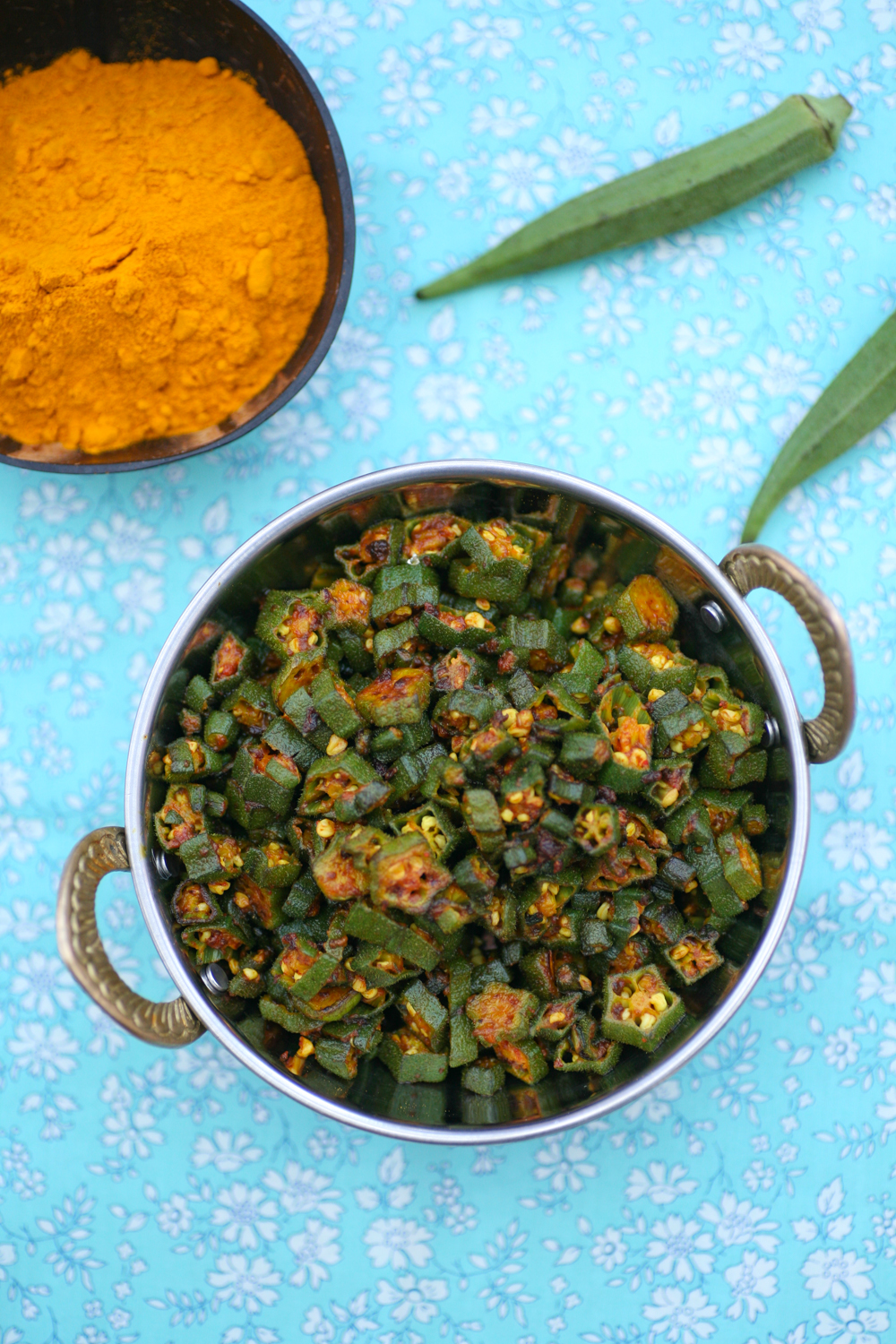
Dry-Fried Ginger and Turmeric Okra

IMG_2268

Okra, or rather ‘ladies fingers’ tends to divide people. Those in the negative camp tend to complain about  ‘a slimy texture’ as the main reason for not raving about this vegetable.  I have recently discovered the reason for this and the way to keep slime at bay whenever you cook with okra.

IMG_2254


IMG_2260


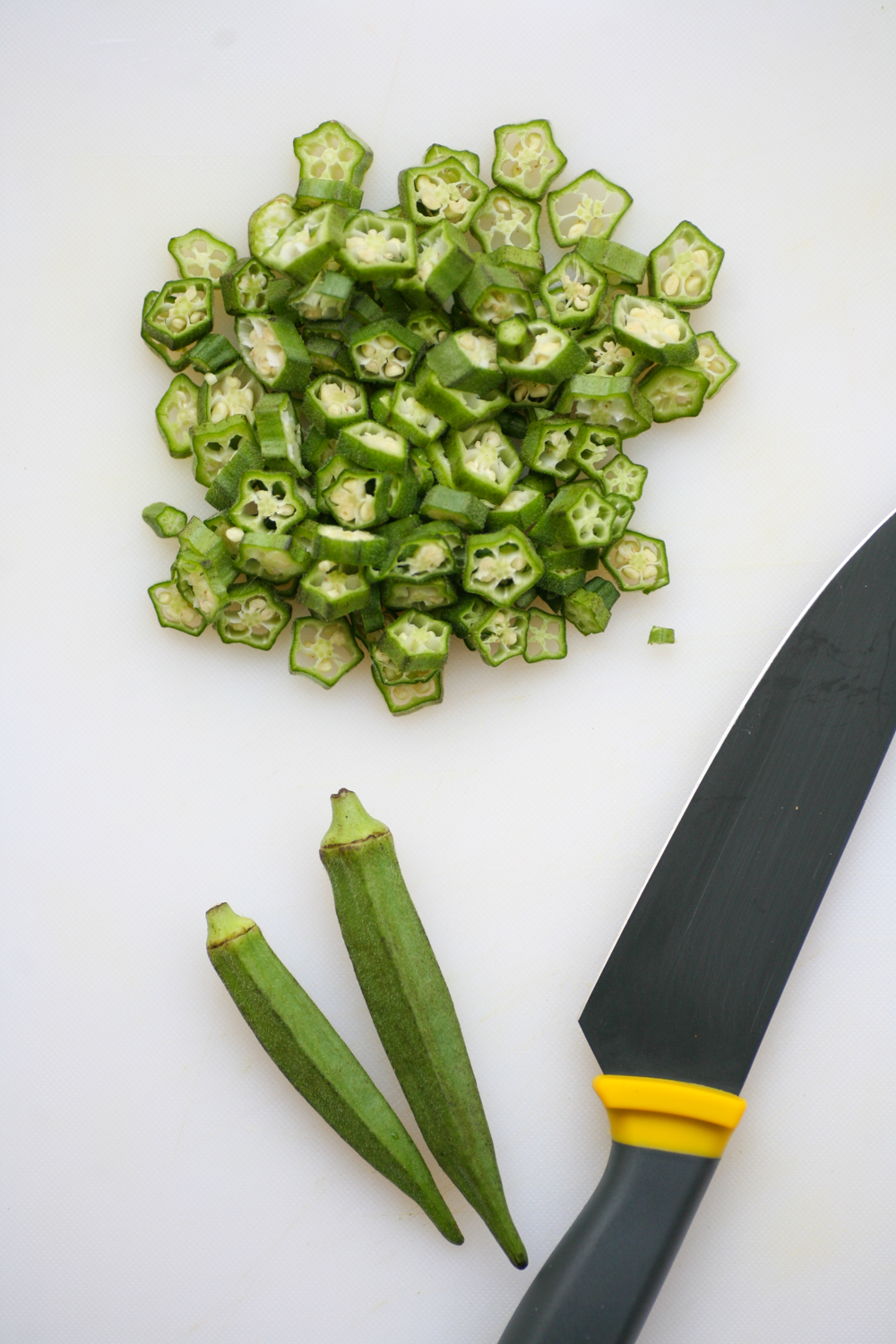
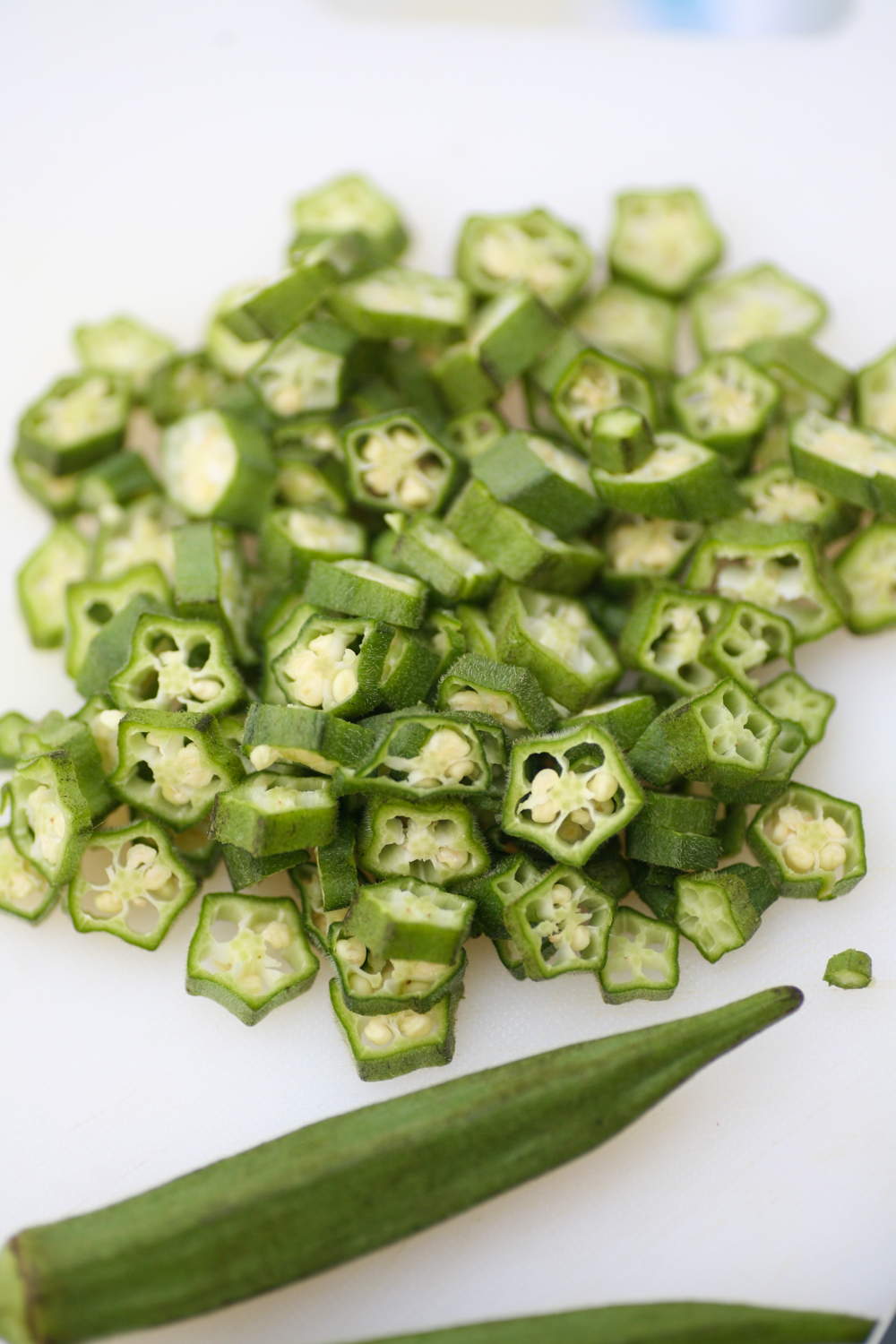
It’s simple. After washing the okra you need to dry them throughly. There cannot be a drop of water remaining on the okra. You need to dry each and every okra with a dry tea towel. It only takes a moment to do but the finished result when you eat your okra will be worth the little drying exercise.IMG_2281

In Cochin recently I was shown a very simple and straightforward okra dish, which is great to accompany meats, fish or dal. Ten minutes max and you have yourself a tasty little dish. If you also prepare my speedy dal then you have yourself a satisfying feast in no time at all.

Did you know there is also a vegetable called ‘gentleman’s toes’? I am totally serious. You can find out more about this tasty vegetable on my blog post here.

So remember don’t add water when cooking with okra and make sure the okra is super dry before cooking with it.

Dry-Fried Ginger and Turmeric Okra

Serves 2

1 tbsp coconut oil

250g okra, washed and completely dried and then chopped and sliced (see photos above)

1/2 tsp turmeric powder

1/2 tsp ginger powder

1 tsp Kashmiri chilli powder

1 tsp salt

  1. Heat the oil in a pan.
  2. Add the okra, spices and salt and stir.
  3. Place a lid on the pan and stir at intervals for 6-8 minutes.
  4. Taste to see if the okra has softened but still holds its shape.
  5. Serve immediately.


Keralan Prawn and Kudampuli Curry – Chemmeen Olarthiathu

IMG_2240

Hidden away in the calm and tranquil backwaters of Kerala you will find a homestay called ‘Philipkutty’s Farm’ that sits on 35 acres of a small island, which totals 750 acres. The island was reclaimed from the backwaters of Lake Vembanad in the 1950’s by the present inhabitant’s late husband’s grandfather.

IMG_8660

Today the farm is run by Anu (pictured above) and her mother-in-law, known as Aniamma, but it was Anu who warmly greeted us as we made our way from the opposite shore in a wooden canoe known locally as a ‘vallam’ (country boat), powered by a local using a wooden punt. After sipping on homemade cool ginger lemonade we were shown our cottage where we would be spending the next couple of nights.

IMG_8659

To say that it was charming was a massive understatement. I read in the visitors book that one lady had stayed for 5 weeks and had returned numerous times. I could see the attraction. It was without doubt the perfect place to unwind, write a book perhaps or simply just relax.

IMG_8638

Without modern day distractions such as television (there was only wifi in the main house) you felt positively cut off from the outside world. Bliss. It enabled you to sit and admire the views and watch the passing traffic, aka houseboats, drift by. My daughter’s fished with Anu’s daughter and managed to collect a number of fish, before always returning them to the waters. Mr B bravely swam in the backwaters themselves, much to all our amusement.

IMG_8639

The highlight of staying at Philipkutty’s Farm, however, is the food. Aniamma, Anu and their team of helpers prepare breakfast, lunch and dinner for guests, which all congregate in a thatched pavilion close to the main house. As there are only a handful of cottages there tend to be no more than 12 or so guests. We all sat on one large table, swapped storied and filled our bellies with dish after memorable dish of food.  The cuisine was predominately Syrian Christian with a strong backwater influence. The vegetables and spices were grown on the farm and these were accompanied by a wide range of fish and meats. I was in heaven.

IMG_8634

I have a feeling that if I stayed for 5 weeks, like one guest, there would be a high chance that I would return home a little more ‘wholesome’ than when I arrived!

IMG_2912Each evening Anu and Aniamma would do a cookery demonstration of a couple of the dishes we were to eat that evening. So it was during these informal demonstrations that I learned a host of new recipes.

This prawn and kudampuli curry – known as chemmeen (prawn) olarthiathu, was interesting as it included an ingredient I had not come across before. It is a staple of Keralan cuisine and adds a unique sourness to seafood curries, fish stews and biryanis. It is also know by the rather exotic name of  ‘Malabar Tamarind’. It is in the same family as Kokum, but is more sour.  The outer skin of the fruit is halved and dried, which in turn curls and becomes a dark purple black colour – apparently the darker the colour the better the kudampuli. d
IMG_2217

Whilst they undoubtedly add a sweet and sour element to a dish they also add a smokiness that is unlike anything that I have tried before. They never drown out the main taste of a dish, instead complementing it with their gentle souring notes.

IMG_2221

I used prawns with tails on but you can use whatever prawns you wish.

IMG_8722

You’ll need red onion, shallots, ginger, garlic and fresh curry leaves. You can pick up fresh curry leaves from most Asian grocers. I tend to freeze mine and then dig them out of the freezer as and when I need to use them, which is most days.
IMG_8725

Above shows Aniamma adding the cherished kudampuli to her curry.

IMG_2251

I served mine with my Indian toor dal, which you can find here and some basmati rice.

IMG_2246

Kerala Prawn and Kudampuli Curry (Chemmeen Olarthiathu)

Serves 4-6

1-2 tbsp coconut oil

1 large or two small red onions, finely chopped

3 garlic cloves, roughly chopped

2 inch fresh ginger, roughly chopped

3 shallots, finely chopped

10 curry leaves

1/2 tsp salt

1/2 tsp turmeric

1 tsp chilli powder

2 medium sized tomatoes, roughly chopped

500g prawns

4 pieces of kudampuli, pre soaked in 150ml boiling water for 20 minutes*  or 35g soaked tamarind (see below)

1 tsp freshly ground black pepper

  1. Heat the coconut oil and then add the garlic, shallots, ginger and curry leaves.
  2. After a minute add the red onion, salt and chilli powder (if using).
  3. On a medium to low heat, add the turmeric and allow the ingredients to soften, which will take around 5-7 minutes.
  4. Add the fresh tomatoes and stir into the other ingredients and allow to soften.
  5. Add the prawns and move around the pan so that they are coated in all the ingredients.
  6. After 3 minutes add the kudampuli and gently cook for a further 5 minutes.
  7. Add the fresh black pepper powder just before serving.

*Kudampuli is similar, but not the same, as Kokum. Both have a tart/sour flavour but kudampuli is sourer in flavour. They are from the same family but the kudampuli has more groves in its skin and is commonly used in south Indian cuisine whilst kokum is used slightly further north in Goan cuisine. Both can be found easily online. Equally you can replace with 35g of tamarind, soaked and then added to the recipe after being strained.

IMG_2253

Each morning at Philipkutty’s Farm the urns would have different arrangements of fresh flowers floating in them. So pretty and symmetrical.

IMG_8641


Keralan Chicken Stew

IMG_2208

Recently my family and I spent the day with a local Keralan family in Cochin: Lt. Col. Mathens, Moly and Philip. The intention was to spend the day with them cooking and eating so you can imagine how excited I was about this. After a good hours drive from our hotel we arrived at their house, still in Cochin but away from the old centre.

Before the cooking began we were given a guided tour of their garden, which grew all manner of spices, vegetables and fruit. They had planted this magnificent oasis themselves when they had bought the property some years before. It had been shrub land, but with such fertile soil, sunny weather and good rains in the monsoon, the vegetable garden had thrived beyond belief. There was no reason to go to the market to buy fresh produce as they had such a bounty waiting for them in the garden.

How many of the above can you recognise? Let me know in the comments box below.

We were showed at least thirty different vegetables, fruit and spices and to see them growing in their natural habitat was hugely memorable – although looking back through my photographs I cannot be certain about a couple of the plants. A return trip is necessary perhaps to further my education? Any excuse really!

After our garden tour we made our way to the kitchen where Moly explained the different dishes we would be cooking and the others she had prepared earlier that would accompany our feast.

IMG_2193

One of the dishes she showed us was her Keralan chicken stew. A couple of things that stood out with the way that she actually prepared the stew.

Firstly it was cooked on the bone, like all authentic curries should. Secondly she add the coconut milk in two stages. To begin with she added the thin coconut milk and at the very end she added the thicker, creamer coconut. The third point was that she added the thin coconut milk when some of the chicken was still pink. She did not measure anything as such, so I frantically took notes as to the approximate amount she was adding into her stew.

It does have a chilli kick to it with pepper, cardamom and clove notes resonating through the dish. By all means reduce the amount of chillies to suit your palate. I added a teaspoon of Kashmiri chilli powder, but this is not necessary and looking back in my notes I don’t believe Moly added it so for the recipe below I have omitted it although when I was testing the recipe I did add it, hence the photos have a red/orange hue to the dish. Yours will not have this in quite the same way if you follow the recipe below.

She did not measure out the coconut milk, but as it generously covered the chicken I think she must have used the equivalent of two tins of coconut milk or thereabouts. I find some brands of coconut milk have a thick creamy coconut milk at the top and a more water milk at the bottom. If you can try and get hold of these types of coconut milk.

Keralan Chicken Stew

serves 6

2 tbsp coconut oil

1 tsp mustard seeds

2 red onions , finely diced

3 garlic cloves, finely diced

7 Kashmiri chillies

2 potatoes cubed

1 whole chicken (approx 1.2kg) skinned and chopped into 10-12 pieces

1tsp cardamom seeds

4 little pieces of cinnamon bark

1 1/2tsp fresh ground black pepper

10 cloves

2 tsp salt

1 tsp ginger powder

400ml tin of coconut milk

160ml tin of coconut cream

  1. In a deep pan – I find my Le creuset casserole works well – add the coconut oil. When it is hot add the mustard seeds and move around the pan for 10 seconds before adding the onion, garlic and dried chillies. Leave to cook in the pan for 3 minutes. Keep on a medium low heat.
  2. Now add the cubed potatoes and stir into the other ingredients and allow to cook away for a further 3 minutes.
  3. Add the chicken and stir before placing the lid on the pan for 5 minutes. Some of the chicken will have whitened but do not be alarmed if some of the chicken is still a little pink at this stage.
  4. Add the cardamom, cloves, cinnamon bark, ginger powder and black pepper.
  5. Add the coconut milk and the salt. Put the lid back on the pan and allow to simmer for 30 minutes, stirring at intervals.
  6. Test to see that the potato is soft and the chicken is cooked. Add more salt if necessary.
  7. At the very end turn the heat down very low and add the coconut cream and stir into the stew. It is important that you do not let it boil as the coconut cream will split.

Serve with rice, luchi, chapati or the traditional Keralan appam.

IMG_2190


Dreaming of Kerala – Squid Coconut Fry

IMG_2170

Kerala, often called ‘God’s own country’, is the perfect destination for the avid traveller who seeks adventure, beauty and tasty food. It encompasses so many different experiences and terrain in this sunshine state that no day is ever quite the same. Over the course of the last few weeks my family and I (and not other animals) spent time in Cochin, exploring their diverse places of worship as well admiring their famous Chinese fishing nets.

IMG_8310

The Western ghats, which provide the state, and much of the wider world, with tea, cardamom and coffee.

IMG_8541

The calming, slower pace of life in the emerald backwaters,

IMG_8731

and of course the palm fringed beaches of the coast and the gloriously warm Arabian sea.

IMG_8898

Along the way I met some wonderful people, both locals and fellow travellers, who all made our experience of Kerala very memorable. It was tough to say goodbye to the warm rays and friendly smiles and head back to a much colder London, which is now firming in the throes of winter.

During our travels I learned to cook a wealth of Keralan recipes from chefs and home cooks who welcomed us into their homes and kitchens. Meet some of them below. From left ‘Mummy’ from Philip Kutty’s Farm,  Sreeja  from Marari Beach Hotel and Moly from Cochin, who allowed me to shadow her for the day.

Prior to visiting the state I had a preconceived notion that a lot of the cuisine would be vegetarian, however this is not the case. In Kerala, Muslims, Hindus, Christians and Jews (there are only 6 now left in Cochin) live harmoniously and respectfully amongst one another. As such we feasted on chicken, lamb, pork and beef as well as delicious fresh and seawater fish, shellfish and a host of vegetarian dishes. Coconut oil and coconut in many forms, is the heart of many Keralan dishes along with the irresistibly sour tamarind and kokum, the latter being new to me. “Kera” in Malayalam (the language of Kerala) means coconut. As Kerala is abundant with coconut plants, it naturally got the name Kerala. Yes, many of the dishes in Kerala have heat, but with the cooling qualities of  coconut, many had their chilli bite tempered.

Over the coming months I will intersperse my blog posts with temptingly delicious Keralan dishes that will hopefully encourage you to try cooking them at home.

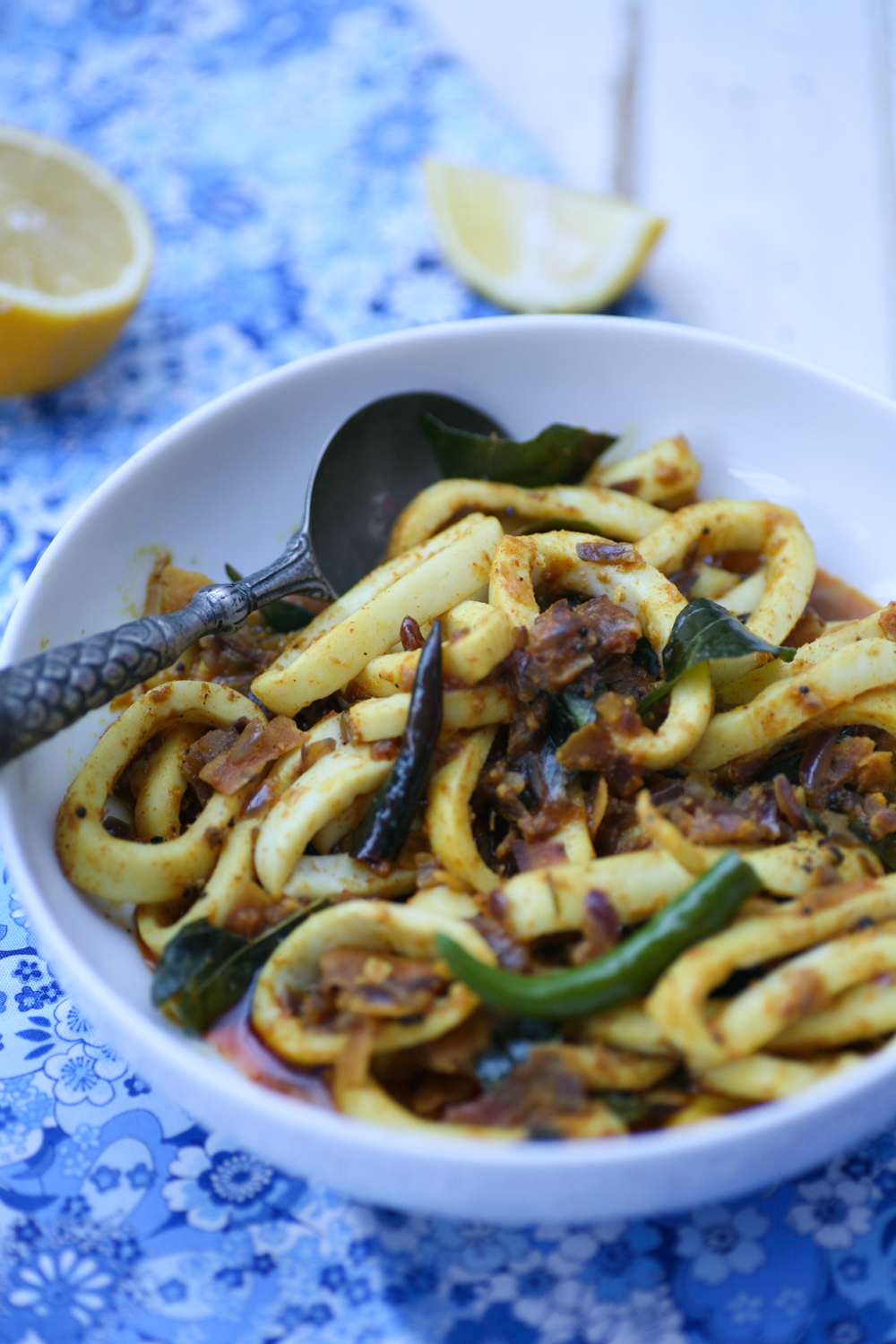
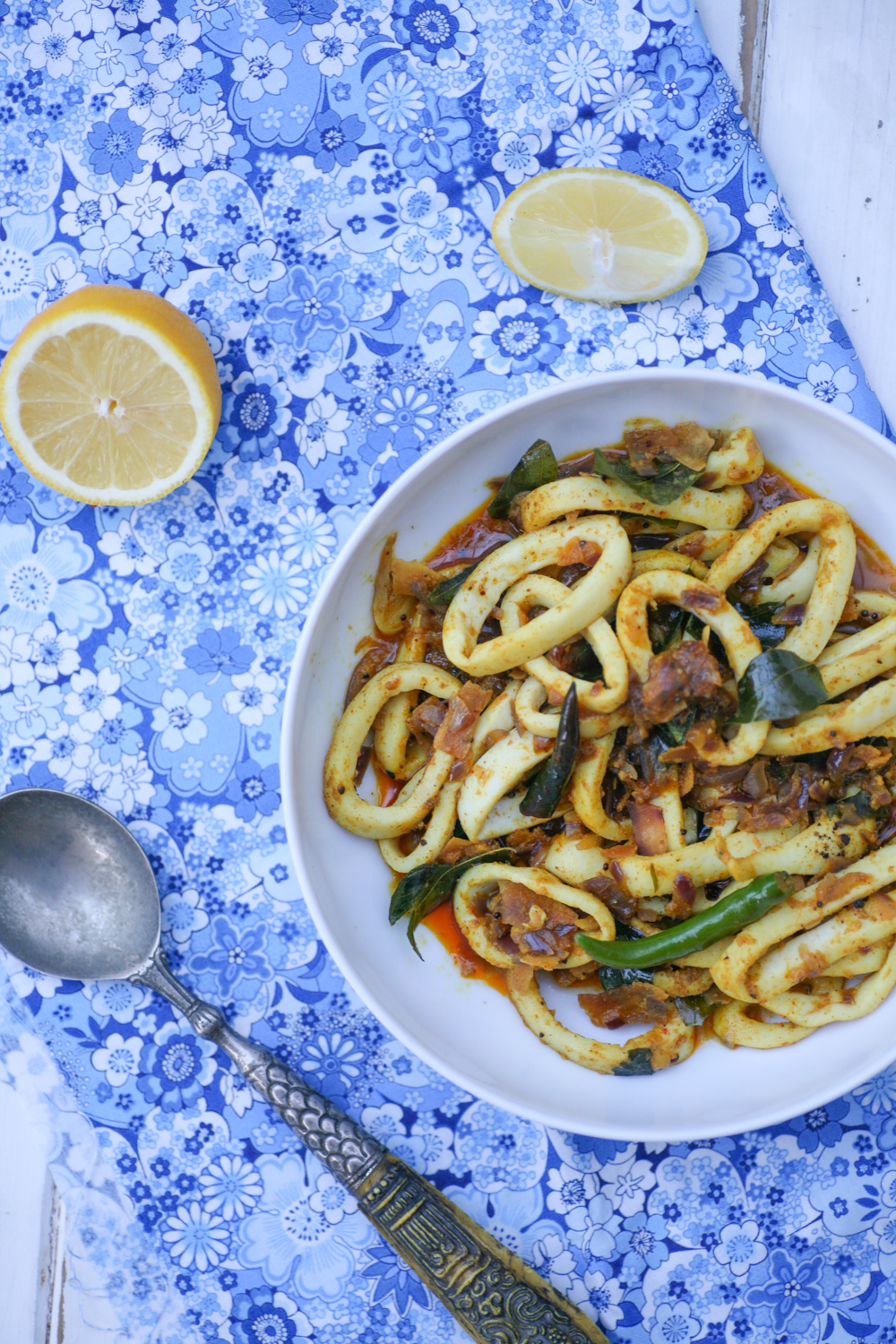
First up is ‘Squid Coconut Fry’, which in all honesty takes 10 minutes and that includes the prepping and cooking. So look no excuses not to give this a whirl. It is so good you’ll be cooking it time and time again. IMG_2160

 Squid Coconut Fry

Serves 2 (or 4 if serving with other dishes)

2 tbsp coconut oil

1/2 tsp mustard seeds

2 dried red Kashmiri chillies, halved and seeds removed if you like it less hot

10 pieces of thinly sliced fresh coconut or dried coconut slices

3 garlic cloves, thinly sliced

1 tsp ginger paste

1 fresh green chilli (2 if you like it hot)

10 curry leaves

1 small red onion, finely chopped

1/2 tsp salt

1/2 tsp chilli powder

1/2 tsp coriander powder

1/2 tsp turmeric powder

300g squid tubes, chopped into thin rings

1/4 juice of a lemon

1/4 tsp ground black pepper

1/4 garam masala

  1. First get all the ingredients ready as the dish takes no time to cook and you will want to eat it immediately. This dish is not good to be reheated.
  2. Heat the coconut oil in a pan. When it is hot add the mustard seeds and red chillies followed by the thin coconut slices. Keep the heat on a medium to low heat.
  3. After 20 seconds add the garlic, ginger, fresh green chilli and curry leaves.
  4. Move around the pan for a minute before adding the red onion and salt.
  5. Now add the chilli powder, coriander powder, turmeric powder and allow the flavours to come together in the pan. Allow the onion to soften for 3-5 minutes
  6. Add the squid and move around the pan. Cook for a further 3 minutes.
  7. Add the lemon, pepper and garam masala. Move the ingredients around the pan.

Serve immediately. All the wonderful flavours will have wrapped themselves around the squid culminating in the most appetising of dishes.

Quick and easy. I would serve with rice, a vegetable curry and a dal (see my recipe library).


Sauteed Chicken Livers with Madeira, Capers, Parsley and Red Onions on Toasted Sourdough

IMG_8170

Christmas beckons and you are now, most probably, all sorted on what you are going to cook over the coming days, well on Christmas day at least. I don’t know about you but I find the week between Christmas and New Year is filled with feasting and if you have family or friends stopping by you want no fuss food that tastes divine with minimum preparation effort.

This is where my sautéed chicken livers come in. They are so darn tasty and can be rustled up in 10 minutes. Seriously folks, 10 minutes and you have a perfect appetiser or relaxed lunch. If you have a mental block over chicken livers I urge you to put it to side this once and dive right in. Sauteed in Madeira and capers these chicken livers are totally transformed and I love the flavours coming from the crunchy red onions and fresh flat leaf parsley. Served on toasted sourdough and you have yourself a real treat.

IMG_8169


If, like me, you adore chicken livers then do try my chicken liver curry here.

I’m going to be checking out now until mid January, but you can find me on Instagram and twitter as I work my way around Kerala in Southern India. I hope you all have a wonderful Christmas and New Year full of festive cheer, merriment and of course feasting.

I’ll be back in 2016 with lots of Keralan treats to share with you.

Sauteed Chicken Livers with Madeira, Capers, Parsley and Red Onions on Toasted Sourdough

Serves 4

2 tbsp extra virgin olive oil

1 banana shallot, finely diced

2 garlic cloves, finely diced

400g chicken livers

salt and pepper, to taste

2 tbsp Madeira or Sherry

2 tbsp capers

1 red onion finely sliced

a generous handful of fresh flat leaf parsley

4 this slices of sourdough bread, toasted under the grill on both sides

  1. Turn on the grill so that it is ready to toast your sourdough bread in a few minutes.
  2. In a frying pan heat the oil and then add the diced shallot and garlic.
  3. After 3 minutes add the chicken livers and a little salt and pepper and let them brown in colour. Gently turn them over so that they heat through evenly. This will take around 6 minutes.
  4. Whilst the livers are browning, slice the red onion and remove the leaves of the flat leaf parsley. Place to one side.
  5. Place the  sourdough bread on a baking tray and lightly sprinkle with a little extra virgin olive oil. Grill it so that it is lightly bronzed on both sides. It happens quickly so keep an eye on it.
  6. Add the Madeira and capers and gently moved around the pan. Turn the heat down and simmer for a further couple of minutes.
  7. To plate up cut the toasted sourdough in half and lay evenly on a serving plate. Sprinkle with a few red onions and parsley. Lay the chicken livers and capers over the toast and then scatter with a little more red onions and parsley.

Eat immediately so that it is still hot.


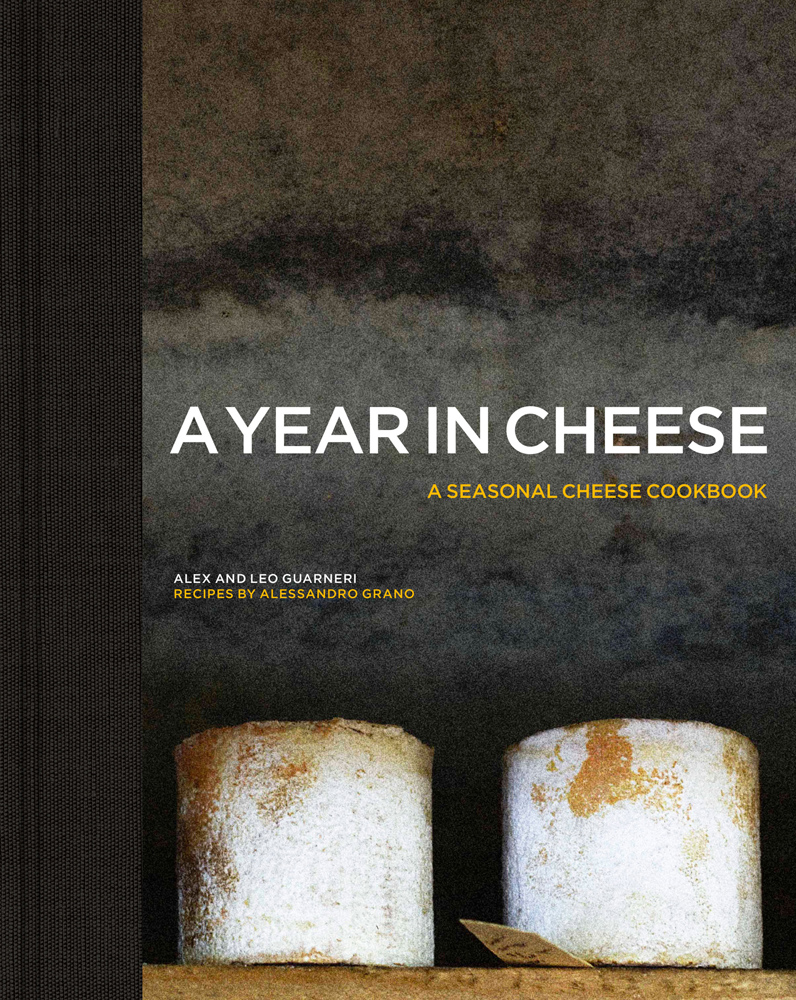
A Year in Cheese – Now isn’t that a thought!

IMG_2134


The brothers Alex and Leo Guarneri who run the London fromagerie ‘Androuet’ and the restaurant next door have just brought out a rather delicious sounding cookbook called ‘A Year in Cheese’. Along with their Italian chef Alessandro Grano they have put together a collection of their favourite recipes incorporating cheese. Much like vegetables, fruit and meat, cheese is also seasonal and it is with this in mind that the brothers have come up with some tasty cheese dishes to whet the appetite all year round.

A Year in Cheese-2

Images from A Year in Cheese: A Seasonal Cheese Cookbook by Alex and Leo Guarneri, Recipes by Alessandro Grano. Photographs by Kim Lightbody. Published by Frances Lincoln.’ 

Those who love ‘kinfolk’ style, myself included, will be naturally drawn to this recipe book. I particularly love it’s matt, rustic, moody photographs and recipes that look homely and inviting. Just browsing through the book, I love the sound of the ‘portobello mushrooms stuffed with walnuts and gorgonzola’, ‘french onion soup with 18-month-old comte’, ‘baked camembert with rosemary, honey and almonds’, ‘green and white asparagus with red Leicester crisps with sauce vierge’. The ‘watermelon and feta’ combination is always a winner and the brothers have come up with their own take on one of my favourite salads – see below. Salty, sweet with a blast of colour – what’s not to love!

WatermelonFetaSalad_22

Images from A Year in Cheese: A Seasonal Cheese Cookbook by Alex and Leo Guarneri, Recipes by Alessandro Grano. Photographs by Kim Lightbody. Published by Frances Lincoln.’ 

IMG_7969

The book is split into chapters according to seasons and then there is a separate chapter on cheeseboards and complementary wines. The book is original – I can’t think of another one focused on cheese in quite the same way – so for any cheese lover it is certainly a great addition to their recipe book library.

IMG_2107

As a christmas present, I think I would probably pair it with an interesting cheese and a fancy cheese spoon – how about this one – to complete the well thought through gift. I know that I would love to receive a gift like that.

IMG_2111


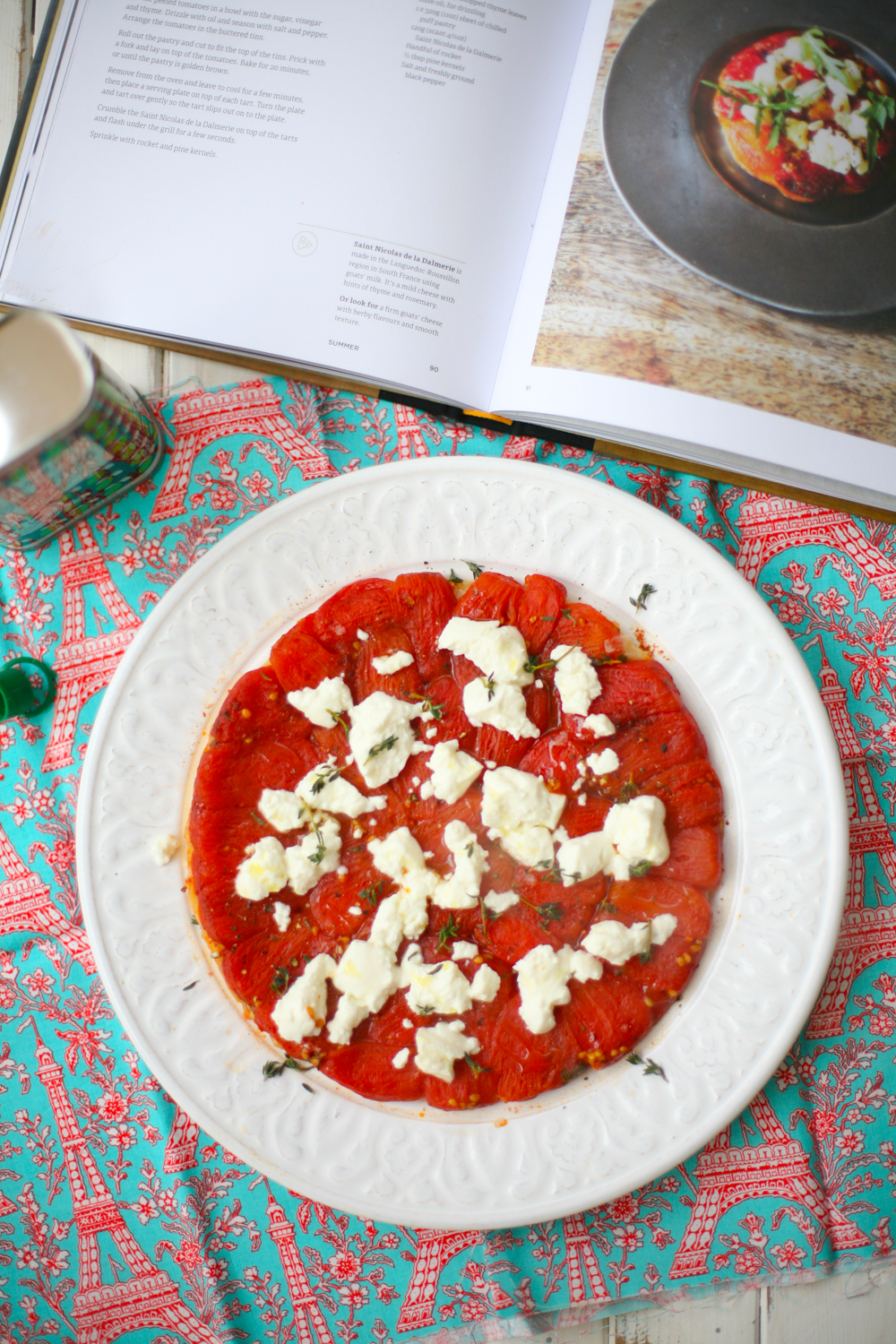
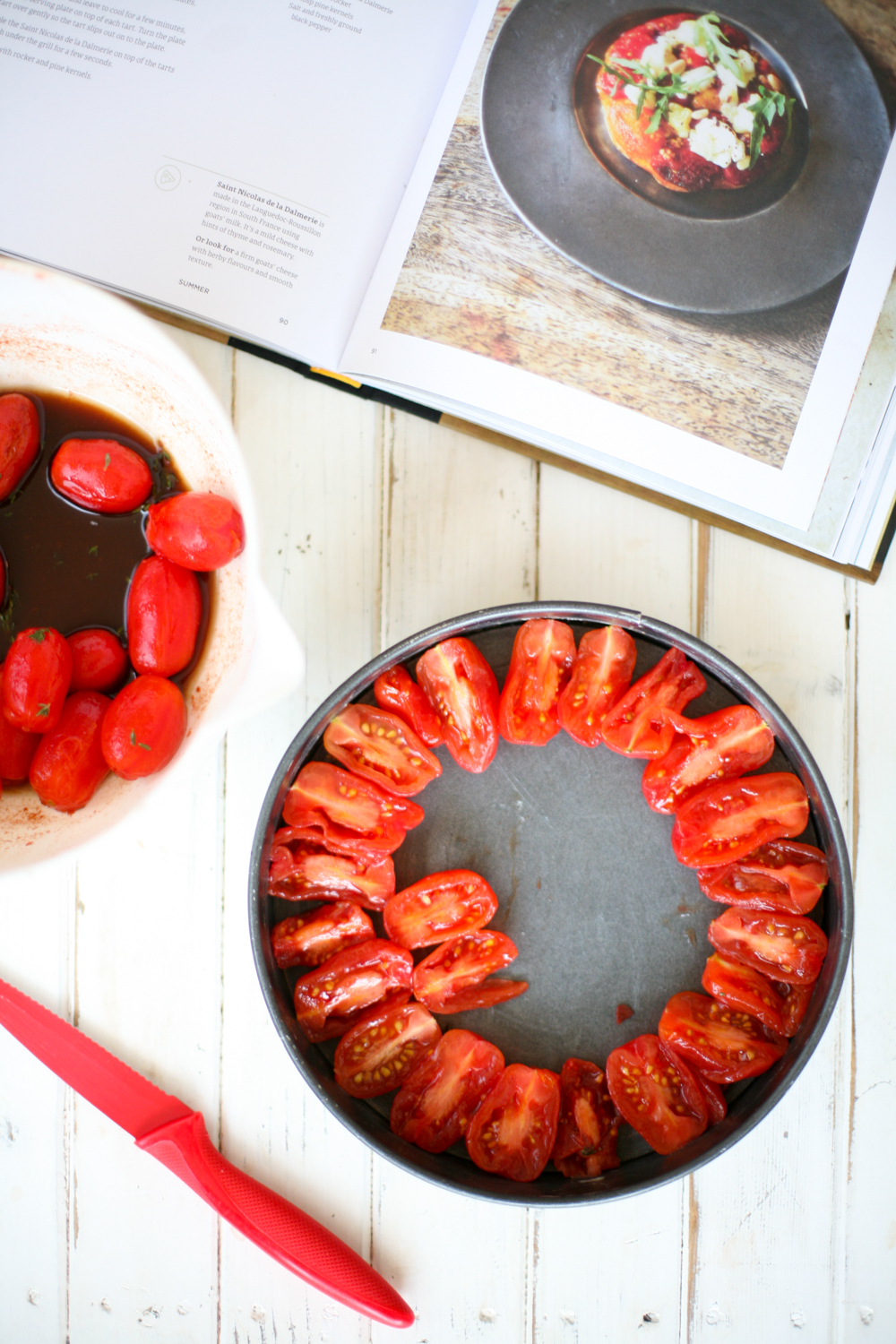
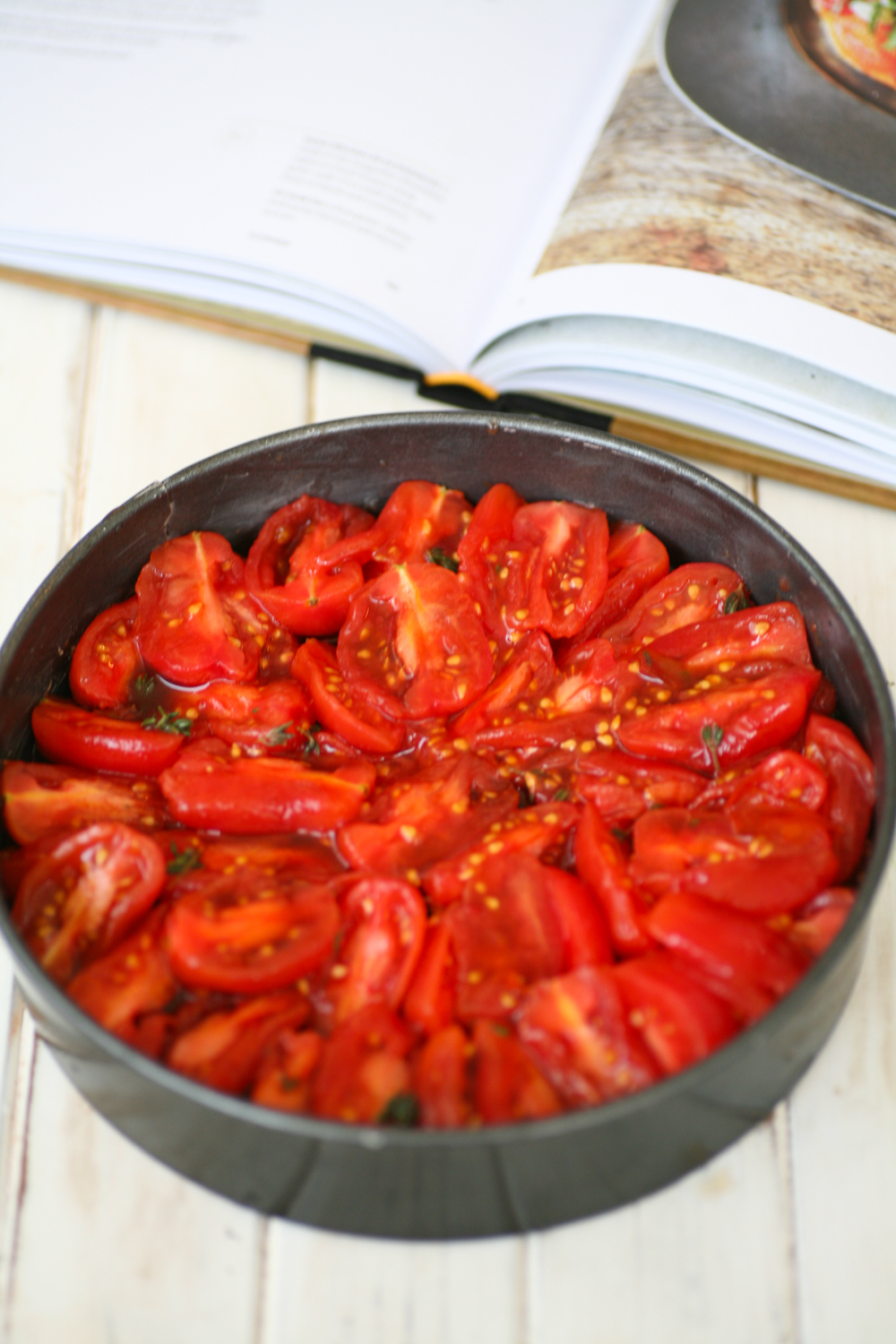
I decided to make their ‘tomato tarte tatin with Saint Nicolas De La Dalmerie’. It comes under the summer chapter, so perhaps I should have chosen one of the winter dishes because the cheese suggested was clearly not going to be in season. As such I replaced it with and English ‘Rosary plain’, which is a mild and creamy fresh cheese made from pasteurised goats milk.

IMG_2120


The recipe was delicious and quite frankly perfect for any time of year, the only thing that I need to work on was making the puff pastry rise better, as mine had not puffed up as well as the one in the photo in the book. I fear that there was too much balsamic vinegar making the pastry a little too wet to puff as much as it would like. As such I have made some alterations to the recipe.

IMG_2124

The olive oil that I like to use is the Nudo variety, which make a whole range of wonderful olive oils that come in eye catching tins. The extra virgin comes in the green tin (I used  this one for this recipe), the yellow tin is infused with lemons and the red tin has notes of chilli. The olive oils themselves make great gifts – see here for the trio selection, but I am also a huge fan (and have been for a number of years) of their gift idea where you ‘adopt’ an olive tree and then receive extra virgin olive oil through out the year. The gift that keeps on giving – perfect. Click here to learn more about the olive tree adoption.


Tomato Tarte Tatin with English Rosary Goats Cheese

Serves 4-6

500g cherry tomatoes, halved (you can use larger just slice them thinly)

1 tbsp brown sugar

2 tbsp balsamic vinegar

2 tsp fresh thyme leaves

Nudo olive oil, for drizzling

salt and pepper

1x320g sheet of chilled puff pastry

1 egg, whisked

50g English Rosary goats cheese


  1. Preheat the oven to 190 degrees (375 degrees Faranheit/gas5) and butter a tart tin. I used my regular 8 inch diameter cake tin. In the book they suggest using 2 6 inch diameter tart tins.
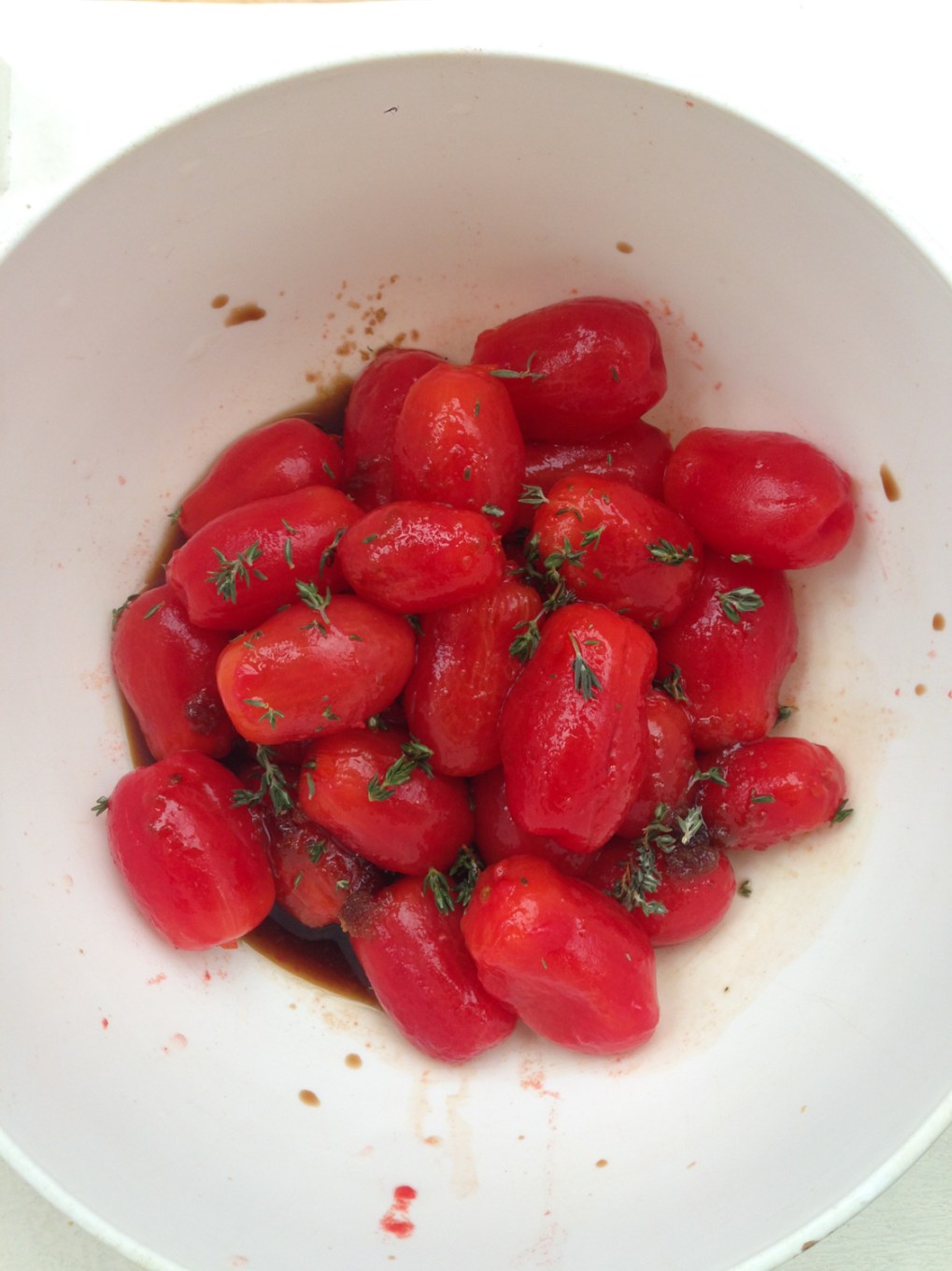
  2. Place the tomatoes in a bowl of boiling water for 10 seconds and then move them to a bowl of cold water. The skins will then peel off easily.
  3. Half the tomatoes and then drizzle them with the balsamic vinegar, sugar, olive oil and fresh thyme.
  4. Arrange the tomatoes neatly in the tin and then drizzle the remaining juice over them and add salt and pepper.
  5. Place a pastry topping over the top of the tomatoes and prick with a fork. Gently brush the pastry with the whisked egg.
  6. Place in the oven for 20-25 minutes, so that the pastry has puffed and bronzed.
  7. Remove from the oven and then place a plate of the top of the tin and turn upside down so that the tomato tarte tatin comes out.
  8. Crumble the goats cheese and place under a grill for around 10 seconds so that it begins to melt.
  9. You can scatter with a few rocket leaves and pine nuts if you have them to hand.

Perfect served hot or at room temperature.


Book Review of Nikkei Cuisine – Japanese Food the South American Way by Luiz Hara

IMG_7931

Luiz Hara has been on my culinary radar for a couple of years now. Word has it that he runs THE most exquisite supper clubs from his town house in Islington focusing primarily on Japanese, Nikkei and French cuisine. I’ve been procrastinating for far too long so I will definitely get my skates on in 2016 and give Luiz’s supper clubs a go. He is also the man behind the successful food blog, ‘The London Foodie’, which focuses on food, wine and travel. Most recently however he has published his very first cookbook called ‘Nikkei Cuisine – Japanese Food the South American Way’. It sounds intriguing right?

Nikkei Cuisine £25

‘Above Image from Nikkei Cuisine: Japanese Food the South American Way by Luiz Hara. Photography by Lisa Linder. Published by Jacqui Small (£25).’

Nikkei cuisine is the cooking of the Japanese diaspora. Japanese immigrants often found themselves in countries that had very different cooking techniques and ingredients to what they were used to. They had to adapt to their new surroundings but at the same time wanted to continue using Japanese techniques and traditions. The resulting cuisine is called Nikkei. To say ‘fusion’ would be wrong and Luiz goes to great lengths in his introduction to explain Nikkei cuisine and how it is a very distinct cuisine in its own right. He explains “Nikkei cuisine is a byproduct of migration and adaption, created over 100 years ago in South America. It was a cuisine created out of necessity”.

IMG_2062

Outside Japan the highest contentration of Japanese live in South America, namely Brazil and Peru. It was in Brazil that Luiz’s family finally settled and became part of the Nikkei community. The cuisine has been part of his family history and is certainly no food fad. Luiz himself moved to London for university after which he worked in Finance in the city.  Much like myself he created his blog ‘The London Foodie’ as a creative outpost for this food thoughts and exploration. It was love of food and cuisine that they led him to quit his day job and embark on a new chapter in food. He trained at Le Cordon Bleu, where he graduated with the Grande Diplome in 2012. It was following his training and some time spent in Japan learning from the masters, that he then opened up his own home to friends and strangers by hosting his supper club. As well as continuing to this day with his supper club, he teaches cooking and writes in many national and overseas publications on the topic of food and travel.

IMG_2074

Which brings us to the book itself. To say that it is a feast for the eyes as well as the belly is a massive understatement. It’s colourful, bold and exciting.  It’s the type of book that is perfect for confident homecooks or for those who like to be pushed in their abilities. I recall some people grumbling over the ingredients lists of the hallowed books from the Ottolenghi empire, but for me this was a revelation and not something that phased me in the slightest. Luiz’s book must be treated with the same respect. Yes, it requires a bit of thought and forward planning, but with the help of some wonderful Oriental supermarkets in the UK and online, it is not too difficult to create the dishes. Luiz even lists a ‘directory of suppliers’ in the back of the book to help you if you are unsure where to buy certain ingredients. He also lists all the ingredients you may be unfamiliar with and gives an overview about each one.

‘Above Images from Nikkei Cuisine: Japanese Food the South American Way by Luiz Hara. Photography by Lisa Linder. Published by Jacqui Small (£25).’

The sound of the dishes coupled with the stunning photographs in the book (see above photos) really inspire you to try cooking these yourself. How about duck breast robata with pickled pearl onions and sancho pepper vinaigrette or salmon and passion fruit tiradito with crispy butternut squash and espelette pepper or Nikkei hotpot of pork belly, cod and seafood? Mouthwatering hey. Word of warning, never read this book if you are feeling hungry as it will make matters a whole lot worse believe me.

I decided to trial one of his recipes. Deciding which to go for was a hard job as they all looked so good. In the end I chose the ‘Aubergine, Pork and Rice Noodle Salad’ as most of the ingredients I had in my kitchen – I’m also partial to little pork mince from time to time. I kept pretty to close to his recipe with the few alterations being:

  1. The amount of pork I used. He said 300g and I used the whole pack of 500g. Unless you go to the butcher, most packets of pork mince in the UK are 500g, hence I decided to use the lot.
  2. I also used vegetable bouillon instead of Asian chicken stock. I went to Korea Foods and when I asked for Asian chicken stock the guy showed me what looked like a regular chicken stock but with Chinese writing all over it. This was probably the Asian chicken stock that Luiz was referring to but the packet was so large I decided that I would replicate it with my regular vegetable stock.
  3. I would recommend you suggest cooking the aubergine for  nearer 7 minutes as opposed to 5-6 as you want to make sure that the aubergine is properly soft inside.
  4. For speed I opted for ginger paste instead of fresh ginger!
  5. I used reduced salt soy sauce.

The recipe was really very straightforward and I would most definitely cook it again. Flavoursome, with great balances of salty and sweet with only a hint of chilli.

IMG_2093

Aubergine, Pork & Rice Noodle Salad

Serves 4

for the pork soboro:

2 tbsp sesame oil

500g pork mince

50ml sake

50ml mirin

100ml reduced salt soy sauce

2tsp ginger paste

2 tsp caster sugar

****

for the dressing:

1/2 tsp of vegetable stock powder (Asian chicken stock if you have it)

4 tbsp boiling water

1 tbsp rice vinegar

1 tbsp sesame oil

1 tbsp caster sugar

2 tbsp soy sauce

2 tsp finely chopped red chilli

2 tsp ginger paste

****

100g dried rice vermicelli noodles

1 tbsp finely chopped fresh coriander leaves

sunflower oil for deep frying

2 aubergines

2 tsp toasted white sesame seeds

a sprinkle of shichimi pepper

  1. First start by making the pork soboro. Place the sesame oil in a pan and when it is hot add the pork mince and allow to brown in colour (this will take around 5 minutes) before adding all the rest of the ingredients in the list for the pork soboro. Cook on a medium heat for around 20 minutes or until all the liquid has evaporated. Leave to cool on one side.
  2. Cook the dried rice vermicelli noodles according to the packet and when cooked through, drain allowing cold water to run through the noodles. Add the fresh coriander to the noodles and place to one side.
  3. Next you need to make the dressing by adding all the ingredients together in a mixing jug. Place to one side.
  4. Using a pan  bigger enough to hold both aubergines gently heat up some sunflower oil. You want to fill the pan up to half way with the sunflower oil. Clean the aubergines and make a few delicate incisions into each aubergine to prevent them from bursting in the pan. Gently place the aubergine into the hot oil.
  5. Gently turn the aubergines over every minute and allow them to cook for 7 minutes.
  6. Get a large bowl of cold water (pop in some ice if you have any). When the aubergines have cooked for 7 minutes, plunge them into the iced cold water. They will immediately shrivel up.
  7. Once the aubergines have cooled, peel their skin. It will come away really easily.
  8. Now cut the aubergine lengthways so that you have 4 pieces. Take one aubergine section and cut it lengthways on the diagonal. Place both sections onto a serving plate.
  9. Place a portion of the noodles across the centre of the aubergine on the diagonal. Layer the pork soboro on top and finish off with some of the dressing, sesame seeds and shichimi pepper.

Luiz suggests eating it at room temperature, which I did. All the elements of the dish can be prepared in advance, which is always a bonus if you are entertaining.

Please don’t be put off by the lengthy ingredient list. From start to finish this dish will not take longer to prepare than 30 minutes. It really is very tasty indeed.

IMG_2071