Mung Bean and Cumin Dal and Durga Puja Festivities

This past weekend has been one of celebration as it was Durga Puja. For Bengali Hindus (my husband’s side of the family) Durga Puja is the biggest religious festival in the Hindu calender. In Kolkata, which is the heart of Bengal, I am told it is taken to another level altogether, when families feast, dance and pray to the goddess Durga – the conquerer of good over evil and the mother of the universe, as well as her children: Ganesh, Saraswati, Lakshmi and Kartik. Schools close and everyone takes time off work to celebrate.

The statue of goddess Durga on her lion fighting the demon Mahishasura in the Hounslow Pandal

Tooting Goddess Durga 

The making of the statues is a hugely lucrative business in India and at the end of the six day festival the statues are ceremoniously carried to the Ganges and left to drift away and be reabsorbed into the Ganges. The statutes themselves are made of straw and mud from the Ganges and then glazed with paint to give them that glossy shine; the craftsmanship and detail never ceases to impress me.

There are thousands of Durga Puja pandals, which are basically huge structures housing the goddess and her children, erected all over the different Kolkata neighbourhoods. It’s all hugely competitive and each pandal competes for attention in beauty and innovation. I visited two different ones in London – one in Tooting and the other in Hounslow and both were very spectacular in terms of colour and design, the latter I know had been shipped from Kolkata.

Ganesh – one of Durga’s offspring in the Hounslow Pandal

The banging of the drums, the blowing of the conch shell, the incense, the chanting of the prays and hustle and bustle of people coming and going really transports you to India. It’s all rather frenetic and yet very warm and inviting at the same time. In the Hounslow pandal alone thousands of visitors came and went over the course of a few days. Catering for that number must be rather daunting but I was very impressed by the taste and quality of the food and the fact that it was all hot. It was the longest queue for food I have ever witnessed, but it moved quickly and before long we were given a plate of tasty vegetarian food.

Some vegetarian cuisine given to those who attended the Hounslow puja in London

Back at home I have been cooking an endless amount of Indian dishes from: methi and pomegranate pork curry to amma’s chicken curry, red lentil dal with spinach, yellow dal with courgette, Bengali fish curry and mung bean and cumin dal.

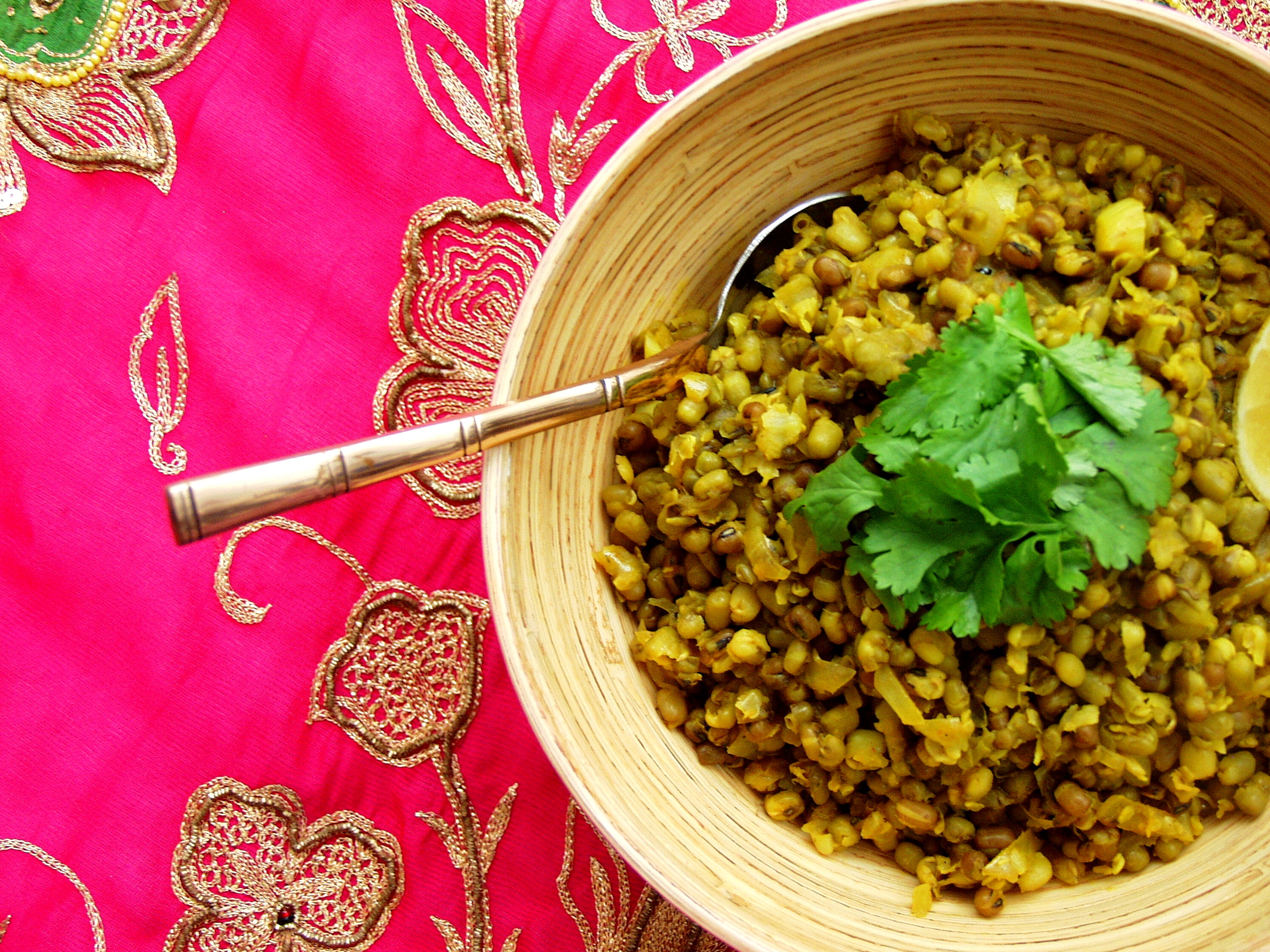
It is the mung bean dal recipe that I wanted to share with you all today. Unlike red split lentil and some yellow dal it does require a little more forward planning as it needs to be soaked, ideally overnight.

It’s delicious, nutritious, cheap to make and other than the soaking of the mung beans, is very straightforward. My mother-in-law makes a completely different tasting mung bean dal, which I will post another time, but to get you started try this one and let me know how you get on. It’s perfect for a week night vegetarian supper.

Mung Bean and Cumin Dal

Serves 4

250g mung beans (also referred to as moong bean), soaked overnight

3 tbsp mustard oil

1 white onion, finely chopped

1 tsp cumin seeds

1 tsp turmeric

half tsp red chilli powder

half tsp garam masala powder

half tsp cumin powder

1 tsp salt

juice of half a lemon

fresh coriander to serve

1. Place the pre soaked mung beans in a pan and cover with water and gently simmer until softened. This will take around 40 minutes.

2. Meanwhile, place the oil in a pan and gently fry the cumin seeds for a minute or so until they begin to bronze. Immediately add the onion and mix together with the cumin seeds.

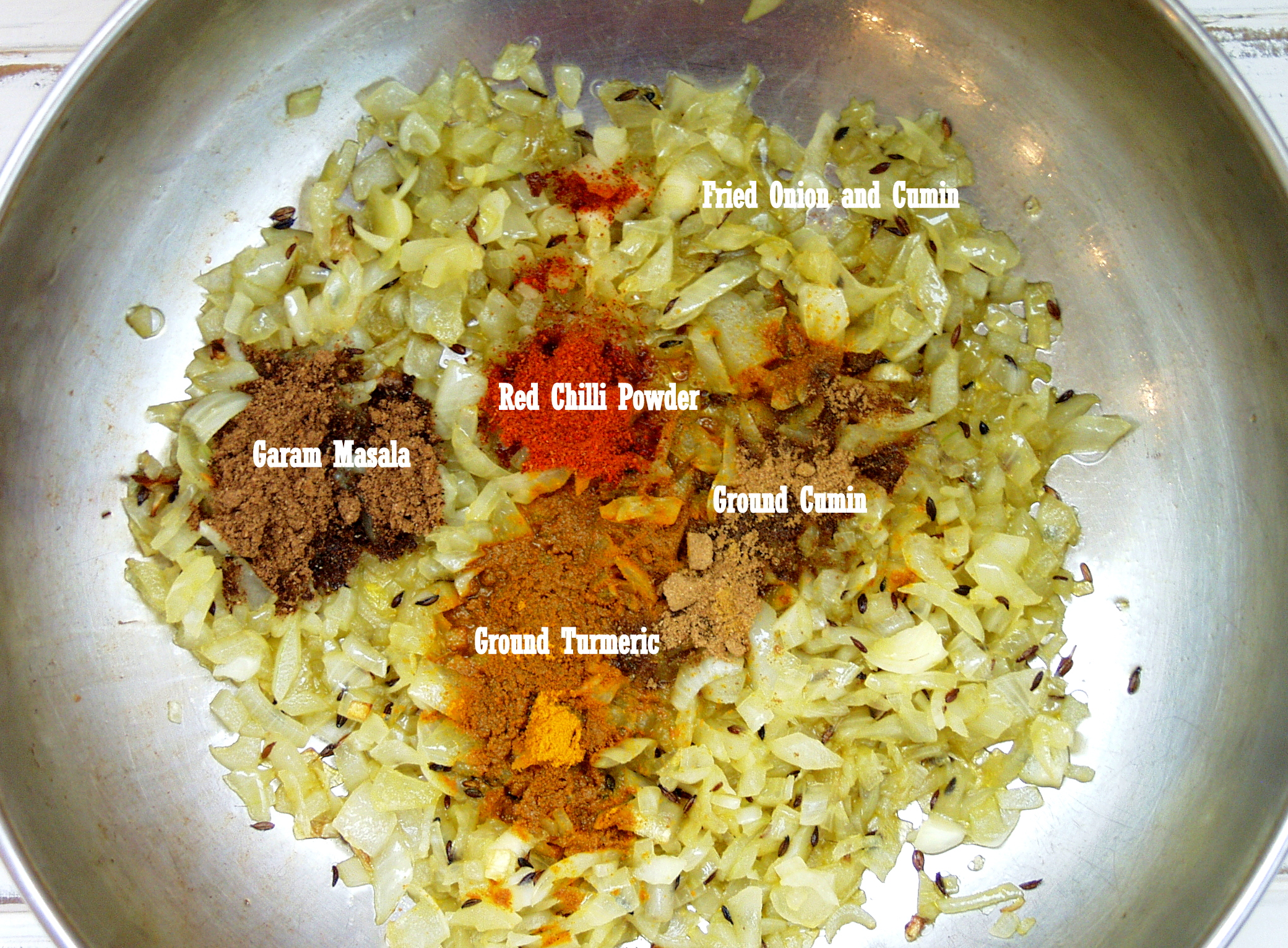
3. When the onions have softened and become translucent add the cumin powder, red chilli powder, turmeric and garam masala and stir together.

4. Drain the mung beans and then transfer them to the pan with the onions and fold in thoroughly. Add the salt and lemon juice and simmer together for a further 5-10 minutes. You may need to add a little more water at this stage.

Whilst it is delicious to eat on its own or with a chapati it is also great to accompany it with a fish, meat or vegetarian curry (see my recipe library) if you wish to make a more substantial Indian feast.

Mung beans soaked overnight

Step 3 above


Roasted Harlequin Squash with Tofu, Kale and Coriander in a Miso-Curry Paste

I am a big advocate of eating a few meals a week that are vegetarian. In the past I think the general public felt rather limited on what vegetarian meals to cook that were satisfyingly tasty. Times have changed however and today a whole universe into vegetarian cooking has developed and become mainstream. There are countless possibilities of what to cook and a wonderful array of cook books and blog posts giving us ideas of new food combinations to try out.

A fabulous success story in the blogging world is the vegetarian food blogger Heidi Swanson from San Francisco, who writes 101cookbooks.com and already has a few cookbooks to her name. I managed to pick up her latest book Super Natural Cooking in Vancouver last year when I was visiting my sister. Her photos always impress me and I like the way they have a matt finish in her book.  Understandably she cooks with a wide range of lentils, beans and grains and has some excellent ideas of pairing them with various vegetables and sauces.

This recipe is very seasonal and is perfect for Autumn time as it requires you buying squash. Heidi uses ‘delicata squash’  for it’s buttery flavour and wonderful green stripes, adding a vibrancy to the dish. Sadly I could not find any at Pimlico farmers market so bought a harlequin squash instead, which worked equally well. Basically any squash that you don’t have to peel (which is actually quite a large number) will work.

I also used roseval potatoes as I adore their red skin and yellow flesh, but any other small variety of potato will work – Heidi uses new!

Finally the only other change I made to Heidi’s original recipe is that I used more tofu as I wanted to use up a whole packet.

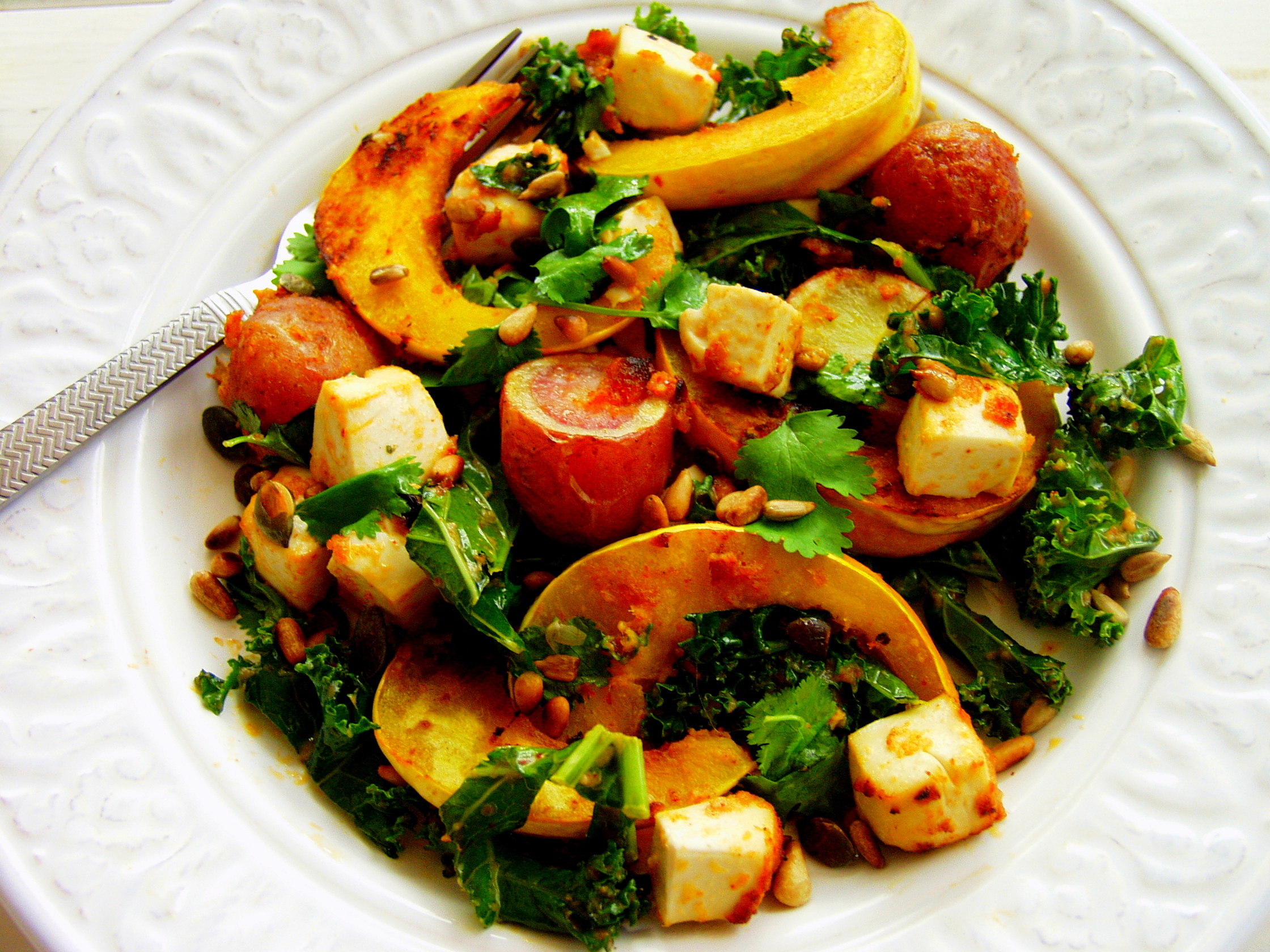
The dish is perfect for a weeknight meal as it is very easy to prepare and takes no time to  actually cook. I also love the fact that it requires no peeling of the squash – result !

Miso-Curry Harlequin Squash

Adapted from Heidi Swanson’s book ‘Super Natural Every Day’

Serves 4

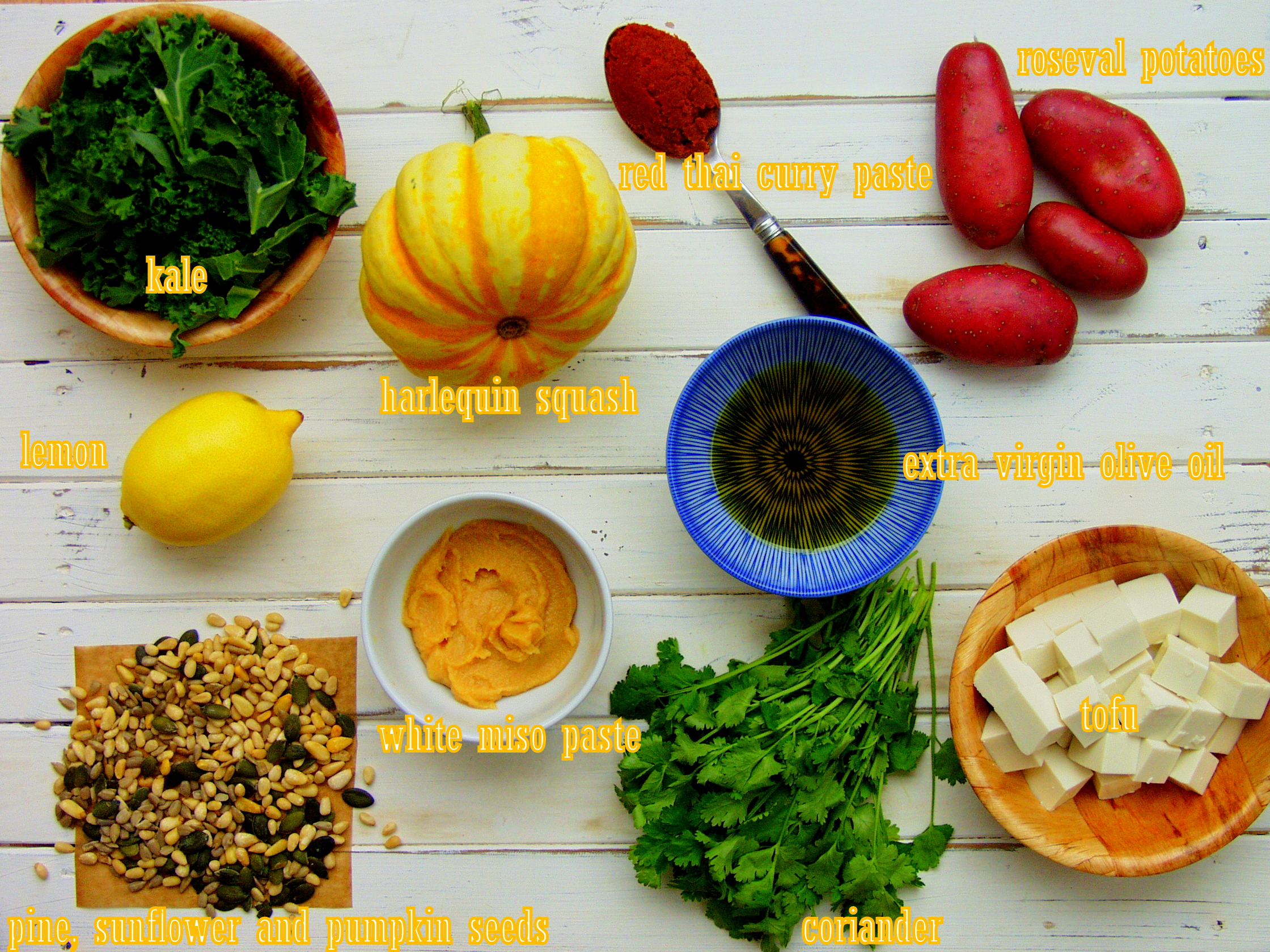
350g harlequin squash (or delicata or any that require no peeling)

60 ml extra virgin olive oil

70g sweet white miso paste (I buy mine from Sainsbury)

1 tbsp red Thai curry paste

349g firm tofu (or whole packet equivalent), cut into small cubes

4 medium Roseval potatoes, unpeeled and cut into chunks

2 tbsp fresh lemon juice

45g chopped kale, tough stems removed

45g seeds (pine nuts, pumpkin and sunflower seeds), toasted

30g chopped coriander/cilantro

1. Preheat the oven to 200 degrees centigrade.

2. Carefully cut the harlequin squash into 1cm thick half moons.

3. In a bowl whisk together the oil, red thai curry paste and sweet miso paste.

4. Gently fold the squash, potatoes and tofu into 80ml of the miso-curry paste using your hands, making sure that you do not break up the tofu. Spread out the ingredients onto a baking sheet and place in the centre of the oven for 25-30 minutes. Toss a couple of times during cooking once the ingredients begin to bronze.

5. With the remaining miso-curry paste whisk in the lemon juice and then stir in the kale (uncooked!).

6. In a heavy skillet gently toast the seeds and nuts over a medium heat until they have bronzed and become fragrant. This will only take a couple of minutes. Do not leave them as they will burn.

7. When the squash, potatoes and tofu are cooked, gently toss all the ingredients together including the nuts and seeds, coriander/cilantro and kale. Serve hot onto warm plates.

The potatoes, squash and tofu coated in the miso-curry paste

Ready to eat – once I’ve got the perfect shot!


Nigella’s Italian Roast Chicken with Leeks, Peppers and Black Olives and Leftover Chicken Soup

We had a family gathering last weekend and I wanted to cook a no fuss meal that would literally cook itself freeing me up to enjoy my guest’s company. So while we all sipped on our Aperol with Prosecco – a drink that I was introduced to this summer when we at our friend’s wedding in South Tyrol (and which has apparently become very in vogue in London this summer!) and caught up on each others news, the chicken and vegetables were nicely roasting in the oven without any need for stirring or turning over.

I paired them with good old roast potatoes (that I had parboiled first and then drained and given a good shake in the saucepan before putting them on a roasting dish with a splash or two of olive oil) that are always a home run at a family occasion. Couscous would work equally well or even mashed potato.

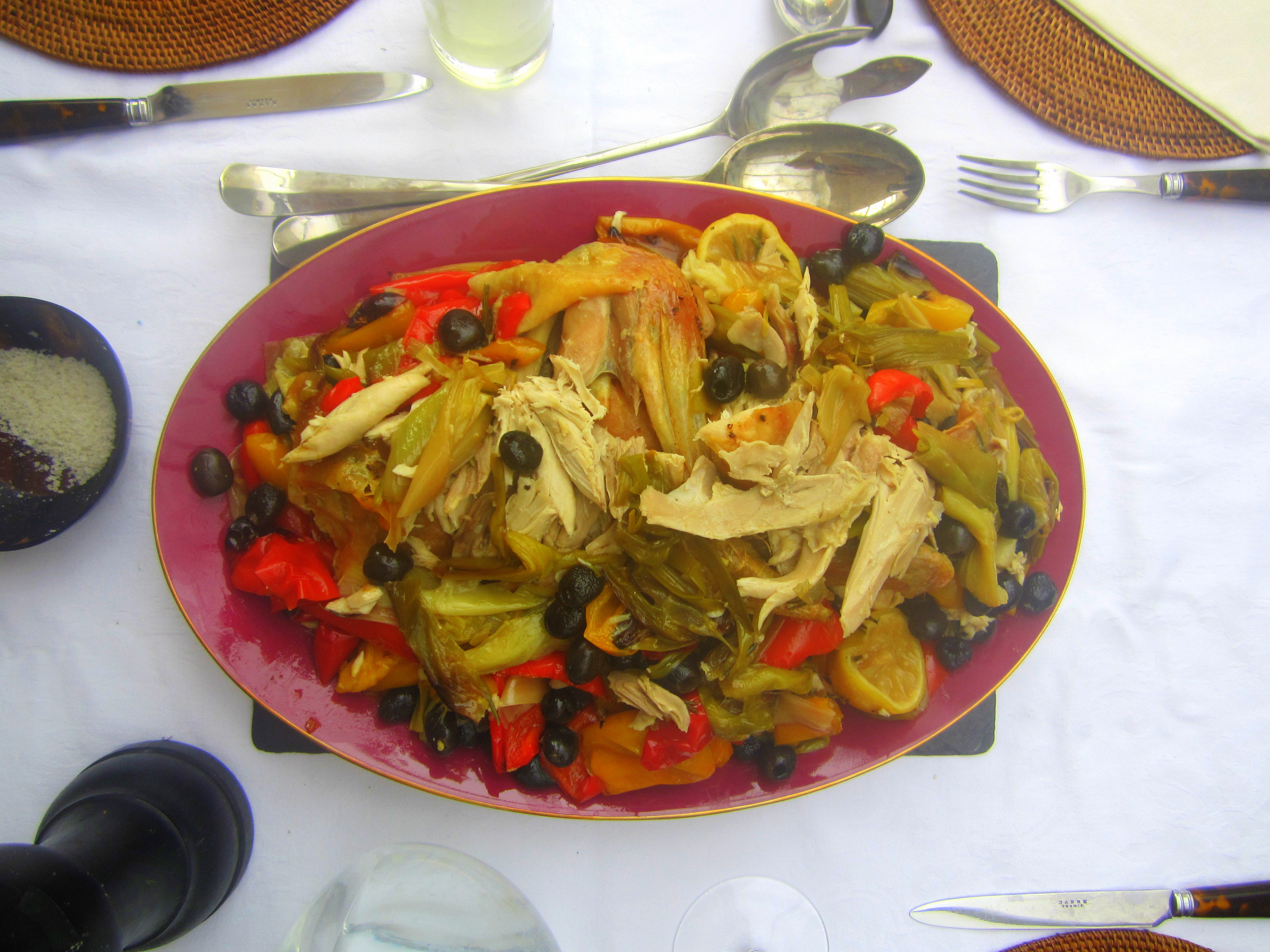
The saltiness from the black olives and the sweetness from the peppers and leeks worked a treat and together they created a delicious gravy to pour over the succulent meat and roast spuds.

I love it when guests can help themselves to what they want as this tends to avoid wastage as they only take what they are going to eat and also it’s a fun and relaxing way to all share a meal together. I chopped (no carving here) the chicken up so that there were lots of options on what meat they could dig into. Around the side I scattered the leeks, peppers and black olives and in a separate gravy jug I gathered all the juices.

With the remaining two carcasses I made some homemade stock, which I then turned into a delicious chicken soup for lunch the followingday. Easy, healthy and no wastage – other than the bones.

Italian Roast Chicken with Leeks, Peppers and Black Olives

adapted from Nigella Lawson’s latest series Nigellissima on the BBC 

Serves 8 (simply halve the quantity for serving 4 people)

2 whole chickens (1.3kg)

2 whole fresh lemons – halved

6 fresh rosemary sprigs

8 leeks, washed and trimmed

6 peppers – red/yellow/orange, quartered

300g black olives

good splash of olive oil

sea salt and pepper

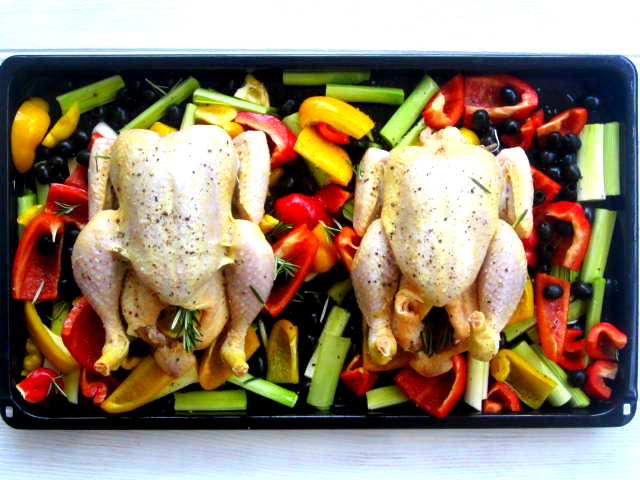
1. Prepare the peppers and scatter them on a large roasting tray along with the leeks, which should be cut to 3 inches in length and then halved. Evenly spread the black olives over the vegetables along with two sprigs of fresh rosemary.

2. Take off any string on the chickens and place a whole lemon – cut in two, into the inside of each chicken along with two rosemary springs in each. Season with pepper and salt and splash the chickens and vegetables liberally with olive oil.

3. Place in a preheated oven at 180 degrees if using a fan oven (200 degrees if not!)  for approximately 1 hour 15 minutes – or until the chickens are bronzed and roasted and the juices are running clear when you cut into the chicken with a sharp knife.

4. Serve on a warm large platter with the chickens cut up in the centre and the vegetables and olives surrounding the meat so that your guests can help themselves.

5. There will be a good amount of juices left in the roasting dish, which you need to transfer to a gravy dish for people to pour over their food.

I served mine with roasted potatoes however, couscous or mashed potato would work equally well.

Homemade Chicken Soup

Serves 4

left over chicken (1 or 2) carcass

1 large carrot, chopped into three

1 medium sized onion, chopped in two

3 bay leaves

water to cover the carcasses

a good glug (half a wine glass) of cheap white wine

1 chicken stock cube (optional)

2 tbsp single cream

juice of half a lemon

pepper and salt

1. Place the chicken carcasses in a large pot and cover with water. Make sure that there are no lemons remaining within the chicken carcasses when you are making the stock.

2. Add the carrot, onion, bay leaves and wine to the pot and simmer gently for an hour and then set aside to cool.

3. Strain the liquid through a sieve and return to the pot along with the carrot and onion. Place the chicken carcasses on the side and remove all the remaining meat with your hands and place into the pot. The meat with easily come away from all the bones. Bits of rosemary will also be on some of the meat from when you first roasted it. Add this to the pot as well as it adds a lovely taste to the soup.

4. Gently heat up the liquid once again and add the single cream, one chicken stock cube (optional), juice from half a lemon, some more water if you want it to go further. Season to taste.

5. Using a hand blender, blend the liquid until it is smooth.

6. Serve piping hot with a quarter of lemon on the side should guests which to add a little more lemon and some crusty bread.


Embracing Autumn and Chutney Making

Autumn has definitely arrived here in England and I for one LOVE the season.

10 reasons to embrace autumn:

1) The dramatic burnt orange, golden and red leaves on the trees is breathtakingly beautiful and it always manages to impress me with its vibrant hue.

2) Kicking the crisp fallen leaves as you walk gives us all – old and young alike – that inner thrill.

3) Roaring fires to warm up by whilst drinking hot chocolate or warm apple cider.

4) Big warm jumpers to keep us roasty toasty. Everyone looks great in autumn fashion.

5) Harvest Festival, Bonfire Night, Halloween and everything that is associated with them.

6) Hearty comfort food such as casserole, stews and soups become regular staples.

7) The smell of woodsmoke – it has to be one of my all time favourite smells.

8) Foraging for blackberries, crab apples, rose hips, elderberries

9) Eating all the foods that are now in season: the above as well as, apples (cox, gala, spartan, egremont, russet), celery, endive, mussels, kale, fennel, spinach, beans, leeks, beetroot, swede, pumpkin, spring onions, carrots, turnips, cauliflower, squash cabbage (autumn, red, spring green, winter white and savoy), marrow, potatoes and parsnips

10) Making chutneys, pickles and preserves.

What do you like most about autumn? Don’t be shy, leave a message below.

Photo sourced by PicoCool 

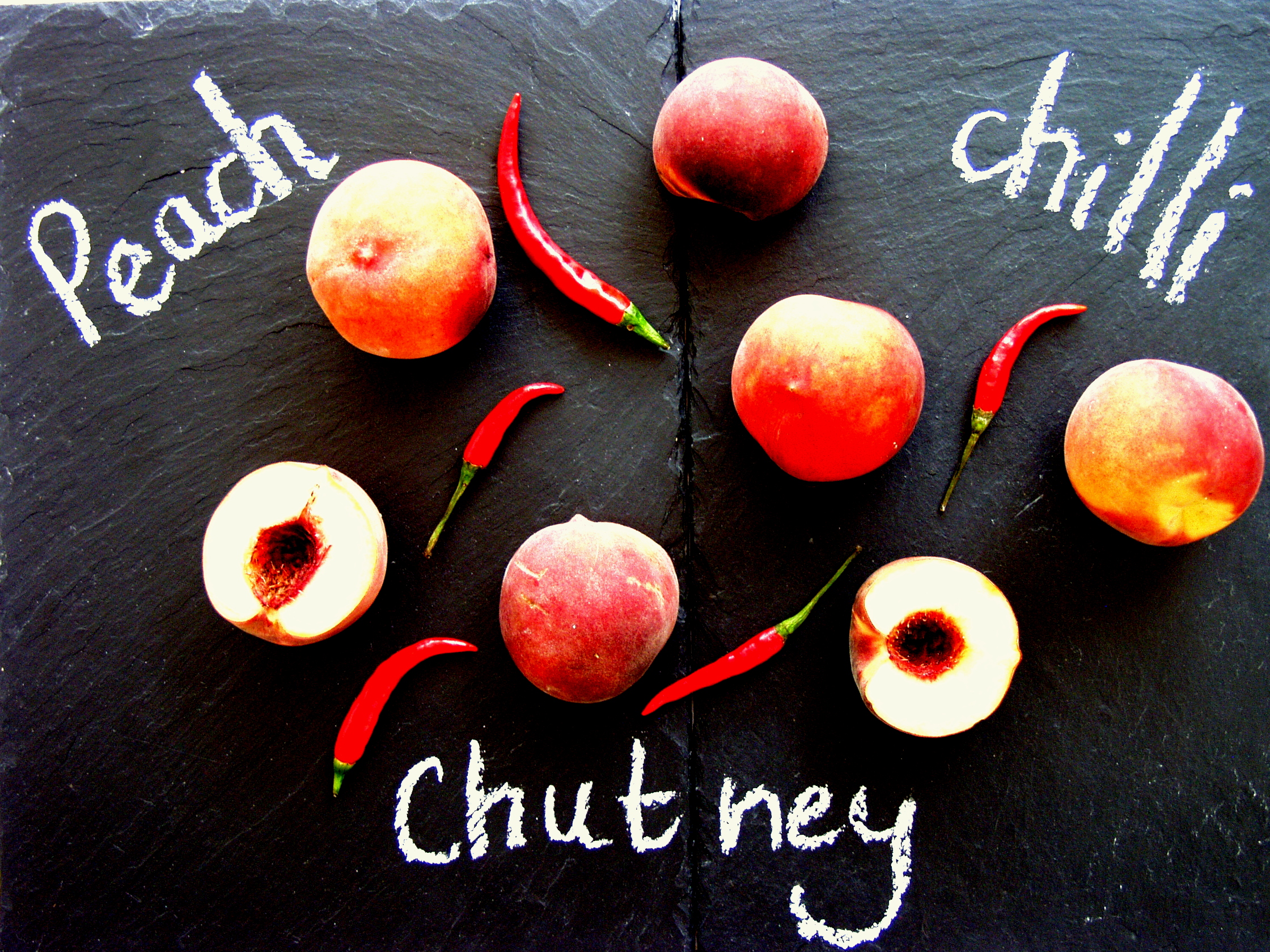
Last year I cooked a huge batch of Kashmir chutney and sweet piccalill which made great little christmas gifts and recently I decided to make some pickled peach and chilli chutney. They were selling huge batches of peaches at the market so I thought that they would be perfect for this chutney. I tend to make double the portions of the amounts below as they last for up to 6 months so are easy to keep and store.

Pickled Peach and Chilli Chutney

Sourced from the Complete Book of Preserves & Pickles by Catherine Atkinson and Maggie Mayhew

Makes about 450g/1lb

475ml cups cider vinegar

275g light brown muscovado sugar

225g dried pitted dates, finely chopped

1 tsp ground allspice

1 tsp ground mace

450g ripe peaches, stoned and cut into small pieces

3 onions, thinly sliced

4 fresh red chillies, seeded and finely chopped

4 garlic cloves, crushed

5cm/2inches fresh root ginger, peeled and finely grated

1 tsp salt

1.  In a large pan place the vinegar, dates, sugar, allspice and mace and gently heat. Stir with a wooden spoon until the sugar is completely dissolved.

2. Bring to the boil and then add the peaches, sliced onion, chopped chillies, crushed garlic, grated ginger and salt continuing to stir occasionally.

3. Reduce the heat and simmer for 40-50 minutes – by which time the chutney should have thickened.

4. Spoon the hot chutney in steralised jars – either by boiling them in water first or putting them in the dishwasher. I place a waxed disc on top – waxed side down and then place the lid on top.

You need to store them in a cool, dark place where the chutney can mature for at least 2 weeks before eating. They will last up to 6 months.

Another great way to eat the chutney is with grilled chicken served in warm wraps or with ricotta or goats cheese and some crusty bread.
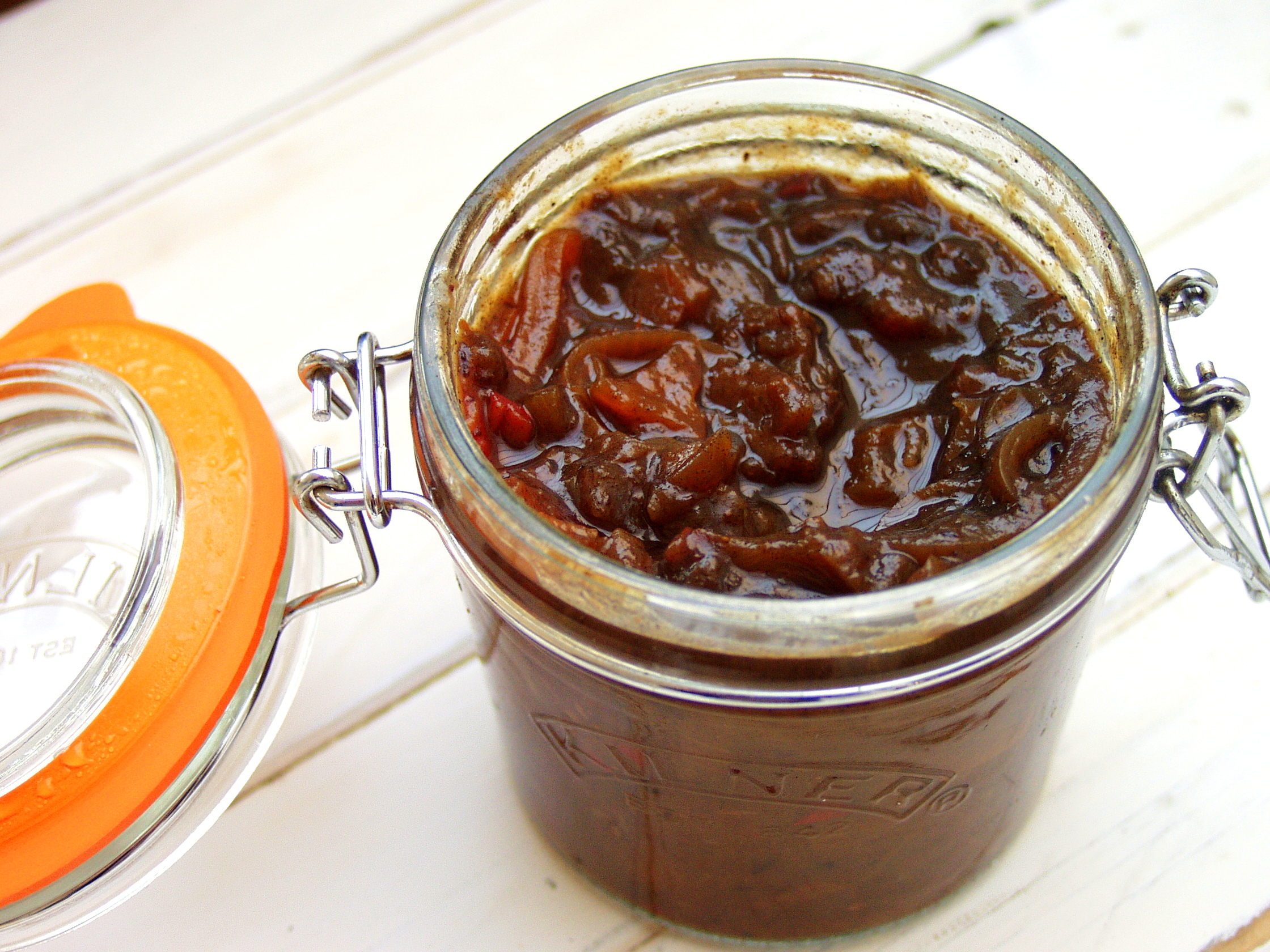
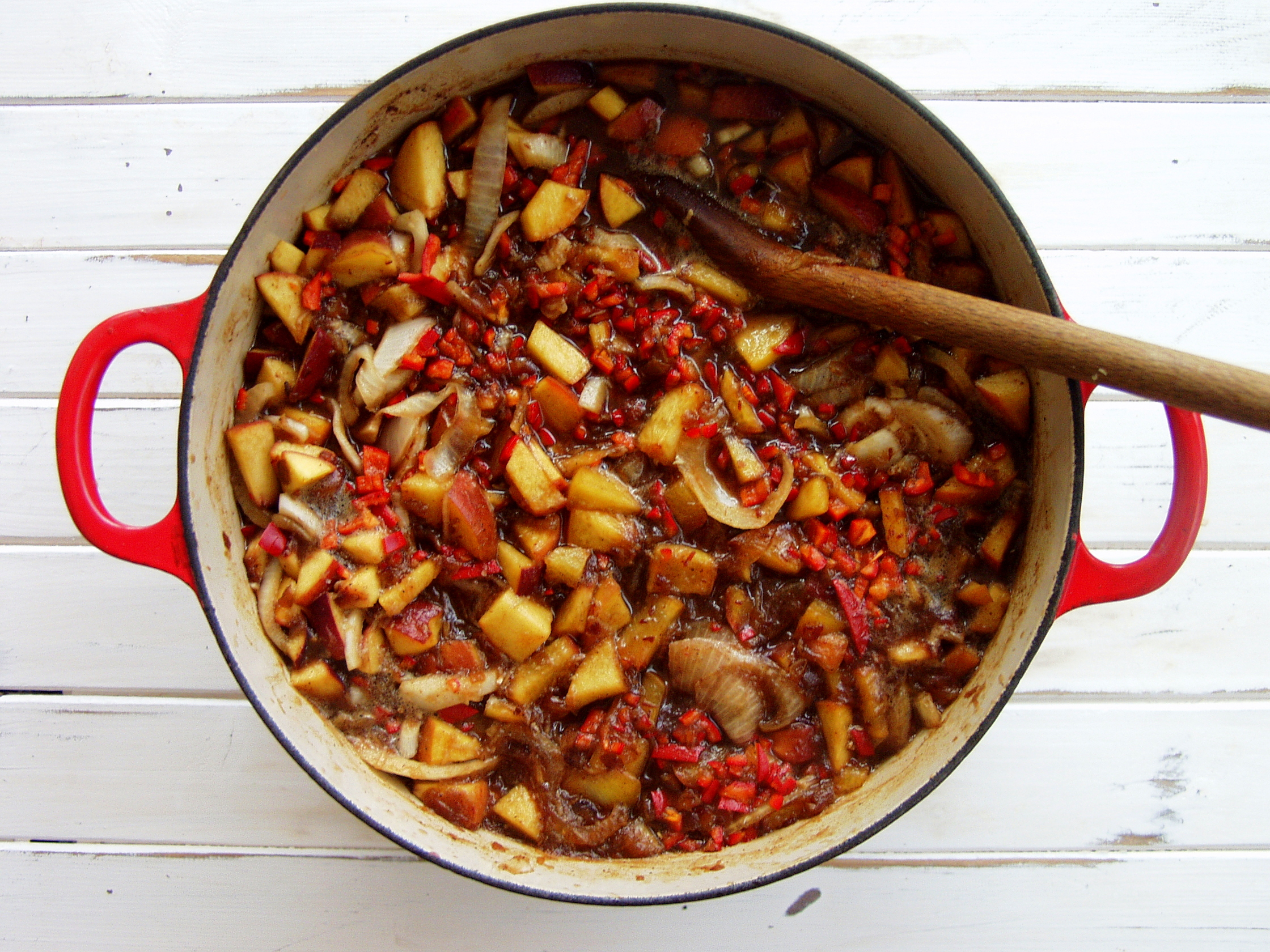
Taken just after point 2) above and before it has been cooking for 40-50 mins


San Bei Ji – Three Cup Chicken

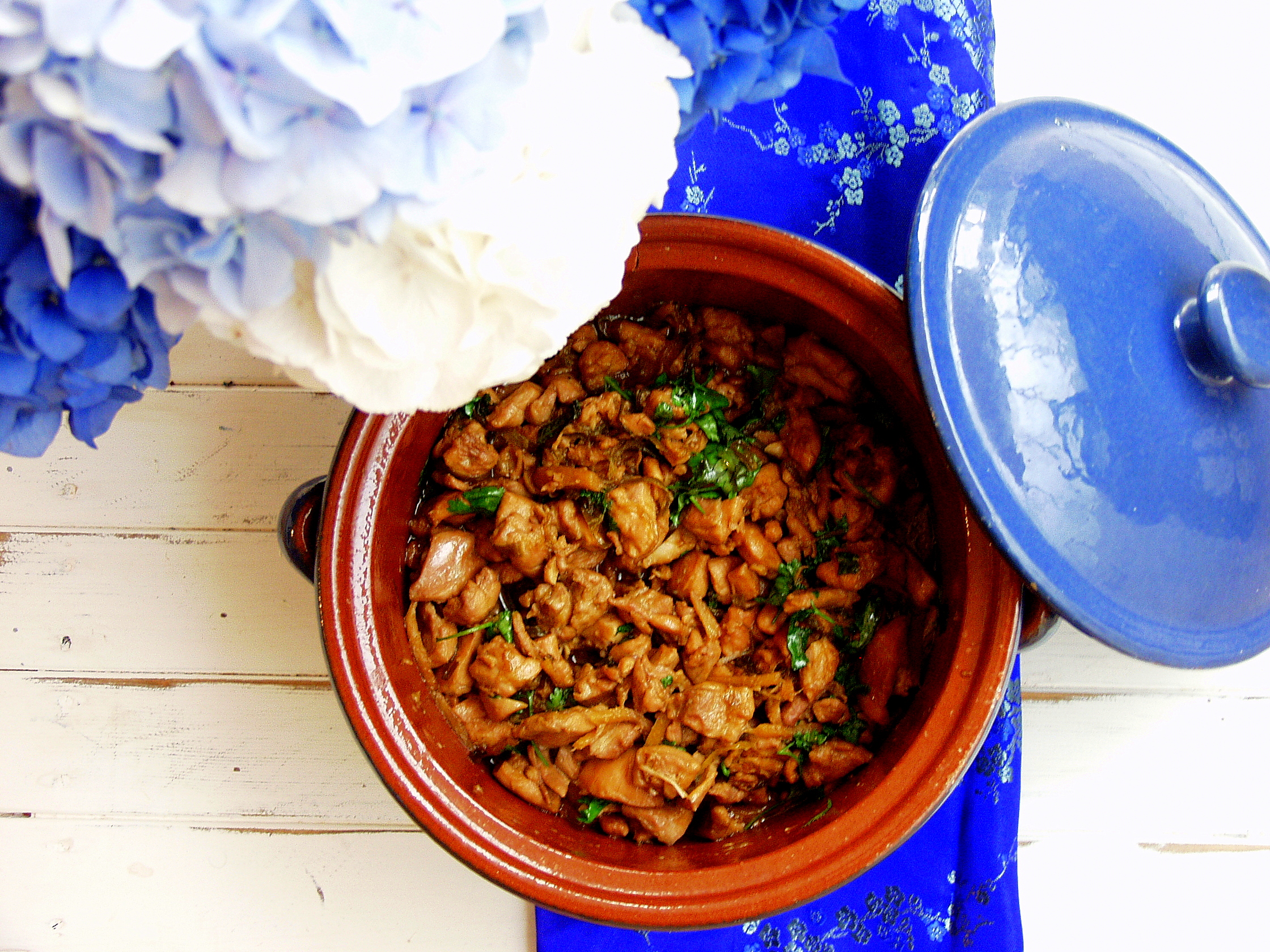
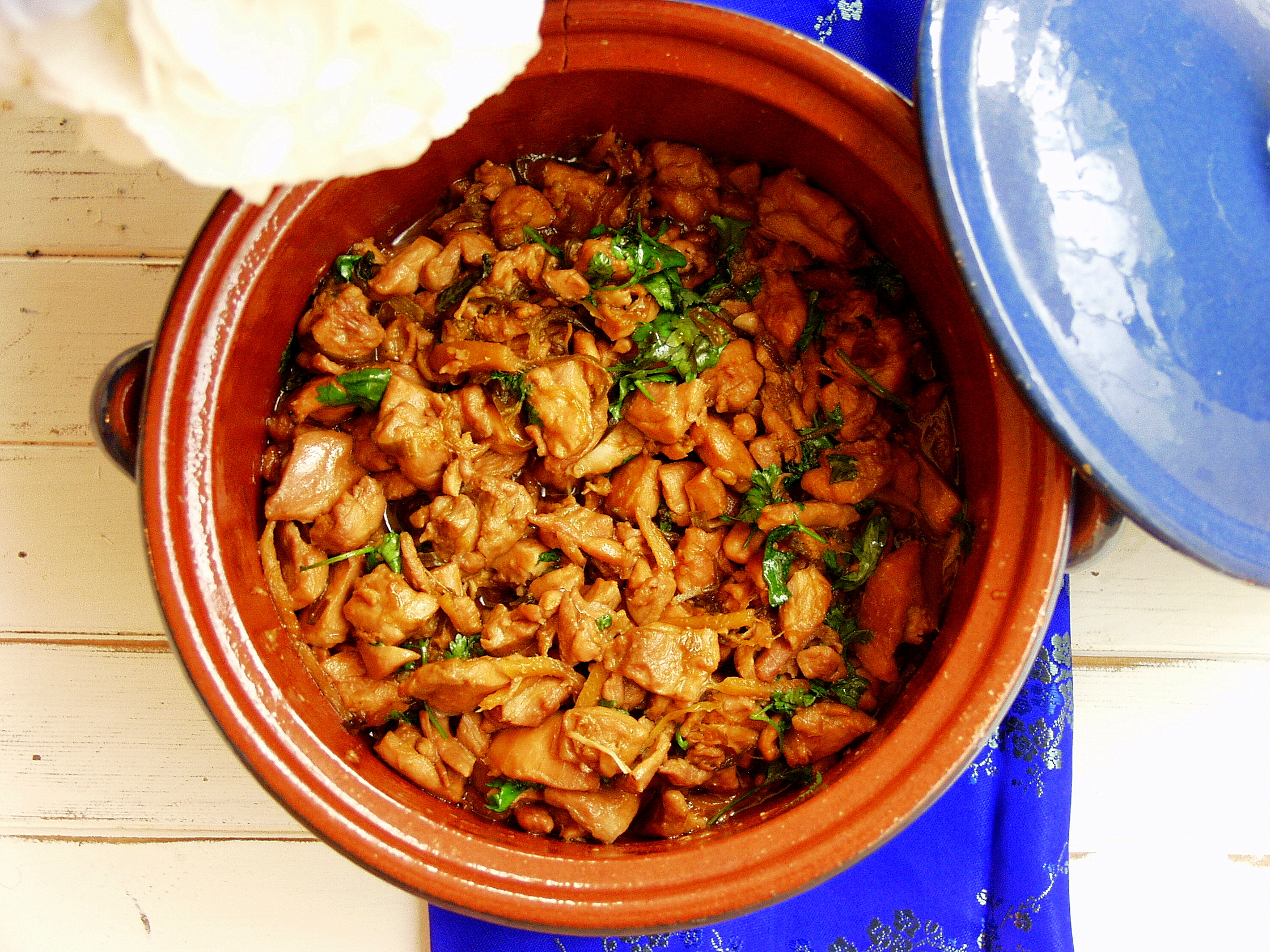
If you are looking for a crowd pleaser then look no further as I can guarantee you that plates will be licked clean if you serve up this dish. As well as cooking a pot for grown-ups, I made up a batch for Big A and Little Z (minus the dried chillies) and they absolutely adored it.

The dish originates from the Southern Chinese province of Jiangxi and is a speciality of Ningdu. In addition, it has also become a popular dish in Taiwan. I can also guarantee it will become a firm favourite in your repertoire once you’ve tried cooking it once.

San Bei Ji literally translates as three cup chicken – the three cups being sesame oil, rice wine and soy sauce. This recipe uses the trio but less liberally and the result is outstanding and quite frankly addictive.

San Bei Ji – Three Cup Chicken

Adapted from Leemi Tan’s book Lemongrass and Ginger

Serves 4 (with no leftovers!)

1.2kg boneless chicken thighs, diced into bite sized pieces

1 tsp sunflower oil

2 inch piece of fresh root ginger, peeled and cut into fine matchsticks

8 garlic cloves, roughly chopped

5 spring onions, cut into 5 cm pieces and thinly sliced lengthways

4 small dried chillies, chopped and seeds discarded (if you prefer it less chilli)

250ml Shaoxing rice wine

6 tbsp light soy sauce

3 tbsp sugar (whatever you have to hand)

4 tbsp sesame oil

1 handful of fresh coriander leaves

1 handful of thai basil leaves


1. In a large pan add the sunflower oil and when it is hot add the ginger and stir fry for one minute before adding the garlic and continuing to cook for a further minute.

2. Add the dried chillies and spring onions and continue to fry for another minute, stirring frequently. Add the chicken and move around the pan for 5 minutes before adding the rice wine, soy sauce and sugar and cover the pan and cook until most of the liquid has dissolved, around 30 minutes. Continue to stir occasionally intermittently during this process.

3. Once the liquid has almost dissolved add the sesame oil and coat the chicken pieces. Add fresh Thai basil and coriander leaves and stir together for a few seconds.

4. Serve immediately so that it is sizzling hot.

Serve with Jasmine rice and steamed greens.


Black Pepper Tofu

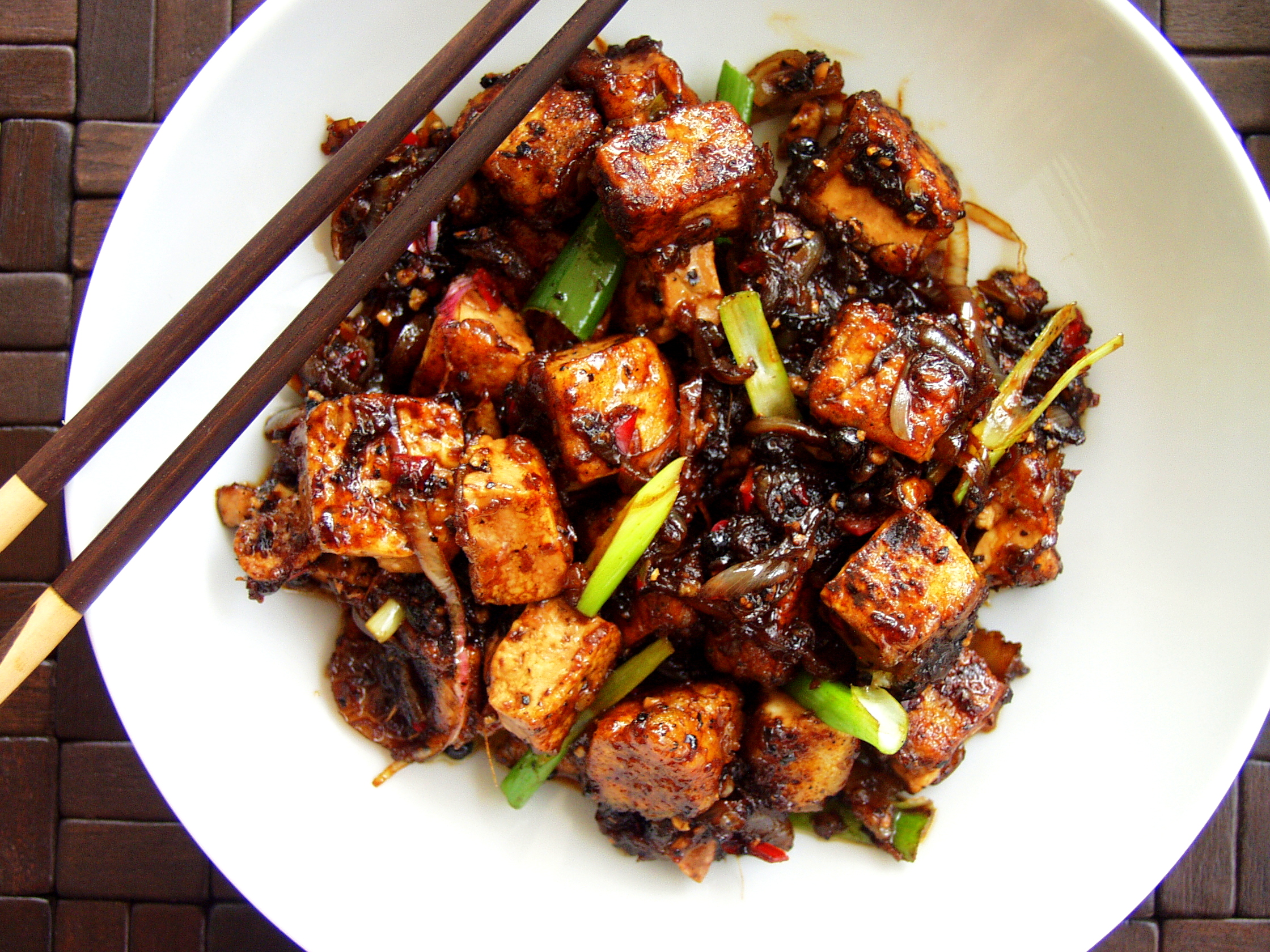
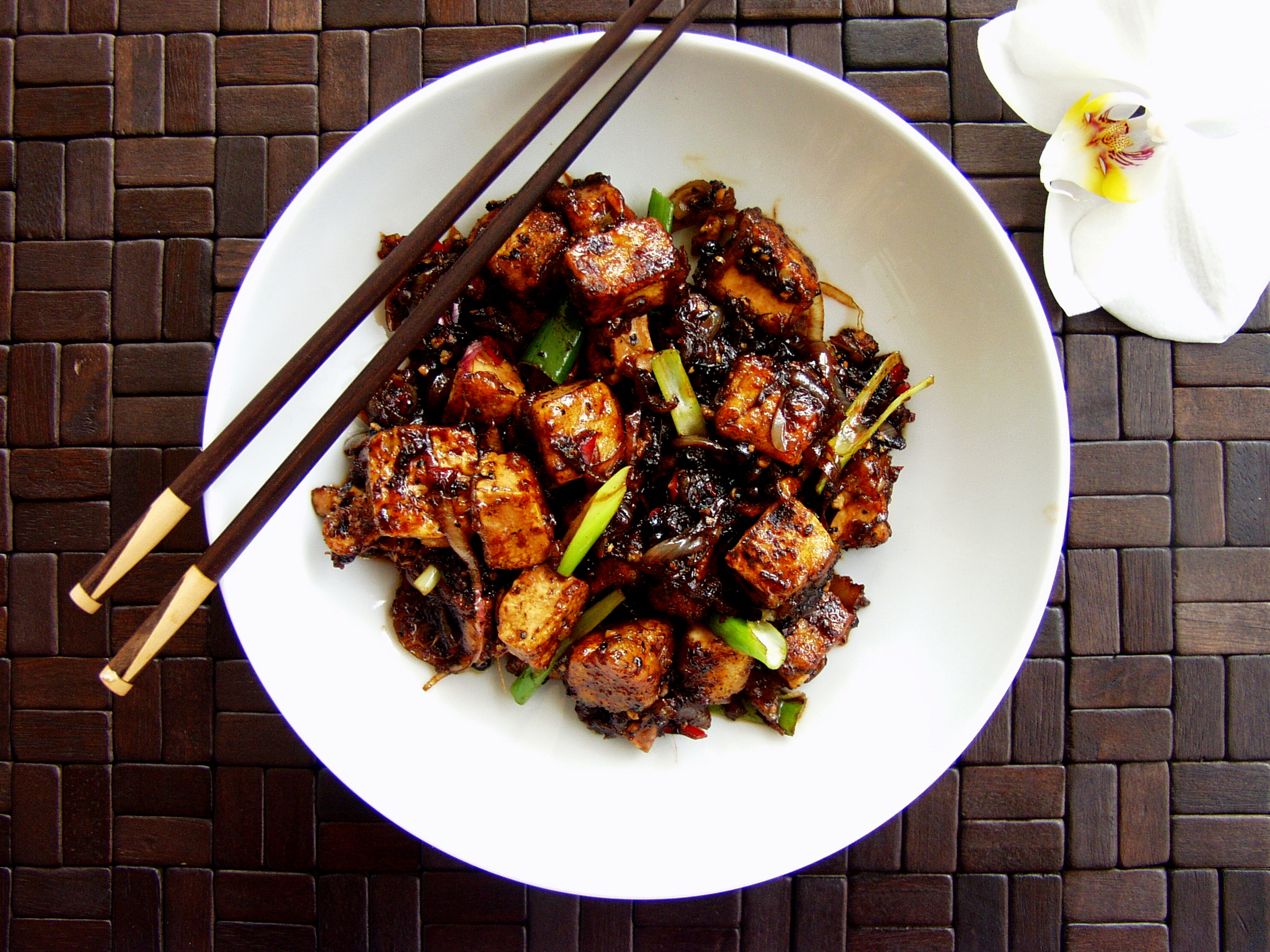
For those of you who are unaccustomed to eating tofu, I really urge you to give it try. Some people simply right it off as being rather bland tasting, but the fact is tofu has a fabulous melt in the mouth texture and absorbs some of the other flavours that you cook it with. Its a great vegetarian option to meat and is hugely versatile. This is my third recipe using tofu on my blog – the other two, Ma Po Tofu and Soba Noodles with Tofu I incorporate fairly regularly in our diet. This recipe is also heavenly and reminds me in fact of one of my favourite dishes of all time – black peppercorn crab – that I ate in Singapore last year at Red House  on Robertson Quay. This recipe is sourced from the Yotam Ottolenghi’s  book ‘Plenty,’ which focuses exclusively on vegetarian recipes.

The recipe itself is fairly straight forward, however, as there is a fair amount of chopping, slicing, crushing it does take a little bit of time on the preparation part. The finished dish though is totally worth the effort you put in to the preparation. I have made a number of alterations to the original as I found that when I followed his quantities exactly the pepper was too overpowering and I did not need quite as many chillies or spring onions. So it is a little toned down but see how you get on and if you prefer it with more pepper just add an extra 2 tablespoons to the 3 that I suggest below and throw in a few extra chillies.

Black Pepper Tofu

A Yotam Ottolenghi recipe adapted from his book Plenty (p44-45)

Serves 4

700g firm tofu

vegetable oil

cornflour to dust the tofu

100g butter

10 small shallots, thinly sliced

4 fresh red chillies (fairly mild ones), thinly sliced (seeds removed)

10 garlic cloves, finely grated/chopped

3 tbsp fresh root ginger, finely grated

3 tbsp sweet soy sauce (kecap manis)

3 tbsp light soy sauce

4 tsp dark soy sauce

2 tbsp caster sugar

3 tbsp coarsely crushed black peppercorns

5 small and thin spring onions, cut into 3cm segments

1. Carefully remove the tofu from its pack and cut it into large cubes, around 3 x 2cm, being careful not to break it.

2. Sieve a little cornflower over the tofu so that it delicately coats the cubes.

3. Heat  a little oil in a deep frying pan and add the tofu in small batches so that the tofu is evenly golden. Place on kitchen roll whilst you prepare the next batch.

4. Clean the pan thoroughly before adding the butter. Once it is melted add the shallots, chillies, garlic and ginger and saute on a low heat for 15 minutes so that the ingredients have softened and darkened slightly. Stir occasionally.

5. Add the soy sauces, sugar and crushed peppercorns and mix into the other ingredients.

6. Place the tofu in the pan and coat in the sauce, being careful not to break up the tofu cubes. After a minute or so add the spring onions and stir into the ingredients.

7. Serve immediately with steamed or boiled rice.

Do you have any wonderful tofu recipes that you would like to share with me? Leave a message below and let me know.


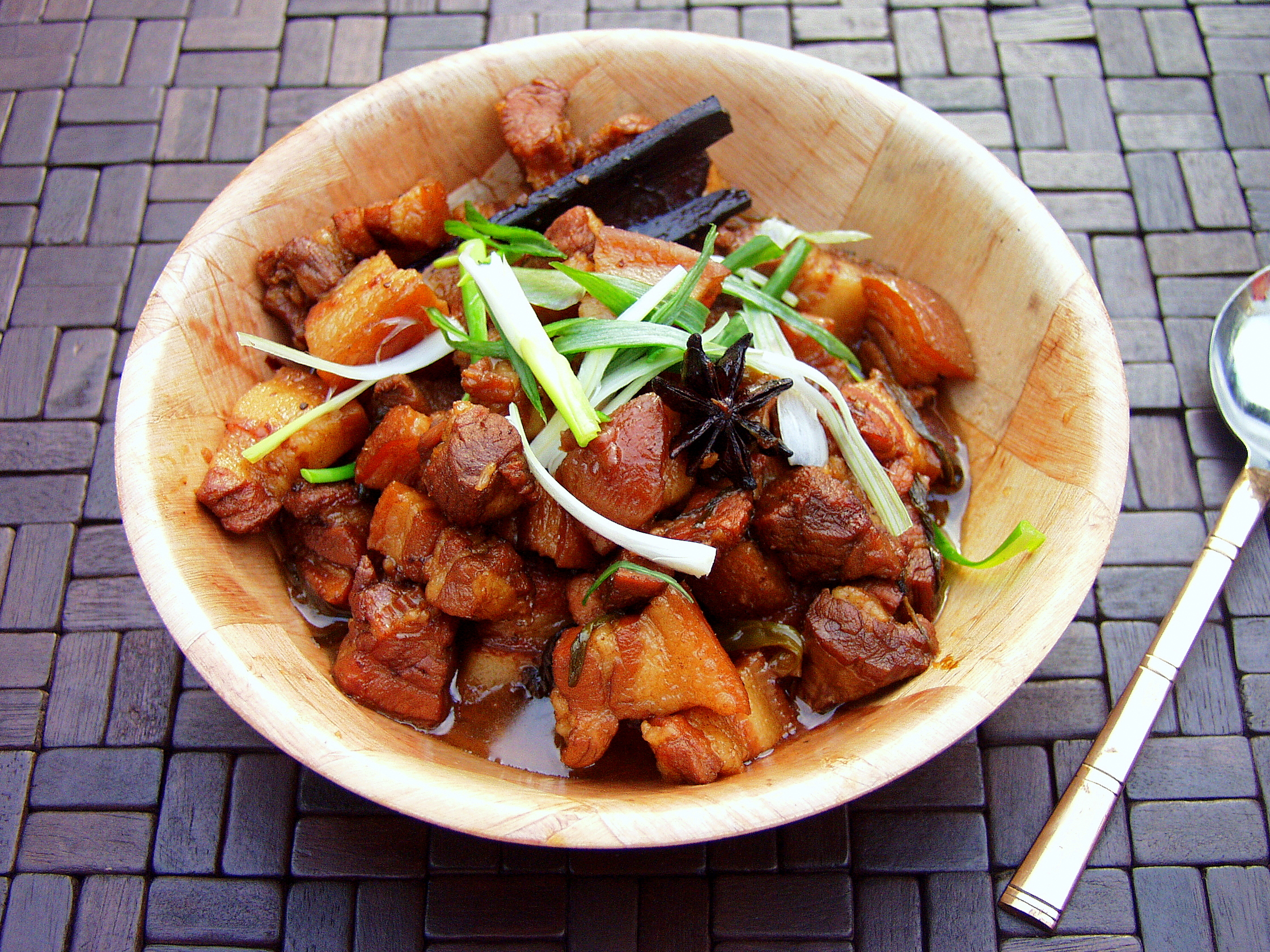
Leemei Tan’s Sweet and Sour Pork Belly

Not so long ago I purchased Leemei Tan’s cookbook ‘Lemongrass and Ginger’, mainly because her Asian recipes were calling out to me to be tried and devoured. It’s her very first cookbook and her recipes and stunning photographs – which she took herself  I might add, are hugely appealing.

She has split her recipes into regional geographies with chapters including: ‘Cambodia & Vietnam’, ‘India and Sri Lanka’, ‘Thailand’, ‘Malaysia & Singapore’, ‘Philippines & Indonesia’, ‘China’ and ‘Japan & Korea’. Not all recipes are accompanied by a photograph but the large majority are.

I decided to start by trying her ‘Sweet and Spicy Pork Belly’. It seemed straightforward and I had some pork belly in the freezer which needed using. I did end up using a little more pork belly than Leemei but that was mainly due to the five large bones that I decided to use instead of discard. Without the bones and the added meat on them, we would have had around the same amount of meat. Whilst the dish tasted delicious with pork belly I am going to prepare it again soon with a slightly leaner cut, which is less fatty.

As I was feeding three adults, and the recipe is for 4-6 people, coupled by the fact I had included a little more meat than Leemei, I managed to have a sufficient amount leftovers for the following day, which I prepared in a slightly different way so as to create a new version of the dish.

Both dishes I prepared with boiled long grain rice.

Sweet & Sour Pork Belly

from Leemei Tan’s book ‘Lemongrass and Ginger’

1.3kg pork belly, cut into bite-sized pieces (I added the 5 large bones), but if you are not doing this only add 800g of pork belly)

1 tbsp sunflower oul

1 star anise

5cm/2in cinnamon stick

2 dried chillies, deseeded and roughly chopped

3 garlic cloves, finely chopped

1/4 tsp Sichuan peppercorns

2 tbsp clear honey

2 tbsp light soy sauce

1 tbsp dark soy sauce

1 tbsp Shaoxing rice wine

2 spring onions, cut into 6cm/2 and a half inch lengths

2cm/3/4in piece of root ginger, peeled and sliced

1. Cut the pork into bite sized portions and add to a saucepan of boiling water for 3 minutes so as to seal the meat. Drain and place to one side.

2. Heat the oil gently in a saucepan and add the star anise, cinnamon and dried red chillies and stir fry for 2-3 minutes until fragrant.

3. Add the garlic and stir fry for another minute before adding the Sichuan peppercorns and stir frying them for a further minute.

4. Add the pork belly and mix well before adding the honey and the light and dark soy sauces, rice wine, spring onions and ginger. Let the ingredients cook together for 5 minutes, before adding 150ml of water. Bring to the boil and cook for  a few seconds.

5. Reduce the heat and cover for 45 minutes when you find the liquid has reduced and thickened and the meat is tender.

********

The following day I added a few more ingredients to the leftovers to create this:

Leftover Sweet and Sour Pork Belly with Fresh Spinach, Yellow Courgettes and Soya Beans

2 tbsp ground nut oil

5 garlic cloves, sliced

1 fresh green chilli, sliced

2cm fresh ginger, finely grated

2 yellow courgettes

225g fresh spinach (basically 2 large handfuls)

150g frozen soy beans

2 tbsp light soya sauce

1 tbsp dark soy sauce

100ml water

Leftover pork belly

1. Heat the oil gently in a pan and add the garlic and chilli. Stir and cook for 20 seconds before adding the ginger and yellow courgettes.

2. Continue to stir occasionally for 3-4 minutes and then add both soy sauces.

3. Add the frozen soya beans along with the water and cover for a few minutes. Once the soya beans have been simmering for a few minutes add the fresh spinach and pork belly and simmer for a further few minutes until the spinach has wilted, the soya beans have cooked and the pork belly is piping hot. Serve immediately with boiled rice.


Rhubarb and Rosewater Tart and a visit to the Jurassic Coast

Fear not, my loyal subscribers, I have not abandoned you, although I realise it might have felt like that these past few weeks. Upon returning from my adventures in Turkey we headed off to the English south west coast, or to be precise, the Jurassic coast on the border of Dorset and East Devon. The old cottage, that we made our home for the week, was fairly remote and had no Wifi so there was no chance of blogging and also if the truth be told I was far too busy rock pooling, exploring coastal and in land walks, swimming – most refreshing although a little chilly upon entry but perfect after 15 seconds, playing board games and eating Devonshire cream teas.

We stumbled across characterful villages where time seems to have stood still and the same families have holidayed at the same place for generations. The weather can be a bit unpredictable but you can guarantee there is always adventures to be had. One such intimate village was called ‘Beer’ – we had to visit it out of curiosity. I liked the fact that the village still has an active fishing community and that you can actually buy fish direct from the fisherman.

Striped deck chairs are quintessentially English and I particularly loved this little advertising board – good honest advertising. Refreshing!

Boats waiting to be hired on the beach in Beer.

Cream teas and crab sandwiches in Beer  – things can’t get much better than this.

View from one of our many coastal walks


I gave swimming a pass on this day….

…………….but these guys just couldn’t resist a good storm

On our return journey we drove cross country in our bid to explore even more quaint, hidden away, little villages.  Not far from Milton Abbas – which is seriously worth a detour when you are next in Dorset – there is a charming little farm shop at Steeptonbill Farm, where we decided to stock up on supplies. We were greeted warmly by Tess who talked us through all the produce and meats. Seeing the sign in the right of the photo for ‘freshly pulled rhubarb’ gave me my idea for my next blog post.  I loved rhubarb crumble as a child but rarely eat rhubarb as an adult. It just so happens that I had stumbled across a recipe recently in House & Garden magazine for ‘Rhubarb and Rosewater tart’ and the combination intrigued me enough to try it out.
All the recipes on this blog, unless stated, are ones that I have cooked a number of times and work well. This recipe however was my first effort and I definitely think I could perfect the results further on my next try. The most important step with this recipe, which I found out a little too late, is to not overcook the rhubarb to begin with. The House & Gardens recipe states simmering the rhubarb in the dissolved sugar, water and rosewater for 8-12 minutes. I found that I cooked mine for less than 8 minutes and it was beginning to lose its shape. So my advice is to keep checking every 2 minutes when it is simmering; by 6 minutes it should almost be done.

You can see what I mean if you look at the bottom left hand side of the tart, which is more how I wanted the whole tart to look compared to the far right side which has rhubarb that has lost its shape.

What it lacked in presentation it certainly gained in taste. I hope you will think so too.

Don’t look too close at this photo, but you can see what I mean regarding the rhubarb loosing its shape on the middle to right of the tart.

You’ll find that you will end up with excess rhubarb and rosewater syrup so take a look at Heidi’s (from 101 Cookbooks) suggestions here on what to do with the leftover syrup.

Rhubarb and Rosewater Tart

Sourced from House & Garden July 2011 issue

Serves 6-8

150g caster sugar

250ml cold water

4 teaspoons rosewater (see another recipe on my blog using rosewater – here)

850g rhubarb, trimmed cut into 3cm pieces

250g ready-made puff pastry

handful of plain flour for rolling out the pastry

1 egg, whisked

300ml whipping cream

1. Wash, cut and trim the rhubarb into 3cm pieces.

2. Gently heat a deep pan with the cold water, sugar and rosewater so that the sugar completely dissolves; this will only take a couple of minutes.
3. Place the rhubarb into the dissolved sugar and water and simmer  for 6 minutes, remembering to cover the pan. You want to make sure the rhubarb is soft BUT  still holds its shape. If after 6 minutes the rhubarb is still firm, continue to heat for another couple of minutes until it has softened.
4. While the rhubarb is simmering, roll out the puff pastry so that it measures a rectangle of 35 x 25cm. Place onto a slightly larger piece of greaseproof paper.

5. Using a slotted spoon lift the rhubarb out of the syrup and place on a flat plate. With the remaining syrup continue to heat it on a high heat so that it is reduced, but that there  is at least 6 tablespoons of rhubarb rosewater syrup.

6. Preheat the oven to 180 degrees, if using a fan oven, 20 degrees hotter if not or mark 6.

7. Arrange the rhubarb on the puff pastry leaving a boarder of 2.5cm. I find it is easiest to make a slight mark with a knife all the way around so that it is fairly uniform.

8. Before placing in the oven brush with egg mixture around the boarder.

9. Bake in the oven for 15 minutes so that the pastry is puffed and golden. Leave to cool for five minutes.

10. When the tart is baking, pour the whipping cream into a large bowl and stir in 3 tablespoons of rhubarb rosewater syrup. Whisk until the cream thickens and peaks form.  Chill until ready to serve.

11. Brush the tart with the rhubarb rosewater syrup and serve hot along with the whipped cream.


Turkish Delights and Coban Salatasi

I have just returned from two glorious weeks spent exploring Turkey’s ancient Lycian Peninsula, which is in the south west of the country, by the warm azure waters of the Mediterranean.

The area is steeped in history with numerous ruins and tombs dating back over 2000 years. I couldn’t help thinking when I was exploring  and clambering all over these ruins (no health and saftey in Turkey!) that our Stonehenge is well, how can I put this delicately, a little underwhelming, if you compare it to all the ancient Lycian ruins. In the cooler months (April and October) guided walks are on offer through Lycia taking in the ruins of lost civilizations, the flora and fauna of the mountain passes and ambling through the charming Turkish villages, many of which seemed to have stood still in time. Perhaps not an adventure to take on with small children but definitely on my to do list for the future.

Ruins of Patara 

We did however, get the chance to soak up the ruins of: Letoon, which was the main religious centre of Lycia, Xanthos – the captial city of Lycia in the late Hellenistic and Roman times, Patara – an ancient city party submerged (ready to be truly discovered) under 12km of sand dunes, Tlos with its spectacular rock tombs carved out of the rock face and Kekova – the sunken city from 2000 years ago. At Kekova you are forbidden to swim and snorkel as the treasures from the old town are there for you to see clearly from a glass bottom boat or canoe. It was quite easy to see the  pots as we sailed gently passed.


Patara’s impressive amphitheatre

Tlos amphitheatre beneath the Taurus mountains

In a bid to absorb ourselves in authentic Turkey as opposed to full on ‘tourist Turkey’, we based ourselves slightly in land, firstly in the Kaya valley and the following week high up in the Taurus mountains. Both locations where a stones thrown from the glorious beaches but far enough away so that we were able to sample another calmer, slower side to Turkey.

Cooler breezes gave us welcome respite from the coast and we enjoyed seeing how the locals pass their days.

our neighbour with her goat

On a couple of days we managed to hire a boat for the day (complete with on-board cook – result!) so that we could see the coast line from the waters and swim in sheltered bays only reachable by boat.

Pretty harbour at Ucagiz

I was amused to see a local selling ice cream from his boat, similar to the one I had seen a few weeks previously on the south coast in England. Clearly all the rage around the world!!

The absolute highlight of our time on the water was when Big A and Little Z both caught rather large fish at the same time. We were all so thrilled by this, even the Captain was impressed as I think he did not think they would catch anything using the hand held real as opposed to a rod. We took them to the local town where they gutted and grilled them for us so that we could have them for lunch. It was great for the girls to see the full cycle of catching a fish and then having it washed, cleaned and gutted before being grilled and then eaten, all within a couple of hours of being caught. Wonderfully fresh and we all agreed, very tasty. We weren’t too sure what the fish were exactly but they tasted delicious and the girls were delighted at being such able fisherwomen. Definitely a life long memory.

The morning’s catch!

When abroad I always enjoy discovering the different local foods and dishes on offer, as well as the spices and herbs that are commonplace.

At the spice market I bought: pink peppercorns, sumac, pul biber  (dried flaked pepper), dried mint tea, a marinade for fish

Turkey is bountiful with wonderful fruit trees bursting with offerings, some ready now – such as figs, grapes, peaches and cactus fruit (prickly pears) and others not quite ready for a month or two – namely pomegranate. I discovered the carob fruit that was completely new to me but I immediately took a liking to its sweet chewy undertones.

Carob fruit in centre of photo – they look like large vanilla pods.

I discovered that it has been cultivated for over 4000 years and that is also known as ‘St John’s bread’ or ‘locust bean’ as the pods were mistaking thought to be the ‘locusts’ eaten by John the Baptiste in the wilderness – although this was proved to be wrong as he ate migratory locusts. It has a honey taste to it and is in fact used as a substitute to sugar. I am certainly going to seek out the powder form and try baking with it this autumn – watch this space. Another interesting fact is that the beans are ground down to make a cocoa substitute, that although slightly different tasting, has a lot less calories and virtually fat free. It is also packed with vitamins (A, B, B2, B3, D). Check out this website which will tell you in more details about the carob fruit’s benefits. I also like John’s youtube summary of the fruit. I would love to grow a carob tree here in the UK, but I fear that our sporadic sun shine may not help it thrive like the ones in the Mediterranean and in California.

The girls discovered a new treat known as ‘gozleme’, which is basically Turkey’s answer to an Italian calzone. The dough is rolled out on a round surface and then half of it is stuffed with a contents of your choice – we liked spinach, feta and potatoes and then folded over to create a crescent. This is then put onto a hot circular surface that is heated underneath by an open fire. The whole process was mesmerizing to watch and the finished snack was polished off in no time at all.

Preparing our gozleme

As the weather was ridiculously hot, salads became a staple at meal times. The most popular salad in Lycia seemed to be ‘Coban Salasti’ otherwise known as ‘Shepherd’s Salad’. It appeared on every menu and is ridiculously easy to make and perfect in hot weather. The trick is to cut the vegetables up  really small – far smaller than I would normally when making a salad.

Coban Salatasi – Shepherd’s Salad

Serves 4

2 large tomatoes (or 3 small), finely chopped

3 Turkish green peppers (the long thin ones), finely chopped

2 small cucumbers, finely chopped

1/2 (half) a white onion

1 large handful of fresh flat leaf parsley, chopped

2 tbsp olive oil

2 tbsp lemon juice

salt and pepper to taste

1. Finely chop all the ingredients into a large bowl and gently mix together.

2. Add the olive oil and lemon juice and season to taste and serve.

So what have you been up to this summer? Any food foraging or discoveries in foreign lands? Don’t be shy and leave a message below, I’d love to hear from you.


Cold Rice Noodles with Peanut-Lime Chicken

The past week or so has been very memorable here in the UK. The Olympics kicked off to an outstanding opening ceremony last friday, which made me laugh and marvel in equal measure. Ok, I’m biased, but I thought that it’s quirky, eccentric nature pretty much summed up us Brits. No amount of money spent on an opening ceremony, past or future, can trump the fact that Her Majesty gamely played herself with Mr Bond as part of the ceremony itself. How cool and even the non royalists out there must have had a sneeky smile on their faces. As for Mr Bean – what a great touch to include him as part of the ceremony; he was definitely one of the highlights.  It was fun, original and gamely humorous and had all of us glued to the TV screen for over three hours, wondering what Danny Boyle was going to bring out of the hat next. I think it is safe to say he is a ‘slam dunk’ for a knighthood in the coming months.

Since the Games begun I have been glued to the TV watching the swimming in particular. Mike Phelps gaining his 19th Olympic medal making him the greatest winner the Olympics has ever seen -truly remarkable. Also the spectacular performance of China’s Ye Shiwen, who, at 16 years of age, wins gold in the women’s individual medley.  It’s addictive viewing watching the world’s best athletes compete in such a wide variety of sports.  I’m going to see the men’s beach volleyball soon, which should be fun and a little surreal to watch in central London.

We’ve had some good sunny days recently, which always inspire me to cook fragrant Asian dishes that are not too heavy. This recipe I stumbled across really recently and it caught my attention as it was served cold and could almost be classed as an Asian noodle salad, of sorts. I’ve cooked it a few times already and I have to admit it’s really good. My number one fan (Big A – who is 6) gave it a definite 10/10.  It was originally posted in the New York Times, however, I found it on the hugely popular food bloggers site ‘Smitten Kitchen‘. As with all great recipes, Deb Perelman – from Smitten Kitchen, adapted hers from the original and I changed hers a little bit further. For example,  I omitted chilli, as I was feeding it to Big A, Little Z and my father who all don’t eat chilli. That said if I were feeding it to just adults (or chilli loving adults) I would definitely add the chilli (hence it has remained on the list of ingredients), I added only one large cucumber, added baby sweetcorn, slightly more rice noodles.

For the really observant amongst you, you will have noticed that I completely forgot to scatter the crushed roasted peanuts over the dish for all the photos. When I sat down and started eating the meal I remembered but clearly too late for the shots for this blog post !

Cold Rice Noodles with Peanut-Lime Chicken

Sourced from Smitten Kitchen, original recipe from David Tanis whose recipe appeared in The New York Times

Serves 6

Dipping Sauce

6 tbsp Asian fish sauce

6 tbsp brown sugar

12 tbsp lime juice

2 garlic cloves, crushed

small thai red or green chilli,  to taste but optional

Peanut Dressing

3 tbsp Asian fish sauce

3 tbsp rice vinegar

9 tbsp lime juice

3 tbsp of light soy sauce

1 1/2 (one and a half) inch piece of ginger, peeled and sliced

6 tbsp natual unsalted peanut butter (if you can’t find this just use regular)

1 tbsp toasted sesame oil

pinch of cayenne

Chicken and Noodle Salad

3 tbsp toasted sesame oil

500g boneless skinless chicken thighs

250g dried rice noodles

1 large cucmber, cut in 1/4 inch half moons

2 carrots, cut in thin julienne

handful of baby sweetcorn, halved

handful of fresh mint and coriander (you could also add Thai basil)

4 spring onions, thinly sliced

handful of roasted peanuts, crushed

lime wedges to serve

1. Begin by making the ‘dipping sauce’. On a low heat, place all the ingredients into a pan and gently stir until the sugar has been properly dissolved – this will only take a few minutes. Place in a small serving bowl and allow to cool.

2. Next you need to make the ‘peanut dressing’. Place all the ingredients into a small food processor and puree all the ingredients so that you are left with a thick creamy sauce. Pour into a serving bowl.

3. In separate large bowl pour approximately half of the dipping sauce and a third of the peanut dressing and stir together. Add the chicken to the mixture and coat thoroughly using your hands. Leave to marinate for at least 15 minutes.

4. Once the chicken is marinated gently heat up a griddle pan and add a little toasted sesame oil and brown the chicken thoroughly on both sides, which will take a few minutes per side. I cook my in batches so that I can be sure that the chicken in properly cooked through. As an alternative you could grill the chicken for 20-25 minutes.

5. When the chicken is cooked, chop into bite sized pieces.

6. To serve there are a few alternatives that you can do –

option 1: Place everything on a large serving platter with the noodles, chicken, vegetables, dressing and marianade all separated out and then your guests/family can help themselves.

or

option 2: Divide the cooked noodles into individual bowls or plates. In a small bowl toss the vegetables with 1 tablespoon of dipping sauce. Place the vegetables and chicken onto each bowl/plate. Place a further 2 teaspoons of dipping sauce and dressing to each helping. Add the herbs, peanuts and spring onions to each bowl and serve.

Note: As an alternative to baby sweetcorn you could add fresh peppers which work equally well.