Bavani’s Cinnamon and Ginger Dal (Parripu)

Very recently I was served this comforting and fragrant dal by my Sri Lankan friend, Bavani. It tasted so darn good that I immediately asked her what she put in her red split lentil dal and proceeded to cook it the following night for the toughest of critics….my husband AND father-in-law. Yes I am definitely keen and eager when I come across a good recipe! They both gave it a definite thumbs up and declared it was unlike all the other dals they eat on a regular basis.

Don’t get me wrong I love my red split lentil dal, but this one tastes so completely different that I will definitely be cooking it from time to time. It’s not a true Sri Lankan dal or parripu, as it is known in Sri Lanka, but instead Bavani’s version of lentil soup for the Western diet. A true Sri Lankan dal would contain turmeric, green chilli mustard seeds, curry leaves, curry powder etc, but I think Bavani’s alternative will definitely appeal to a wide audience. It has a gentle chilli kick and subtle cinnamon and ginger undertones, very different from my red split lentil dal which has turmeric and panch phoron.

Red split lentils are the easiest of all lentils to cook as they are cooked in 10 minutes and do not need any soaking first – so perfect for a quick meal when you are tired and exhausted after a manic day. They are also really cheap and most importantly – healthy, so perfect for the bank balance and general well-being.

Bavani’s Cinnamon and Ginger Dal (Parripu)

Serves 4

400g red split lentils

2 tbsp mustard oil (or vegetable if you don’t have mustard)

1 whole garlic bulb, peeled and sliced

1 thai red chilli, thinly sliced

2 cinnamon bark sticks

half tsp of asafoetida

1 tsp cumin powder

2 inch of fresh ginger thickly sliced

2 carrots, sliced into small cubes

1 tsp salt

fresh coriander, chopped to serve

1. Place the red split lentils in a pan and run under cold water and wash through thoroughly, using your hands, a couple of times. This is to clean the lentils before cooking them.

2. Place boiling water into the pan with the red split lentils so that there is a good inch of water above the lentils. During the course of the cooking you may need to add more boiling water if all the water has been soaked up or if you prefer the dal to be more soup like in consistency! The lentils should be cooked after ten minutes – if you place one lentil between your forefinger and thumb it should be soft to touch; the colour will also have lightened.

3. In a large separate saucepan/wok heat the mustard oil and add the garlic and red chilli and gently cook for a couple of minutes before adding the carrots, cinnamon bark, cumin powder, asafoetida and the fresh ginger. (You want to keep the ginger fairly thickly sliced so that they are easy to identify and scoop out before serving). On a low heat mix the ingredients together for roughly 6 minutes.

4. Transfer a large spoonful of the cooked red split lentil dal to the saucepan and mix together and then place all the ingredients BACK into the saucepan with the dal. Stir in throughly and add the salt – to taste.

5. Let the dal simmer for a further five minutes or until the carrots are completely soft. You may find you need to add a little more boiling water at this stage. It is not an exact science but more one of personal taste. Add a little water at a time as you can always add a little more if necessary.

 6. Before serving scoop out the fresh ginger and cinnamon bark. Serve with fresh coriander and eat either on its own, with rice or a chapati.

It also works really well accompanying Speedy Salmon Curry,  Goan Hot and Sour Pork Curry, Chicken Liver Curry, Goat Curry


Mountain Air and Chinese Marbled Tea Eggs

Mr B and I have just returned from one of those magical long weekends when you literally have to pinch yourself that what you are experiencing and seeing is actually real. We were attending a friend’s wedding in South Tyrol in Northern Italy, but due to logistics we decided to fly into Munich, a city we hold dear and one that we visited last December. Driving through Germany, Austria and into northern Italy may sound like a bit of an epic journey but the truth of the matter is that it only takes 3.5 hours and we thought a scenic drive through the  Brenner pass would be rather pleasant.

Our destination was the stunning eco spa hotel, Vigilius mountain resort, which was lovingly designed by architect Matteo Thun. The hotel blends into the natural environment seemlessly due to the use of materials from renewable resources. All the water used in hotel – from the pool, shower, baths and drinking comes from the Vigiljoch spring water.  To reach the hotel you need to take a cable car for about 15 minutes and upon arrival you really do feel a world away from the stresses and interruptions of day to day living. There is no Wifi or TV in the hotel, which allows you to really switch off and enjoy the natural environment that you find yourself in.

The wedding itself allowed us to explore the mountain side, not least because we had to take a single chairlift a further 15 minutes higher up the mountain and then a 15 minute walk to the church. It was one of those experiences that we will remember and cherish forever, not least because of the surreal nature of taking a chairlift dressed in wedding attire.

The smell of the pine forests and the wood burning in the chimneys conjured up happy memories of times in the mountains when the snow was thick and heavy. It was refreshing though seeing the mountains covered with grass and wild flowers and the cows with bells around their necks.

During the church service itself, the cow bells could be heard just outside the church entrance, to the extent we would not have been surprised had they ambled in to take a look at what was going on.

On Sunday, after all the wedding festivities were drawing to a close, Mr B and I returned to the top of the mountain and had a good amble around the wooded paths that are carved into the mountain. We came across characterful chocolate box houses similar to the ones that we all draw as children. I loved the green shutters and the window boxes filled with bright red flowers matching perfectly with the red gingham curtains.

We returned, one last time, to the church where we had spent some precious moments the previous day.

It was hard to drag ourselves away from such a picturesque spot, with beautiful blue skies and wonderful green mountains.

Returning to London I was convinced that the good weather must surely have arrived to our shores – I was clearly delusional after all that mountain sun and fresh air – as the rain persists and people’s moods continue to fray.

As activities with Big A and Little Z are housebound with the continuous downfall, we decided to make some Chinese marbled tea eggs. In China, the eggs are a common snack that are adored by school children and adults alike. The marbled effect, that is created through gently cracking of the hard boiled eggs, is attractive and unique, in that no two eggs will look the same. The girls love to see the different effects that are created each time we finally break open the shells.

I have loved hard boiled eggs for as long as I can remember, to the extent that no picnic is complete without them. As well as being aesthetically pleasing, Chinese marbled tea eggs also taste really delicious with the subtle flavours of tea, soy and aniseed gently resonating from the egg. So why not try making these next time you plan on having a picnic when the sun shines or, for that matter, when it rains and you decide to have it inside instead.

Chinese Marbled Tea Eggs

Sourced from Balance and Harmony Asian Food by Neil Perry – p193

6 free range or organic eggs

3 tbs Jasmine tea leaves (or black tea leaves)

2 cinnamon bark sticks

3 star anise

half tsp sea salt

100 ml dark soy sauce

1. Place the eggs in a pan of cold water so that they are completely covered and gently bring the water to the boil. Simmer gently for 6 minutes.

2. Gently transfer the eggs to a bowl full of ice and then cover with cold water. Place the pan of boiled water to one side as you will use this later.

3. Once they are cooled tap the eggs gently so that the shell cracks but does not break off. You want to have the effect of lots of small cracks.

4. Place the eggs in the pan of boiled water and add the tea, cinnamon bark, star anise, salt and soy sauce.

5. Simmer for a further hour and then remove from the heat and leave to cool completely. The longer you leave them the more flavour is drawn into the eggs and the more marbled the eggs become. Those above were left in the fridge overnight.

6. To serve remove the eggs from the stock and carefully remove the shell to reveal the unique marbled effect.


Croissant Bread and Butter Pudding

Have you ever been in the situation of having croissants in your bread bin slowly going stale over a couple of days and not wanting to simply discard them?

I was in this very dilemma recently so thought that the best option was to either:

(a) feed them to the birds

or

(b) make croissant bread and butter pudding.

I opted for (b)…………..sorry birds you’ll have to make do with normal bread crumbs!!

Lardy? Most definitely.

Decadent? Well just a little bit.

Healthy? We’ll just pass on that one shall we.

Bread and butter pudding is a much loved British dessert that we can all fondly (well for the most part!) remember eating as children. Today there are so many varieties of the dish to tempt and inspire. As well as stale bread or croissants you can also use brioche or panetonne – the possibilities are limitless. I stumbled across a rather interesting and amusing website called ‘The British Bread and Butter Pudding  Appreciation Society’ when looking into the exact origins of the pudding. Do check it out here to find some interesting facts about the dish.

My daughters asked me to omit sultanas, which would normally be my go-to fruit of choice to put in the pudding, and asked for chocolate drops. The closest thing I could find in my pantry to little chocolate drops were giant chocolate buttons, so as a treat I scattered a few of these in the pudding. You can basically add any fruit to the mix – summer berries would be delicious and colourful or even blackberries in the late summer, early autumn. If you do end up using sultanas do remember to soak them first in warm water or the ones you scatter on the top will become hard and rather burnt.


I had a couple of almond croissants getting stale so added these with my regular croissants.

Croissant Bread and Butter Pudding

Serves 6-8

5 stale croissants, sliced into thin segments

3 eggs, whisked

400ml semi-skimmed milk

150ml double cream

2 tbsp caster sugar and an extra sprinkling to go on top

pinch of cinnamon powder

pinch of nutmeg

1 tbsp melted butter

1 tsp of vanilla extract

handful (or two!) of chocolate drops

1. Preheat an oven at 180 degrees (I use a fan oven). Slice the croissants evenly and line them in a greased ovenproof dish.

2. Whisk the eggs and then add the milk, cream, sugar, cinnamon, nutmeg, melted butter, vanilla extract and some of the chocolate drops. Whisk/stir the ingredients into the eggs.

3. Pour the mixture over the croissants and leave for 10 minutes to let the mixture soak into the croissants.

4. Before putting in the oven scatter with a few extra chocolate drops , along with a sprinkling of extra caster sugar.

4. Place in the oven for 30 minutes and serve immediately.

Naughty but very very nice!


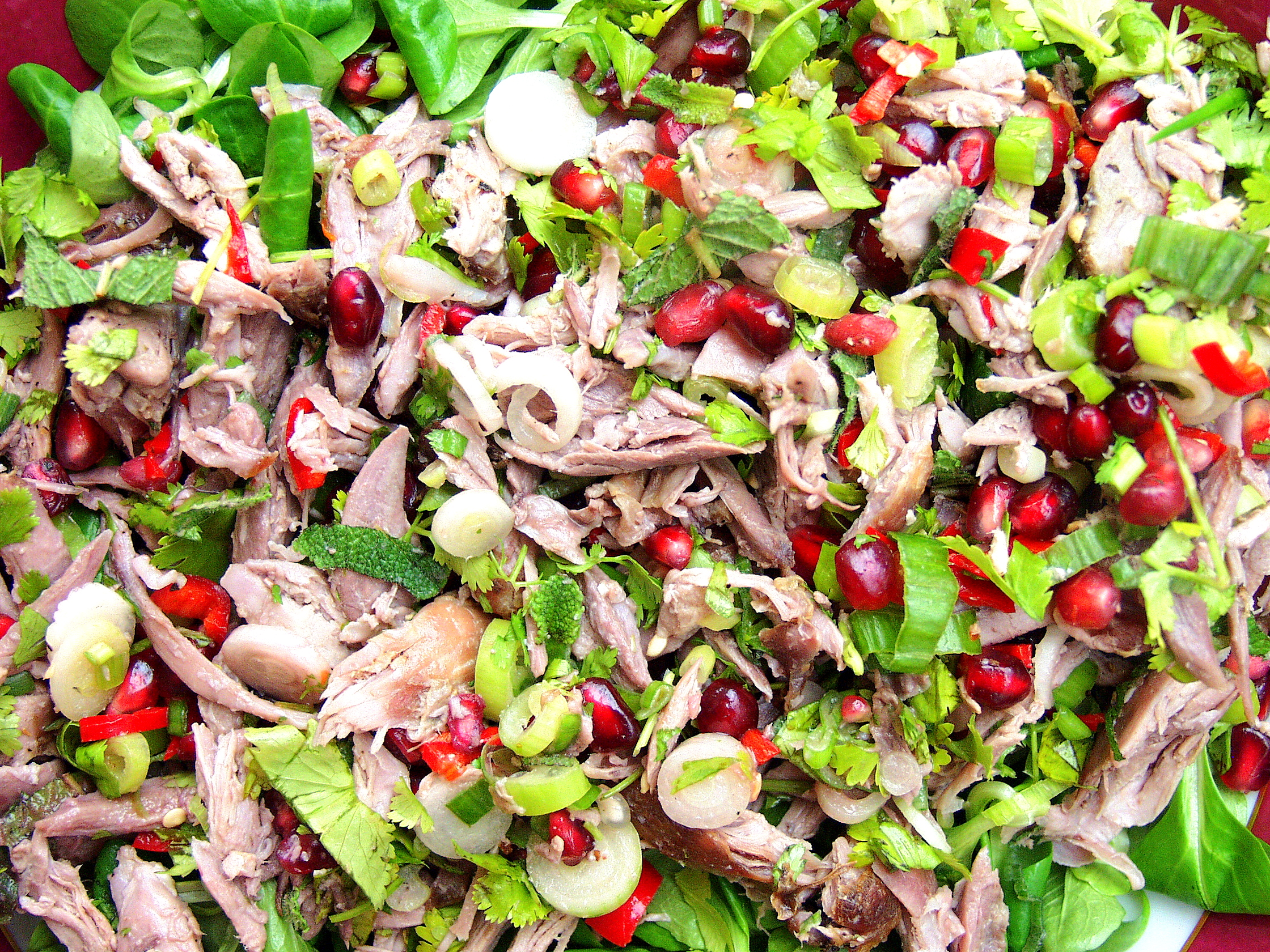
Duck, Pomegranate, Coriander and Mint Salad with a Raspberry Vinegar Dressing

Long gone are the days when salads consisted of a few lettuce leaves, some tomatoes and grated carrots, a la 1970’s. Today there are so many inventive recipes that ordering, cooking and most importantly, eating, salads has been given a new kudos and a certain status that it is now totally acceptable to serve up a salad or two as the main dish when guests come over.

Personally I like them to be colourful and a little bit unexpected in as far as ingredients and taste go. Mixing and marrying ingredients that are salty and sweet and creating the right ying yang within the dish is so important. Over the last year I have cooked a few that stand out for me – check them out here – watermelonmangotofulentil. If you cook a couple when friends come over you’ll have a real feast and they can all be cooked in advance so that there is no stress when your guests arrive. People often like a choice so I normally prepare two or three. Leftovers the day after also work providing you keep them in the fridge.

 I had a very similar duck salad to the one I have cooked here at a friend’s house a couple of years ago and was eager to share it with you. Other than the fact that the duck needs to cook slowly in an oven for an hour and half, the dish is very straightforward to make and will definitely get a positive response from those you serve it to. The raspberry vinegar you can buy at large supermarkets here in the UK and I am sure they have something similar overseas. The sweetness mixed with the duck and salad is really tasty. You do need to get hold of duck legs (ideally with the skin on) as opposed to breast, as the meat is far more succulent on the bone.

Which salads stand out for you? Post a comment to let me know and perhaps you’ll see your salad idea up here on my blog over the summer – with all credit to you.

Who said salads are boring?

Duck, Pomegranate, Coriander and Mint Salad with a Raspberry Vinegar Dressing

Serves 4

4 duck legs

110g pomegranate seeds

1 handful of fresh mint, chopped

1 generous handful of fresh coriander, chopped,

5 spring onions, finely chopped

1 red chilli, finely chopped

4 tsp of raspberry fruit vinegar

rock salt and ground black pepper

70g lambs lettuce

 1. Place the duck legs in a preheated oven at 150 degrees (if using a fan oven and 10 degrees more if not) for an hour and a half. Cooking the duck slowly at a low heat will allow the meat to become tender and the fat to reduce considerably.

2. I used the speedy option of pre-prepared pomegranate seeds but obviously if can get hold of fresh pomegranate I encourage you to use them. Tapping the fresh pomegranate gently on its side will allow the pips to dislodge from the pith allowing them to break free more easily. I used 110g but if you use a little more that is absolutely fine, it does not have to be exact with regards to the pomegranate seeds. Place them and the juice into a mixing bowl.

3. Finely chop the spring onions and add to the mixing bowl along with the fresh chopped coriander and mint.

4. Finely slice a red chilli and if you prefer it to have less of a kick remove the seeds. Add to the mixing bowl. If you are feeding this dish to young children then obviously just omit the chilli part.

5. When the duck legs are cooked it is important to let them cool completely before shredding them with a fork. I tend to remove most of the skin, but it is up to you.

6. Place the duck into the mixing bowl and add 4 tsp of raspberry fruit vinegar and mix in well to the ingredients. Add salt and pepper to taste.

7. Place the lambs lettuce on a serving dish and lay the the duck salad across the top and serve.


The Perfect Steamed Lemon Chicken

I have always been massively underwhelmed when ordering lemon chicken at Chinese restaurants to the extent that I never order it anymore as I don’t want to have further disappointments. It’s always far too sweet and the chicken looks too white and unappealing. So you can guess how delighted I was when I recently tried Neil Perry’s ‘Steamed Lemon Chicken’ recipe that actually tasted really good. I am a HUGE fan of the Australian chef  and his beautifully presented book ‘Balance and Harmony’. It was in his book that I found this recipe that is now one of my absolute favourites.

The beauty of Perry’s ‘Steamed Lemon Chicken’ is that it is really really easy. Seriously it is definitely going to become one of my ‘go to’ recipes that I can rustle up really quickly and yet can also be perfect to offer guests coming around for dinner.  Steaming the chicken really retains the flavour and tenderness through the use of steam and is one of the most healthy forms of cooking. It’s a win win.

The key with a good lemon chicken is to buy thighs and not breast meat folks as it is so much more tasty and tender. Seriously, do not think about buying breast meat for this recipe as it really won’t taste half as good. Trust me on this one.

The only alterations I have made to Perry’s recipe are:

1) As I did not have peanut oil to hand I used ground nut oil as an alternative.

2) Neil Perry’s recipe uses 350g of chicken and I have used 550g so my chicken needed more steaming time. He suggested 25 minutes but mine needed closer to 40 minutes.

Steamed Lemon Chicken

Serves 2-3

550g free-range or organic chicken thigh fillets, skin on (if possible), each cut into 3 pieces

1 1/2 (one and a half) lemons, quartered lengthways

a pinch of freshly ground white pepper

2 spring onions (scallions), cut into julienne

Marinade

1 tbsp shaoxing

1 1/2 tbsp light soy sauce

1 1/2 tbsp oyster sauce

2 tsp sesame oil

1 tbsp peanut/ground nut oil

2 tsp sea salt

1 tbsp sugar

 1. Place the chicken thighs in a shallow heatproof bowl and squeeze the lemon juice over the chicken and add the lemon skins to the bowl.

2. Prepare the marinade and add to the bowl of chicken and mix thoroughly using your hands and leave for at least 30 minutes so that the marinade can infuse the chicken with it’s wonderful flavours.

3. Firmly cover the bowl with foil and place into a large bamboo steamer (you can also use a steam oven if you do not have a bamboo steamer – both work equally well).

4. Place the bamboo steamer on a rack over a pot/wok of rapidly boiling water – you will need to place a couple of  inches of water into the pot. Put the lid on and steam the chicken for 40 minutes.  You will need to turn the chicken once during cooking so be careful when removing the lid and foil as the steam will be very hot. To check the chicken is cooked sufficiently make a small incision into the flesh to see that it is fully cooked and not pink! If it is not quite done, continue to steam for a further few minutes. If you cook with a smaller amount of meat – 350g – steam for 25 minutes.

5. Carefully remove the bowl from the steamer and place the chicken onto plates, or a warmed central plate and sprinkle with ground white pepper and spring onions.  Serve with rice.


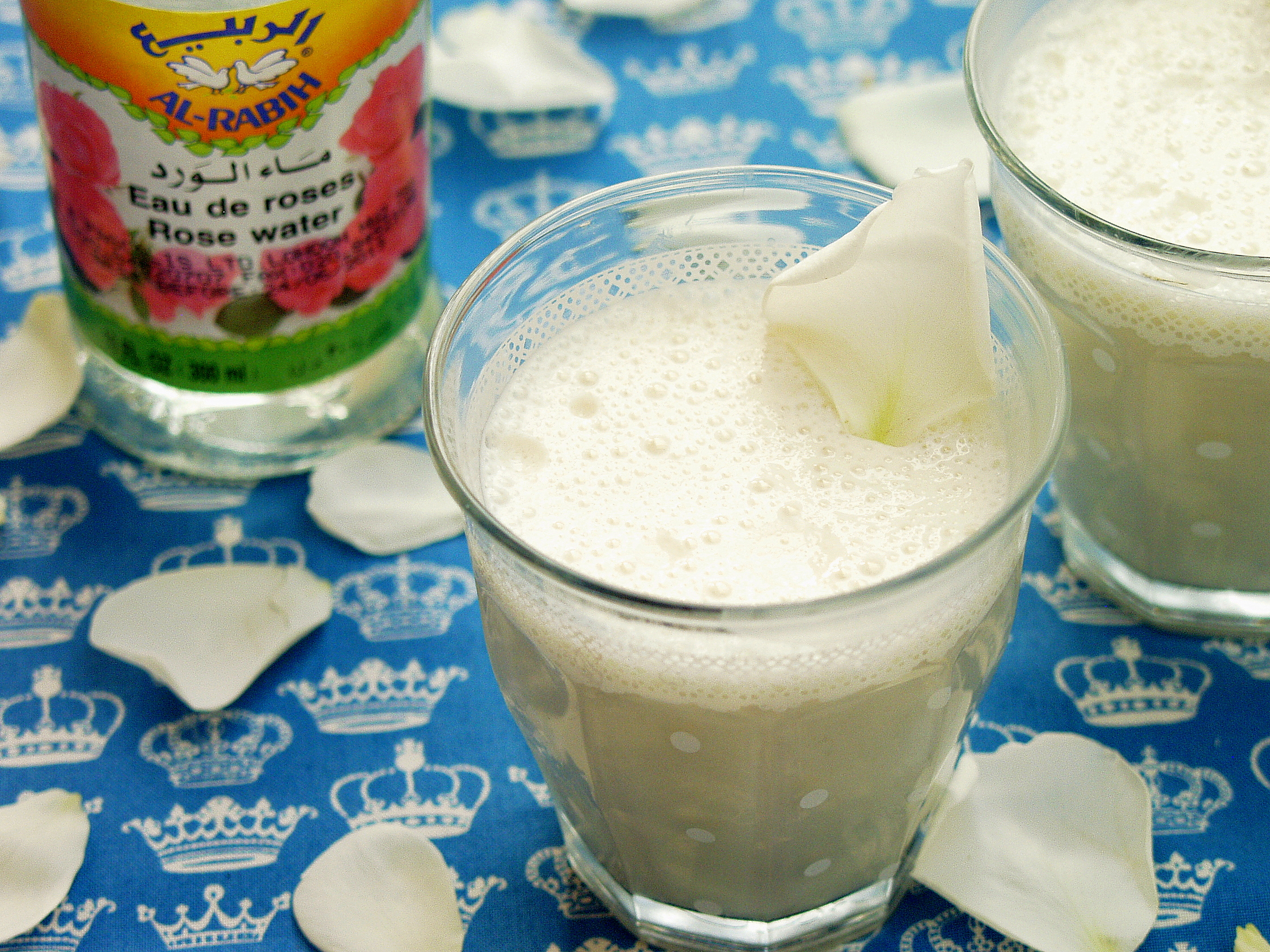
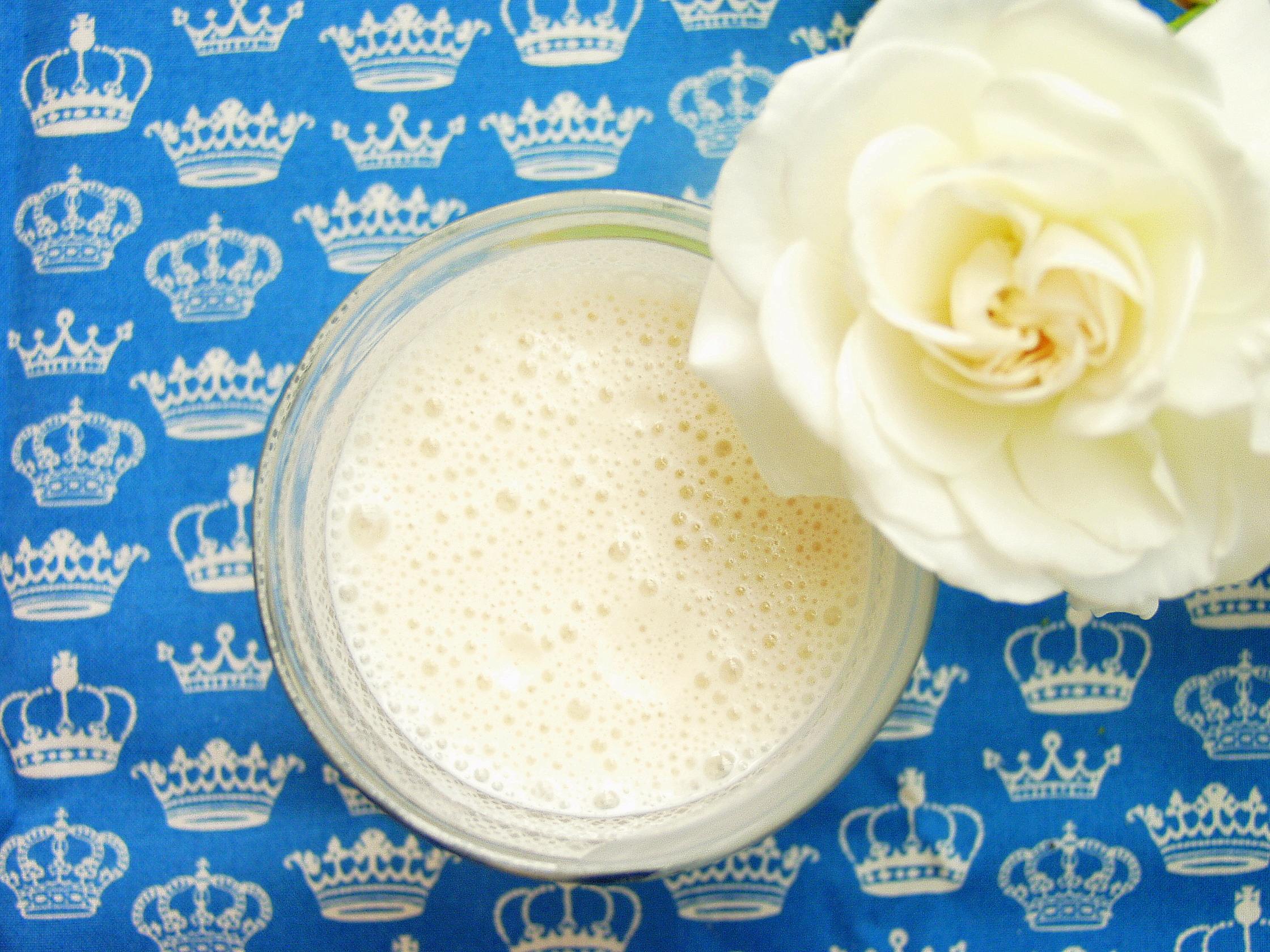
Rose Lassi – a drink fit for a Queen

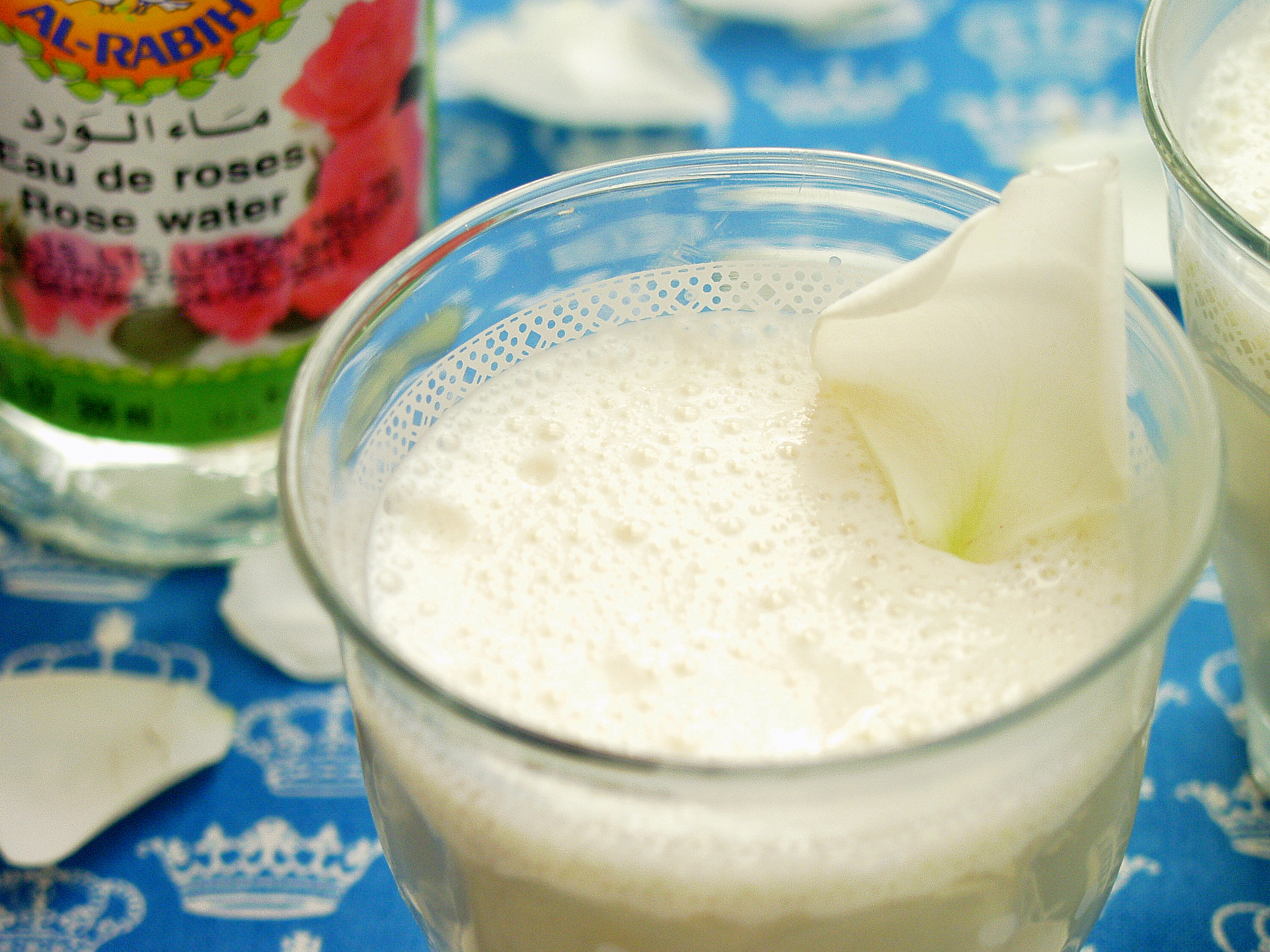
I think I have found the perfect summer drink for Her Majesty, Queen Elizabeth II, to sip whilst on board the royal boat that will take her down the Thames this weekend to celebrate her Diamond Jubilee. It has a sufficient amount of sugar in it to give her the necessary energy boost to last the occasion and has a hint of decadence with the sweet aromas of rose water. Being non alcoholic and yoghurt based it is wonderfully cooling and lines the stomach well, ahead of the feasts that will no doubt follow.

The drink in question – drum roll please –  is Rose Lassi.

It is quick and easy to prepare and I assure you is a crowd pleaser, for those preferring to keep off the alcohol.

Lassi drinks are commonplace in the Indian subcontinent and it is customary, in many households, to have a jug of it in the fridge ready for when guests drop by. Sweet, salt or mango are common flavours, but there is so much potential for many more delicate flavours to be added. How about mint, peach, strawberry, raspberry?  My favourite of late has been rose, I hope you agree, it is a drink fit for a Queen.

Rose Lassi

Makes 4 glasses (in the size of glass that I used in the photos)

450ml plain natural yoghurt

75g soft light brown sugar (or white if you do not have brown to hand)

2 tbsp rose water

3 tbsp water

4 ice cubes

1. Using a hand whisk or blender mix the yoghurt, sugar, water and rose water together so that it begins to froth. It will only take about 30 seconds.

2. If using a hand whisk, crush the ice in a plastic bag using a rolling pin and add to the other ingredients. For speed and ease I use a blender. Once there is a sufficient amount of froth pour into glasses and serve immediately.


Queen’s Diamond Jubilee Quail Scotch Eggs – with a twist!

For those who like a bit of tradition and flag flying this coming weekend is going to be super HUGE in the UK as it’s the Queen’s Diamond Jubilee, which marks her 60th anniversary on the throne, impressive by anyone’s standards.

The celebrations will stretch far and wide and, for the most part, everyone seems to be really embracing the whole event. I, for one, am looking forward to watching the ‘Thames Diamond Jubilee Pageant’, which is going to be one of the largest flotilla of boats to ever sail down the Thames. I was fortunate to be in Amsterdam a number of years ago, during their famous ‘SAIL Amsterdam’, which only occurs every 5 years and consists of thousands of boats, including the  impressive tall ships, gathering together on the waterways that make up Amsterdam. If the Thames Pageant is going to be anything like Sail then we are going to be in for a real spectacular treat.

High streets and retailers have gone into cool Britannia overdrive with a plethora of merchandise celebrating the Diamond Jubilee. British designers such as Vivienne Westwood  have even created a whole collection – the ‘Capsule Collection’ – to honour, in her own rock hard/edgy way that we so love, the Diamond Jubilee. There are scents, patterened tights and even make-up lines who are all adding their own twist and mark on the occasion. The National Portrait gallery in London has even dedicated a whole exhibition to Her Majesty the Queen.

Union Jack bunting is literally up everywhere and similarly to when Will and Kate tied the knot, street parties will be happening up and down the land. It’s neighbourly, jolly and brings everyone together over a glass of Pimms and a scone with jam and clotted cream or whatever English fancy floats your boat.

There are certain foods which scream ‘I’m British’ such as the trifle, scones (as above), sticky toffee pudding – well perhaps not in this heat,  cocktail sausages, egg, salmon or cucumber sandwiches, Eton mess….but for me I thought the scotch egg was synonymous with Britishness. I have made up my own recipe for making them and instead of using hens’ eggs, I thought that using quail eggs would be a dainty alternative and more attractive finger food. I have made two varieties, which give them an individual twist – either black pudding scotch eggs or fresh red chilli scotch eggs.  I initally prepared 12 however in a very short space of time they were consumed, so another batch of 12 was made the following day.

What little dainties will you be cooking for your Diamond Jubilee party?

Queen’s Jubilee Quail Scotch Eggs

Makes 12 scotch eggs

12 quail eggs

325g sausagemeat

50g black pudding

1/2 red chilli, deseeded and finely chopped

50g panko breadcrumbs

2 hen eggs, beaten

sunflower oil

1. Separate the sausagemeat out evenly into two separate bowls. I used sausages and then split them open and discarded the outer skin, but you can also simply buy a packet of sausagemeat.

2. Place the black pudding into one of the bowls of separated sausagemeat and the finely chopped red chilli into the other. Use your hands to mix together the ingredients.

3. Place the panko breadcrumbs (I also used these Japanese breadcrumbs here) in a separate bowl and whisk the hen eggs into another bowl.

4. Gently place the quail eggs in boiling water for just under 3 minutes, then drain under cold water and peel the shells and set aside.

5. Using damp hands create a layer of  the sausagemeat/black pudding around 6 of the quail eggs so that they look like little meatballs. Damp hands will allow you to work more easily with the sausagemeat. With the remaining 6 eggs cover with the sausagemeat and red chilli. Then dip each scotch egg into the whisked hen eggs to coat completely and then into the breadcumbs.

6. Fill a third of a small deep pan with sunflower oil and gently heat up. When it is hot – drop a couple of panko breadcrumbs into the oil and if it sizzles the oil is ready.

7. One at a time, place the scotch eggs gently into the hot oil. I suggest cooking in batches of three at at time as you want to make sure that they are evenly cooked. Using a slotted spoon turn the scotch eggs over so that they are evenly cooked through and are golden brown. After 3 minutes transfer them to a preheated oven (160 degrees if using a fan oven), for a further 2-3 minutes.

8. Serve warm or  at room temperature.


Classic Lemon Tart

Sometimes in life I think it is best to get straight to the point…….

COOKING A CLASSIC LEMON TART IS NO EASY FEAT

However,  I have been fine tuning this recipe now for sometime (I had a few disasters on the pastry front) so I think that if you follow my instructions carefully you should be rewarded with a delicious dessert that will wow your friends into thinking you a natural patisserie chef in the making.

My blog has been up and running for one year now (….jumps for joy…) and after looking through all the recipes I have shared with you I realise that I have tended to ignore the sweeter things in life. This is largely because I rarely eat puddings – I just don’t really have a sweet tooth and I guess part of it stems from the fact that, for the most part, I don’t think they are massively healthy. Then again the old adage of ‘everything in moderation’ is so true, so perhaps over the coming year you may find a few more sweet recipes to tempt you.

So to the recipe in hand. Scroll through the photos below and read the tips I have added to prepare a perfect lemon tart. Let me know if you find any other tweeks necessary that you would like to share with the wider community. I would always love to hear from you.

I prepare the pastry a day ahead and leave it in the fridge. Bring it out of the fridge at least an hour before rolling so that it can acclimatise to room temperature.

Thoroughly grease the loose bottom tart tin with butter. This is really important as you want the tin to come away easily from the pastry after cooking. Failing to do so will result in the sides of your tart breaking.

Sprinkle flour on the surface that you are going to roll the pastry. I have found that to transfer the rolled pastry to the tin is virtually impossible as some of it breaks off. Do not be alarmed. Place as much of the pastry in the tin as you can and with the bits that have broken off simply piece together.  Also make sure that the pastry is sufficiently up the sides so that it is evenly spread.

Remember the bottom of the flan is not going to be seen by a wider audience as you have the lemon mixture going on top of it.

Make sure you have enough ceramic baking beans/and or mixed beans to cover the whole of the tart dish. You want to make sure that they are evenly spread.

Do not whisk the eggs so that they are frothy. A gentle whisk, using a hand whisk is suffice.

Don’t forget to strain the creamy lemon mixture before transferring into the tart base. You want the mixture to be smooth.

I added some raspberries to compliment the lemon tart in both appearance and taste. Strawberries would also be a great addition.

A scattering of icing sugar adds the finishing touch. I noticed a little hand popping into the frame of my photo just as I had taken the shot. Clearly too irresistible not to eat!

Classic Lemon Tart

Serves around 12 people

Adapted from the recipe in Red Magazine April 2012  

I use an 11 inch (29cm by 4cm) tart dish

For the pastry

300g plain flour

45g ground almonds

pinch of salt

200g butter, keep at room temperature and cut into cubes

4 tbsp caster sugar

3 egg yolks

1 1/2 (one and half) tbsp cold water

For the filling

300 ml double cream

zest of 2 lemons

juice of 8/9 lemons (so that it measures 200ml juice)

6 eggs

200g white caster sugar

1. If you can make the pastry a day in advance. If not make the pastry and leave to chill in the fridge for 20 minutes. Ideally using a food processor, pulse the flour, ground almonds and pinch of salt and then add the butter followed by the caster sugar. Add the add yolks and water and whizz together until the mixture forms a large clump. Work the pastry into a neat ball and wrap in clingfilm and place into the fridge, either over night or for around 20 minutes.

2. Preheat the oven to 180 degrees if using a fan oven or 200 degrees if not or gas mark 6.

3. Grease the tart dish throughly. On a cold surface sprinkle some flour and roll out the pastry and transfer, as best you can, to the tart dish. If it breaks simply press the remaining pastry pieces together to cover the gaps. Make sure the pastry has sufficiently gone into all the grooves of the dish. You will probably find that you have a little pastry left over, which you can either use to make a mini tart or use as you see fit.

4. Place baking paper into the tart dish and cover with baking beans. Place in the oven for 20 minutes to bake blind. Take out of the oven and discard the baking paper and save the baking beans for another time.  Brush the pastry with egg yolk and return to the oven for a maximum of 5 more minutes. Then leave to rest before putting in the lemon mixture.

5. Put the cream in a pan with the lemon zest to infuse gently. When small bubbles appear turn off the heat.

6. Break the eggs into a bowl along with the caster sugar. Using a hand whisk gently stir together – you do not want to make them frothy so do not over do it here. Stir in the lemon juice and very slowly, so as not to cook the eggs, add the warm lemon zest cream.

7. Place the tart shell onto an oven tray and then sieve the lemon mixture into bowl/jug and gently pour into the warmed pastry tart shell. Transfer to the oven on the middle shelf and cook for 18 minutes. Keep checking for the lemon mixture to set (it becomes nicely firm and does not wobble when you move the tray!!) as you may find you can bring it out of the oven a touch sooner than this.  I left mine in for 20 minutes (as the Red Magazine recipe states) but found that it darkens some of the pastry too much (have a close inspection of final photo !).

8. Place on a wire rack to cool completely. Gently remove only the outer part of the tart dish. Serve at room temperature.  Add icing sugar, raspberries to decorate as required.


Soba Noodles with Tofu, Aubergine and Mango – it’s totally addictive BEWARE!

It’s always a joy cooking for a foodie friend who eats everything and shares a similar enthusiasm for exciting flavours, textures and foods. Said friend is off to pastures new in California so I wanted to prepare a simple and yet interesting lunch that he may not have tried before, but that he was hopefully going to remember fondly.

In the last couple of years my love for tofu has grown exponentially, on average I would say I eat it once a week as a main meal. One of my all time favourite recipes – Ma Po Tofu – I  sometimes cook without the pork mince and add loads of spinach to compliment the tofu instead. I would really recommend you give this dish a go if you haven’t already, it’s absolutely superb.

Another dish using tofu, which I discovered more recently, is the one that I want to share with you today. It’s a perfect spring/summer dish bursting with colour and if the truth be told, totally addictive. Between the two of us we almost saw off a portion which Yotam Ottolenghi says ‘serves 6’. I know, I know, it  makes us sound rather piggy. Look we were hungry and it is so delicious I bet you too would have seconds or maybe thirds ;o). I think that as a main dish it’s serving is better suited to 4 than 6, unless your guests have sparrow appetites that is!

 Don’t be shy, once you’ve cooked it do write a comment below to let me know how you got on and  that you too had seconds/thirds.

Soba Noodles with Tofu, Aubergine and Mango

Adapted  from Plenty by Yotam Ottolenghi

Serves 4-6

120 ml rice vinegar

40g caster sugar

1/2 tsp salt

2 garlic cloves, finely chopped

1/2 red chilli, finely chopped

1 tsp toasted sesame oil

1 lime, zest and juice

300ml sunflower oil

2 aubergines, cut into 1cm dice

396g firm tofu, cut into small cubes (a little more or less is fine so don’t worry about getting exact amount)

250g soba noodles

2 ripe mangoes, cut into strips or dice

small handful of Thai sweet basil, chopped

handful of fresh coriander, chopped

1 small red onion, finely sliced

1. To prepare the dressing warm the vinegar, sugar and salt in a pan for a minute so that the sugar dissolves. Remove from the heat and add the chilli, garlic and sesame oil and leave to cool. Once it is cool add the lime juice and zest.

2. In a frying pan heat up  half the sunflower oil and gently fry the aubergine in batches. To save time I cooked the aubergine in two frying pans cooking simultaneously. When they have bronzed place on kitchen paper to cool.

3. Using the remaining sunflower oil (if necessary – you may have enough left from cooking the aubergine!) gently heat up the tofu and cook until it has a crispy light brown appearance. This should take 6-8 minutes. Similar to the aubergine place on some kitchen paper to soak up some of the oil.

4. Heat a pan of boiling salted water and cook the soba noodles for around 5-8 minutes, stirring occasionally. Drain and rinse under cold water, shaking off as much excess water as possible. Place on a tea towel to dry.

5. In a mixing bowl toss the noodles with the dressing, mango, aubergine, herbs (save a few to scatter on top when serving),  red onion and tofu. Transfer to another serving plate/dish. You can eat immediately or set aside for a couple of hours.

The dressing resting whilst I prepare the rest of the ingredients (above)

The final result (below)

SaveSave


Garlic Roasted Butternut Squash, Lentil and Feta Salad

Butternut squash are one of those wonderful fresh ingredients that you can buy and store for a reasonable amount of time. I haven’t tested their longevity as such, but I know that they are fine for at least a month. (Any other educated guesses then let me know?)

If you can get past the fact that peeling them can be a bit labourous at times, you are treated to a sweet tasting, vibrant and versatile vegetable that generally passes muster with most people. It’s generally not one of those vegetables that people are known to turn their noses up at, unlike perhaps this, so it’s a great vegetable to feed the whole family. It’s bright, vivid colour is clealy a mood enhancer and with all this terrible weather we have been having lately, I welcolme it wholeheartedly into my cooking.  

I love all manner of lentils and pulses and cook with them most days in some capacity. This dish I cook in bulk and then eat over a few days. It stores well in the fridge, although I tend to keep the feta seperate until ready to serve, as I find it tends to crumble if I mix it in too early with the other ingredients. As with all my recipes if you are feeding it to your young children I omit the chilli.

The dish has some wonderful flavours going on, that combined together works really well. I sometimes add pomegranate seeds and had planned to put them in, but somehow managed to forget this time around. So if you fancy throwing in another bright colour to make the dish even more cheery and summery then add some pomegranate seeds.


 Garlic Roasted Butternut Squash, Lentil and Feta Salad

Serves 6

250g lentils

8 garlic cloves, chopped

1 butternut squash, peeled and cubed

3 tbsp olive oil

1 red chilli, finely chopped and deseeded

200g feta

1 small red onion, finely sliced

handful of fresh parsley

2 tbsp pomegranate seeds (optional)

2 tbsp red wine vinegar

2 tbsp sherry vinegar

1 tsp sugar

1. Preheat an oven to 180 degrees.

2. Peel a small/medium sized butternut squash and cut into bite sized cubes. Place on a baking/roasting tray along with the chopped garlic cloves. Using your hands cover the cubes and garlic with olive oil.

3. Place in the oven and leave to cook for 40 minutes.

4. Rinse the lentils in cold water to give them a good clean and then place them in a pan with cold water so that they are well covered and leave on a medium heat for 20-25 minutes (see packet for details). They should be nicely softened by this stage. Drain and leave to cool.

5. Finely slice a small red onion and red chilli (de-seeded if you prefer it less hot) and cut the feta cheese into small cubes.

6. In a small bowl mix the red wine vinegar, sherry vinegar and sugar and season to taste.

7. Gently mix all the ingredients, aside from the feta, together in a bowl first. Serve sprinked with feta cubes and a generous portion of chopped flat leaf parsley.

Serve at room temperature.

As the feta is so naturally salty you will probably find that you do not need to season with extra salt.